

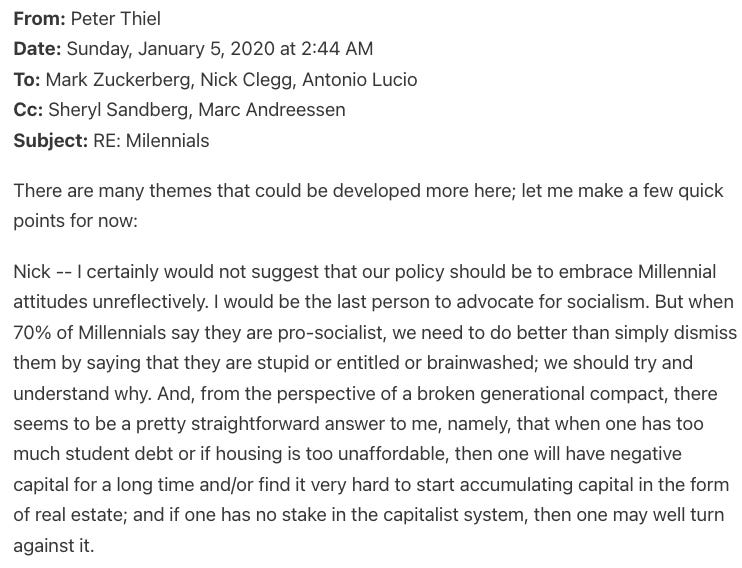
In January 2020, Peter Thiel sent an email to Mark Zuckerberg, Marc Andreessen, and other tech leaders that has since gone viral.
His warning was prescient:
“When 70% of Millennials say they are pro-socialist, we need to do better than simply dismiss them by saying that they are stupid or entitled or brainwashed; we should try and understand why.” (R)
Thiel’s prediction proved eerily accurate. In November 2025, democratic socialist Zohran Mamdani won the New York City mayoral race, bringing socialism to the doorstep of America’s financial capital.
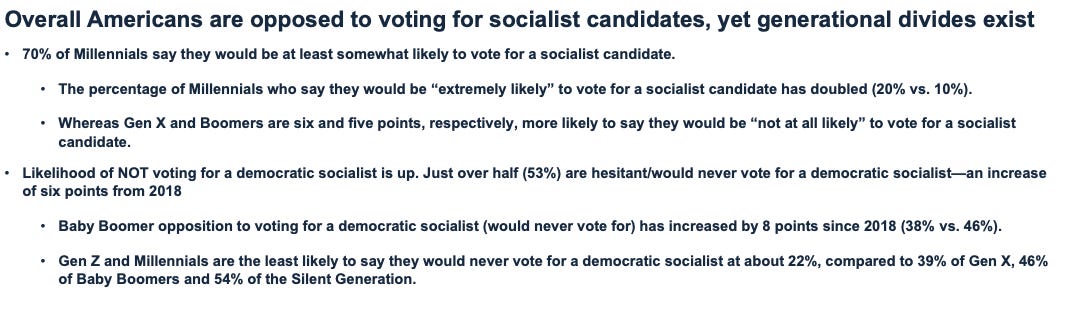
The billionaire class is scrambling for explanations. Thiel offered one: housing and student debt.
“From the perspective of a broken generational compact,” he wrote, “when one has too much student debt or if housing is too unaffordable, then one will have negative capital for a long time and/or find it very hard to start accumulating capital in the form of real estate; and if one has no stake in the capitalist system, then one may well turn against it.” (R)
In a 2025 interview with The Free Press, Thiel expanded on this thesis.
He noted that strict zoning laws have been good for boomers (watching their properties appreciate) but terrible for millennials who can’t buy homes.
“If you proletarianize the young people,” he warned, “you shouldn’t be surprised if they eventually become communist.” (R)
Thiel is right about the phenomenon: The socialist drift among younger generations is real, measurable, and accelerating.

But his explanation (economic materialism) is almost certainly wrong. And his implied solutions will either make the problem worse or have no meaningful effect in solving the problem.
Quick rant: We need to fix the housing market and student debt fiasco. The best way to fix these isn’t with blanket handouts and stupidity: (1) YIMBY (accomplishes nothing if you don’t allow organic SES sorting and don’t severely punish criminals) and (2) Forgive all student loans (just keeps the problem going… kids keep taking out mega loans, selecting moronic majors at expensive universities, universities keep charging more and end up bloated with useless staff/majors, then gov bails students out to sustain the university Ponzi. This dynamic needs to be obliterated).
My solutions to those specific problems?
Housing: Deregulation + zero government subsidies (organic SES sorting) + brutal crackdowns on crime (you can’t have “YIMBY” without cutthroat law enforcement or you just get flight of the competent).
Student loans: Zero government loans (private lenders only). Private lenders won’t give out loans unless applicant has high test scores (e.g. SAT/ACT/GPA) and selects a smart major. This fixes pricing and bloat and nukes most garbage majors out of existence. Why? University bloat cannot be sustained if the kids aren’t getting loans to pay exorbitant prices for degrees of all types (legitimate and bullshit). Universities will be forced by the market to cut dead weight… win-win. (Plus you won’t turn colleges into an extension of high school with test score inflation… Currently universities are incentivized to accept everyone to max out profits.)
Related: The U.S. Housing Crisis: YIMBY, Immigration, Singles
Part I: Democrats and Republicans are Far Detached from what Built America

Before diagnosing why young people are embracing socialism, we need to understand what we’re actually measuring.
The standard framing: right wing equals free markets, left wing equals big government— is directionally true but extremely misleading.
Both American political parties are extraordinarily far from what built the country from ground zero.
The Frontier Ethos (built America from nothing):
Minimal/no government beyond basic defense and courts
Low/no taxes
No welfare state whatsoever
“You work or you die” — literal survival pressure
Minimal regulations
Individual responsibility, not collective provision
Self-reliance as the core operating principle
Tough on crime and strong property rights
The settlers who crossed the Atlantic in the 1600s through 1800s operated under these conditions. There was no safety net. You made it or you didn’t.
This brutal filter selected for specific traits: delayed gratification, risk tolerance, self-reliance, distrust of authority, and willingness to accept consequences for your choices.
How far have BOTH parties drifted?
The Democratic drift is obvious and openly celebrated.
The party explicitly campaigns on expanding government:
Medicare for All, free college, student loan forgiveness, Green New Deal, universal pre-K, expanded child tax credits, wealth taxes.
The 2020 and 2024 platforms represented the furthest-left major party positions in American history. Democratic governance has brought welfare spending from 1.2% of GDP in 1964 to over 5% today. (R)
The Republican drift is less discussed but equally real. Consider what “conservative” now means:
Social Security: Created by FDR, opposed by Republicans. Now untouchable — Republican voters are its strongest defenders. Trump explicitly promised not to cut it.
Medicare: Created by LBJ, opposed by Republicans. Now untouchable. Trump ran on protecting it.
Farm subsidies: $30+ billion annually. Republican stronghold states are the primary beneficiaries.
Military spending: Over $800 billion annually, larger than the next ten countries combined. Republicans consistently vote to increase it. No focus on maximal efficiency.
Tariffs and industrial policy: Trump’s signature economic policies were protectionism and government intervention to favor specific industries — the opposite of free markets. Related: (1) Trump Tariffs and MAGA Socialism & (2) Trump’s Economic Delusions. (Even if you think tariffs aren’t smart now, they were consistent with the Foundational Ethos of America.)
Federal debt: Exploded under Reagan, Bush, and Trump. No Republican president since Coolidge has actually shrunk government.
The “small government conservative” barely exists in practice. Republican voters support Social Security and Medicare at rates similar to Democrats.
They support tariffs and protectionism. They oppose cutting military spending. The median Republican voter is not a libertarian—they’re a nationalist who wants government to help their people rather than other people.
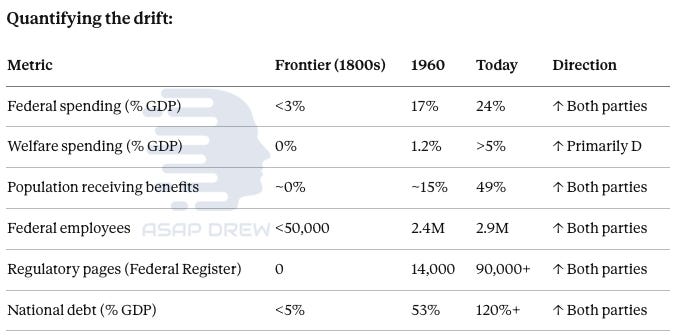
Quantifying the drift:
Federal spending (% GDP) Frontier: <3% | 1960: 17% | Today: 24% (Trend: ↑ Both parties) (R)
Welfare spending (% GDP) Frontier: 0% | 1960: 1.2% | Today: >5% (Trend: ↑ Primarily D)
Population receiving benefits Frontier: ~0% | 1960: ~15% | Today: 49% (Trend: ↑ Both parties) (R)
Federal employees Frontier: <50k | 1960: 2.4M | Today: 2.9M (Trend: ↑ Both parties) (R)
Regulatory pages (Federal Register) Frontier: 0 | 1960: 14,000 | Today: 90,000+ (Trend: ↑ Both parties) (R)
National debt (% GDP) Frontier: <5% | 1960: 53% | Today: 120%+ (Trend: ↑ Both parties) (R)
The current alignment
Frontier Drift Index (FDI): Here’s a simple way to quantify how far each party is from frontier assumptions.
First, the U.S. is structurally far from “frontier government”: federal net outlays are about ~23% of GDP in the modern era. (R)
Second, party coalitions differ sharply on how much they want government to do:
Dem/lean Dem: 74% for a bigger government, 76% say government should do more to solve problems, 82% say business regulation is necessary, 76% say government aid to the poor does more good than harm, and 72% say government should do more for the needy even if it increases debt (average ≈ 76% “big/activist government”). (R)
Rep/lean Rep: 20% for a bigger government, 28% say government should do more, 33% say regulation is necessary, 34% say aid to the poor does more good than harm, and 33% say do more for the needy even if debt rises (average ≈ 29.6%). (R)
FDI formula (transparent and repeatable):
FDI = 70% institutional drift + 30% coalition drift, where institutional drift is approximated as 1 − (3% / 23%) ≈ 87% (frontier baseline ~3% vs modern ~23%).
Republicans ≈ 0.70×87 + 0.30×29.6 ≈ ~70% drift
Democrats ≈ 0.70×87 + 0.30×76 ≈ ~84% drift
This supports the idea that the Democrats are further out of touch with the original American ethos (what built it up from ground zero).
Republicans are directionally closer to frontier values on:
Tax rates (favoring lower)
Regulations (favoring fewer)
Law and order (favoring more policing)
Welfare expansion (generally opposing)
Government size rhetoric (if not practice)
Individual vs. collective responsibility framing
Market solutions vs. government solutions
Democrats are directionally further from frontier values on:
Explicit redistribution policies
Law, order, property rights, policing (favoring fewer police, softer sentencing)
Expanding government programs
Collective provision framing
Viewing inequality as inherently unjust
Trusting government to solve problems
Party labels are contingent, not permanent.
“Republican” and “Democrat” are just labels for the two major parties in a winner-take-all electoral system.
The coalitions they represent have changed dramatically over time:
Republicans were the party of Lincoln and Reconstruction; Democrats were the party of the Confederacy and Jim Crow
Democrats were the party of urban machines and working-class Whites; now they’re the party of educated professionals and minorities
Republicans were the party of free trade and internationalism (Bush); now they’re the party of tariffs and “America First” (Trump)
The parties could realign again. If Republicans become fully populist-nationalist (embracing industrial policy, tariffs, and entitlement protection) while Democrats become the party of technocratic neoliberalism, the “closer to frontier” designation could flip.
What matters is the underlying positions, not the party label.
I’m not claiming politics reduces to one axis. I’m talking about a Frontier-aligned bundle — a cluster of positions that built America up from ground zero:
Less redistribution / smaller welfare state
Lower taxes / less fiscal extraction
Fewer regulations / more market allocation
Tough-on-crime / high enforcement / strong property rights
Personal responsibility framing (choices have consequences)
In a two-party, winner-take-all system, voters don’t get to vote these dimensions separately, so I’m using Republican vs. Democrat voting as an imperfect but practical proxy for which coalition is closer to that frontier bundle in the current era.
Currently in 2025 Republicans are significantly more aligned with the foundational ethos of America than Democrats (even if both remain far detached).
Labels can flip; what I’m tracking is the bundle.
Note: Social conservatism (aligning with most Hispanics) is a separate dimension and can conflict with libertarian/frontier ideals when it demands state control over private life. That’s another reason party voting is an imperfect proxy: social issues can cross-cut the frontier bundle.
Part II: Why Thiel’s Explanation Fails
Hispanic voters consistently support the party offering more redistribution and government provision, regardless of label.
For 50+ years, that’s been Democrats. If Republicans became the redistribution party, Hispanic voters would likely follow — as they did in Latin American countries where right-wing parties embraced populist economics.
The voting pattern reveals the preference. The preference is for redistribution. The party label is incidental.
California Case Study
If housing unaffordability and student debt were driving socialist sentiment, we’d expect the political shift to follow the affordability crisis. It didn’t.
California provides the clearest case study.
California was close to a Republican presidential lock for decades: Republicans carried California in 9 of 10 elections from 1952 through 1988 (the lone exception was LBJ’s 1964 landslide).
Then the state flipped in 1992 and became a permanent uniparty lock for Democrats. (R)
Republicans held 25 of 52 U.S. House seats in California in 1994. Today they hold just 9 of 52. (R)
This transformation tracked demographic change, not housing prices.
Between 1980 and 2000, California shifted from two-thirds White to about 47% non-White, with the bulk of the increase in the Latino community. (R)
Non-Hispanic Whites went from 76.3% of California’s population in 1970 to 33.7% in 2022. (R, R)
We’ve observed that California shifted further away from the foundational American ethos and more toward evolutionarily hardwired Hispanic preferences (socialism, redistribution, softer on crime, decriminalization, etc.).
This means more redistribution tolerance, more regulatory comfort, and a different equilibrium on law-and-order (the are unfriendly to business. California has legalized many actions that would’ve been considered “criminal” in the past (no wonder crime is dropping!) and they don’t bother enforcing or reporting crimes in many cases now.
(So “crime is dropping”… but “Is Crime Actually Dropping”?)
Young People Are Objectively Well-Positioned
If material conditions drove political preferences, Gen Z should be the most pro-capitalist generation in history.
The S&P 500 has returned 655% since 2010 — roughly 13.86% annually, one of the three major bull runs in 150 years of market history. Gen Z is entering adulthood knowing nothing but a bull market.
The “Great Wealth Transfer” will see $84-$124 trillion pass from Boomers to younger generations by 2045. (R)
By any objective measure, young people today live better than kings of old — smartphones, streaming, air conditioning, modern medicine, abundant food, global connectivity.
If material conditions drove socialism, Gen Z and Millennials should be celebrating capitalism. Instead, they’re its harshest critics.
Related: Gen Z vs. Boomers: Who Had It Harder?
The Expectation Gap Is Perceptual
Thiel is right that there’s a gap between expectations and reality. But the gap is perceptual, not material.
Gen Z adults say they need $587,797 annually to consider themselves “successful”—10x their actual median income of roughly $57,000. (R)
Millennials report needing $180k+ per year to “feel happy.” (R)
This isn’t a housing problem. It’s an Instagram, TikTok, Snapchat perceptual distortion. Fixing housing won’t fix distorted perceptions.
We even have prominent figures like Michael Green claiming the U.S. poverty line is $140k!
They’ve fallen for the combo of the: MSM psychological trap, social media trap, and pathological empathy trap… against better judgment and common sense.
Read: No, $140k is Not the Poverty Line
Part III: My Hypothesis — Demographic Change (Fewer Whites, More Hispanics) is Causing Socialism in the U.S.
Socialist drift is driven by multiple factors, but they’re not equally important.
I rank order them by estimated impact.
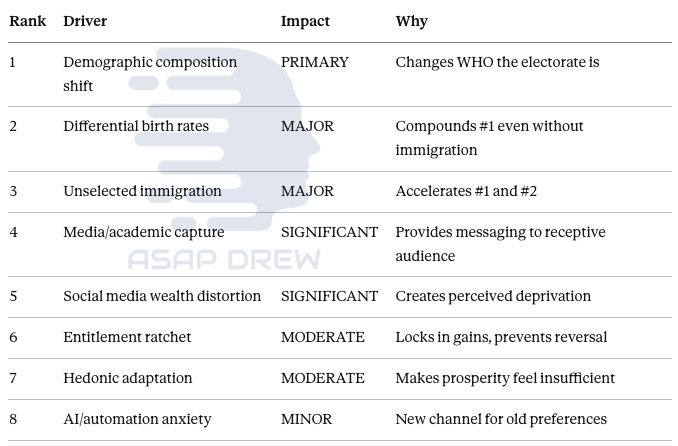
PRIMARY
1. Demographic composition shift Why: Changes WHO the electorate is
MAJOR
2. Differential birth rates Why: Compounds #1 even without immigration
3. Unselected immigration Why: Accelerates #1 and #2
SIGNIFICANT
4. Media/academic capture Why: Provides messaging to receptive audience
5. Social media wealth distortion Why: Creates perceived deprivation
MODERATE
6. Entitlement ratchet Why: Locks in gains, prevents reversal
7. Hedonic adaptation Why: Makes prosperity feel insufficient
MINOR
8. AI/automation anxiety Why: New channel for old preferences (will likely increase as AI becomes more powerful)
The first three are PRIMARY + MAJOR because they change the composition of the electorate itself.
The rest are secondary (SIGNIFICANT + MODERATE/MINOR) — they shape how dispositions are expressed and reinforced, but they operate on an electorate whose baseline preferences are set by composition.
DRIVER 1: Demographic Composition Shift (PRIMARY)

This is the central driver. Everything else is secondary.
Younger generation: White replacement (higher diversity).
Non-White Youth: Gen Z alone (ages 18–27 in 2024) is ~40.8M eligible voters, and about 45% of that Gen Z electorate is non-White (including ~8.8M Latino, ~5.7M Black, ~1.7M Asian American, ~1.8M multiracial). (R) In 2020, Gen Z’s first eligible cohort was already only 55% non‑Hispanic White and 22% Hispanic.
Hispanics = fastest-growing large bloc of eligible voters: 36.2M eligible in 2024 (a new high 14.7% of all eligible voters) and they accounted for ~50% of eligible‑voter growth since 2020. Hispanic eligible voters are also younger than the electorate overall (only 33% are age 50+ vs 48% overall). (R)
Even if group voting margins stay within their historical ranges, the weighted average moves as older cohorts exit and younger, more diverse cohorts replace them.
And the pipeline after Gen Z is already <50% non-Hispanic White: in the 2020 Census, the under-18 population was 47.3% non-Hispanic White (vs 60.8% among adults), while Hispanics were 25.7% of under-18 (vs 16.8% of adults). (R)
The Voting Pattern IS the Evidence
Here is a fact that cannot be disputed:
Hispanics have never majority-voted Republican in any presidential election since exit polling began.
Not once. Not for Reagan. Not for either Bush. Not for Trump at his historic high point in 2024.
The historical record shows Hispanics voting 57%+ Democratic consistently since 1984.
This pattern holds across:
Different Republican candidates (Reagan, Bush, Romney, Trump)
Different economic conditions (recessions, booms, stagflation, growth)
Different issues (immigration-focused campaigns vs. not)
Different states (California, Texas, Florida, Arizona, Nevada)
Different generations (immigrant, second-generation, third-generation+)
What about the 2024 Presidential Election (Trump vs. Harris)?
The 2024 American Electorate Voter Poll: Latino Voters by State. (R)
California: Harris 66% vs. Trump 33%
Texas: Harris 60% vs. Trump 38%
Florida: Harris 43% vs. Trump 56%
Arizona: Harris 63% vs. Trump 36%
Nevada: Harris 64% vs. Trump 35%
Trump’s 2024 performance—widely celebrated as a breakthrough—got him between 42% of the Hispanic vote (R) and 46% of the Hispanic vote (R) — depending on the poll you use. This was predictable.
Gender split / “toughness” branding: AP-NORC found Hispanic men more likely to see Trump as “tough enough,” while Hispanic women were much warmer on Harris.
Masculinity-coded campaign strategy: AP’s VoteCast takeaways explicitly describe Trump leaning into hypermasculinity and targeting young men.
Populism + economy salience: Edison notes Hispanics/Latinos (esp. men) naming the economy at high rates; Brookings deep dive also emphasizes cost-of-living salience and outreach dynamics.
50 years of revealed preferences.
Actual voting behavior with actual consequences. Across different candidates, issues, economic conditions, and states. The direction is consistent.
This is not a small sample. This is not a fluke. This is the most robust dataset we have for measuring group political preferences.
What would we expect if the preference were environmental — shaped by party behavior, historical accident, or cultural factors that could shift? We’d expect drift over 50 years. Economic conditions changed dramatically.
Candidates ranged from moderate (McCain, Romney) to populist (Trump). Issues emphasized varied from immigration restriction to immigration reform.
Margins move, but the sign doesn’t flip: Across decades of changing candidates and conditions, Hispanics still haven’t become a durable national Republican-majority bloc. When Republicans do gain ground, it’s typically through candidate-specific cross-pressures (populist branding, social conservatism, nationalism), not a wholesale shift toward the frontier-aligned bundle.The GOP can narrow the margin in candidate-specific cycles (2024 being the clearest example), but it still hasn’t consistently converted that into a durable national majority among Hispanics.
Within the young electorate, the racial splits remain large.
According to Tufts Civic Engagement Center, in 2024 (R):
Black youth: 74-24 Harris (Dem)
Latino/Hispanic youth: 57-40 Harris (Dem)
Asian youth: 72-23 Harris (Dem)
White youth: 54-44 Trump (Rep)
This debunks the idea that “all young voters skew Democrat.” Even when they do, the magnitude of political preference differs between racial/ethnic groups.
Currently, “Republican” is the party more aligned with frontier values — lower taxes, less redistribution, law enforcement, more individual responsibility.
Pew shows these “role of government” preferences vary sharply by race/ethnicity even before you get to party labels:
White adults (54%) are most likely to say government is doing too many things better left to businesses/individuals vs. Hispanic adults (29%) say the same. (R)
Even inside the GOP coalition, Pew finds Hispanic Republicans are far more pro-government than White Republicans: 58% of Hispanic Republicans say government should do more to solve problems vs. 21% of White Republicans. (R)
The parties could theoretically realign, and labels are contingent (as was mentioned earlier). But for the past 50 years, consistent Democratic voting reveals consistent preference for the more redistributive option.
The burden of proof is on those claiming the pattern is environmental or cultural.
Hispanics have never majority-voted for the less-redistributive party. The counter-evidence doesn’t exist.
Genetic Dispositional Differences (Mean/Median)
Important: (For the idiots out there.) This does NOT mean every Hispanic votes against Frontier Aligned values and is a Democrat. This is about evolved trait distributions (means, medians, tails)… meaning on average/median.
Hispanics prefer socialism, softer on crime policies, larger government, etc.
This is observed: (1) historically and (2) presently in (3) the U.S. and (4) global Hispanic/Latino diaspora.
We know from twin studies that political orientation is at least partly heritable. Based on the fact that we observe consistent preferences in the global diaspora AND within the U.S. for Hispanics — and we know populations have different evolved genetic traits — it’s fair to assume these preference distributions are mostly stable unless you get a highly-selected population. (R)
The pattern suggests dispositional (genetic) tendencies that favor:
Collectivism over individualism. Extended family networks, community orientation, group loyalty over abstract principles. This translates politically to comfort with collective provision.
Social conservatism combined with fiscal liberalism (i.e. “SCAFFLE”). Traditional values around family, religion, gender roles—but also expectation that government should provide economically. This is the modal Hispanic voter profile. They may oppose abortion while favoring wealth redistribution. When they do vote Republican, it’s for populist-nationalist candidates (Trump), not free-market conservatives (Romney).
Present-orientation over future-orientation (faster life strategy). What can government do for me and my family now, rather than abstract arguments about how free markets produce prosperity over decades. The appeal of immediate, concrete redistribution over abstract, long-term optimization.
Lower engagement with second-order effects. Understanding “tax the rich” is easy. Understanding “wealth inequality drives innovation which creates prosperity for everyone” requires abstract reasoning about systemic effects that aren’t intuitive. The first argument wins because it’s simpler.
This isn’t speculation. It’s observable in the global pattern.
The Global Hispanic Diaspora Pattern
This preference pattern isn’t unique to the United States.
It appears everywhere Hispanic populations are politically organized:
Venezuela: Voted for Chavez’s socialism repeatedly until economic collapse.
Argentina: Repeated cycles of Peronist redistribution → economic crisis → brief reform → back to Peronism.
Mexico: PRI dominated for 70 years with corporatist redistribution; current AMLO/Morena government is explicitly redistributionist.
Bolivia, Ecuador, Nicaragua: Similar patterns.
The pattern is as follows:
Favor socialist/redistributive policies
               ↓
Policies fail and create economic disaster
               ↓
Emigrate from the disaster
               ↓
Vote for similar policies in the new country
Not a single Hispanic-majority country has ever sustained frontier-style capitalism.
The preference travels with the population.
The Selection Exception (And Why It Proves the Rule)
Cuban Americans vote more Republican (56-41 for Trump in Florida 2024). Venezuelan Americans similarly lean right.
This is a selection effect. People who fled Castro’s communism were self-selected for anti-communist preferences. The act of leaving filtered for ideology.
But this exception proves the rule for two reasons:
First, they’re statistically irrelevant nationally. Cuban Americans are roughly 2 million people out of 36+ million eligible Hispanic voters—approximately 5% of the Hispanic electorate. They can swing Florida but are a rounding error nationally. Citing Cubans as evidence against the broader pattern is innumerate.
Second, and more importantly, the selection effect doesn’t persist. The children of Cuban refugees are reverting to the Hispanic mean. Second-generation Cuban Americans—children of people who literally fled Castro—have been documented preferring Democratic and Socialist candidates. (R)
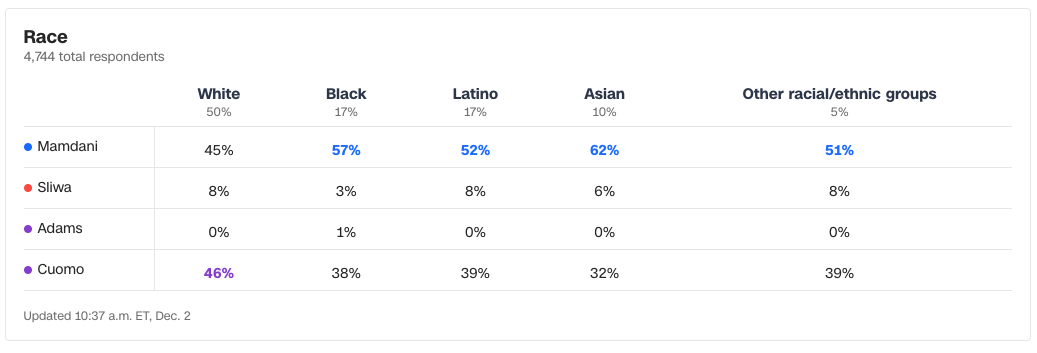
If only Whites voted, Mamdani would’ve likely lost (45%).
Predictably, Mamdani won with Blacks (57%), Hispanics/Latinos (52%), and Asians (62%).
This is devastating to the “cultural transmission” counter-argument. If anti-communist values were effectively transmitted culturally, second-generation Cuban Americans would maintain those patterns. Yet this doesn’t seem to be the case.
There’s evidence of this in other racial/ethnic groups too (parents flee socialism/communism → kids vote for socialism/communism).
The City NYC: Their Families Fled Soviet Socialism. Now They’re Knocking Doors for Mamdani.
NY Times: In Chinese American Families, There’s a Generational Split on Mamdani.
The selection effect only works on people who directly experienced socialism. Their children, not subjected to that selection pressure, revert to the baseline distribution.
This is exactly what you’d expect if political preferences are genetically dispositional rather than cultural. Selection can temporarily shift a subpopulation. But without continued selection pressure, reversion to the mean occurs in the next generation. If it were cultural, the values would transmit across generations. They don’t.
I know this isn’t what many people want to hear. Many enjoy telling themselves lies or embellishing the magnitude of assimilation to virtue signal “all racial/ethnic groups are like this!”
The Assimilation Paradox
Hispanic Americans are assimilating on many dimensions:
Language acquisition: Second and third generation speak fluent English.
Intermarriage: Rates increasing with each generation.
Cultural markers: Music, food, holidays blending into mainstream.
But assimilation is NOT happening on voting patterns. Hispanics aren’t voting in ways that uphold the foundational ethos of America.
Multi-generational Hispanic Americans (families in the United States for three or four generations) still vote Democratic at similar rates to recent immigrants.
The specific variable that matters for political outcomes isn’t assimilating. Everything else is.
Why Racial Composition Is Primary
Changing the composition of the electorate changes outcomes even if no individual changes their mind.
Simple arithmetic: If Group A votes 60-40 for Party X, and Group A grows from 15% to 30% of the electorate, Party X gains vote share mechanically. No persuasion required. No policy change required. Just demographic math.
This is why composition is the PRIMARY driver. Media, academia, and social media shape how preferences are expressed, but the baseline preferences are determined by who’s in the electorate.
DRIVER 2: Differential Birth Rates (MAJOR)

Even with zero immigration, demographic composition would shift due to differential birth rates.
The Numbers
Birth rates per 1,000 women (2019): (R)
Non-Hispanic White: 9.8 (lowest of any group)
Hispanic: 14.6
Black: 13.4
Total fertility rate (children per woman): (R)
White: 1.6-1.8 (below replacement of 2.1)
Hispanic: ~2.4 (above replacement)
In 2016, for the first time in U.S. history, White deaths exceeded White births. (R)
The White “natural loss” was 39,000 in 2016, compared to a natural gain of 393,000 in 1999.
The birth-to-death ratio for Whites fell from 1.21 in 2000 to just 0.98 in 2016.
Whites accounted for 77.7% of all U.S. deaths but just 53.1% of births.
What This Means
Demographic composition shifts even with closed borders.
You could build a wall from sea to sea and demographic composition would still change due to differential fertility.
Immigration accelerates what differential fertility would do anyway. Both mechanisms push in the same direction. Closing immigration slows the shift but doesn’t stop it.
This is why birth rates are ranked as MAJOR, second only to composition itself. It’s the engine that keeps composition shifting even if immigration stopped tomorrow.
DRIVER 3: Unselected Immigration (MAJOR)
Mass immigration compounds the fertility effect by adding populations with redistribution preferences faster than natural increase alone.
Selected vs. Unselected
Selected immigration (what built frontier America):
Crossing the Atlantic in the 1600s-1800s with no safety net
Multi-year voyages, high mortality, no guaranteed outcomes
Frontier conditions on arrival: you work or you die
Brutal filter for: risk tolerance, self-reliance, future orientation, willingness to defer gratification
Those who couldn’t hack it died or went back
This selection pressure created a population with specific traits. Current White Americans are mostly descendants of these ultra-selected settlers.
Unselected immigration (current policy):
No filter for political ideology
No filter for economic philosophy
No filter for cognitive ability
No filter for frontier ethos
Brings baseline population distribution of origin countries
The country is already built. New arrivals gain voting rights without necessarily understanding or sharing the ethos that built American prosperity from zero.
The Mechanisms
Demographic change happens through many channels:
Naturalized citizenship
Chain migration (family reunification)
Birthright citizenship (automatic citizenship for anyone born here, regardless of parents’ status)
Amnesty programs (starting with Reagan’s 1986 amnesty)
Sanctuary cities and states
Work visa overstays
Asylum claims (often economic migrants rather than genuine refugees)
Expedited processing under certain administrations
Each mechanism adds to the electorate without filtering for frontier values.
The “Americans” Problem
Many current “Americans” are Americans only in the legal sense.
They hold citizenship (through birth, naturalization, or amnesty) without holding the values that citizenship historically implied.
The founders assumed citizens would be the kind of people who built the country or their descendants.
They didn’t anticipate a system where citizenship could be acquired by:
Being born on U.S. soil regardless of parents’ situation
Waiting out a residency period
Qualifying for amnesty
Chain migration from a single anchor relative
The result: An electorate that includes millions who gained voting rights without ever assimilating to the founding ethos — and who may not understand what policies enabled American prosperity in the first place.
Abstract vs. Concrete Reasoning
Frontier capitalism requires understanding abstract, long-term concepts:
Delayed gratification at societal level
Why letting successful people keep wealth benefits everyone long-term
Why government intervention creates perverse incentives
Second and third-order effects of policy
These concepts aren’t intuitive. The immediate, concrete appeal of “take from the rich and give to me” is much easier to grasp than “wealth inequality drives innovation which creates prosperity for everyone over decades.”
Populations that favor immediate, concrete redistribution over abstract, long-term optimization will vote for redistribution. Mass unselected immigration brings such populations without filter.
DRIVER 4: Media and Academic Capture (SIGNIFICANT)

Demographic composition creates an electorate receptive to redistribution messaging. The media-academic complex provides that messaging constantly.
The Academic Pipeline
Between 1969 and 1998, faculty identifying as left or liberal remained relatively stable at around 44%. Beginning in 2001, professors on the political left began approaching a supermajority. (R)
Democrat-to-Republican (D:R) ratios by field: (R)
Engineering: 1.6-to-1
Economics: 4.5-to-1
History: 33.5-to-1
Communications: 56-to-0
Interdisciplinary studies: 108-to-0
Gender studies, Africana studies, peace studies: 0 Republicans found
At Williams College: 132:1 D:R ratio. (R)
Administrators are even more liberal than faculty.
Programs like “Stay Healthy, Stay Woke” and “Understanding White Privilege” signal which views are acceptable.
Conservative students learn to hide their views or avoid academia, reinforcing the imbalance.
The “Peer Reviewed” Problem
This homogeneity corrupts knowledge production.
Liberal academics produce studies supporting redistributive policies
Studies are framed as neutral, peer-reviewed science
But peer review means review by ideologically similar peers
Topics confirming liberal priors get studied and funded
Counter-evidence is understudied
Conservatives are studied as pathology, not engaged as legitimate viewpoint
The debunking lag: It takes years to rebut each flawed study (e.g. Black doctors don’t improve outcomes for Black patients; diversity doesn’t actually increase earnings/productivity, etc.). But new studies are produced constantly. By the time one is discredited, ten more have been published. The spam overwhelms the correction.
Note: This is why I proposed “Truth Tiers” to keep the wokes honest. Many “Pseduo Truths” are contaminating science and AI models. I’ve explained the social dynamics in “Game Theory of Silence.”
The Media Pipeline
Journalists are trained in captured institutions. They learn to see wealth inequality as self-evidently unjust and redistribution as self-evidently good.
The pipeline: University → Media → Policy → Public Opinion → Elections
At each stage, the redistributive frame is reinforced. “Experts say...” almost always means liberal-trained academics. Counter-narratives are excluded from legitimate discourse.
The Billionaire Demonization Campaign
The standard narrative frames billionaire wealth as hoarded loot rather than productive capital.
Billie Eilish claims Elon Musk could:
“End world hunger, save critically endangered species or even rebuild Gaza entirely.” (R)
The braindead socialist propagandists at Oxfam (“The Future Is Equal”) note that Elon paid an effective tax rate of ~3%. (R) And they want him to pay way more (of course they do)! They are too dense to actually understand the grave damage this would do long-term.
Reality: Musk’s wealth is Tesla and SpaceX stock — already deployed, funding EVs, space exploration, satellite internet, neural interfaces. It’s not sitting in a vault. When he sells, he pays capital gains. The “3%” figure compares unrealized gains (paper wealth) to cash income — deliberately misleading. And paying over 3% in taxes is still a lot of money going to the gov who mostly just wastes it!
But the narrative is set by the MSM and politicians (Bernie, AOC, Warren):
Billionaires are hoarding your wealth. Let’s take more from them.
What none of the mentally challenged celebs like Eilish understand is that the main driver of human advancement and innovation is the innovators themselves.
What’s Never Explained
The case FOR wealth inequality in free markets is systematically suppressed.
Wealth inequality incentivizes innovation
Billionaire capital is already deployed productively (not hoarded)
Government spending is less efficient than private investment
Redistribution kills the goose that lays golden eggs
A basic safety net plus letting entrepreneurs keep the rest produces better outcomes
In mainstream discourse, wealth inequality is treated as self-evidently immoral, and the pro-market case for it is basically forbidden: make it and you’re branded a Scrooge, a shill, or morally defective. But in a real free-market system—equal rights, rule of law, competition, and low corruption—high inequality can be a feature, not a bug, because it’s the payoff structure that funds risk and pulls talent into hard problems. The massive upside is what makes people spend years failing, grinding, and reinvesting until something finally scales.
Most “billionaire wealth” isn’t cash sitting in a vault; it’s ownership in productive systems—companies, factories, platforms, infrastructure, R&D—and markets punish idle capital. Even what critics call “hoarding” is usually just not consuming: it’s invested, reinvested, used to fund new ventures, and absorbed as risk capital.
Redistribution, by contrast, often shifts money from compounding investment into short-horizon consumption and political allocation. Private capital is disciplined by profit and loss; government spending is disciplined by politics, perverse incentives, and low accountability. Heavy redistribution doesn’t just move money—it changes behavior by shrinking the return on innovation and pushing more energy into bureaucracy, lobbying, and safe rent-seeking instead of building.
This is where socialism/communism (and “soft” versions of it) predictably fail: the state becomes the main allocator, incentives get replaced by committees, price signals get distorted, and ambitious people optimize for political status rather than invention. You don’t get builders—you get managers.
And the core principle people dodge: if someone creates wealth legally, it’s their right to keep it, invest it, “hoard” it, or pass it to their kids. That’s property rights. The government already takes a huge cut through layers of taxation; the idea that everyone else has an unlimited moral claim on the output of the most productive is just entitlement dressed up as ethics.
The best setup is a strong floor and a huge ceiling: a basic safety net, hard anti-corruption/anti-crony enforcement, then let builders keep most of the upside—because that upside is the engine that makes progress compound.
Related: Trickle Down Economics Works
The Boomer-Blame Narrative
“Boomers ruined everything. Boomers pulled the ladder up. Boomers are selfish.”
This creates intergenerational resentment that translates into openness to redistribution.
If you are wrongfully psyopped into thinking the prior generation stole from you, you feel justified in demanding that the government take it back.
Related: In Defense of Boomers
Active Marketing of Redistribution
Democrats explicitly run on a combination of:
Giving away free shit: Funded by other people’s hard work/money. They are taking from someone who worked/labored.
Woke entitlement politics: Making people feel as though everything is now a “human right.” Soon trips to Mars will be a “human right.” They brainwash you into thinking you are entitled to receive free labor from others.
This is grievance as electoral strategy: Identify something people want, promise to take it from the rich, create a voting bloc dependent on continued redistribution.
Note: This gets much bigger when factor in the organizations (e.g. businesses, charities, NGOs, et al. who receive government money then dedicate a % of that money to fund elections of individuals who promise to give them more government money)! It’s a complete full-circle racket.
DRIVER 5: Social Media Wealth Distortion (SIGNIFICANT)

Social media creates perceived deprivation independent of material conditions.
The Perception Gap
Gen Z adults say they need $587,797 annually and a $9.46M net worth to feel successful. (R)
Millennials need $180,865 annually and a $5.29M net worth to feel successful. (R)
Social media is giving people (especially younger generations) a sense of “money dysmorphia.” (R)
The Mechanism
Social media algorithms prioritize aspirational content. Influencers display sponsored and gifted lifestyles as “normal” or even rent Ferraris, Lambos, private jets, etc.
Constant exposure creates a false baseline.
Everyone on Instagram seems rich. It’s mostly a mirage with carefully curated (often completely fake) photos.
But the perception is real and lingers in one’s psyche: “Everyone is rich except me.”
Political Consequence
Perceived deprivation creates resentment toward “the system” and openness to redistribution—even among the objectively prosperous.
This is why Thiel’s solution fails. Even if you fix housing, the perception problem remains.
People who feel poor vote for redistribution regardless of actual material conditions.
DRIVER 6: The Entitlement Ratchet (MODERATE)

Government programs only expand. They never contract.
The Mechanism
Each expansion creates constituencies that defend it. Social Security recipients vote to protect Social Security. Medicare recipients vote to protect Medicare. Student loan forgiveness recipients vote for more forgiveness.
Reversals become politically impossible. You can never put the cat back in the bag.
The Numbers
1964: Welfare programs consumed 1.2% of GDP
Today: Over 5% of GDP
1980s: 30% of population receiving government benefits
2011: ~48.5% receiving benefits (R)
No examples exist of successfully rolling back entitlements at scale.
Mindset Expansion
Beyond literal entitlements, the entitlement mindset expands. “Government should provide X” becomes baseline expectation.
Each generation expects more. What was once charity becomes “a human right.”
This interacts with demographic change: populations favoring redistribution vote for expansion, expansion creates dependency, dependency votes for more expansion. Self-reinforcing cycle.
DRIVER 7: Hedonic Adaptation (MODERATE)

Good times create weak men who demand state protection.
The Unprecedented Bull Market
S&P 500 since 2010: 655% return, 13.86% annually — 1 of 3 great bull runs in 150 years. Gen Z has entered adulthood knowing nothing but rising markets.
Note: Not all of them actually invest. Many engage in conspicuous consumption and thus feel left out of the “winning” because they are unable to delay gratification.
The Adaptation Effect
Rising markets become baseline expectation. Normal returns feel like stagnation. Any decline feels catastrophic.
Previous generations would have celebrated this performance. Gen Z isn’t impressed—their expectations are calibrated to outlier conditions.
The Weakness Problem
A generation with no experience of real hardship expects continuous improvement. They have minimal resilience from adversity.
When conditions worsen, they demand government protection.
Combined with entitlement mindset, this produces a generation expecting government to solve problems previous generations solved themselves.
DRIVER 8: AI and Automation Anxiety (MINOR)

Genuine uncertainty about the future of work creates openness to UBI and expanded redistribution.
Employment Anxiety
AI, robotics, and automation are advancing rapidly.
Many young people conclude traditional employment may not exist in 20-30 years. If robots do most jobs, what happens to workers?
This drives support for UBI (universal basic income). If work is becoming obsolete, government should provide for everyone directly.
Why Premature UBI Would Be Disastrous
UBI hype is being driven by “AGI soon → jobs gone soon.” That’s counting AI chickens before they hatch.
Even if AGI is real/near, job displacement won’t hit instantly.
Real-world replacement is bottlenecked by deployment costs, reliability, liability, regulation, integration, and (for many roles) hardware/robotics.
Rolling out UBI early isn’t “safe.” It breaks incentives before the crisis exists.
Raises the “why work?” threshold and worsens shortages in essential jobs.
Forces bad funding choices: growth-killing taxes, debt blowouts, or inflation.
Becomes politically permanent: “temporary checks” turn into an entitlement state that keeps growing.
UBI should be treated as an emergency tool that gets triggered only after sustained proven structural unemployment. It should be kept as minimal as possible to accelerate technological innovation.
Read: Don’t Count Your UBI Chickens Before They Hatch
Same Disposition, New Channel
AI anxiety is a new vector for the old preference: present-oriented, concrete, skeptical of markets, trusting government provision.
Young people worried about automation default to demanding government guarantee income rather than trusting market adaptation.
Part IV: Synergy of the Drivers
These drivers don’t operate in isolation. They compound.
The Compounding Model
Demographic composition (PRIMARY)
    ↓
Electorate receptive to redistribution
    ↓
Media/academia provides redistribution messaging → Finds receptive audience
    ↓
Social media creates perceived deprivation → Grievance regardless of reality
    ↓
Democratic Party offers policy vehicle: "Vote for us, we'll take from them"
    ↓
Entitlement expansion → Creates dependency constituencies
    ↓
Dependency votes for more expansion → Ratchet continues
    ↓
Hedonic adaptation → Even prosperity feels insufficient
    ↓
AI anxiety → New channel for same preference
The insight: Changing media or academia without changing composition is rearranging deck chairs. The audience’s baseline preferences are set by genetic wiring. Messaging shapes expression, but disposition is primary.
The Arithmetic Inevitability
Let’s assume:
Hispanics vote 60-40 Democratic (better than historical average for Republicans)
Whites vote 55-45 Republican (roughly accurate)
If electorate is 70% White, 15% Hispanic → Aggregate favors Republicans
If electorate shifts to 50% White, 30% Hispanic → Aggregate favors Democrats
No one changes their mind. Pure composition change produces the shift.
At some point in the future, even winning 100% of White votes won’t produce a Republican majority.
California is already there.
Nevada is close.
Arizona is trending.
Texas is further out but on the same predictable trajectory.
The math is inexorable unless voting patterns change… and they haven’t changed in 50 years.
Part V: Why Thiel’s Solutions Won’t Fix the Socialism Preference

Thiel’s implied solutions (address student debt, fix housing) wouldn’t solve the problem. And they may even accelerate it!
Student Loan Forgiveness Creates Moral Hazard
Forgiveness teaches that choices have zero consequences for both students and universities.
Junk degree (gender studies, africana studies, etc.): forgiven
Responsible choice (community college, trade school, paid loans): punished
Universities: increasing tuition prices, expanding admin bloat, woke major offerings, DEI, etc. (college becomes just an extension of high-school)
Almost half of students already expect forgiveness. (R)
“What’s the message? Borrow as much as you can and wait for the debt to be canceled.” (R)
Loan cancellation creates implicit guarantee that future borrowers won’t pay back.
This drives up demand and prices:
“It won’t just be predatory institutions that raise prices—it will be all of them.” (R)
Federal aid increased 295% since 1991-92; colleges more than doubled tuition. (R)
Forgiveness does absolutely nothing to rein in costs going forward.
Worse: Forgiveness recipients become voters for more forgiveness. New dependency constituency. Ratchet moves further wrong direction. Cat never goes back in bag.
Housing Programs Have Same Problems
Government housing involvement (Fannie/Freddie) contributed to 2008 crisis.
Rent control reduces supply. Public housing creates dependency.
And it doesn’t address the actual driver.
Hispanic voters with affordable homes in Texas still vote Democratic. Material conditions aren’t causing the pattern.
The Personal Responsibility Problem
Frontier ethos: you make choices, you live with consequences.
Bailouts teach: your choices don’t matter, government will fix it.
This infantilizes adults, creates learned helplessness, and reinforces exactly the mindset driving socialist drift.
Thiel assumes: Fix material conditions → people become pro-capitalist.
Reality: The people themselves have different baseline preferences downstream of evolution/genetics. No material fix changes disposition.
The electorate isn’t temporarily confused. It has different values downstream from genetics. (Genetics → Cognition/Behavior → Culture/Values).
Part VI: Socialist Drift Prediction
Fixing housing and student debt won’t change socialist drift because the major driver is genetic (demographic / dispositional).
Other drivers matter (social media, MSM, institutional capture, etc.) too… but material conditions are not the primary cause.
Primary drivers:
The electorate is compositionally different (more Hispanic, less White) and Hispanics have shown dispositional preference for redistribution stable for 50+ years across all contexts
Differential birth rates compound the shift even without immigration
Unselected immigration accelerates what fertility would do anyway
Secondary drivers:
Media/academia provides constant redistribution messaging to a receptive audience
Social media creates perceived deprivation regardless of actual prosperity
Entitlement ratchet locks in each expansion
Hedonic adaptation makes good times feel insufficient
AI anxiety adds new channel for old preferences
Thiel’s solutions might make it worse depending on which solutions are implemented for things like “housing” and “student loans” (especially if they shirk personal responsibility and create new dependency constituencies).
The selection exception proves the rule: Immigrants who fled communism and socialism revert back to the Hispanic mean/median. Cultural transmission of anti-redistribution values is mostly ineffective. The underlying distribution reasserts itself.
The electoral arithmetic is inexorable: At some demographic composition, frontier-compatible policies become electorally impossible. We may have already passed this threshold in key states. The national tipping point approaches.
The frontier ethos is almost fully bred out through differential fertility and immigrated out through unselected mass migration. Even selected subpopulations see their children revert. No policy fix addresses this.
Final Take: Peter Thiel vs. Rise of Socialism in the United States
Peter Thiel correctly identified that young people are turning against capitalism.
But he’s wrong about why.
The socialist drift isn’t a bug that can be fixed with better housing policy or student loan relief. It’s a feature of demographic transformation.
Material conditions aren’t destiny. Demographics are. I’ve written about this many times:
Racial Composition of the U.S. Predicts Political Preferences & Voting Outcomes
Population Genetics Determines Corruption Levels of Countries
Thiel’s proposed solutions may accelerate the very trend he’s trying to prevent—creating moral hazard, expanding government dependency, and reinforcing the entitlement mindset.
The honest conversation nobody wants to have: the electorate itself is changing in ways that favor redistribution regardless of economic conditions.
The voters demanding socialism aren’t confused about their interests. They’re expressing genetic preferences that have been stable for 50 years.
The frontier is closed. The question is what replaces it.
Hopefully there won’t be an obituary: Autopsy of America.