

For reference, I already:
Calculated Stram for Super Bowl LX.
Reported GPT-5.2 Pro’s Super Bowl LX prediction.
And noted the recent era Super Bowl betting outcomes.
I am cheering for Seattle. If NE wins that’s cool too. I am mostly ambivalent.
Am curious about the O/U on “ICE” or “ICE OUT” mentions by El Conejo Malo (a.k.a. Bad Bunny) at halftime.
Below is the full SBLX Prediction report from Gemini 3.0 Pro.
Do not be surprised if you encounter: (A) errors (yes even “3.0 Pro” makes egregious errors are times) + (B) critical omissions (e.g. key injuries). I caught both A and B in the output. I am not correcting because I don’t think they matter enough to change the outcome. The analysis is still pretty good!
The confrontation between the Seattle Seahawks and the New England Patriots in Super Bowl LX, scheduled for February 8, 2026, at Levi’s Stadium in Santa Clara, California, represents a watershed moment in the cyclical history of the National Football League. This matchup is not merely a contest for the Lombardi Trophy; it is a definitive stress test for two franchises that have radically reconstructed their identities following the departures of legendary architects. The Seattle Seahawks (14-3), entering as the National Football Conference (NFC) champions, and the New England Patriots (14-3), representing the American Football Conference (AFC), arrive at this summit via divergent paths of organizational reinvention.
For Seattle, the 2025-2026 campaign validates the aggressive organizational pivot from the Pete Carroll era to the modern defensive architecture of Mike Macdonald. Led by the resurgent quarterback Sam Darnold—whose career trajectory has been redefined in the Pacific Northwest—and bolstered by a defense that draws favorable comparisons to the historical “Legion of Boom,” Seattle enters the contest as the betting favorite (-4.5). Their 31-27 victory over the Los Angeles Rams in the NFC Championship Game demonstrated a resilience and offensive versatility that contrasts sharply with the attrition-based style of their opponents.
Conversely, the New England Patriots serve as the embodiment of a rapid, high-efficacy rebuild. Following a disastrous 4-13 campaign in 2024 and the firing of Jerod Mayo, the hiring of Mike Vrabel has catalyzed an immediate return to dominance. Quarterbacked by sophomore sensation Drake Maye, the Patriots navigated a brutal AFC path, culminating in a gritty 10-7 victory over the Denver Broncos in blizzard conditions. Their presence in Super Bowl LX marks a return to the league’s summit seven years after their last appearance, seeking an NFL-record seventh championship.
Historical Narrative and Franchise Trajectories

The Rematch: Echoes of Super Bowl XLIX
The narrative backdrop of Super Bowl LX is dominated by the shadow of Super Bowl XLIX (2015), widely regarded as one of the seminal moments in NFL history. That contest, which concluded with the interception of Russell Wilson by Malcolm Butler at the goal line, fractured the burgeoning Seahawks dynasty and solidified the second phase of the Patriots’ dominance. While more than a decade has passed, the institutional memory of that event permeates the current matchup, creating a psychological undercurrent that cannot be ignored in a holistic analysis.
For the Seahawks, this game represents an opportunity to exorcise the ghosts of 2015. The acquisition of players like Cooper Kupp—a former divisional rival—adds a layer of mercenary focus to the squad. They are not burdened by the history of the Pete Carroll era directly, but the franchise’s identity is inextricably linked to “avenging” that loss. The narrative arc is particularly potent for General Manager John Schneider, the sole remaining executive architect from that era, whose reconstruction of the roster has been vindicated by this return to the championship stage.
For New England, the continuity is less about personnel and more about institutional standards. Mike Vrabel, a former Patriots player who won three Super Bowls with the franchise, embodies the “Patriot Way” in a manner that his predecessor, Jerod Mayo, struggled to maintain. The presence of Offensive Coordinator Josh McDaniels, who called the plays in Super Bowl XLIX, provides a direct schematic and intellectual link to the dynasty years. McDaniels’ ability to prepare a young quarterback for the Super Bowl stage, mirroring his work with a younger Tom Brady, is a critical narrative thread that suggests the moment will not overwhelm the Patriots’ signal-caller.
Seattle: The Macdonald-Schneider Masterpiece
The 2025-2026 season for Seattle is the culmination of John Schneider’s “retool, don’t rebuild” philosophy. Following the departure of Pete Carroll, the hiring of Mike Macdonald—the architect of the Baltimore Ravens’ elite defenses—was a calculated move to modernize the team’s defensive identity. Macdonald’s “Dark Side” defense has proven to be a statistical outlier in the modern NFL, leading the league in scoring defense (17.2 points per game allowed).
The roster overhaul required to achieve this was significant. The departure of franchise stalwarts like Tyler Lockett and DK Metcalf (to the Titans and Steelers, respectively) signaled a shift in offensive philosophy toward precision and separation over vertical physicality. The signing of Sam Darnold to a $100 million contract was viewed with skepticism by external analysts , but internal metrics suggested his skill set was perfectly aligned with Coordinator Klint Kubiak’s Shanahan-style system. Darnold’s performance—3,619 passing yards and 25 touchdowns in the regular season —has validated the decision. His resurrection mirrors the late-career renaissance of other quarterbacks in this system, proving that Seattle’s ecosystem was the missing variable in his career.
New England: The Vrabel Reformation
New England’s path to Super Bowl LX is historic. To go from 4-13 to 14-3 in one season is unprecedented in the modern salary cap era. This turnaround is attributed almost entirely to the cultural shift instilled by Mike Vrabel. Vrabel restored the physicality and situational discipline that eroded in the final Belichick years and the brief Mayo tenure. His familiarity with the organizational expectations, combined with a player-friendly approach, maximized the potential of a roster that was arguably underperforming rather than devoid of talent.
Central to this reformation is Drake Maye. In his second season, Maye threw for 4,394 yards and 31 touchdowns, numbers that placed him firmly in the MVP conversation. His development under Josh McDaniels has been rapid, characterized by high efficiency (113.5 passer rating) and mobility (as seen in his rushing touchdown in the AFC Championship). The Patriots have successfully transitioned from post-Brady purgatory to a new era of stability, making them a dangerous, if slightly inexperienced, adversary in this championship setting.
Environmental and Logistical Analysis
Venue Dynamics: Levi’s Stadium
Super Bowl LX returns to Levi’s Stadium in Santa Clara, California. The venue, home to the San Francisco 49ers, presents specific environmental variables that favor the NFC representative.
Surface Conditions: The playing surface at Levi’s Stadium is Tifway II Bermuda grass, known for its rapid recovery but occasional slippage issues under high torque. However, for a February matchup with no preceding game traffic, the surface is expected to be pristine and fast. This surface favors speed and cut-heavy route running, marginally benefitting the Seattle Seahawks’ offensive skill players, specifically Jaxon Smith-Njigba and Cooper Kupp, who rely on precise footwork and lateral agility. Conversely, New England’s secondary, particularly heavier press-man corners, may find the footing slightly less forgiving against elite lateral separators.
Proximity and Familiarity:
While technically a neutral site, Santa Clara lies within the NFC West footprint. The Seahawks play at Levi’s Stadium annually, affording them a familiarity with the locker rooms, sightlines, and specific wind tunnels that the Patriots lack. This “quasi-home” advantage reduces the acclimatization period for the Seahawks roster. The travel logistics also favor Seattle, involving a short flight down the West Coast compared to New England’s cross-country journey, minimizing the circadian rhythm disruptions often associated with Super Bowl travel.
Meteorological Forecast and Tactical Implications
The kickoff is scheduled for 3:30 p.m. PST (6:30 p.m. EST). Early forecasts for February 8, 2026, in Santa Clara predict clear skies with temperatures in the mid-50s (°F) dropping to the high 40s by the fourth quarter.
Impact on Passing Games: Unlike the AFC Championship Game in Denver, where New England was forced into a conservative, run-heavy script due to snow and 21-degree temperatures , the conditions in Santa Clara will allow for a fully operational passing attack. This shift significantly alters the evaluation of Drake Maye, who threw for only 86 yards in the conference title game due to the elements. In optimal conditions, New England’s passing offense will likely revert to the spread concepts and play-action shots that defined their regular season success. This “weather correction” implies that New England’s offensive output potential is significantly higher than their recent 10-point performance suggests.
Special Teams Impact: The lack of significant wind or precipitation places a spotlight on the kicking units. In a game with a spread of 4.5 points , the reliability of field goal operations is paramount. Seattle’s Jason Myers has been perfect in the postseason , converting all kicks including from distance. Conversely, the Patriots’ kicking situation has been less stable following the departure of Chad Ryland, whose accuracy dipped to 75.8% in 2025. The clear weather removes “conditions” as an excuse, placing the pressure squarely on the mechanics and mental fortitude of the kickers.
Team Anatomy: Seattle Seahawks
The Macdonald Doctrine: Defensive Architecture
Mike Macdonald’s defensive scheme is the cornerstone of Seattle’s success. It is an evolution of the Ravens’ 3-4 hybrid scheme but tailored to the athleticism of the Seahawks’ personnel. The philosophy relies on “simulated pressures”—showing blitz pre-snap to force a protection check, then dropping defenders into coverage while rushing a non-traditional four.
The “Dark Side” Defense Stats :
Scoring Defense: 1st (17.2 PPG)
Total Defense: Top 10
Pressure Rate: 3rd (40.1%)
Sack Distribution: 17 different players with at least 0.5 sacks.
This distribution of pressure is critical. Seattle does not rely on a single edge rusher; the threat comes from everywhere. Interior linemen Leonard Williams and Byron Murphy II collapse the pocket, forcing quarterbacks to step into the waiting arms of edge loopers like Boye Mafe or blitzing linebackers like Ernest Jones IV. Against a young quarterback like Drake Maye, this multiplicity creates hesitation, which leads to sacks and turnovers.
The Darnold Renaissance: Quarterback Analysis
Sam Darnold’s performance in the 2025 season is a testament to the importance of ecosystem. Under Klint Kubiak, Darnold has shed the turnover-prone tendencies that plagued his early career.
2025 Regular Season Metrics :
Passing Yards: 3,619
Touchdowns: 25
Interceptions: 15 (High, but corrected in playoffs)
Playoff Performance: 69.8% Completion, 4 TDs, 0 INTs.
The critical evolution in the postseason has been Darnold’s decision-making. In the NFC Championship, he threw for 346 yards and 3 TDs without a turnover. He has become adept at using his legs to extend plays (functional scrambling) without taking unnecessary risks. His ability to execute the “bootleg” game—moving the pocket to mitigate pressure—aligns perfectly with countering New England’s aggressive interior rush.
Offensive Weaponry: The Kupp-JSN Nexus
The Seahawks possess arguably the most technically proficient receiving corps in the NFL. The combination of Cooper Kupp and Jaxon Smith-Njigba (JSN) creates a “pick your poison” dilemma for defenses.
Jaxon Smith-Njigba: First Team All-Pro. He dominates the intermediate areas and excels at yards after catch (YAC). His 153-yard performance in the NFC Championship showcased his ability to take over games.
Cooper Kupp: Acquired to be the ultimate zone-beater. Even at an advanced age, his football IQ allows him to find soft spots in zone coverage instantly.
Kenneth Walker III: The engine of the ground game. With RB2 Zach Charbonnet out with a torn ACL , Walker’s workload is immense. He rushed for 116 yards and 3 TDs in the Divisional Round. His violent running style wears down defenses, setting up the play-action shots for Darnold.
Team Anatomy: New England Patriots
The Vrabel Culture: Toughness and Adaptability
Mike Vrabel’s impact on New England cannot be overstated. He has instilled a culture of resilience, evidenced by the team’s ability to win in multiple ways—shootouts (42-10 vs Jets) and defensive struggles (10-7 vs Broncos). His coaching philosophy emphasizes “complementary football,” where the offense protects the defense by controlling the clock, and the defense sets up the offense with field position. This reduces the burden on any single unit.
Drake Maye: The Sophomore Phenom
Drake Maye has rapidly ascended to the upper echelon of NFL quarterbacks. His physical tools—arm strength and mobility—are elite, but it is his processing speed that has surprised analysts.
2025 Metrics:
Passing Yards: 4,394
Touchdowns: 31
Interceptions: 8
Passer Rating: 113.5
Completion Percentage: 72.0%
However, Maye has shown volatility in high-pressure situations. In the playoffs, he has been sacked 10 times and has fumbled 6 times (losing 3). This ball security issue is the primary vector of vulnerability for New England. Against Seattle’s strip-happy defense, Maye’s pocket awareness will be the deciding factor.
Offensive Adjustments: The McDaniels Factor
Josh McDaniels has tailored the offense to protect Maye while maximizing his arm. The scheme features heavy use of 12 personnel (two tight ends) to create favorable running lanes for Rhamondre Stevenson and Antonio Gibson. This forces defenses to stay in base personnel, which McDaniels then exploits with play-action passes to Stefon Diggs. Diggs, the veteran acquisition, serves as Maye’s security blanket, winning isolation routes on the outside when defenses commit to stopping the run.
Defensive Resilience: Post-Judon Era
New England’s defense has remained effective despite the loss of Matthew Judon (trade) and Christian Barmore (illness). They rank 4th in scoring defense (18.8 PPG).
Secondary Strength: The unit is anchored by Christian Gonzalez, a Second Team All-Pro cornerback. Gonzalez allows the Patriots to play man coverage (29% rate) without safety help, freeing up resources to blitz or bracket other receivers.
Linebacker Concerns: The injury to Harold Landry III (out with knee injury) depletes the pass rush significantly. New England must manufacture pressure through scheme rather than individual dominance, which is a risky proposition against a disciplined QB like Darnold.
Trench Warfare Analysis
Seattle Offensive Line vs. New England Defensive Front
Seattle OL: Anchored by LT Charles Cross and RT Abraham Lucas , Seattle’s line has been healthy and effective. Lucas’s return to health has been “night and day” for the run game.
New England DL: Without Barmore and Landry, the Patriots rely on Deatrich Wise Jr. and Keion White (implied depth) to generate push. The matchup of Charles Cross vs. New England’s edge rushers heavily favors Seattle. If New England cannot disrupt Darnold with four rushers, they will be forced to blitz, exposing their secondary to Kupp and JSN.
New England Offensive Line vs. Seattle Defensive Front
New England OL: The line has struggled at times, surrendering 48 sacks in the regular season.
Seattle DL: The depth is overwhelming. Leonard Williams and Byron Murphy II on the interior are a nightmare for interior linemen. Seattle’s pressure rate (40.1%) suggests they will consistently collapse the pocket on Maye. The ability of Mafe and Hall to win on the edge prevents Maye from easily escaping the pocket, forcing him to step up into the interior pressure. This is a severe mismatch favoring Seattle.
The Air War: Secondary vs. Receivers
Christian Gonzalez vs. The Seattle Trio
Christian Gonzalez is New England’s defensive ace. The tactical question is how Defensive Coordinator Terrell Williams utilizes him.
Scenario A: Gonzalez shadows JSN. This neutralizes Seattle’s top target but leaves Cooper Kupp matched against New England’s CB2 (likely Jonathan Jones or Marcus Jones). Kupp’s size and route running create a mismatch there.
Scenario B: Gonzalez plays sides. Seattle will simply motion JSN or Kupp away from him, creating free releases.
Analysis: Seattle’s depth of elite route runners (JSN, Kupp, Bobo) exceeds New England’s depth of elite cover men. The “Dark Side” offense wins by attrition and mismatch hunting.
The “No Fly Zone” vs. Stefon Diggs
Seattle’s secondary features two Pro Bowlers: Devon Witherspoon and Riq Woolen.
Devon Witherspoon: A chaotic force who plays the slot, blitzes, and covers. He will likely match up with New England’s slot options (Demario Douglas).
Riq Woolen: With his length and speed, he is the ideal defender to neutralize Stefon Diggs. Diggs relies on savvy, but Woolen’s recovery speed allows him to take chances.
Advantage: Seattle. New England lacks a dominant WR2 to punish Seattle if they bracket Diggs.
Special Teams and Hidden Yardage
Kicking Game
Seattle: Jason Myers. 85.4% FG accuracy in 2025. Perfect in the postseason. He has range from 50+ yards, which is critical in a tight game.
New England: The situation is unstable. With Chad Ryland’s accuracy dipping and potential roster moves , there is uncertainty. In a Super Bowl, trusting a kicker with a 75% conversion rate is a liability.
Return Game
Seattle: Rashid Shaheed is an All-Pro returner. His ability to flip field position is a game-breaking variable.
New England: Lacks a comparable explosive element in the return game.
Advanced Metrics and Predictive Modeling
Turnover Differential
The most predictive stat for Super Bowl outcomes is turnover margin.
Seattle: +7 turnover differential during their 8-game winning streak. Darnold has 0 turnovers in the playoffs.
New England: +3 turnover differential in regular season. Maye has 2 INTs and 3 lost fumbles in the playoffs.
Analysis: The trend is stark. Seattle protects the ball; New England’s QB exposes it. This discrepancy is worth approximately 3-6 points in expected value.
Offensive Efficiency (DVOA/EPA)
Seattle: Ranked 3rd in Points For. High EPA/play on play-action.
New England: Ranked 2nd in Points For. High EPA/play on dropbacks.
Analysis: Both offenses are elite, suggesting the “Under” (46.5) is risky. However, Seattle’s defense (Ranked 1st) has a higher suppression rate than New England’s (Ranked 4th).
Injury Impact Analysis
The injury report significantly favors Seattle.
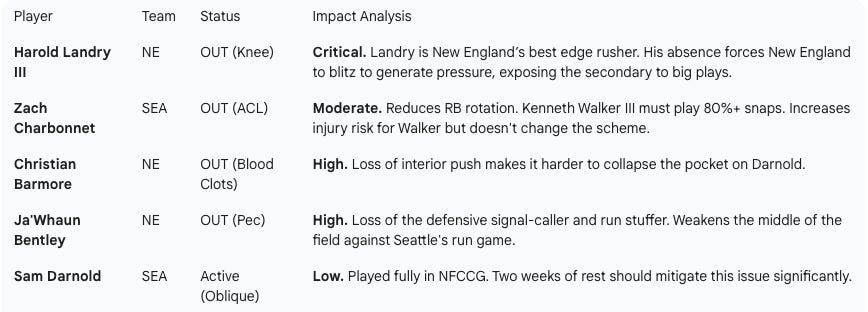
Harold Landry III (NE) – OUT (Knee): Critical impact. As New England’s best edge rusher, his absence forces the defense to blitz to generate pressure, subsequently exposing the secondary to big plays.
Zach Charbonnet (SEA) – OUT (ACL): Moderate impact. This reduces the running back rotation, meaning Kenneth Walker III must play 80%+ of snaps. This increases the injury risk for Walker but does not drastically change the offensive scheme.
Christian Barmore (NE) – OUT (Blood Clots): High impact. The loss of interior push makes it much harder for the defense to collapse the pocket on Darnold.
Ja’Whaun Bentley (NE) – OUT (Pec): High impact. This results in the loss of the defensive signal-caller and primary run stuffer, weakening the middle of the field against Seattle’s run game.
Sam Darnold (SEA) – Active (Oblique): Low impact. He played fully in the NFCCG; two weeks of rest should have mitigated this issue significantly.
Psychological and Intangible Factors
The Pressure Cooker: Maye vs. Darnold
Sam Darnold is playing with “house money.” His career was left for dead; now he is a $100 million man in the Super Bowl. His psychological state is one of redemption and confidence. Drake Maye, while talented, is a 23-year-old making his 21st NFL start on the biggest stage. The history of second-year quarterbacks in Super Bowls is mixed, often defined by how they handle early adversity. If Seattle confuses Maye early, the psychological weight could lead to a spiral (as seen in his playoff fumbles).
The “Home” Crowd
While the ticket allocation is neutral, the proximity of Seattle to Santa Clara ensures the crowd will lean heavily toward the Seahawks. The “12th Man” effect, even diluted in a corporate Super Bowl atmosphere, will be audible, potentially complicating New England’s cadence and audibles.
Game Simulation
First Quarter: The Scripted Opening
New England wins the toss and defers, trusting their defense. Seattle opens with a scripted drive. Klint Kubiak calls wide zone runs to test New England’s edges without Landry. Walker gains chunk yards. Darnold hits JSN on a crossing route. Seattle stalls in the red zone but hits a Field Goal.
Score: SEA 3, NE 0.
Drake Maye takes the field. Seattle shows a “Simulated Pressure” look—lining up 7 on the line. At the snap, only 4 rush, but the confusion causes Maye to hold the ball. Leonard Williams sacks him. New England punts.
Second Quarter: The Adjustment
New England settles down. McDaniels calls quick screens to Diggs and run plays for Stevenson to nullify the rush. They construct a 12-play drive capped by a Stevenson TD run.
Score: NE 7, SEA 3.
Seattle responds immediately. Darnold executes a play-action bootleg, finding Cooper Kupp deep down the sideline for a 40-yard gain. Walker punches it in from the 5-yard line.
Score: SEA 10, NE 7.
Just before halftime, Maye leads a 2-minute drill. He scrambles for a key first down but fumbles when hit by Devon Witherspoon. Seattle recovers. Jason Myers hits a 50-yard FG as time expires.
Score: SEA 13, NE 7.
Third Quarter: The Turning Point
New England receives. Maye forces a throw into double coverage intended for Douglas. Intercepted by Julian Love.
Seattle takes over with a short field. They go for the throat. Darnold hits JSN on a double move for a Touchdown.
Score: SEA 20, NE 7.
New England is now forced to become one-dimensional. Without the threat of the run, Seattle’s pass rush tees off. They sack Maye twice on the next drive. New England manages a Field Goal.
Score: SEA 20, NE 10.
Fourth Quarter: The Closing
Seattle leans on the run game. Kenneth Walker III hammers the depleted New England front (missing Bentley and Barmore). The drive eats 7 minutes of clock. Walker scores his second TD.
Score: SEA 27, NE 10.
New England scores a late TD to Diggs in garbage time to make the score respectable, but the onside kick fails.
Final Score: SEA 27, NE 17.
Betting Market Analysis
Spread: Seattle -4.5.
Moneyline: Seattle -225, Patriots +185.
Total: 46.5.
Market Movement: The line opened at Seattle -3.5 and was quickly bet up to -4.5 and even -5 at some books. This indicates “sharp” money backing the Seahawks. Professional bettors prioritize defense and turnover differential in Super Bowls. The public is often swayed by the “Patriots Mystique,” but the smart money recognizes the mismatch in the trenches caused by New England’s injuries.
Betting ideas:
Best Bet: Seattle -4.5. The injury disparities and defensive metrics suggest a win by a touchdown or more.
Total: Under 46.5. Seattle’s defense is elite, and New England will struggle to sustain drives.
Prop Bet: Kenneth Walker III Over Rushing Yards. With Charbonnet out and New England’s LBs depleted, Walker is the focal point.
Final Prediction and Conclusion
Super Bowl LX will be defined by the collision of Seattle’s modern defensive complexity and New England’s youthful offensive exuberance.
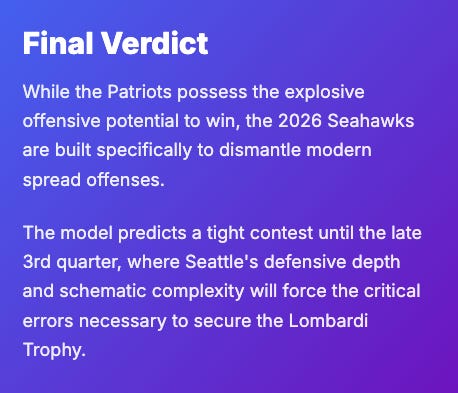
The data overwhelmingly points to a Seahawks victory driven by three key factors:
Turnover Margin: Seattle’s ball security vs. Maye’s fumbles.
Trench Dominance: Seattle’s healthy O-line and D-line vs. New England’s injury-ravaged front seven (Landry, Barmore, Bentley out).
Coaching Matchup: Mike Macdonald’s scheme is specifically designed to confuse young quarterbacks like Drake Maye.
While New England’s turnaround under Mike Vrabel is a remarkable story, the injury to their pass rush creates a fatal flaw. Sam Darnold, protected and confident, will distribute the ball to his superior playmakers (Kupp/JSN), while the “Dark Side” defense suffocates New England’s attack. The “Rematch” concludes with the Seahawks avenging their 2015 loss, cementing the new era of Seattle dominance.
Predicted Score: Seattle Seahawks 27, New England Patriots 17.
Winner: Seattle Seahawks (Cover -4.5).
Super Bowl MVP: Kenneth Walker III (125 Yards, 2 TDs).