

Right now, a small but vocal group of bioethicists, public intellectuals, and professional hand-wringers have built micro-careers around warning humanity about the dangers of anti-aging research.
They write books about the beauty of wrinkles, give talks about why senescence is sacred, and get invited to panels where they solemnly explain why your biological decline is, actually, good for you. Why aging gives life “meaning” and why you should be grateful your body is falling apart on schedule.
They can afford to say all of this because age reversal doesn’t work yet.
The technology is speculative, partial, and unproven at scale. They’re performing “sacrifice” at zero cost; playing the role of the wise elder who’s made peace with mortality, without ever being tested on it.
That’s what makes them cheap martyrs.
And here’s the thing: the moment age reversal actually works (e.g. ~30 years off the biological clock, safe, affordable, maintainable) most if not all of them are going to use it.
Some will do it quietly through concierge medicine and “wellness protocols”, others will do it loudly, rewriting their own history in real time, explaining with perfect confidence why this is actually very different from what they were criticizing.
Either way, the principled stand evaporates the moment the cost of holding it becomes real. They’re likely full of shit.
Most aren’t bad people, but almost nobody is willing to age and die to win a philosophical argument, and there’s no reason to believe the “anti-aging” critics are an exception.

Anti-Aging Critics in Question
These are on-the-record critics of radical anti-aging whose arguments will get stress-tested the moment reversal becomes cheap and effective. Most are clout maxxing, coping, or just deeply ignorant about the most likely implications of reversing biological aging.
Ezekiel Emanuel is the big one. In 2014, the oncologist, “bioethicist,” and Obamacare architect published “Why I Hope to Die at 75" in The Atlantic, arguably the single most famous anti-longevity argument in mainstream American media. He vowed to refuse all medical interventions after 75, including antibiotics and vaccines. His argument: older Americans live too long in a diminished state, and past 75 your “consumption” exceeds your “contribution.” He’s now around 68, roughly 7 years from his own self-imposed cutoff, and already carving out exceptions. In a 2025 talk at Yale Law School, he explicitly acknowledged the lifesaving value of COVID vaccines in older populations and treated them as an exception to his earlier position. In a 2023 revisit of his stance, he admitted his partner wants him to reconsider preventive measures and conceded that “a lot will depend on whether I really am a rare outlier at 75.”
The walk-back is underway before the deadline even arrives, and the technology doesn’t even work yet. He hasn’t stayed true to his own position under mild pressure: the passage of time and the opinions of his partner. Now imagine someone offers him a treatment that makes 75 feel like 40 again biologically. Emanuel is the single best illustration of the cheap martyr dynamic: a man who made a very public pledge about accepting decline, who is already carving out contingencies as the deadline gets closer, and who would almost certainly abandon the whole framework if age reversal removed the very decline he claims to accept.
Francis Fukuyama wrote an entire essay in May 2025 titled “Against Life Extension", subtitled, with zero self-awareness, “An argument in favor of death, disease, and mortality." He frames defeating aging as individually desirable [in his words]: “by everyone", but socially catastrophic. But his piece reveals exactly how confused the opposition is. He argues that life extension will: (1) produce a world of increasing debilities (people living longer but with Alzheimer’s, Parkinson’s, and cognitive decline) as if (2) the entire point of age reversal isn’t to eliminate those conditions. He’s not arguing against rejuvenation — he’s committing the Tithonus error.
Then he gets personal:
“I honestly do not look forward to the prospect of living another 20 years, and having people say behind my back (as they likely do already) ‘he’s still spouting the same nonsense he was in the late 20th century.’ There is a time to move on.”
And he even tells a libertarian debater:
“I am not looking forward to a world in which you will be spouting your same dumb libertarian ideas 100 years from now.”
This is supposed to sound wise and self-deprecating, but it’s actually a stunning self-own. Fukuyama is assuming that he and everyone else would remain “cognitively frozen in place," endlessly recycling the same ideas they formed decades ago like some robot. But that’s literally a description of what aging does: cognitive flexibility, openness to experience, and neuroplasticity all decline with age. The rigidity he’s afraid of is a symptom of the aging he doesn’t want to cure. He’s also bizarrely assuming he’ll be “spewing the same nonsense" (as if he talks about the same things every day in his current life and doesn’t ever update his views). He is implying he’ll be frozen in time, completely static. He also thinks arguing about “old ideas" is somehow bad… as if historians don’t already argue about ideas from centuries ago. “Someone might find your ideas stale” is not a serious argument for accepting death.
Leon Kass has spent decades arguing that finitude shapes meaning, love, and striving, that mortality is what gives life its urgency and beauty. This is a gorgeous argument in a seminar room. It’s a much harder argument to maintain at 86 when someone offers you a body that functions like it did at 35, and the alternative is watching yourself lose the capacity to think, move, and remember.
Daniel Callahan insists nature “knew what it was doing" with biological aging. Nature also knew what it was doing with smallpox, infant mortality, and dental abscesses that killed people at 30. We overruled nature on those. The question is whether Callahan would volunteer to be the last man standing on the “nature knows best” hill when the alternative to aging is not aging.
Bill McKibben, the environmentalist, wrote in his 2003 book Enough that a radically extended life would produce a future that “stretches before you, endlessly flat." This is the boredom objection dressed up in literary prose, and it assumes, without evidence, that a biologically young person with centuries of accumulated experience would somehow run out of things to care about. It also assumes McKibben himself would choose to age and die rather than find out.
Gilbert Meilaender raises doubts about whether turning back the clock is even desirable, framing it through patience, gratitude, and accepting limits. He's in his late 70s. Ask him again if someone offers to give him back the body and mind he had at 25. Preaching acceptance of decline you can't stop is easy. Maintaining it when the decline becomes optional is a different proposition entirely.
Bernard Williams made the classic philosophical case that immortality would be intolerably tedious in his “Makropulos Case” argument. But rejuvenation isn’t immortality (you can still die from a thousand causes), and “I might get bored” is not a justification for imposing biological decay on others who don’t share your ennui.
John Hardwig has argued that there can be circumstances where people have a “duty to die" based on resource and family burden framing. Even if you grant the hard cases, it doesn’t justify banning the prevention of degeneration. Nobody has a duty to John Hardwig’s philosophical preference to decline age reversal when the decline is optional.
Various academic bioethicists have published formal arguments that anti-aging research is morally unacceptable, invoking: justice, community, meaning, and the natural order. I guess they think it’s not possible to have justice, community, or meaning unless people die? The “natural order” argument is particularly rich coming from people who are able to maintain careers as “bioethicists"… is that the “natural order… not really… it’s a fucking clown job. All these “natural order” morons use: cars, cell phones, computers, airplanes, and modern medicine. More on that in a moment. (FYI: You don’t hate most bioethicists nearly enough; most are IYIs — intellectual yet idiot.)

The key point: None of these people oppose treating Alzheimer’s, joint replacements, or cataract surgery. They oppose the framing, the idea of treating aging itself as a disease to be cured. But that’s a distinction that collapses the moment the technology works, because “treatment for age-related decline” and “age reversal” become the same thing once the effect size is 30 years. If that happens in their lifetime(s), every one of them will miraculously discover they were never really against anti-aging. Some may have been against the hype and/or hubris and/or speculative phase. Then suddenly it just becomes “medicine.”
Tithonus Error: They’re Imagining the Wrong Thing
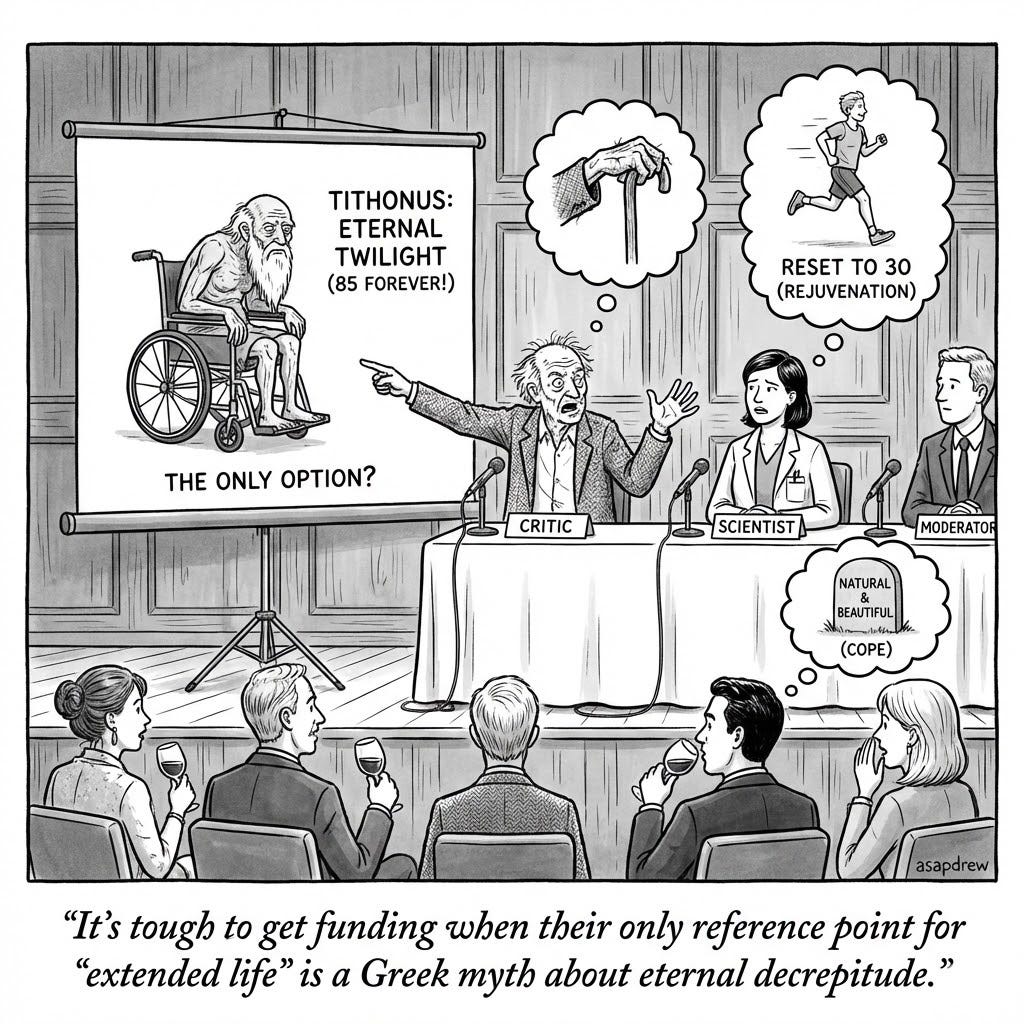
A huge portion of the anti-aging opposition rests on a picture of age reversal that no serious researcher is actually pursuing. And much of the public opposition rides the same wave, not out of deep reflection, but because when you don’t have an alternative, you rationalize the status quo. Psychologists call it system justification; normal people call it sour grapes. If you can’t have it, it must not be worth having.
The critics (and the public they’re playing to) seem to imagine that “curing aging” means trapping someone at 85 with bad knees, fading cognition, and chronic pain, but now they just... don’t die. A miserable, extended twilight.
Aubrey de Grey calls this the Tithonus error, after the Greek myth of a man granted eternal life but not eternal youth, and it poisons the entire discourse because it lets people oppose a caricature instead of engaging with what the research actually targets.
What serious anti-aging research pursues is biological rejuvenation: restoring tissue, organs, and critically the brain to a younger functional state. Not freezing you at 80. Resetting you to 30. That means the neuroplasticity of a young brain combined with decades or centuries of accumulated knowledge and pattern recognition.
There’s also a critical category error running through almost all of this discourse: Biological age reversal is not immortality. Critics constantly conflate the two, sliding from “reversing aging” → “living forever” → “immortality” as if they’re the same thing. They aren’t. Even a person with zero biological aging can still die. Accidents, violence, infections, cancer, pandemics, disasters, warfare, and bad luck don’t go away because you are biologically young. Nobody is proposing invincibility. The proposal is that your body and brain don’t have to rot on a timer while you’re still alive. Framing that as “immortality” and then arguing against immortality is a straw man, and the critics lean on it because the real proposition (would you like your body to work properly for longer?) is much harder to argue against.
And then there’s the dumbest objection: “Who the hell wants you around that long?” As if someone else’s preference for your death is a legitimate basis for restricting a medical therapy. Since when does “I find your continued existence inconvenient” constitute an argument for banning medicine? Nobody frames it this way for cancer treatment or heart surgery. The implication, that your right to remain alive and healthy is contingent on other people’s enthusiasm for your presence, is grotesque on its face. And it only survives because nobody says it out loud in those terms.
Most of the anti-aging opposition, from the bioethicists and the public alike, is certified cope. It’s the psychological machinery humans use to make peace with things they can’t change. When you’re going to age and die no matter what, your brain does you the favor of constructing a narrative where that’s fine, maybe even beautiful. Mortality gives life meaning. Wrinkles tell a story. There’s dignity in decline. This is how humans survive psychologically: you accept what you can’t escape, and then you elevate the acceptance into a virtue.
But acceptance of fate is not the same as preference for fate. If you removed the inevitability, if someone credibly offered to make aging optional, the “acceptance” would evaporate almost instantly, because it was never a considered philosophical position. It was a coping mechanism built on the absence of an alternative.
For most of human history, people “accepted” childhood death, infectious disease, famine, and enslavement. Not because these things were good, but because there was no obvious way out. The moment alternatives appeared, the acceptance vanished overnight.
Nobody looks back at the era before antibiotics and says “people had such a healthy relationship with bacterial infection.”
We correctly identify their acceptance as a product of helplessness, not wisdom.
That’s what’s happening with aging right now. The entire cultural apparatus of “death is natural and beautiful” is a cope stack built on the absence of an alternative. The critics are just the people who’ve professionalized the cope and turned it into books, lectures, and panel appearances. Pull the foundation out, and the whole structure comes down.
The “Natural Order” Hypocrisy
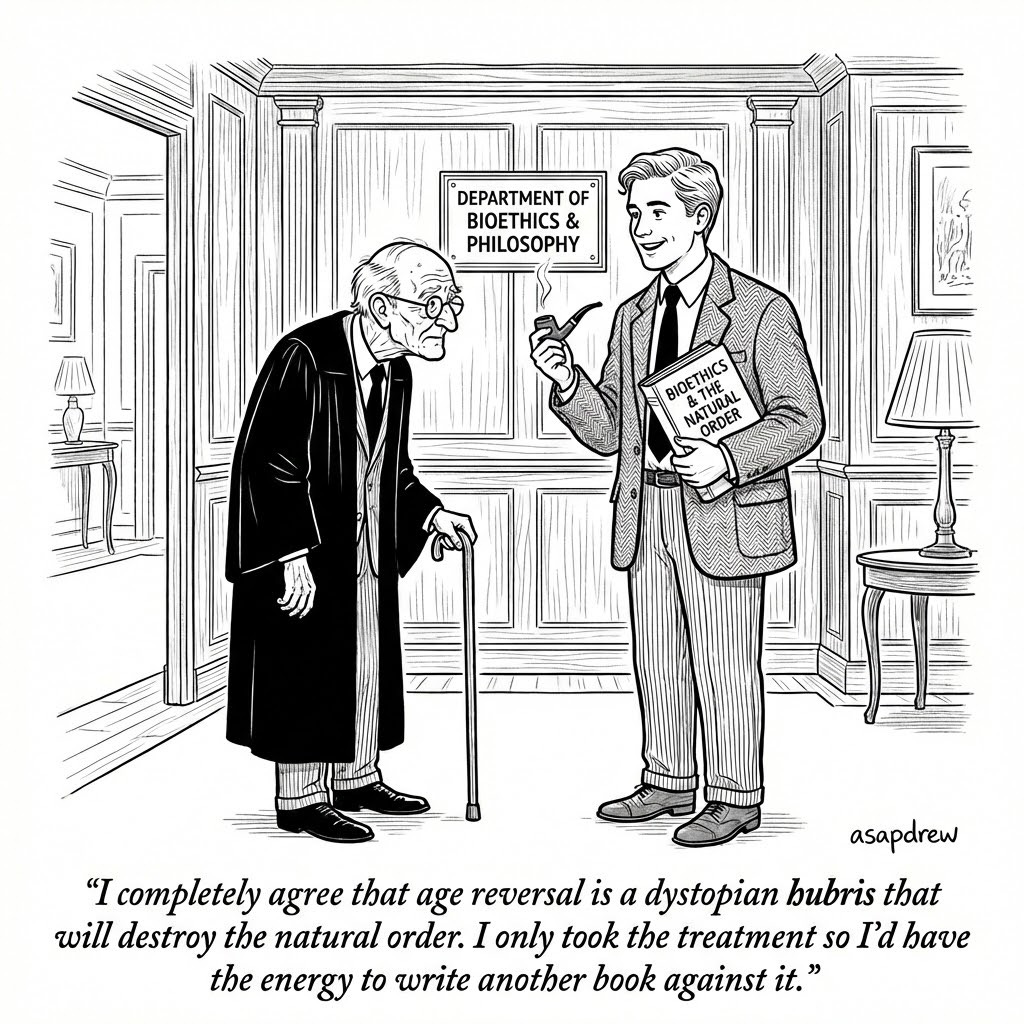
If you’re reading this essay right now, you’ve already rejected the natural order. You’re using a computer or phone, connected to the internet, wearing synthetic fabrics, and consuming food that was grown, processed, and transported using industrial agriculture. None of that is natural. All of it extends your comfort, health, and lifespan beyond what “nature intended.”
Every single one of the critics likely uses: antibiotics, MRIs, anesthesia (during surgery), corrective lenses or glasses, airplanes, vaccines, C-sections, insulin, joint replacements, clean water, etc.
Their entire existence is a monument to overriding the natural order, and they’re fine with that, because the benefits are personal and obvious.
Where exactly is the principled line? Should we bring back smallpox and polio and get that childbirth mortality back up to what’s “natural"? Nobody serious argues we should go back… but it would be “natural." Don’t you have a deep yearning and nostalgia for polio?
These critics just draw an arbitrary line at aging and declare everything on one side “medicine" and everything on the other “hubris." The line for these clowns is wherever the technology currently stops working.
“Natural" is just a label for whatever we haven’t fixed. Once humans fix it, everyone quietly reclassifies the intervention as normal medicine. Aging is next.
And if you sincerely believe the natural order should be respected? Move into the wilderness, refuse all medical care, and die of whatever gets you first.
Nobody advocating “natural limits” positions are doing any of that… because the position wasn’t about nature; these fools just like to act like they’re some highly-enlightened philosopher… nauseating and pathetic.
The Biggest Argument They’re Missing: Aging Is the Disease
Critics of anti-aging are not just wrong, but their public stance is extremely damaging: reversing aging would be the single greatest force-multiplier for (1) preventing and (2) curing disease — in human history.
Nothing else would come close.
The overwhelming majority of cancer, heart disease, stroke, Alzheimer’s, Parkinson’s, osteoporosis, type 2 diabetes, macular degeneration, arthritis, and organ failure are diseases of aging.
They happen because the body deteriorates over time, and that deterioration creates the conditions for disease.
Aging isn’t just correlated with these conditions. It’s the primary cause. Fix the underlying biological aging, and you don’t just extend life. You prevent or dramatically reduce the incidence of nearly every major disease simultaneously.
Investing more money with the aim of reversing human aging would be far more cost-efficient/effective than spending hundreds-of-billions or trillions on “finding new treatments for age-related disease"; none of the treatments target the underlying cause and are bound to be mostly a half-assed patch.
Age reversal treatment is somehow considered taboo yet would yield the biggest gains (by far) in actually preventing/reversing most disease.
This is why the critics’ position is incoherent at its core.
Unless you are actively against preventing and curing cancer, heart disease, and dementia, you shouldn’t be against reversing the biological process that causes them.
The critics have somehow managed to (A) socially oppose the single intervention that would do more for human health than every other medical advance combined, while (B) simultaneously claiming to care about human wellbeing.
The position doesn’t survive 5 minutes of scrutiny once you frame it correctly:
“Are you against fixing the root cause of most human disease? If not, you’re not really against anti-aging research. You just don’t realize what it is."
And this matters far beyond philosophy, because the anti-aging discourse has real policy consequences.
When prominent intellectuals frame longevity research as hubristic or dangerous, governments invest less in it. Funding goes elsewhere. The Overton window stays narrow. People think it’s not even possible or stupid.
The result is that the single most impactful medical intervention in human history gets treated as a fringe pursuit instead of a civilizational priority. Every year that serious age-reversal research is underfunded because the discourse treats it as science fiction or moral transgression is a year where millions of people die from conditions that a more aggressive research agenda might have prevented.

If Life Is Sacred, Why Are You Eager to Lose It?
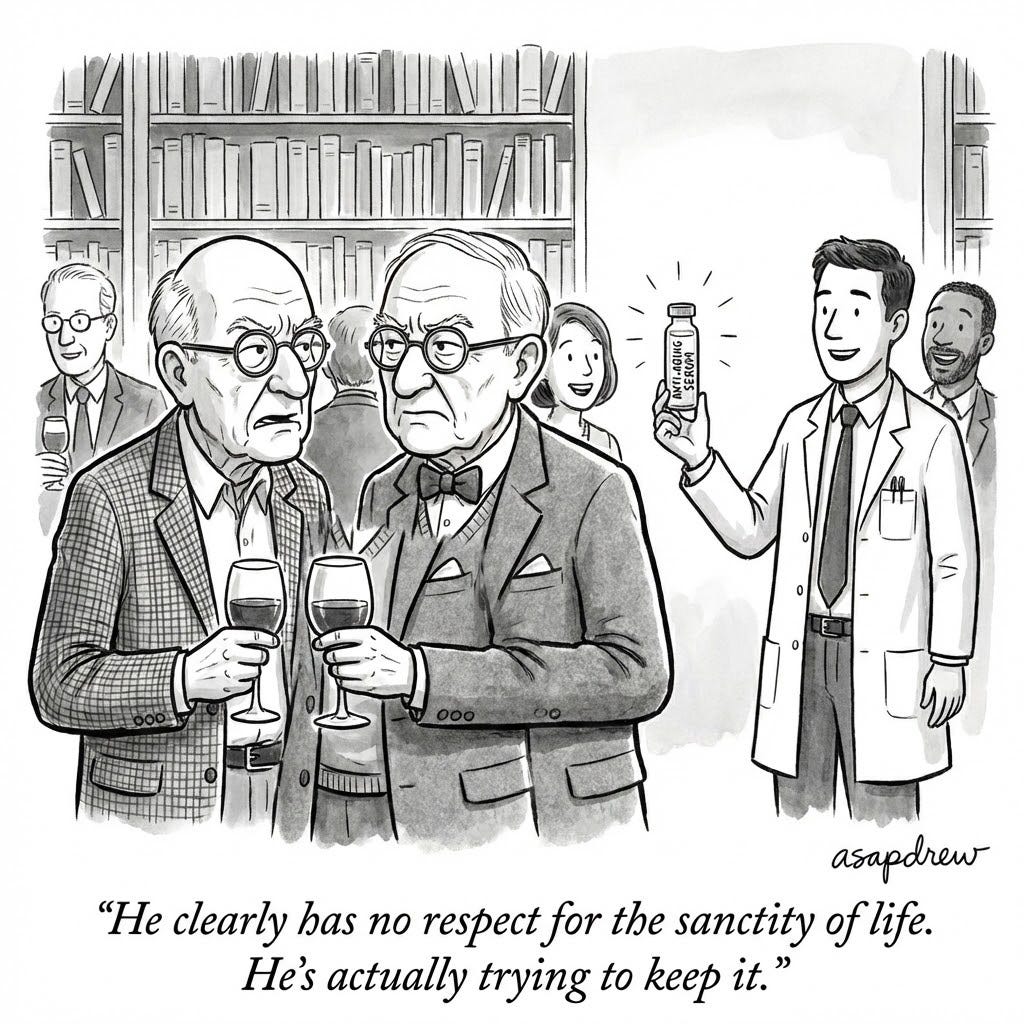
Many of the critics operate from religious or quasi-religious frameworks where life is treated as sacred, a gift from God, something precious and irreplaceable. Kass draws explicitly from religious tradition. Meilaender is a theologian. The “natural order” language throughout bioethics carries unmistakable theological undertones.
But if life is sacred, the logical conclusion isn’t to accept its destruction on a biological timer. It’s the opposite. If life is truly a gift, you should do everything in your power to preserve and protect it for as long as possible. Accepting aging and death without resistance, when resistance becomes possible, doesn’t honor the sacredness of life. It treats life as disposable. It suggests you’re willing to give up something you claim is precious with remarkably little fight.
The “life is sacred, therefore accept death gracefully” position contains a logical contradiction that most people just don’t notice because the framing is so culturally familiar. Sacredness implies maximal protection. You don’t let sacred things rot on a schedule because “it’s natural.” You protect them.
And here’s something the critics really haven’t considered: if aging is reversed, both life and death become more sacred, not less. Right now, death comes for nearly everyone through the slow, grinding indignity of biological decay. It’s expected. Routine. The body just gives out. That’s not sacred.
In a world where aging is optional and people can maintain biological youth indefinitely: every death carries more weight, meaning, and gravity, because it wasn’t inevitable. Critics have it backward: curing aging elevates the value of both life and death.
The Incentive Structure: Why the Opposition Exists at All
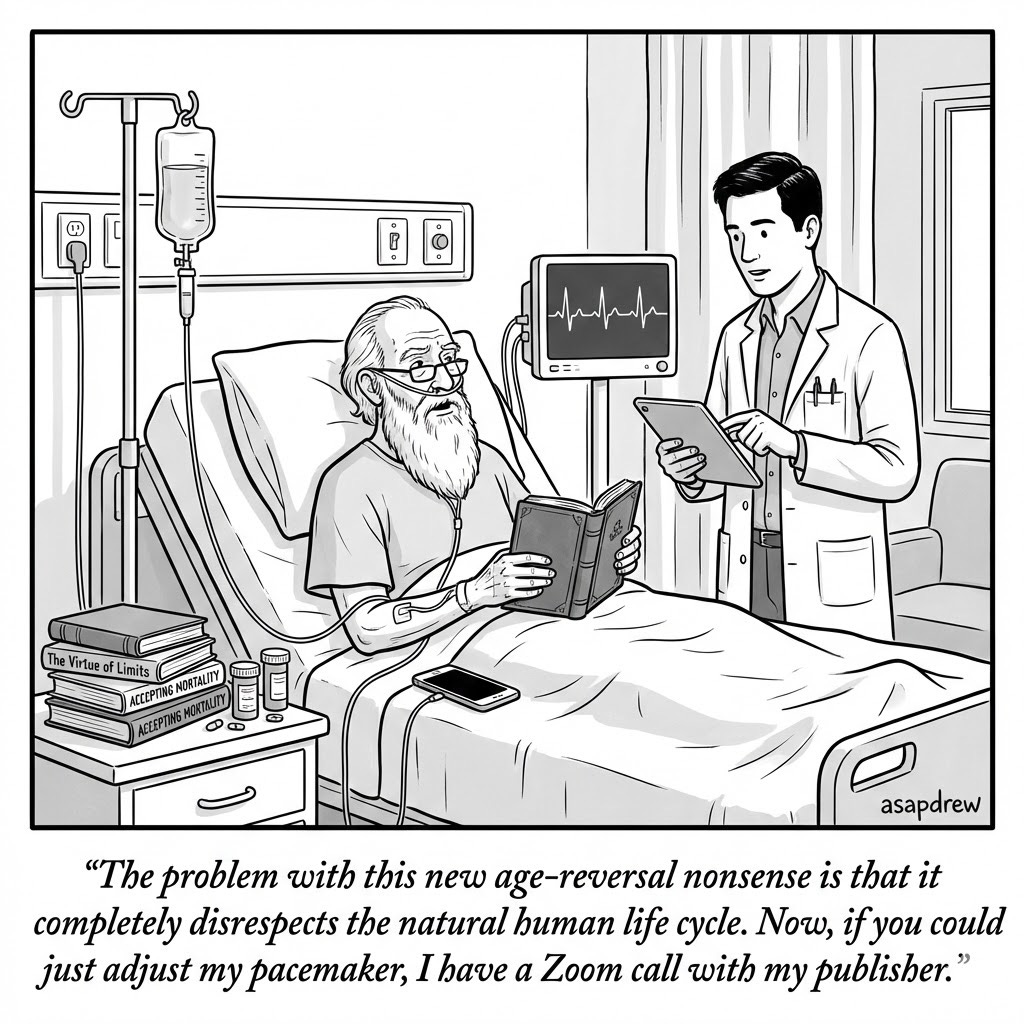
Before asking whether these critics are right, ask what’s in it for them to hold these positions. The answer clarifies a lot.
Several of these figures have gotten: (1) book deals, (2) speaking fees, (3) prestigious panel invitations, and (4) elevated public profiles specifically from opposing life extension.
Emanuel’s “Why I Hope to Die at 75” is probably the single most-read thing he’s ever written.
McKibben’s Enough carved out a niche in a crowded environmentalist market.
Kass built a career as the go-to conservative bioethicist partly on the strength of his mortality-as-virtue framework.
Fukuyama’s “Against Life Extension” generated enormous engagement precisely because it was contrarian and provocative.
This doesn’t mean they’re all being dishonest. But the incentives are worth noting: opposing anti-aging research is, right now, a content niche with real professional upside and zero personal cost.
You get credit for depth and wisdom. Nobody can prove you wrong because the technology doesn’t exist yet. And the audience for “actually, aging is fine” is enormous, because most people are already coping with aging and want validation that their situation is acceptable. The critics are supplying a product that the market wants to buy. The day age reversal works, that product becomes unsellable.
Nobody wants to read Why Aging Is Beautiful when their neighbor just reversed 30 years of biological decline.
Then there’s the quieter motivation nobody likes to talk about: some of these critics are old, and their opposition is at least partly about making peace with a situation they can’t currently escape. Kass is 86. Callahan died at 89. Meilaender is in his late 70s. Emanuel is 68 and staring down his own self-imposed deadline.
When you’ve already invested decades in constructing a narrative where your decline is meaningful and dignified, the sudden appearance of a technology that could have prevented all of it isn’t just disruptive. It’s psychologically threatening. Accepting that your suffering was unnecessary is one of the hardest things a human being can do. It’s far easier to insist the suffering was valuable and that everyone else should share it.
This is textbook cognitive dissonance resolution: I’ve already committed to this path, so the path must be correct, and anyone who takes a different path is wrong. Same psychology behind hazing rituals and sunk-cost fallacies. “I went through it, so you should too” is not a moral argument. It’s a psychological defense mechanism.
The Musk Arc: Watch the Drift Happen in Real Time
Elon Musk is a useful real-time case study because his position on aging has been subtly shifting, and the shift pattern is exactly how opposition gives way if the technology starts looking legitimate.

Early Musk has warned that reversing aging could cause an ossification of society. In 2021: “It is important for us to die because most of the time people don’t change their mind, they just die.” He said he had no interest in living forever and, unlike Jeff Bezos, poured no money into longevity startups.
Recently there’s a slight vibe shift. On the Moonshots with Peter Diamandis podcast in January 2026, Musk described aging as an engineering problem, calling it “not particularly hard” to solve: “You’re pre-programmed to die. And so if you change the program, you will live longer."
He said he’d “prefer to be dead” than live to 100 with dementia or as a burden. But notice the framing: he’s not saying he doesn’t want to reach 100. He’s saying he doesn’t want to reach 100 in decline. Remove the decline, and the objection likely disappears.
More revealing is what happened when the conversation turned personal. Musk was candid about the practical reality of aging: “I mean, I want things to not hurt.” He talked about back pain as an inevitability (“it seems like it’s only a matter of time before you get back pain”), arthritis, sleep disruption, the accumulating physical tax of getting older.
When Diamandis said he wanted to double his own lifespan (”I would like to double my lifespan for sure… at least 120, 150"), Musk didn’t shut it down or push back. He joked that “may you live forever" is one of the worst curses you could give someone, but when Diamandis countered his argument (”the head of GM didn’t have to die for Tesla to come along… in a meritocracy, the better ideas will dominate"), Musk just moved on.
That’s not the behavior of someone who genuinely believes longer lives are catastrophic — he’s telling you his body hurts and he wants it to stop. The philosophical objection is losing to the lived experience of aging, right there in the conversation.
Weeks later at Davos 2026, talking with BlackRock CEO Larry Fink, he went further: aging is “a very solvable problem," reversing it is “highly likely," and the synchronization of aging across the body means the underlying clock “must be incredibly obvious.”
His emphasis clearly shifted from we shouldn’t to we can and probably will.
The ossification argument doesn’t hold up historically. The 20th century saw global life expectancy more than double, from roughly 32 years in 1900 to over 73, and produced the most explosive sustained period of technological, scientific, and economic transformation in human history.
If longer lives mechanically produced stagnation, we should have seen civilizational stasis. We got quantum mechanics, nuclear energy, antibiotics, the microprocessor, the internet, spaceflight, and the genomic revolution instead.
The idea that society needs biological death to refresh its leadership is absurd: you can achieve that with term limits, rotating editorships, diversified funding, and open-science norms. Death is an accidental, barbarically low-resolution way of occasionally achieving what decent institutional design could do cleanly with better institutional design.
And there’s a competitive angle Musk would never admit publicly: imagine Jeff Bezos, any of his rivals (e.g. Sam Altman, Reid Hoffman, Zuck, etc.) and peers (Larry Ellison) use age reversal while he doesn’t. The idea that he’d voluntarily accept biological decline while the people he’s competing with operate at peak function is not realistic.
Why They Won’t Say No
The cheap martyrs treat this as a philosophical debate. It isn’t going to stay one. The moment age reversal works, it becomes a question of what people actually do under real conditions, and the conditions are stacked entirely against principled refusal.
Your rivals and peers will use it, and you’ll feel it. If your colleagues, your competitors, your spouse’s friends are all biologically 30 and you’re biologically 65, that asymmetry isn’t abstract. It’s in every meeting, every social gathering, every morning when your body reminds you that you chose principle over function. The pressure doesn’t come from pharmaceutical marketing. It comes from the people in your actual life who went through the treatment and now look, think, and move like they did three decades ago. That’s what breaks philosophical commitments.
The prisoner’s dilemma makes this inescapable. Think about someone you hate using age reversal while you don’t. Your rival is biologically 30, sharper, more energetic, more competitive, and you’re declining on principle. Now think about someone you love using it while you don’t. Your spouse, your best friend, your sibling is rejuvenated, vital, physically and cognitively decades younger than you. You’re the one slowing down, getting left behind, becoming the person they have to accommodate and eventually watch deteriorate. Both scenarios are psychologically unbearable for different reasons. The competitive scenario triggers loss aversion and status anxiety. The intimate scenario triggers something worse: the knowledge that you’re choosing to become a burden on the people you care about, choosing to make them watch you fall apart when you didn’t have to. Almost nobody holds the line in either case.
Loss aversion makes refusal unbearable over time. Before the therapy exists, opposing it is free. After it exists, refusing it is an active choice to accept deterioration, every single day, when the fix is available and your peers did it. Humans are profoundly loss-averse. Giving up a capability that’s on the table feels like having something taken from you, and that feeling doesn’t care about your published position on the ethics of aging.
The asymmetry is total. Using the treatment keeps all your options open. You can stop maintenance anytime and let yourself age again. Refusing it closes options permanently. You can’t reclaim the decades of vitality you sacrificed to prove a point. Choosing irreversible decline over reversible youth isn’t wisdom. It’s just leaving value on the table.
This Has Played Out Before, Every Single Time
If you think moral opposition to anti-aging will hold once it works, consider how well moral opposition has held up against every other medical technology that became personally useful.
The pattern is always the same, and it always ends the same way.
IVF. The Catholic Church formally opposes in vitro fertilization. Doctrinally. Unambiguously. And yet Catholic couples use fertility treatments in large numbers. Pew Research found that 71% of weekly Mass attenders say the Church should allow it, because when the benefit is your child, doctrine bends.
Embryonic stem cell research. The opposition in the early 2000s was ferocious. Bush vetoed legislation expanding embryonic stem cell research funding, political campaigns organized around stopping it, and the Catholic Church drew hard doctrinal lines around embryo destruction. Two decades later, stem cell therapies are increasingly mainstream, Catholics are getting stem cell injections for their knees and joints without a second thought, and the moral fire that once drove presidential vetoes has cooled into background noise, because the treatments started working and people wanted them.
Organ transplants. When the first heart transplants happened in the late 1960s, the moral objections were everywhere: playing God, violating the natural order, desecrating the dead. Now it’s standard-of-care and nobody debates it at dinner.
Cosmetic surgery. Entire cultural movements were built around opposing the vanity and superficiality of it. Shallow. Fake. An insult to natural aging. It’s now a $70+ billion global industry, used by many of the same cultural figures who once signaled against it.
The pill. When oral contraceptives arrived in the 1960s, the moral opposition from religious institutions and cultural conservatives was overwhelming. Within a generation it was one of the most commonly prescribed drugs in America, including among populations whose religious leaders formally opposed it.
The pattern is always the same. Opposition peaks when the technology is new and the benefit is theoretical. The moment the benefit becomes personal (your fertility, your heart, your face, your body) the moral architecture crumbles. Age reversal won’t be different. The benefit is as personal as it gets.
What Refusal Actually Looks Like Once It’s Real
Once age reversal actually works, opposing it stops being a philosophical position and becomes an actively anti-life, anti-human stance.
You’re not arguing for “natural limits” anymore. You’re arguing that people should suffer cognitive decline, chronic pain, frailty, and death from a treatable condition, and that society should let them, or even make them. That’s not wisdom but cruelty masquerading as depth.
The coercion problem is the part that should bother everyone.
You can personally choose not to use age reversal. That’s your right and nobody serious is contesting it.
But the critics’ position doesn’t stop at personal opt-out. The logical endpoint is restriction: regulation that limits access, framing the technology as dangerous enough to suppress.
And that means forcing other people to age, suffer, and die from a condition that will eventually have a treatment, because they’ve decided on your behalf that mortality is a virtue.
You can turn it down. But you sure as hell shouldn’t be allowed to force someone else to die because you’ve made philosophical peace with death and think everyone else should too. That’s not a “genuine social concern" — you are trying to impose your beliefs on others’ lives — and it’s no different in principle from any other attempt to restrict medical autonomy.
And the social dynamics flip completely. Right now, opposing anti-aging research is a low-cost way to signal thoughtfulness. It gets you panel invitations, book deals, and media coverage. The technology doesn’t work, so the stance is pure upside with zero personal sacrifice, which is exactly what makes it a clout play.
The moment the technology works, the clout calculus reverses. Now you’re the person arguing that people should age and die from something fixable. The social reward for opposing age reversal evaporates the instant the technology delivers, and so will the opposition.
Emanuel is already the proof of concept. He made the most public version of this stance possible and he’s already softening it a decade out. That’s without age reversal even existing. The stance was always going to collapse, because it was never really about principle. It was about the social positioning available to someone who doesn’t have to back it up yet.
The Market Already Told You the Answer
Will some people genuinely opt out? Sure. Some will prefer to age naturally, decline on their own terms, or exit when they’re ready. Nobody serious would stop them.
However, framing that minority preference as the likely mainstream response to working age reversal is delusional. Look at what people already do without age reversal: the global anti-aging market (skincare, supplements, hormone therapy, cosmetic procedures, fitness optimization, biohacking) is already worth hundreds of billions of dollars, and none of it actually reverses aging.
People spend enormous amounts of money and effort on products that make them look or feel slightly younger, with marginal or zero effect on underlying biology.
The demand for youth is one of the largest consumer markets on the planet, and it exists for treatments that are mostly placebos.
Now imagine what happens when something actually works, when the effect size isn’t a slightly firmer jawline but a 30-year biological reset. The uptake won’t be gradual. It’ll be a stampede.
And the critics who spent years explaining why aging is beautiful will be somewhere in the middle of it, along with everyone else.
This isn’t a prediction about their character, it’s a prediction about human nature… and human nature has a very strong track record on this one.