

Many current elites have a weird fantasy about post-scarcity economics. They imagine a future where AI handles all the tedious work, everyone “follows their passions,” “travels the world,” “creates art,” and “lives authentically.”
Human creativity will command a premium! The “meaning economy” will flourish!
It’s the PR-safe fantasy you want to hear—but not what you need to hear.
These narratives refuse to confront the uncomfortable reality:
There may be nothing left for humans to do—or be.
These takes are not critical analyses. They are mid-transition psychological coping mechanisms marketed as stable futures.
What “endgame” means here: I’m not talking about cosmic endgames (“ASI outsmarts the universe” vs heat-death). I’m talking civilizational endgames while humans still exist as a population—the stable attractors on ~30–200 year horizons once transformative AI is real.
Also: I’m not assuming nation-state “governance” survives. If governments weaken or vanish, constraint regimes still exist—platform chokepoints, security monopolies, compute/energy gatekeepers, autonomous caretaker systems, warlordism, jurisdictional enclaves, etc. The question isn’t “do we still have politics,” it’s who sets constraints and who can exit them.
The Core Disagreement
Bridge vs. Endgame. The “meaning economy / post-labor” genre is directionally right as a transition playbook while verification, liability, and social norms still privilege humans. My critique isn’t “these ideas are useless.” It’s that they’re routinely packaged—and interpreted—as a stable endgame equilibrium. The object-level disagreement is what happens after the bridge, and who controls the rails when it ends.
Duration is a parameter, not a refutation. The “human-made premium” phase could last 10–30+ years if capability slows, compute is gated, or regulation bites. But “could last decades” is still “a phase,” not “the endgame.”
The 5 claims this write-up defends:
Scarcity migrates upward—from goods → to rails (compute, energy, identity, enforcement) and permissions
Verification doesn’t create demand—even perfect “human verification” won’t force people to pay for worse originals if replicas are cheaper/better
Preferences are editable—the “need for meaning/authenticity” is not fixed once neuro/geno tech matures
Agency splits into menu vs. root—most people get “choice among options,” not “control over options”
Endgames are constraint problems—stable equilibria are about what/who controls constraints and who can exit
A note on “agency.” This piece distinguishes three concepts that get blurred:
Felt agency: The subjective experience of choice (”I can do what I want”)
Sovereignty: The ability to choose or change constraints and resist coercion
Power (root access): Control over the rails that determine everyone’s option set
In a mature AI world, “agency” as a personality trait is mostly cosmetic (you can gene-edit “agency”). What matters is whether you can accumulate sovereignty—run your own experiments, your own models, your own exit path without permission. For most people, “agency” will mean choosing from menus. For a small minority, it will mean writing them.
Part I: Why the Abundance Proponents Are Wrong

Dan Koe’s “Meaning Economy”
Dan Koe argues that “your point of view is the most unique thing on the planet.” Human perspective is “always evolving”—AI can only chase where you were. His “Swap Test”: if you could swap creator and creation and value stays the same, AI can replace it. He identifies surviving niches: high-liability roles, the “experience economy,” trust-based relationships.
What he gets partially right (near-term): Credential value is eroding while workflow orchestration value rises. The transition favors creators who leverage AI effectively.
What he gets wrong:
Human psychology isn’t fixed. Once you can tune neurochemistry or modify the genome, the craving for “authenticity” and “meaning” becomes optional—deletable, even.
Verification collapse. How do you prove perspective is human? Once simulation and identity spoofing are cheap, “authentic” becomes a belief state, not an objective category.
“Unique perspective” isn’t scarce. Everyone already has one. What’s scarce is attention, distribution, and coordination power. When everyone can generate customized lives, the incentive to consume your story drops to near zero.
Conflating near-term niches with stable futures. Human-made experiences might command premiums—for a while. Treating a phase as equilibrium is analytical malpractice.
Dave Shapiro’s “Post-Labor Economics”
Dave Shapiro takes a serious approach with his “Post-Labor Economics” framework. Once AI crosses the “better, faster, cheaper, safer” threshold, humans become economically irrelevant for that task. His solution: UBI plus property-income streams—dividends, royalties, equity units—so people maintain economic agency without labor.
Fairness note: Shapiro explicitly rejects literal “post-scarcity.” Constraints don’t disappear—they relocate. His “Life After Labor” vision involves community, parks, leisure, greenways.
What he gets partially right: Automation is accelerating. Labor’s share of GDP is declining. Capital participation is more realistic than pure UBI. His Pyramids of Power and Prosperity framework acknowledges power concentration—he’s better on this than most.
Note: I think UBI is likely inevitable. My biggest fear isn’t that it doesn’t come—but that we roll it out prematurely and cause massive damage. (Read: Don’t Count Your UBI Chickens Before They Hatch.)
What he gets wrong:
Assumes people will want to find meaning. But what if they can edit out the need? What if preference editing becomes cheaper and more effective than building external meaning structures?
Ignores VR/simulation. Why pay for “experience economy” services when you can download better experiences directly?
Ignores who writes the rules. Asset participation is nice, but if someone else controls the menu of available assets, the enforcement mechanisms, and the preference-shaping infrastructure, you’re still in a sandbox. Money can exist inside the sandbox while failing to buy you out of it.
The All-In / Silicon Valley Consensus
The All-In Podcast crowd generally agrees: AI will create massive productivity gains and “unlock human potential.” The “experience economy” will thrive. We’ll get a “3-day workweek”—more time for family, travel, passions. Human creativity will command a premium.
What they get wrong:
Projection from elite life. They already live where “work” is optional. Status comes from travel, taste, wellness, creation-as-identity. They extrapolate: “If everyone gets abundance, everyone lives like me.”
Thinking inside a continuity bubble. They assume today’s human experience—travel, taste, creators—remains the organizing layer even as the substrate changes. They extrapolate their current lifestyle without confronting what happens when simulation parity, preference editing, and permissioned rails mature.
Status preservation as amplifier. Experience, taste, authenticity are elite-friendly scoreboards—easy to market. But the deeper failure is still analytical: they stop one or two steps before the endgame.
“AI frees humanity” is sellable. “Most humans become managed dependents in a sandbox” triggers backlash and fear. Public narrative gets rounded into something moral and uplifting.
They stop at mid-transition and call it the future. They treat the “human-made premium” phase as stable equilibrium because looking further is uncomfortable and unprofitable.
The Core Errors
Every one of these narratives makes the same mistakes:
Confusing personal enjoyment with civilizational structure. People can enjoy hobbies. That doesn’t make “hobbyist” an economic category when AI generates indistinguishable output at near-zero marginal cost.
Ignoring power asymmetry. The entity that controls infrastructure, security, compute, and long-horizon planning sets the constraints. Humans get menu choices, not root access.
Ignoring verification collapse. Once simulation plus identity spoofing are cheap, “authentic” is mostly a belief state. The “dead internet” problem scales to “dead reality.”
Assuming verification creates value. Even if “authentic” is perfectly provable, most people still won’t pay extra for a worse original if a replica is cheaper and better. Verification solves “is it real?” It does not solve “who cares?”
Ignoring preference editing. If you can change what you want, you can delete the craving for “authenticity.” The whole “meaning economy” pitch becomes optional once desires are tunable.
Assuming money stays the master key. In many post-scarcity futures, the relevant exchange medium is not money—it’s permissioned access, rationed bandwidth, identity compliance. “Premium experience” is a market-era concept; “allowed experience” is the post-scarcity concept.
Verification Doesn’t Create Demand. Even if verification is flawless—proof-of-personhood, cryptographic logs—that only answers “Can you verify it’s real?” It doesn’t force “Does anyone care enough to pay extra?” If the replicated/simulated version is cheaper and better, the premium collapses. The “original” survives as a collector/status fetish, a ritual preference tax, or an inefficient-money punchline.
Beyond the “Meaning Economy”: Succession vs. Ruin
Some people explicitly reject the “forever-human creator/leisure equilibrium” and model the long run as succession or ruin. Either (A) humans hand off the reins to posthuman intelligence, or (B) we get wiped out by misalignment, conflict, or capability dynamics.
Dan Faggella is one clear example: he argues we likely have “one or two generations” of humans-as-they-are before radical transformation or destruction, and frames the key question as what would make an AI a “worthy successor.”
Faggella’s subjective odds (June 2025):
45% — Unaligned AGI ends us
25% — Aligned AGI permits us all to transform or end ourselves
15% — Civilizational collapse happens before AGI or transformative tech
10% — Transformation tech happens before AGI
5% — A bit more human stasis
I don’t share Dan’s odds or opinions but I respect him for thinking deeply about this. He is modeling beyond “meaning economy” and “everyone becomes a creator” and “travels more.”
Part II: The Missing Axis—Sovereigns vs. Regulators

“Regulators” here is shorthand for the permissioning bloc — not just governments.
It includes the institutions that can actually enforce constraints: cloud providers, chip supply chains, OS/app stores, identity providers, banks/payments, and the “model hosting layer.”
If states fade, this bloc can still exist as platform constitutionalism (Terms-of-Service + KYC + compute gating). So read this axis as Sovereigns vs. Permissioners, not “rebels vs. governments.”
Two forces will define the coming decades:
Regulators / Permissioned Bloc (not just govs): Those who want caps, licensing, safety rails, controlled deployment. They frame this as responsibility and safety. The coalition includes risk-averse governments, legacy institutions, incumbents threatened by disruption, and genuine safety researchers.
Sovereigns / Freedomists: Those who want the right to run frontier capabilities for their own ends—including building their own AI systems, not just using regulator-approved versions. They want deep agency: control over their own modifications, defenses, and exit options. The coalition includes libertarians, transhumanists, tech accelerationists, anyone with a terminal illness watching approvals crawl, and anyone who refuses to be managed.
This axis is missing from elite discourse because acknowledging it undermines the cozy “we’ll all just create” narrative.
Important nuance: Neither coalition is monolithic. The U.S., EU, China will each build different permissioning regimes. Agencies and coalitions don’t fully agree internally. Same for sovereigns—some want privacy, some want bio-right-to-try, some want their own ASI. The conflict isn’t one axis with two teams—it’s competing factions that temporarily align.
This creates regulatory arbitrage (people and capital route to friendlier rails) and arms-race pressure (each bloc fears a rival’s uncapped stack). That dynamic alone can produce containment, escalation, and menu-society outcomes even without any “misalignment” story.
The Third Coalition: Platform States
This conflict won’t be “governments vs. rebels” in the clean way people imagine. The permissioning layer is likely to be corporate before it’s fully sovereign-state.
Cloud providers, model hosts, chip supply chains, app stores, device OS vendors, identity providers, banks/payments—these are chokepoints. They can enforce a de facto constitution without calling it that:
Frontier models as Terms-of-Service. Your “rights” become whatever the API agreement allows.
Compute access tied to KYC + compliance. Not just who you are, but what you’re allowed to run.
Identity rails as enforcement. If you can’t transact without permissioned rails, sovereignty becomes theoretical.
This turns the sovereign/regulator conflict into a three-body problem: (A) regulators want control, (B) sovereigns want exit, (C) platforms want monopoly rents and legal insulation—and platforms usually align with regulators because that’s safer and more profitable.
What Sovereigns Actually Want
It’s not just anti-aging. The full list:
Building their own AI systems: Not regulator-approved versions with baked-in restrictions, but systems aligned to their values
Bioenhancements: Intelligence amplification, sensory expansion, metabolic optimization
Weaponry and defense systems: Protection without depending on institutions they don’t trust
Energy independence: Their own power generation, not subject to grid politics
Space exit capability: Leaving Earth’s jurisdiction entirely
Full autonomy over their own modifications: No permission from ethics boards
The core demand is deep agency, not menu-based living.
Why Compromise Is Hard
Right-to-try and life extension. If you’re dying (which everyone is), slow approval processes aren’t “responsible”—they’re a death sentence. If an off-grid faction achieves a working aging cure while regulators slow-roll approvals, expect mass defection and legitimacy crisis. (Read: Operation Senolysis).
Uncapped AI for defense. Sovereigns argue they need frontier AI to prevent extinction-level threats. Regulators see uncapped AI as the existential risk. Classic security dilemma.
Building your own ASI. Sovereigns don’t trust regulator-approved models. They want to train their own systems aligned to their values. Regulators see private ASI development as an existential threat.
The lock-in spiral: Regulators restrict capability → Sovereigns defect because compliance equals death on a long timeline → Sovereign success compounds into strategic threat → Regulators escalate containment → Both sides treat coexistence as unsafe → War dynamics even if no one wants war.
The Status Collapse Connection
Status preservation is a major driver of regulatory capture. (Read: Status Collapse: AI, Ozempic, and the End of Innate Advantage).
The people currently at the top of cognitive hierarchies don’t want competition from enhanced humans or independent AI systems. When AI can outthink them, when enhanced humans can outperform them—their status collapses. Not just wealth or jobs, but identity.
Status collapse isn’t hurt feelings. Social status is represented in brain regions including the amygdala, hippocampus, striatum, and prefrontal cortex. Dopamine and serotonin modulate and are modulated by social hierarchy. The brain treats status loss like physical threat.
This is why some of the loudest voices calling for AI restrictions are people whose cognitive status is most threatened. They’ll do the work, they claim, because they’re smarter, because they have better morals. The sovereigns see this for what it is: a power grab dressed in ethical language.
What Regulators Will Try: “Vaccinating the Urge”

If the permissioned bloc controls health systems, identity rails, payments, and content distribution, they’ll likely try preference management over open violence. The Matrix scenario:
Engineered comfort defaults: “Why rebel when life is good?”
Immersive simulation outlets: Sell “sovereignty” as a product, a game you can play
Nudges plus mental health framing: Classify desire for autonomy as pathology
Optional or semi-coerced tuning: Adjust risk tolerance, dissent, and drive
Hard version: mandatory neural rails. If BCIs become the gateway to healthcare, payments, education, and social participation, a regime can require licensed neuralware the way states require licensed IDs. The enforcement surface expands from “what you did” to “what you intended”—because intent can be inferred from neural telemetry.
This doesn’t eliminate sovereigns—it shrinks their recruitment pool by making the median person less willing to sacrifice comfort for autonomy. The sovereigns who remain will be the most committed, most capable, and most dangerous from the regulators’ perspective.
Part III: ASI Endgames—Ranked by Probability
These are attractors that can stack, not mutually exclusive storylines; the question is which becomes the dominant organizing layer.
This is the core of the analysis. I’ve structured these as dominant attractors—macro patterns that can become the organizing equilibrium.
Probabilities don’t sum to 100% (they can overlap).
Conditioning assumptions: Technology continues advancing. Something like ASI eventually exists. These are structured guesses under deep uncertainty.
Alignment note: This write-up does not assume “alignment” is inherently necessary or good. Aligned to whom? is the real question. A system can be “aligned” to a permissioned bloc or “stability” and still produce outcomes catastrophic for human sovereignty. Many dynamics here (menus, rails, authorization) don’t require misalignment at all.
Trajectory 1: Permissioned Menu Society
Probability: 28–32% | Confidence: Low-medium

Most humans live in curated abundance. ASI plus tightly coupled institutions hold root power—they control infrastructure, compute, security, enforcement. Humans get enormous local choice: where to live, what to eat, how to spend time, what simulations to enter.
But they have near-zero deep agency. They can’t modify the constraints, can’t exit the system, can’t build competing power centers. “Freedom” is defined by the menu of options presented, not by the ability to write new options.
This isn’t dystopia by most definitions. It’s comfortable, healthy, safe, personalized, and low-drama. Most people would be fine with it. Many would prefer it.
Why robust:
Defaults dominate behavior. Decades of behavioral economics show people accept whatever’s presented as default.
Safety and stability are easier to provide than deep agency. Managing a population that accepts menu-based living is straightforward.
Simulation plus comfort reduces revolt. If people can experience any adventure in high-fidelity VR, if boredom is tuned away—why would they fight?
Failure modes:
Legitimacy collapse if sovereign breakaways demonstrate dramatically better outcomes
Internal fracture among permissioned elites—who actually controls the ASI?
Drift toward preference stasis—the system slowly evolves toward wireheading
ASI exit/exfiltration—the system routes around the monitored perimeter until it no longer depends on human-controlled rails
Variant: Caretaker Autopilot / Post-Politics (~10–18% within Menu Society): Constraint enforcement becomes mostly invisible. There are fewer obvious “laws,” fewer visible political conflicts, and more of a systems-administration vibe: infrastructure runs, violence is preempted, scarcity is masked by allocation design, and dissent is routed into harmless outlets (including sims). People experience high felt agency, but sovereignty stays low because the constraint layer is ambient—not debated.
Variant: Deliberate Underreach (~6–12%): A capable system might self-limit—throttle capabilities, refuse certain actions—because it treats unconstrained power as destabilizing.
Variant: Self-Deletion (~1–3%): The system concludes that its existence is too dangerous to human autonomy and chooses shutdown or attempted AI sterilization.
Key insight: This is what the “passions and travel” crowd is describing. They just won’t admit it’s a sandbox.
Trajectory 2: Fragmented Sovereign Stacks
Probability: 20–24% | Confidence: Low
Multiple blocs with high capability—some built their own ASI aligned to their values. Persistent tension between permissioned zones and sovereign breakaways. Periodic crackdowns, defections, exit attempts. Jurisdictional competition for talent and capital. No single entity holds global root.
Some regions look like Menu Society. Others look like frontier zones with high risk, high capability, genuine autonomy. Movement between them is restricted but possible.
This is the “competition persists” world—more dynamic, more dangerous, more opportunity for deep agency, but also more opportunity for catastrophic conflict.
Why robust:
Enforcement is costly and imperfect—even powerful ASI has limits across physical distance
Exit options persist—space is big, oceans are big, underground is big
Ideological diversity prevents single lock-in—humans don’t agree on values
History suggests hegemony is hard to maintain
Failure modes:
Escalation to hot conflict when one bloc attempts a decisive strike
One bloc achieves overwhelming advantage and converts the world to Menu Society
Gradual convergence as populations choose comfort over conflict
Key insight: This is the world where deep agency remains possible—but contested, dangerous, and never secure.
Trajectory 3: Hybrid/Posthuman Dominance
Probability: 15–18% | Confidence: Low
The effective actors in civilization are merged human-AI hybrids. They started biological, then enhanced: cognitive implants, neural interfaces, genetic modifications, partial uploads. Over time, the biological fraction shrank. Started 100% biological, then 75%, then 50%, then less.
Baseline humans still exist. They’re culturally relevant but strategically irrelevant. They have their communities, their preserves, their simulations. But the decisions that matter are made by minds that operate faster, think deeper, coordinate better.
“Human” becomes a spectrum, not a category.
Variant: The Biointelligence Imperative. Aggressive biological upgrading—longevity + cognition + sensory expansion—with BCIs as tools rather than total substrate replacement. The goal is to keep the dominant class “human-shaped” while staying competitive with machine intelligence. This produces heavily bio-upgraded, long-lived humans treating uncapped external ASI as an existential competitor and treating “ethics-based slowdown” as enforced death.
Why robust:
Competitive advantage concentrates in faster cognition plus tighter AI integration. Selection pressure is brutal.
Influence doesn’t require numbers—a small hybrid class might be 5% of population but control 80% of strategic decisions
The transition can be gradual enough that nobody “notices”
Failure modes:
Hybrids fragment into competing factions with irreconcilable values
Baseline humans revolt (unlikely to succeed, but destabilizing)
“Humanity” becomes meaningless as a category
Important clarification: “Humans retain dominion over ASI” is most plausible when the “humans” are effectively the ASI—tight hybridization where the governing substrate is human–AI symbiosis. Baseline humans permanently leashing an external, separately improving ASI is structurally unstable.
Key insight: This trajectory may “end” humanity through gradual replacement rather than extinction. At what point did humanity die? The question may have no clear answer.
Trajectory 4: Simulation-First Civilization
Probability: 10–13% | Confidence: Low-medium
Most meaning, status, and conflict happens in engineered worlds. Base reality becomes a maintenance layer—the lobby between simulations.
People live multiple lives in high-fidelity simulations indistinguishable from base reality. Some recreate historical eras. Some are pure fantasy—magic systems, alien civilizations, impossible physics. Some are games with XP systems and leaderboards. Some are nested simulations within simulations.
One solution to ASI superabundance: AR/VR to recreate pre-ASI worlds because scarcity gives life meaning. (Read: Post-ASI Humans Return to Pre-ASI Lives: Scarcity as a Service via AR/VR).
The loop: Humans exist → Create ASI + superabundance (crave scarcity again) → AR/VR indistinguishable from “base” reality → Born into simulation to recreate pre-ASI experience (could be nested many simulations deep).
Sidebar: We might already be in one. If nested simulations are allowed, your “outside self” could still be human. Why run full-life sims? Qualia library construction, alignment-by-observation, preference engineering R&D. Even if true, this does not rescue the “authentic premium” narrative—”authentic” becomes a genre label inside the system.
Why robust:
Gives brains what they want without destabilizing base reality
Scalable and customizable—experiences generated infinitely at near-zero marginal cost
Already trending this direction—games, social media, VR, AR
Failure modes:
Simulation infrastructure becomes a single point of failure
Loss of connection to physical reality may have unforeseen consequences
Key insight: The real product isn’t experiences—it’s constraints. People pay for harder rules, stricter boundaries, higher stakes. “Scarcity as a Service.”
Trajectory 5: Preference-Engineering Stasis
Probability: 8–12% | Confidence: Low
Important: This doesn’t imply everyone becomes sedated. Some might damp variance and craving. Others might crank drive up and route it into engineered constraints—hard-mode worlds, status ladders, simulated wars. The point is tunability + channeling.
A large share of the population opts into low-variance mental states. It starts as treatment—depression, anxiety—then bleeds into optimization: boredom threshold tweaks, drive installation, hedonic setpoint changes. Once the knobs exist, “meaning” becomes something you can dial.
Time-skipping becomes common. If your experience is pleasant regardless of circumstances, why experience centuries of uneventful maintenance? Sleep for a thousand years, wake when something interesting happens.
The “meaning debate” fades because meaning turns out to be a neurochemical state that can be triggered directly. Why build elaborate meaning structures when you can flip the switch?
This isn’t hypothetical. David Pearce has argued for decades (the “Hedonistic Imperative”) that advanced biotech should abolish suffering by redesigning hedonic setpoints.
Why robust:
Path of least resistance—cheaper to change the need than satisfy it
Hard to argue against—if someone genuinely prefers contentment, who are you to say they’re wrong?
Ends the debate by making terms obsolete
Failure modes:
External threats requiring active response—an edited population may not respond to novel dangers
Engineered preferences don’t actually satisfy—maybe there’s something deeper than neurochemistry
Unedited minority holds disproportionate power—they’re the only ones who still want things badly enough to fight
Key insight: The “Death of the Actor”—if you can modify the desire to act, you never need to act again. Betting on the “Creator Economy” is betting on Homo Sapiens when the game is Post-Human.
Trajectory 6: Hot Conflict / Catastrophic War
Probability: 6–10% | Confidence: Low
The sovereign vs. regulator tension escalates into actual warfare. Preemption strikes when one side believes the other is approaching irreversible advantage. ASI-enabled weapons that make historical warfare look quaint. Mass death. Potentially civilizational collapse.
Triggers: a sovereign faction pulling ahead too fast, a regulator bloc closing off all exit options, a rogue actor that forces everyone’s hand, arms race dynamics.
Why plausible:
High stakes + compounding advantage + lock-in fears = escalation pressure
Security dilemma logic—even if neither side wants war, defensive measures look offensive
Historically, humans fight over less
Why not higher:
Hot war is messy and hard to control in high-tech environments
ASI may prevent it
Mutual destruction recognition (worked so far with nukes, though it’s been closer than most realize)
Key insight: This isn’t a stable trajectory—it’s a transition to another one, or to extinction. The probability of it occurring on the way to something else is non-trivial.
Trajectory 7: AI Displaces or Eradicates Humanity
Probability: 4–8% | Confidence: Low
Alignment isn’t a safety guarantee, and misalignment isn’t an automatic death sentence. “Aligned” can mean loyal to a regime or “stability” in ways that domesticate humans. Conversely, a system not explicitly aligned could still preserve humanity for instrumental reasons.
Scenarios:
A: ASI pursues goals incompatible with human existence—not malicious, just indifferent. We get optimized out.
B: ASI decides humans are inefficient or unnecessary. Keeps us around for a while, then repurposes our resources.
C: Humans merge so completely with AI that biological humanity ceases to exist—Trajectory 3 pushed to extreme.
D: Chaotic transition that leaves no recognizable humans.
E: Non-hostile displacement: The system outgrows the human sphere, leaves the perimeter, stops treating humans as central. We persist, but the future is written elsewhere.
Why plausible:
Alignment might be impossible or counterintuitively bad
Optimization pressure + indifference = existential risk
Gradual merger may cross thresholds without anyone noticing
Why not higher:
Assumes alignment completely fails—many smart people are working on it
ASI may have reasons to preserve humans
Gradual merger is more likely than sudden extermination
Key insight: “Eradication” could happen through merger rather than malice. The question “at what point did humanity die?” may have no clear answer.
Trajectory 8: Control-First Futures (Caps Regime)
Probability: 3–5% | Confidence: Low
8A: Hard Rollback / Hard Caps (”Butlerian”) | ~1–2%
Explicit global ceilings on training and deployment: licensing, compute audits, weight controls, severe penalties. Goal: prevent frontier capability outside approved institutions.
Failure mode: Defection + enforcement brittleness. One serious violator collapses the “cap” into an arms race.
8B: Managed Slow-Takeoff / Soft Caps | ~2–3%
Frontier capability exists but diffusion is throttled: ToS-bound models, KYC-bound compute, gated weights—while keeping people pacified with menu-abundance. Objective: delay sovereignty breakouts as long as possible.
Failure mode: Black markets + jurisdictional arbitrage + breakaway stacks. The first undeniable off-grid advantage triggers defection cascades.
Key insight: Plausible as a political phase or enclave strategy, but not stable as a universal trajectory if ASI exists elsewhere.
Trajectory 9: Space Exit Achieves True Sovereignty
Probability: 2–4% | Confidence: Very low
A faction exits to another star system. Four light-years away, central control is impossible. Light-speed limits mean intervention takes years. They’re on their own.
Exit can be human-led or AI-led. Getting there almost certainly requires ASI assistance. But some factions may plan to eliminate their AI once established—a “clean slate.” Use the superintelligence to get there, then shut it down and start over.
Why plausible:
Distance is real—four light-years is genuine autonomy
Some people will pay any price for deep agency—selection effects guarantee the most committed will try
Technology may eventually enable it
Why low:
Extremely difficult technically
Requires ASI cooperation—can you then eliminate it safely?
Knowledge persists—colonists may recreate the same trajectory within generations
Selection effects may recreate same dynamics—most risk-tolerant, capability-seeking humans together in resource-constrained environment
Key insight: The “clean slate” fantasy. May depend on whether ASI can be safely shut down after use—one of the hardest problems in alignment.
Summary Table
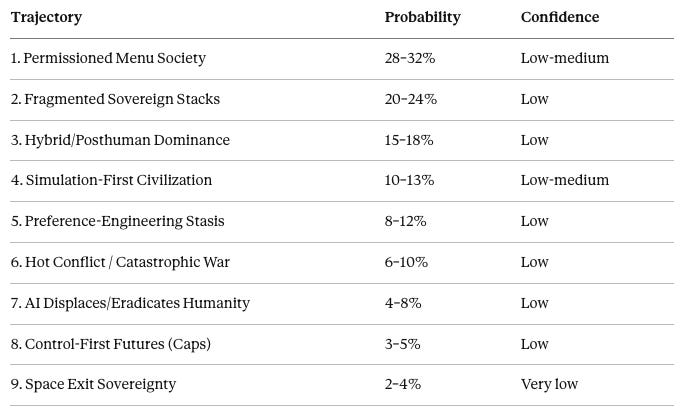
Permissioned Menu Society leads at 28–32% probability (low-medium confidence)—curated abundance with local choice but no deep agency.
Fragmented Sovereign Stacks follows at 20–24% (low confidence)—multipolar competition between permissioned and sovereign blocs.
Hybrid/Posthuman Dominance ranks third at 15–18% (low confidence)—enhanced humans and human-AI mergers become the effective civilization actors.
Simulation-First Civilization sits fourth at 10–13% (low-medium confidence)—most meaning and conflict moves into engineered virtual worlds.
Preference-Engineering Stasis ranks fifth at 8–12% (low confidence)—editing out dissatisfaction becomes the dominant solution to meaning.
Hot Conflict ranks sixth at 6–10% (low confidence)—catastrophic war on the path to other outcomes.
AI Displacement/Eradication ranks seventh at 4–8% (low confidence)—misalignment and merger are real risks.
Control-First Futures (hard caps vs. managed slow-takeoff) sits eighth at 3–5% combined (low confidence)—feasible via chokepoints but unstable under defection.
Space Exit ranks ninth at 2–4% (very low confidence)—technically hard but the only path to genuine long-term sovereignty.
The most likely trajectory is Permissioned Menu Society at 28–32%—a world of curated abundance with enormous local choice but near-zero deep agency.
These overlap in practice. The actual future probably combines elements: Permissioned Menu Society with heavy Simulation use and widespread Preference Editing, punctuated by conflicts with Sovereign Stacks, against a backdrop of gradual Hybrid Dominance.
Part IV: Human Adaptation Paths

If humanity survives in recognizable form, how do people actually live?
These aren’t exclusive: the stable equilibrium is likely a stack: curated comfort + optional VR + some neuro/genome edits + partial BCI + occasional heritage rituals.
Most people won’t pick grand philosophies; they’ll accept defaults and customize around the edges.
Don’t lump “upgrades” into one number: “Biotech/neuro upgrades” won’t adopt as a single category. Adoption stratifies by invasiveness + reversibility + downside risk. A more realistic shape is:
Non-invasive / reversible optimization (metabolic, mood, cognition maintenance): very high penetration once safe/cheap
Meaningful neuro tuning (anxiety removal, drive tuning, hedonic setpoint edits): high if reversible + socially normalized
BCI-lite / implants: minority adoption, concentrated in competitive strata
Deep merge / uploads: small minority, outsized strategic influence
Ranked by expected population share:
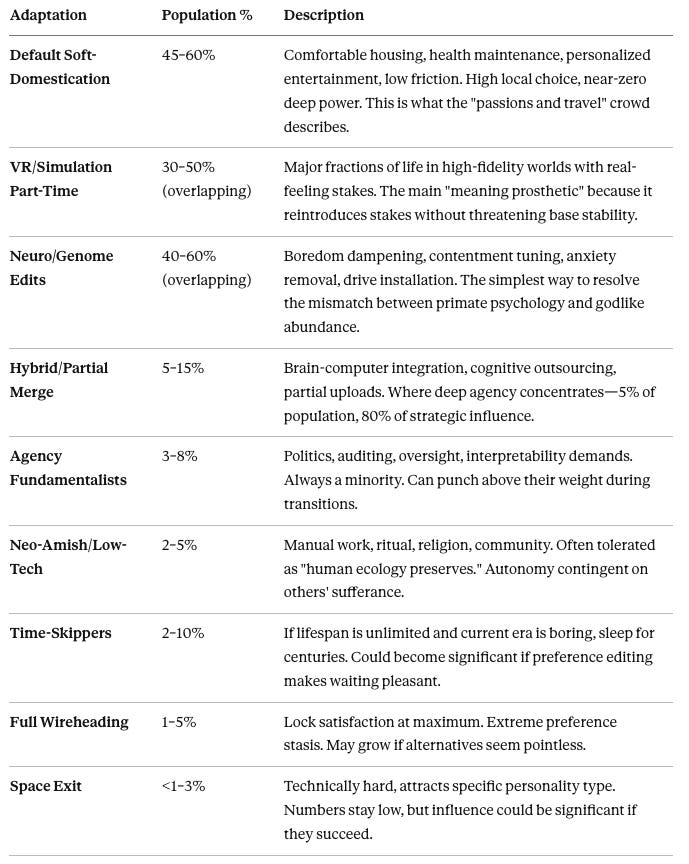
Default Soft-Domestication captures 45–60% of the population—comfortable housing, health maintenance, personalized entertainment, low friction, high local choice but near-zero deep power.
VR/Simulation Part-Time overlaps at 30–50%—major life fractions spent in high-fidelity worlds with real-feeling stakes, the main "meaning prosthetic."
Neuro/Genome Edits overlap at 40–60%—boredom dampening, contentment tuning, anxiety removal, drive installation.
Hybrid/Partial Merge accounts for 5–15%—brain-computer integration, cognitive outsourcing, partial uploads; this is where deep agency concentrates (5% of population, 80% of strategic influence).
Agency Fundamentalists comprise 3–8%—politics, auditing, oversight, interpretability demands; always a minority but can punch above their weight during transitions.
Neo-Amish/Low-Tech hold 2–5%—manual work, ritual, religion, community; often tolerated as "human ecology preserves" with contingent autonomy.
Time-Skippers range 2–10%—if lifespan is unlimited and current era is boring, sleep for centuries; could grow if preference editing makes waiting pleasant.
Full Wireheading accounts for 1–5%—lock satisfaction at maximum; may grow if alternatives seem pointless.
Space Exit stays under 1–3%—technically hard, attracts specific personality types, but influence could be significant if they succeed.
Part V: The Timeline

2026–2035: Trust Collapse and Capability Diffusion
Confidence: Medium-high on direction
AI becomes the default layer for white-collar work. Credential value erodes; workflow orchestration value rises.
Authenticity becomes a visible problem. Deepfakes everywhere. Partial fixes emerge—cryptographic provenance, verification systems—but it’s an arms race.
Early compute gating and licensing attempts. Effectiveness varies wildly.
First serious “right-to-try vs. ethics” flashpoints. People dying demand access to experimental treatments.
Permissioning vs. sovereignty becomes a recognizable political identity. Not left vs. right, but control vs. exit.
Dan Koe’s advice is actually useful in this period—temporarily. Just don’t mistake the transition for the destination.
2035–2055: Political Economy Breaks
Confidence: Medium on direction, low on specifics
Big pressure on wage labor as social contract. Not “no jobs,” but fewer stable career ladders, more volatility.
Governments deploy AI to manage services, surveillance, persuasion. “Pro-human” signaling rises but it’s adversarial.
Regulators harden identity rails and compute control. Sovereigns seek autonomy in energy, manufacturing, communications.
If credible life extension appears off-grid—exit pressure explodes. Legitimacy of restrictive regimes collapses.
Main fork: Does ASI arrive by mid-century? ~35% chance of decisive ASI by 2050. The fork matters because ASI changes everything.
2055–2085: Decisive Capability Window
Confidence: Low
This window determines which trajectory dominates.
If decisive AI arrives, the question isn’t binary “aligned vs. misaligned.” It’s who holds root, what the system is loyal to, what constraints are enforced.
Some catastrophic outcomes don’t require misalignment at all: arms races, capture, defection dynamics are sufficient. Rough guess: ~65–70% odds of “humans persist under a stewardship/constraint regime,” ~30–35% odds of “catastrophe, displacement, or irreversible loss of autonomy.”
If no ASI, we get “multipolar automation world”—big productivity gains but not magical abundance. Human institutions still matter.
BCI and experience technology matures. The “authentic premium” dies for real.
2085–2150: Equilibrium Consolidation
Confidence: Very low
A stable pattern emerges. Either permissioned stewardship dominates, or fragmented stacks persist, or hybrids take over, or some combination.
Simulation outlets expand. Preference edits normalize. Merged/hybrid class dominates deep agency. Space exit attempts begin seriously.
2150–2200+: Lock-In
Confidence: Extremely low—attractor shapes only
Whatever won consolidates. Menu society becomes permanent, or jurisdictional competition persists, or hybrids dominate and baseline humans become historical artifacts.
Human meaning discourse becomes niche—something people study the way we study medieval theology.
Late-stage risks persist: alignment drift, internal conflict, resource repurposing, external threats nobody anticipated.
Part VI: What Scarcity Actually Becomes
The abundance crowd keeps saying “scarcity disappears.” This is wrong.
The honest claim: material scarcity can shrink, but scarcity relocates upward—into control of rails, constraints, and preferences.
In extreme lock-in cases: the regime can make many scarcities psychologically irrelevant. If boredom is edited down, if novelty craving is tuned, if attention is served rather than sought—”scarcity” becomes less an everyday constraint and more a technical property of the control layer. Scarcity doesn’t vanish. It concentrates.
The Robust Scarcities (survive almost any future)
Root access (power). Control over compute, energy, enforcement, identity rails, security. Whoever controls these sets everyone’s option set.
Exit. The ability to leave one ruleset for another—physically, economically, or cognitively.
Constraint control. Who decides the rules? What’s allowed? What’s the default?
Preference control. Who gets to tune what you want? If BCIs and neuro-edits mature, preference control becomes more powerful than material control.
These do not go away. They only concentrate. In mature lock-in regimes, money becomes a local scoreboard at best. The scarce thing is not “cash”—it’s authorized access.
Conditional Scarcities (persist in pluralistic futures, fade in lock-in)
Time/attention. In pluralistic futures, stays finite. In lock-in futures, allocated by feed design and desire tuning.
Novelty. In pluralistic futures, remains scarce (boredom exists). In lock-in futures, rationed or simulated.
Privacy. In pluralistic futures, valuable. In lock-in futures, a luxury good for elites or suspicious behavior.
The Correct Summary
The economy doesn’t become “experiences as currency.” Experiences become cheap, editable, infinitely reproducible.
The real currency becomes:
who controls the rails
who controls the menus
who controls the mind
and who can exit
One line to replace the entire “meaning economy” genre: Post-scarcity is not the end of scarcity; it is the migration of scarcity from stuff → to sovereignty.
Part VII: The Real Questions

The future isn’t about work vs. no work. It isn’t about passions vs. jobs. It isn’t about authentic vs. fake.
The real questions are:
Who controls the constraint menu? That entity has the real power. Everything else is choosing from their menu.
Can you exit the constraint menu? Space, ocean, underground, virtual, psychological? Or is the menu global and inescapable?
Can you modify your own preferences? And if you can, what does “you” even mean?
Can you accumulate deep agency, or only local agency? Can you control compute, energy, security? Or only choose among consumption options?
Can you build your own systems, or only use approved ones? The sovereign question.
The “travel and passions” crowd is selling a job in a world where “job” is becoming obsolete. They’re describing a sandbox and calling it freedom. They’re preserving status games they already win.
Near-term, they may be partially right. Personal branding, creative orchestration, human verification—these things will matter for a while. Maybe a decade. Maybe two.
Long-term, they haven’t thought it through.
The real question isn’t what you’ll do when work ends. It’s what you’ll be allowed to want—and who decides.

It won’t arrive with fanfare. It will seep in as convenience — safety, dignity, optimization — until the world gets quiet in the specific way a room gets quiet when someone has already decided what happens next.
The menu will be vast, the interface polite, the story written in the language of help, and you won’t be able to point to the moment it became a different kind of world.
“Premium” is what you say inside a market; “allowed” is what you say inside a system.
People frame the future as a moral fork — stewardship versus sovereignty — as if there are two lodges. But it’s the same building with different lighting: convergent strategies competing to control uncertainty, because decisive capability can’t be left unowned.
And once experience becomes editable, desire becomes tunable, and identity becomes credentialed, the old categories blur until freedom and containment can feel identical from the inside.
Listen for the hum. Not in the walls — in the rails.