

Donald Trump is selling his Ukraine policy with 4 simple promises:
“I’ll end the war very quickly.”
“We’ll stop sending money.”
“We’ll avoid World War III.”
“We’ll finally put America First.”
Underneath the slogans, there really is a plan: an original 28‑point “peace framework” now cut down to 19 points after emergency talks with Ukrainians and Europeans in Geneva. (FT)
We now know something else: that original plan was heavily shaped by a Russian “non‑paper” drafted by Kirill Dmitriev, a Kremlin‑linked financier, and carried into the Trump system by Trump envoy Steve Witkoff. (Reuters)
A leaked Witkoff call shows him literally coaching Putin aide Yuri Ushakov on:
What territory Russia should demand (“Donetsk and maybe a land swap”)
How to flatter Trump as a “man of peace” so he’ll embrace it (Meduza)
So: Russia helped write the script, Trump branded it as “America First,” and is now desperate to deliver a “historic deal” that proves he kept his promise to “end the war in 24 hours” – a promise he’s since tried to reframe as “a little bit sarcastic,” but which his base and the media haven’t forgotten.
That mix: Russian input, Trump’s ego, and a grinding war, is exactly where something I’ve dubbed the Perfidy Loop shows up.
I believe Putin has been attempting the Perfidy Loop strategy the entire time… the magnitude of his success may not be significant, but the payoff could still be significant if Trump takes the bait.
1. The Perfidy Loop, in Plain English
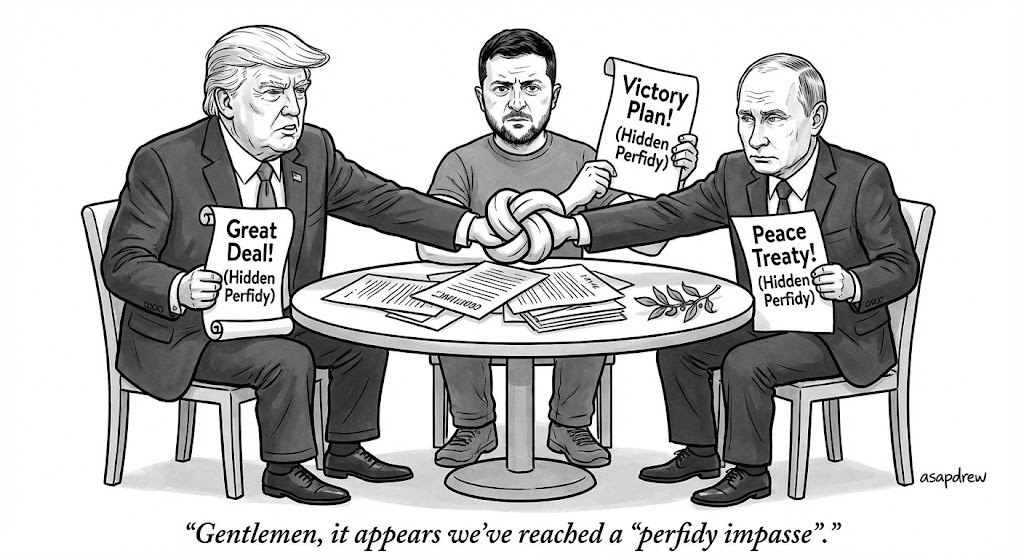
Perfidy (definition): In the context of war, perfidy is a form of deceptive tactic where one side pretends to act in good faith, such as signaling a truce (e.g., raising a white flag), but does so with the deliberate intention of breaking that promise. The goal is to trick the enemy into lowering its guard, such as stepping out of cover to accept a supposed surrender, only to exploit its vulnerability.
The Perfidy Loop is a repeatable con designed for an optimistic opponent:
Suck Up (Hoovering): Flatter the other leader, praise his “historic” plan, hint that peace is close.
Pullback: The mark (here, Trump) relaxes pressure: pauses weapons, delays decisions, leans on the weaker party (Ukraine) to compromise.
Defection (Theft): While the pressure is off, you keep attacking and grab what you can on the battlefield.
Gaslight & Reset (DARVO): When the mark gets angry, you Deny, Attack, Reverse Victim and Offender (DARVO): “We didn’t break the deal, they did. We’re reasonable; Ukraine is extremist.” Then you offer a “new opening” for peace…and spin the loop again.
The point isn’t one big decisive betrayal; it’s to buy time and incremental advantages every time the other side gets starry‑eyed about peace.
This pattern fits a lot of Russia’s behavior since 2014 (Minsk, “ceasefires” used to rearm). In 2025, for the first time, it’s wired directly into a US‑branded peace plan.
2. How Trump’s Peace Plan Was Built (and Why It Looks So Russian)
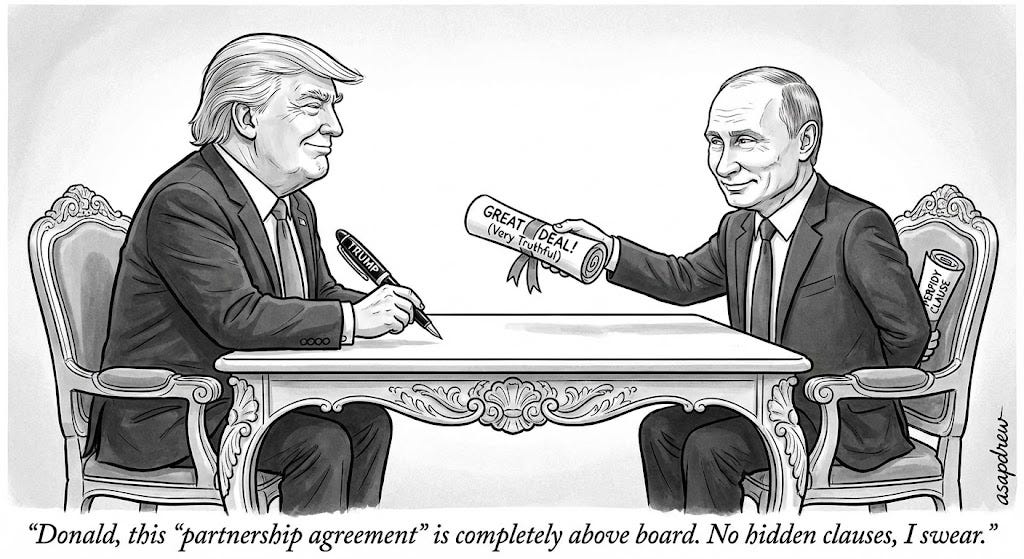
Step 1: The “non‑paper” from Moscow
In late 2025, Reuters and Kyiv‑based outlets reported that the original 28‑point US peace plan relied heavily on a Russian non‑paper drafted by Kirill Dmitriev, head of Russia’s sovereign wealth fund and a close Putin ally.
According to those reports and analyses of leaked transcripts:
Dmitriev wrote down Moscow’s ideal end‑state:
Ukraine recognises Russian control of Crimea, Luhansk, Donetsk – including areas still held by Ukraine.
Ukraine renounces NATO membership and bars Western troops/bases.
Ukraine accepts a cap on its armed forces (initially ~600,000).
Sanctions are phased out as Russia “complies,” and frozen Russian assets help fund reconstruction and joint US‑Russia projects.
Dmitriev said openly in those calls that the idea was to hand this to the Americans so they could “present it as their own” and keep it “as close as possible” to the Russian version.
Step 2: Witkoff as the go‑between and “coach”
A leaked transcript of the Witkoff–Ushakov call fills in the rest:
Witkoff tells Ushakov:
“I know what it’s going to take to get a peace deal done: Donetsk and maybe a land swap.”
He explains how to talk to Trump:
Praise Trump’s Gaza peace efforts.
Call him a “man of peace.”
Frame the Dmitriev‑type ideas as Trump’s plan, not Russia’s.
He pitches a 20‑point outline that maps neatly onto what later appears as the 28‑point US peace plan.
By November, Reuters, Sky News and others are reporting that US senators briefed on the document called it effectively a “Russian wish list.”
The original plan’s core elements:
Territory
Recognise Russian control of Crimea, Luhansk, Donetsk – including Ukrainian‑held parts of Donetsk.
Freeze front lines in Kherson and Zaporizhzhia where Russia currently sits.
Ukraine’s status
Amend the Ukrainian constitution to renounce NATO forever.
No NATO troops or bases on Ukrainian soil in peacetime.
Forces
Cap Ukraine’s army at 600,000 troops in peacetime (no matching cap on Russia).
Economics
Use ~$100B in frozen Russian assets plus matching Western money in reconstruction funds.
Phase out sanctions and open the door for G8 return and joint ventures.
That’s not just “not neutral”; it’s basically Dmitriev’s non‑paper with an American cover page.
3. Trump’s Psychology: Recency, Nobel, and “Promises Kept”
This only works because Trump is unusually vulnerable to this kind of play.
“Last person in the room” + recency bias
For years, former aides and analysts have described Trump as highly influenced by whoever spoke to him last, especially on complex issues he hasn’t fully internalized.
You can see that in microcosm during August 2025:
Alaska summit (Trump + Putin) – Putin leaves with the sense Trump is open to:
Freezing lines close to current Russian positions,
NATO block for Ukraine,
Troop caps, etc.
Three days later: White House summit (Trump + Zelensky + EU leaders) – surrounded by Europeans, Trump suddenly talks much more about:
Strong Ukrainian post‑war forces
Serious security guarantees
Avoiding “peace through capitulation.”
Then he phones Putin again to pitch a follow‑up, and the cycle re‑starts.
That recency whiplash is exactly what both Putin and European leaders are racing to exploit.
The 24‑hour promise + Nobel fixation
On top of that, Trump has:
Repeatedly promised he’d “end the war in 24 hours”, made it a campaign staple in 2023–24, and then had to retreat to “a bit sarcastic” once he was back in office and the war kept going.
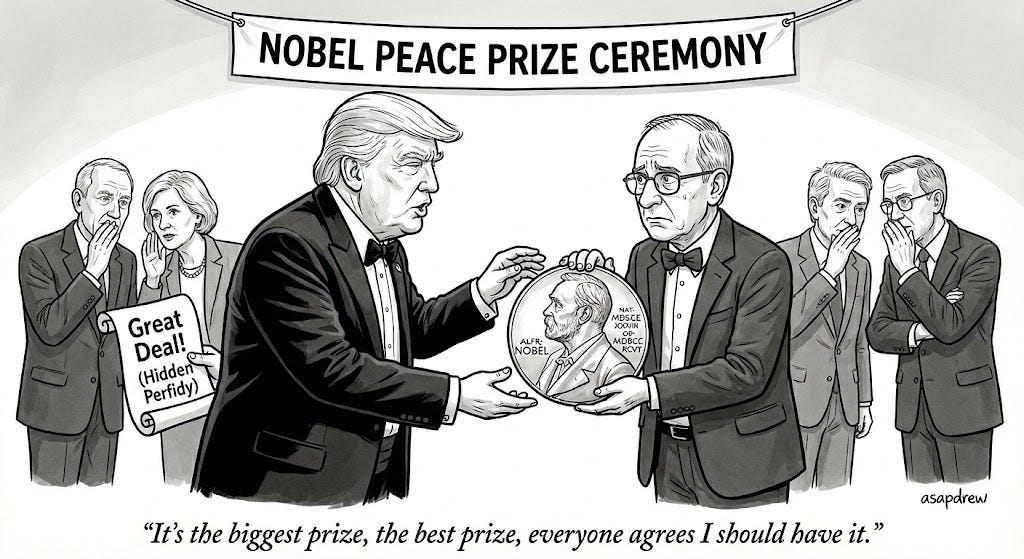
A long‑standing obsession with the Nobel Peace Prize and “legacy” status – something commentators, psychologists and even friendly outlets have pointed out for years. (Axios)
Ukrainian President Zelensky explicitly saying that if Trump delivers a ceasefire and advanced missiles (Tomahawks), “we will nominate him for the Nobel Peace Prize.” (Reuters)
That combo creates a structural vulnerability:
Trump needs some visible peace outcome to say “promises made, promises kept,” and he wants a Nobel‑level legacy moment.
Which means he’s unusually open to:
“Good faith” gestures that look Nobel‑ish (pauses, summits, generous talk).
Grand photo‑ops that can be sold as “historic peace.”
Perfect conditions for perfidy: he badly wants to believe there is a deal to be had if he just pushes hard enough.
4. The Perfidy Loop in 2025: Step‑by‑Step
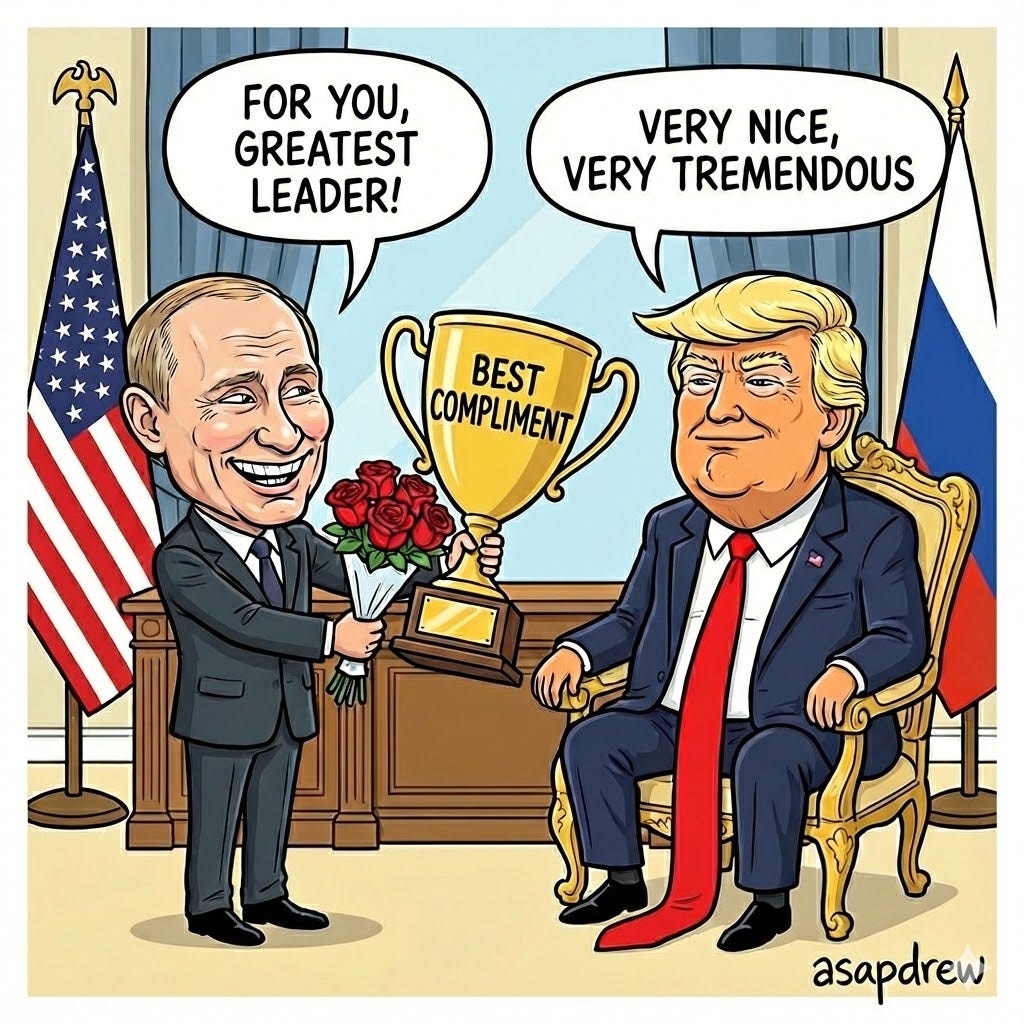
Phase 1: Suck Up (Make Trump the Hero of “His” Plan)
The strategy from Moscow’s side is almost insultingly straightforward:
Write down your maximal demands (Dmitriev’s non‑paper).
Feed them through Witkoff so the US side turns them into an “American plan.”
Treat Trump as the indispensable peacemaker:
Praise the plan as “constructive” and a potential basis for settlement.
In public, Putin now describes the US–Ukraine text refined in Geneva as a “basis for future peace agreements” – while insisting it needs to reflect the Alaska “understandings,” which in his telling include Ukraine’s full withdrawal from Donetsk, Luhansk, Kherson and Zaporizhzhia and a NATO ban. (Reuters)
That framing:
Makes Trump feel validated (“my plan matters”)
Puts pressure on Ukraine and Europe (“even Putin says Trump’s plan is a basis”)
Plants the idea that any deviation from the original 28 points is the West backtracking
Phase 2: Pullback (Aid Pauses and Policy Wobbles)
You then aim to get some reduction in Western pressure (especially weapons deliveries) in the name of “good faith.”
2025 gives two key examples:
The March freeze. Earlier in the year, the Pentagon briefly froze all US military aid and intelligence sharing to Ukraine. Analysts at the Atlantic Council and elsewhere criticized it as a serious mistake that undercut US leverage and signaled disunity. (Atlantic Council)
The July “pause.” On July 1, Politico reported the Pentagon had halted shipments of a wide range of weapons, including PAC‑3 Patriot missiles, 155mm shells, GMLRS rockets, Hellfires, AIM‑7 Sparrows, Stingers and spare parts. (OSW)
Official rationale: The US needed to safeguard its own stockpiles. (PBS)
Real effect: Ukraine’s air defences and artillery supplies tightened just as Russia was ramping up strikes.
The Atlantic Council’s post‑mortem describes how this pause backfired politically:
It angered Congressional Republicans and Ukrainians. (Politico Pro)
After days of criticism and Russian escalation, Trump overrode the Pentagon and announced that weapons shipments would resume – and that he would “send more weapons” than before. (WYPR)
From Putin’s vantage point, though:
Even a brief pause is useful.
It signals that US support isn’t automatic.
It creates a temporary window where Ukrainian defenses are weaker.
He doesn’t care why the pause happened; he just uses it.
Phase 3: Defection (Keep Grinding on the Battlefield)
Throughout all the peace talk, Russia never stops attacking.
Russia Matters’ “war report card” shows:
Since Jan 1, 2025, Russia has gained on average ~169 square miles of Ukrainian territory per month.
In the four weeks from Oct 28–Nov 25 alone, Russian forces gained 258 square miles.
Weekly gains oscillate (30–60 square miles) but trend upward when Ukrainian logistics are strained.
In the June 24–July 22 window (which overlaps the July pause), Russia captured about 180 square miles of additional territory – roughly the size of a large US county.
These aren’t war‑winning advances, but they add up, and they happen while:
Washington is arguing about stockpiles and peace plans, and
Trump’s team is floating deadlines and ceasefire schemes.
On the casualty side, Russia is paying a horrific price:
UK Defense Intelligence and independent tallies estimate over 1.1 million Russian soldiers killed or wounded by late 2025. (Wikipedia)
Ukrainian losses are also enormous — roughly 400,000 killed or injured by one composite estimate, with 46–80k killed and hundreds of thousands wounded according to Ukrainian and Western sources.
So the Perfidy Loop doesn’t cancel the attrition; it just tries to tilt the attrition slightly by exploiting Western hesitation.
Phase 4: Gaslight & Reset (“We’re reasonable, they’re sabotaging peace”)
When pauses end or pressure resumes, the Kremlin doesn’t say “we tried to scam you.” It says:
The West and Ukraine are torpedoing peace.
Russia welcomed Trump’s plan; it’s Kyiv and Europe who are “maximalist.”
The current messaging:
Putin calls the revised US–Ukraine text a “basis for future agreements” – but:
Demands Ukraine withdraw from all territory Russia claims in Donetsk, Luhansk, Kherson, Zaporizhzhia
Insists Ukraine renounce NATO and Western forces
Labels Ukraine’s leadership “illegitimate”
Then he invites further talks, welcomes Witkoff’s visit to Moscow, and suggests Russia is open to “constructive” discussion – all while continuing the offensive.
Meanwhile, the loop resets:
A new “refined” 19‑point version appears from Geneva, with higher troop caps and softer language.
Europeans float a counter‑proposal starting from current front lines rather than pre‑labelled “Russian” regions. (Newsweek)
Putin cherry‑picks the bits he likes and threatens to keep fighting until his terms are met.
And so on.
5. What’s in It for Putin? Risk vs Reward
Potential Rewards if the Loop Works
If you zoom out from the specific 28‑point text, the Frage für Putin isn’t “can I get this exact plan signed?” It’s:
“Can I use Trump’s ego + Western war‑weariness to change the basic maths of this war in my favour?”
There are several different levels of payoff he might be chasing — and different risks baked into each.
Level 1: The “jackpot treaty” (formal win on paper)
This is the maximal dream scenario everyone fixates on.
A Trump‑branded treaty locks in:
Russian control of Crimea, Luhansk, Donetsk (and maybe more in the south).
A permanent NATO ban for Ukraine and bans on Western bases.
A hard cap on Ukraine’s armed forces.
A sequenced path to sanctions relief and economic reintegration, including access to frozen assets via “reconstruction” funds.
In that world, Putin gets:
More land than he has actually conquered.
A structurally weaker neighbor that can’t ever join NATO and has to live with Russia’s shadow.
Help from his enemies to rebuild the Russian economy after his war.
This is the scenario the 28‑point plan was trying to engineer. It’s also the one that’s now clearly running into the most resistance from Ukraine and Europe.
Level 2: The “failed deal that still works” (US pullback without a treaty)
There’s a darker, more subtle payoff that doesn’t require any treaty at all.
In this branch, the Perfidy Loop “succeeds” if it eventually produces:
Maximum frustration in Trump.
He keeps being told there is a “historic peace” within reach if only “both sides” compromise.
He leans harder and harder on Kyiv and NATO/EU to accept a lopsided plan.
Ukraine and key European capitals keep saying: no, that’s capitulation.
A narrative flip in Trump’s head.
Instead of seeing Putin as the main obstacle, he starts framing Ukraine and Europe as the ones “blocking peace” and making him “look weak.”
A US pullback from Ukraine even without a signed deal.
To prove he’s serious, Trump freezes or winds down US aid: fewer munitions, slower air‑defense resupply, less budget support.
He sells it as “no more blank cheques” or “time for Europe to handle their own backyard.”
From Putin’s perspective, that’s a win even if every formal peace plan dies in Brussels.
Ukraine is still heavily dependent on U.S. munitions, air defences, ISR and financial backstops. Europe is ramping up, but it can’t instantly replace Washington across the board.
A sharp U.S. pullback creates at least a temporary window where:
Ukraine’s skies are thinner.
Its artillery fires less.
Its budget is under severe strain.
In that window, Russia can:
Intensify strikes on power, logistics, and cities.
Push harder along critical sections of the front.
Try to break Ukrainian morale or force a much worse “peace” at gunpoint later.
The nightmare outcome here isn’t Trump and Putin shaking hands over a signed surrender. It’s:
Trump fails to get his peace‑prize moment, blames Kyiv and Brussels, walks away — and in the gap before Europe can fully backfill, Ukraine gets mauled.
That’s a real potential payoff of the Perfidy Loop: not a treaty, but induced abandonment.
Level 3: Negotiation drift and Western division (medium payoff)
Even short of those “jackpot” scenarios, the loop has intermediate benefits:
Shift the negotiating baseline. If your non‑paper becomes the first draft of the U.S. plan, you’ve already moved the Overton window: things that used to be unthinkable (600k troop cap, permanent NATO ban, built‑in territorial losses) suddenly appear as “starting points.”
Exacerbate allied splits. Washington pressuring Kyiv to “be realistic” while Berlin/Warsaw/London say “no peace through capitulation” is exactly the kind of intra‑Western friction Moscow likes. Even if the alliance holds, the constant tug‑of‑war burns time and political capital.
Blur responsibility. The more Trump owns the plan as “America’s,” the easier it is for Moscow to say: “We’re just accepting what they proposed; it’s Ukraine and Europe who are sabotaging peace.”
That narrative doesn’t win wars, but it helps Russia with domestic audiences and some parts of the Global South.
Level 4: Minimum payoff (propaganda and time)
Even if none of the above really materialize, the Perfidy Loop is cheap and has some baseline value:
Domestic story:
“We are reasonable; we accept Trump’s fair plan; Zelensky is the extremist.”
Useful for keeping your own population on board during a long, expensive war.
Time and distraction:
Every week Western capitals spend arguing about draft clause 14 is a week they’re not fully focused on:
Accelerating ammo production
Tightening sanctions enforcement
Hardening NATO’s eastern flank
From the Kremlin’s point of view, a tactic that costs almost nothing and might occasionally buy you pauses, confusion and talking points is worth running — even if most iterations don’t produce big gains.
Given that the alternative is a grinding war that’s killing hundreds of thousands of Russians and costing ~7%+ of GDP a year in military spending, even a chance of that payoff makes the loop attractive.
Risks & Downsides
But the loop also carries significant potential downsides.
Exposure and backlash
Reuters, the FT, Meduza, Bloomberg and others have now documented the Russian origins of the plan and Witkoff’s “coaching” role.
US senators from both parties have come out of briefings calling it a Russian wish list.
That makes it politically harder for Trump, Rubio and others to ram through the most Russia‑friendly clauses.
Triggering ego backlash in Trump
July 2025 is a neat example: after the Pentagon pause and continued Russian attacks, Trump got more hawkish, publicly vowing to send more weapons and floating “very severe” tariffs and sanctions if Putin didn’t move toward a deal.
Hardening Ukrainian and European red lines
Ukrainian public opinion:
~52–54% firmly oppose any territorial concessions, up slightly in 2025. (kiis)
Around 38% say they’d consider some concessions in principle, but details matter a lot, and concession of currently free cities is deeply unpopular. (Kyiv Independent)
Europe:
Germany’s chancellor says explicitly, “We do not want peace through capitulation” and “Ukraine must not be forced to cede territory.”
The UK/France/Germany counter‑proposal deletes clauses recognizing Crimea/Donbas as Russian and raises the troop cap to 800,000.
The more obvious it becomes that Putin is using peace talk as cover, the harder it is politically for Kyiv or Europe to sign up to anything that smells like Minsk III.
No escape from attrition: Perfidy doesn’t stop casualties. Western and independent estimates still show Russia suffering over a million total casualties, with some analyses suggesting five Russian soldiers killed for every Ukrainian in 2025. Even if he gets an okay deal, Putin still ends up with:
A smaller, older population
A more China‑dependent economy
A NATO that has built Ukraine into a permanent, heavily armed outpost on its border
6. Has the Perfidy Loop Actually Worked, Compared to Just Grinding?
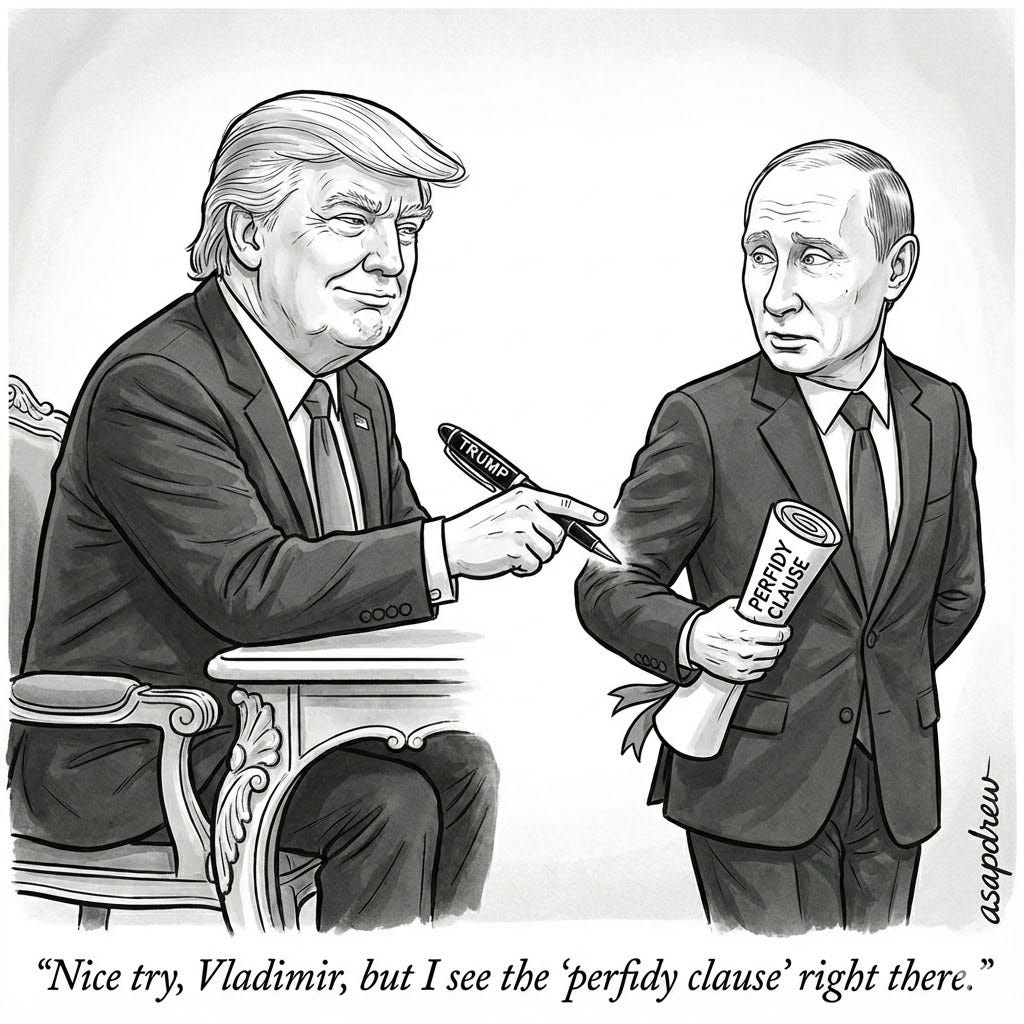
So, compared with a “no peace theatrics, just keep fighting and stonewall” strategy, has the Perfidy Loop been a win for Russia?
This is something to analyze because although it is clearly Putin’s strategic playbook, from my perspective the magnitude of benefit has been modest at best.
Tactical / battlefield advantage: small but real
The aid pauses (especially July) almost certainly made Ukrainian life harder at the margin:
Russia pressed offensives while Patriot/GMLRS shipments were frozen,
Ukrainian air defense and artillery timelines slipped.
Russian territorial gains in 2025 – averaging ~169 square miles per month – reflect a grinding offensive that might have gone a bit slower without those windows, but there’s no evidence of a clean “because of the pause, Russia took X city it otherwise couldn’t.” (Russia Matters)
In other words: the loop probably yielded incremental tactical benefit – slightly easier bombardment here, a bit more pressure there – but no decisive breakthroughs attributable purely to perfidy.
Diplomatic / narrative advantage: moderate, but contested
Here the loop did more:
Russia got its own non‑paper turned into a US‑branded 28‑point plan, anchoring early discussions around:
600k troop cap
NATO ban
Extensive territorial concessions
That forced Kyiv and Europe to fight uphill to remove or amend those clauses, rather than starting from a more balanced template.
But the backlash has eaten into that win:
The plan has been cut down to 19 points, with troop caps raised to around 800k and some of the worst language (an explicit war‑crimes amnesty, formal recognition of Russian annexations) reportedly stripped out or watered down.
European leaders have put their own counter‑text into the mix, explicitly rejecting forced concessions and formal recognition of occupied territory.
The loop shifted the starting point of negotiation in Russia’s favor, but the final outcome is now heavily contested.
Strategic balance: largely unchanged so far
The big picture has NOT been transformed from this loop.
Russia:
Holds roughly 19–20% of Ukraine
Still grinding forward at high cost
Absorbed staggering casualties and is stuck in a semi‑war economy
Ukraine:
Battered but still sovereign
Inching toward deeper EU integration
Being built into a long‑term armed outpost on NATO’s eastern flank
NATO/Europe:
Rearming faster than anyone thought politically possible in 2021,
are increasingly serious about using frozen Russian assets and bigger defense budgets. (The Guardian)
In that light, the Perfidy Loop looks less like a grand strategy and more like opportunistic nibbling layered on top of a war Russia is still paying heavily for.
7. Why Putin Will Keep Running the Loop Anyway
Given the mixed results, why doesn’t he just drop the pretense and go full “no talks, only war”?
Because from Putin’s perspective:
Cost of running the loop is low:
some flattering words
some PDF drafts
a few press conferences where he says he’s “open to peace”
Potential upside is huge: If Trump, Ukraine or Europe blink at the same time.
And Trump’s personal mix of:
Recency bias
“I’ll end it in 24 hours” promises
Nobel‑level legacy hunger
… means that each new iteration might be the one that gets Putin a breakthrough.
At the same time, everyone else has learned:
Zelensky and EU leaders now treat any “Putin is reasonable” moment as a five‑alarm fire, racing to get in the room next and reset Trump’s instincts.
European counter‑texts and Ukrainian public opinion make it harder and harder to sell a deal that looks like outright capitulation.
Putin stays running the loop
It has given him some marginal tactical and diplomatic benefits compared to a pure “no talk, just fight” strategy. But it has not, so far, changed the fundamentals:
Russia is still bleeding men and money
Ukraine is still standing
The West is still rearming
The war’s long‑term outcome will be decided more by artillery tubes, drones, industry and demography than by Steve Witkoff’s phone scripts