

Kevin Warsh gets one vote. The FOMC has twelve.
Knee-jerk commentary implies Warsh is about to rewrite U.S. monetary policy the moment he takes the chair (balance-sheet shrinkage, dovish pivots, the works).
Almost none of the coverage has grappled with the most important constraint in the entire story:
Right now, the FOMC does not appear aligned with Warsh’s stated desire for a meaningfully smaller Fed footprint / balance sheet — specifically slow net shrink: smaller total assets over time without destabilizing money markets.
So there’s no “regime change” unless Warsh can build a durable majority inside a FOMC that’s currently signaling “ample reserves first” and “wait-and-see” on cuts.
Trump announced Warsh as his pick to replace Jerome Powell when Powell’s chair term expires in May 2026.
TL;DR
Warsh can steer agenda, messaging, and coalition-building — but he still needs 6+ votes for rates and the balance sheet.
The first mechanical change is Miran out → Warsh in, which likely removes the committee’s loudest pro-cut pressure (so the “dovish revolution” narrative is often backwards).
“Net shrink” (smaller total assets) is the fight. The Fed’s current operating posture is “ample reserves first,” which makes net shrink difficult without plumbing/regulatory sequencing.
The market reaction that fits this reality: the front end barely moves, while curve shape / term premium risk rises.
The FOMC doesn’t work for the Fed Chair
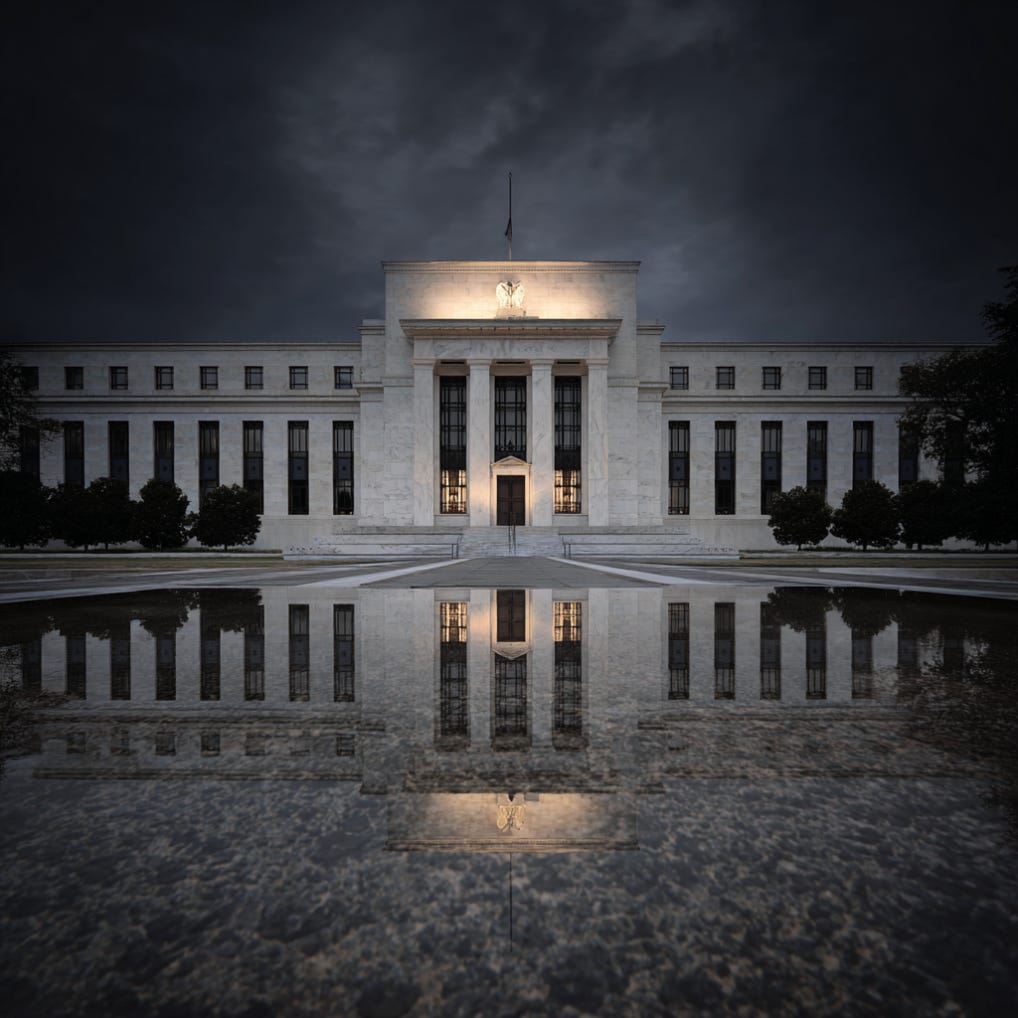
The Fed sets interest rates by majority vote: 7 Board of Governors members + the New York Fed president + 4 rotating regional bank presidents.
The chair runs the meeting, shapes the agenda, holds the press conferences, and builds coalitions. That’s major power and influence, but it isn’t a veto or a dictator’s podium.
At the January 28, 2026 meeting, the committee voted 10–2 to hold rates at 3.50%–3.75%. Only (1) Stephen Miran and (2) Christopher Waller dissented, both wanting a 25 basis point cut.
That’s a committee firmly in “wait and see” mode.
Also: Warsh’s historical record argues against ‘crusader chair’ fantasies. When he served as a Fed governor (2006–2011), he voted with the majority at every FOMC meeting and never dissented. That’s consistent with a consensus operator who works inside the median, not someone who turns the chair into a factional war.
Atlanta Fed President Raphael Bostic said publicly that Warsh faces a “tall task” winning trust and support inside the institution — and that he and colleagues oppose cuts this year.
This isn’t a FOMC waiting to get dog-walked by Warsh.
The Miran Swap
Apparently some were suggesting “Warsh = dovish revolution.”
Warsh is expected to enter the Board via the seat currently held by Miran, whose term expired January 31 and who’s still serving as a holdover. (If the confirmation of Warsh drags, Miran remains a voter for longer.)
Miran has publicly called for more than a full percentage point of cuts this year and he’s the most aggressive dove on the committee. Waller dissented for a single 25bp cut. Miran’s dissent was 25bp, but he’s been arguing for over 100bp of cuts through 2026.
So the initial mechanical effect of the Warsh transition is removing the loudest pro-cut voice on the FOMC and replacing him with someone described in coverage as inclined to favor lower rates but “well short” of the most aggressive easing associated with other possible nominees. (Warsh himself is a noisy signal: once hawkish-coded, lately dovish-coded).
Run it back turbo: The swap from Miran to Warsh could actually make front-loaded rate cuts less likely, not more. The opposite of what most surface-level analysis implies.
The Balance Sheet Fantasy
This isn’t just ancient Warsh lore.
2025: In a Wall Street Journal op-ed in November 2025, Warsh called the Fed’s balance sheet “bloated” and said it could “be reduced significantly.”
2026: In late January 2026, Warsh has called for an overhaul that would slim the balance sheet—arguing that shrinking it would let the Fed “redeploy” excess liquidity and lower its policy rate.
What “redeploy excess liquidity” means (his logic):
Warsh’s pitch is not “make markets risk-on.” It’s “shrink the Fed’s footprint.” In his framing, a very large balance sheet leaves too much cash warehoused in financial plumbing (reserves/money markets) and turns the Fed into a dominant player in pricing safe assets.
Operationally, that implies less cash parked in reserve/money-market plumbing earning administered rates (e.g., IORB) and more of the marginal adjustment pushed back into private markets.
By shrinking the balance sheet slowly, he thinks the Fed can rely less on balance-sheet support, reduce distortions, and use a lower policy rate to support the “real economy” (broad borrowing costs) rather than paying a large risk-free return inside money markets.
Is that sound, or a gamble?
It’s coherent as a philosophy: smaller Fed footprint, fewer QE-era distortions, cleaner pricing of safe assets.
It’s a gamble operationally: even slow net shrink shifts duration risk back onto private markets and can keep long yields sticky. And the FOMC’s revealed preference right now is “ample reserves first”—meaning they will choose plumbing stability over ideological footprint reduction.
He hasn’t published an explicit reserves target or implementation roadmap, and he’s acknowledged that a different rate management system “will take time” and “it’s not something that could or should be done overnight.”
And remember: (1) wanting and (2) doing are different animals, and the constraint here is the rest of the FOMC and general politics.
The Fed currently operates under an “ample reserves” framework. In plain terms: the Fed still holds a very large balance sheet — down from the ~$9T peak to about $6.6T by late 2025.
On the other side of that balance sheet sit bank reserves—cash that banks park at the Fed. The Fed controls short-term interest rates primarily by paying interest on those reserves (IORB) and by operating backstop facilities like the standing repo facility and the overnight reverse repo facility, rather than by constantly fiddling with the quantity of reserves the way it used to before 2008.
The problem with “just shrink it”: If reserves fall below what banks need to function comfortably, money markets start seizing up. We saw this in 2019 when repo rates spiked violently, forcing the Fed to intervene.
That’s why QT is now paired with an explicit shift to technical Treasury bill purchases to maintain ample reserves and prevent a repeat funding-market flare-up.
The January 2026 implementation directive is explicit: the Fed is authorized to buy Treasury bills as needed to maintain ample reserves. That’s the FOMC publicly choosing “ample reserves first” even if it requires bill purchases (the opposite revealed preference from a near-term net shrink).
There are 2 different “shrinks”: (1) composition (shift out of MBS, hold more bills, keep reserves ample—what the Fed is already doing) and (2) net shrink (smaller total assets over time without pushing reserves into scarcity). The fight is over net shrink.
That’s the pre-Warsh posture, but also the institutional default he’d be trying to unwind, and he’s explicitly said it would take time.
Warsh can give speeches about a smaller footprint until he’s hoarse. The operating system itself pushes back. And changing that operating system requires either (a) redesigning bank liquidity regulations and facility incentives—a multi-year project that needs Board-wide support—or (b) just running down reserves and hoping it doesn’t blow up.
And critically, balance sheet policy is FOMC-directed (it’s not a one-man show). If the committee says “No, we’re keeping reserves ample,” the chair can’t override that.
One area Warsh can influence without “winning the dot plot” is the credit channel — but not unilaterally.
As Chair of the Board of Governors he can set priorities, staffing, and messaging around supervision, but major regulatory shifts still require Board votes (and often interagency coordination), and day-to-day supervision is heavily shaped by the Vice Chair for Supervision.
The point: Even if the FOMC rate path barely changes, a bank-friendly supervisory posture can nudge credit conditions at the margin. Recent reporting explicitly links Warsh’s “regime change” pitch to both (1) slimming the balance sheet and (2) more bank-friendly supervisory stance.
A bank-friendly supervisory posture can support profitability and credit creation, but a too-fast or poorly timed net shrink can tighten liquidity and raise funding stress risk. Synergy only exists if shrink is slow and sequenced with plumbing changes.
One under-discussed offset is regulation: a more bank-friendly supervisory stance (capital/leverage constraints, dealer balance-sheet capacity) can make it easier for the private sector to absorb Treasuries and intermediate repo even if the Fed shrinks assets.
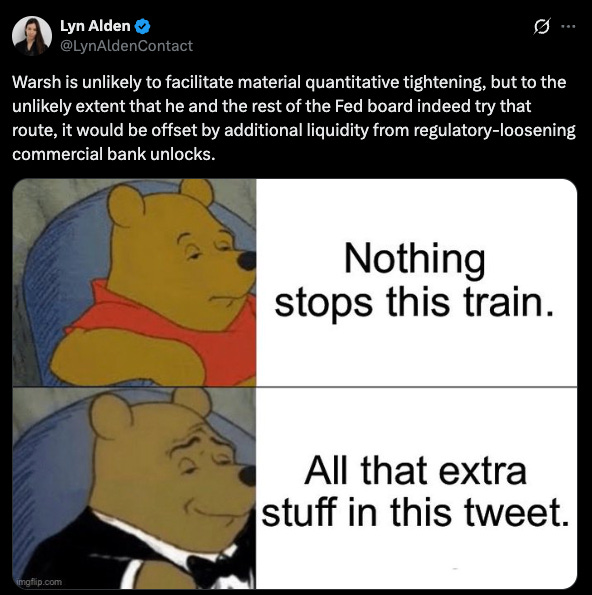
Lyn Alden’s point: Warsh is unlikely to facilitate material QT, and if he tries, some of it gets offset by “bank unlocks” — but “nothing stops this train.” If deficits and issuance keep ramping, the pressure shows up somewhere: higher term premium, more risk stuffed into bank/dealer balance sheets, or the backstop returning when something cracks.

Can Warsh sway the FOMC? (Odds)
Warsh only “changes policy” if he can get durable majorities. That means either (1) the data move the median anyway, or (2) he persuades members on the margin.
Rough estimate:
70%: Warsh doesn’t win net shrink. The committee keeps “ample reserves first” (bills if needed), and any balance-sheet change stays slow/conditional.
20%: Warsh nudges timing/messaging at the margin (esp. if his productivity thesis gets confirmed by ULC/core services/expectations).
10%: Warsh wins a major coalition for a multi-year redesign that eventually allows smaller reserves and a smaller balance sheet.
Key point: Powell didn’t “convince” the FOMC with rhetoric. The ample-reserves framework is the Fed’s post-crisis operating equilibrium reinforced by funding-market stress episodes. Talking them out of it is possible, but it’s a multi-year plumbing project, not a chair preference.
If Warsh got slow net shrink + cuts, what would it mean?
This is the ~10% scenario above wherein Warsh rallies a coalition within the FOMC to get on board with his slow shrink + cuts strategy.
Assume the Fed: (1) cuts somewhat (if inflation/ULC allow) while (2) also pursuing a slow, multi-year reduction in total assets that does not push reserves into scarcity.
Quick translation:
Short end = short-term rates (0–2y), anchored by policy-rate expectations.
Long end = long-term rates (10–30y).
Curve steepening = long rates stay higher (or fall less) than short rates.
Term premium = extra yield investors demand to hold long bonds due to inflation/deficit/policy uncertainty.
Duration = how sensitive a bond’s price is to yields (long bonds = high duration).
Most likely market effects:
Stickier long-end yields / higher term premium than otherwise, because private markets absorb more long-maturity risk over time.
Steeper curve bias: short rates can fall with cuts, while long rates don’t fall as much.
Asset-class map (if this slow shrink + some cuts regime happens):
US long bonds: headwind in this regime if long yields stay sticky / term premium rises.
High-multiple tech/growth: can still win on earnings, but higher/sticky long yields cap multiples.
Financials: tailwind if curve steepens without credit stress and funding markets stay calm.
Gold: mixed (higher real yields/stronger USD can pressure it; fiscal/credibility stress can support it).
Bitcoin: mixed (often likes easing/liquidity; can struggle in strong-USD / tighter-liquidity regimes).
Foreign vs US: often hinges on USD strength; strong USD can be a headwind to foreign returns in USD terms.
Tension at the Heart of the Trump-Warsh-Bessent Triangle
Trump wants lower borrowing costs. He’s been explicit about that. There’s a particular focus on long-term yields (the 10-year Treasury) because that’s what drives mortgage rates and most private borrowing costs.
Bessent, the Treasury Secretary, has pushed the same line: high rates are hurting housing, the administration wants them down.
But Warsh’s “signature idea” (shrinking the Fed balance sheet) would tend to: raise long-term yields, not lower them.
When the Fed steps back as a buyer and holder of Treasury duration, more supply hits private markets, which pushes up term premia and long-end yields.
Many investors are already positioning for exactly this — a steeper yield curve under a Warsh-led Fed, meaning the gap between short and long rates widens.
As Reuters put it: Warsh’s Fed “won’t be much help” on long yields.
So why would Trump pick a guy whose most distinctive policy preference works against what Trump says he wants?
Reporting suggests a few things: (1) Warsh was lobbied heavily by influential allies including Ron Lauder and Stanley Druckenmiller; (2) Warsh offers an intellectual justification for lower rates (the “productivity/AI disinflation” argument) without looking like a political puppet; (3) he has prior Fed experience and “looks like a central banker”; and (4) he aligns with the GOP’s broader deregulatory instincts.
But the fundamental tension remains. Shrinking the balance sheet tends to push term premium up and keep long yields stickier than they otherwise would be, which works against the lower-borrowing-costs goal at the long end (mortgages). You only get both if something else does the heavy lifting — and in Warsh’s framing, that “something else” is the AI productivity bet.
AI Productivity Bet: Can You Talk Your Way Into Lower Rates?
Warsh has explicitly argued that the Fed has underestimated the inflation-busting potential of productivity growth “supercharged by artificial intelligence.”
The logic, stripped to its core:
If output per hour rises fast enough, the economy can grow without generating inflation, because unit labor costs (hourly compensation divided by productivity) stay contained. Therefore the Fed can be less restrictive without risking price stability.
It’s not a crazy argument on its face. It’s literally how the late-1990s productivity boom played out. But there’s a critical difference between advancing a thesis and getting 12 FOMC voters to act on it.
A “productivity/AI disinflation” framing only buys Warsh influence if it actually shows up in the same real-time variables every FOMC member is already watching. Otherwise it’s just a story, and stories don’t get you votes for long.
What would “convincing data” actually mean in an FOMC meeting room?
He doesn’t need to prove a permanent productivity boom—that’s basically impossible in real time. He needs enough evidence to justify a risk-management tilt: “We can ease a bit sooner because the inflation risk is lower than it looks.”
The committee would look for multiple independent confirmations:
Unit labor costs. This is the cleanest cross-check because it directly bridges wages, productivity, and inflation pressure. If wages are solid but unit labor costs are cooling, that’s consistent with productivity absorbing wage growth. If unit labor costs stay hot, the committee says: “your productivity story isn’t showing up where it matters.”
Core inflation. Even if productivity is rising, the question is whether it’s actually showing up in prices. If core PCE and core services are sticky, productivity talk won’t justify easing.
Real activity strong without re-accelerating inflation. The committee tolerates strong growth only if inflation doesn’t reignite. Strong growth plus stubborn inflation kills the thesis.
Market-based and survey inflation expectations staying anchored. If long-run inflation expectations start drifting up, the Fed stops entertaining optimistic narratives, period.
If Warsh is behaving rationally, he won’t say: “productivity is definitely higher, therefore cut.” He’ll frame it conditionally: “We may be underestimating productivity; if so, policy is more restrictive than we think. We can move gradually and conditionally, and we’ll reverse if inflation doesn’t cooperate.”
He’ll tie the thesis to observable checkpoints.
But the bottom line is the same… if: ULC stays hot, core services inflation doesn’t cool, expectations drift — the committee outvotes him and he falls in line.
The alternative: A chair who repeatedly loses public votes and destroys the Fed’s signaling function (which is the chair’s most valuable tool).
An extra wrinkle: The “data-dependent Fed” is only as good as the data pipeline. Leadership turbulence at statistical agencies and occasional shutdown-driven release delays don’t prove manipulation, but they can widen error bars and increase the Fed’s reliance on triangulation (claims, private payrolls, inflation expectations, regional surveys). That makes it even harder for Warsh to sell a productivity-led easing thesis unless it shows up cleanly in downstream series like unit labor costs and core services inflation.
My lens: innovation vs. capital misallocation
I care about innovation rate, not CPI prints in isolation. The only coherent “innovation” argument for a smaller Fed footprint is capital allocation: abundant liquidity can make price signals noisy, push money into hype narratives, and set up boom/bust cycles where the bust maybe causes an innovation funding winter. Warsh’s bet is that a smaller footprint (done slowly) restores cleaner price discovery without triggering a plumbing crisis. Whether that improves innovation depends on execution: if it raises long yields too much, it can still choke off long-duration R&D.
The FOMC Won’t Flip By 2029
A common fantasy is that Warsh (or Trump via Warsh) will “reshape the FOMC.” The composition math doesn’t support this.
Board of Governors seats have 14-year staggered terms. The only governor seat clearly opening before 2030 (beyond the Miran slot Warsh is expected to fill) is Powell’s, which runs until January 31, 2028—and only if Powell actually leaves.
After that: Waller’s term ends in 2030, Barr’s in 2032, Bowman’s in 2034, Jefferson’s in 2036, Cook’s in 2038.
Reserve Bank presidents are also locked in: the Board reappointed most bank presidents for new 5-year terms beginning March 2026, running through early 2031. The only way to get rapid FOMC turnover is unexpected resignations or legally contested removals—and the Supreme Court appears skeptical of the administration’s attempt to remove Governor Lisa Cook.
So the “Warsh cronies take over” scenario requires a level of institutional disruption that courts and Senate confirmations make very slow, even if the White House wants it badly.
Powell Probably Stays in 2026
Powell’s chair term ends May 15, 2026. But his governor term runs until January 31, 2028. If he stays on the Board, he keeps voting on FOMC decisions. If he resigns, Trump gets to nominate a replacement.
The incentive structure is straightforward: leaving hands the administration an extra appointment during the most politically charged Fed transition in decades. Staying blocks it and signals institutional continuity. Multiple reports frame his decision as a strategic lever in the independence fight.
The last former chair to stay on as a governor after stepping down was Marriner Eccles, who held his Board seat from 1948 to 1951. It’s historically unusual. But this is an unusual moment.
My read: Powell stays on the Board at least through the end of 2026 (call it 65% odds), primarily because the alternative—handing over a vacancy—is strategically worse from an institutional-independence perspective.
Whether he sticks all the way to January 2028 is lower probability (~25% odds), but not implausible given the stakes.
The Warsh Confirmation Isn’t a Sure Thing
None of this happens if Warsh doesn’t get confirmed — and right now, the path isn’t clean.
Senate Democrats have asked to delay proceedings until DOJ investigations into Fed officials are closed. Senator Thom Tillis has threatened to block any Fed nominee until the Powell probe is resolved. In a 13-11 Republican committee, one GOP holdout can stall the process.
The “Powell probe” itself is a DOJ investigation connected to Powell’s testimony about Fed building renovations—sufficiently formal that it’s generating grand jury subpoenas and criminal indictment threats, but widely interpreted as political leverage by Democrats and some Republicans.
Senate Banking Chair Tim Scott has said he doesn’t believe Powell is a criminal, signaling intra-GOP discomfort with the probe being used this way. (I don’t believe Powell did anything wrong here either.)
Confirmation odds: Eventual confirmation sometime in 2026 looks probable (~75-80%), but the timing risk is real, and a confirmation by May 2026 is far from guaranteed.
So What Actually Changes with Warsh?
Strip away the noise and you’re left with this: the most likely outcome under Warsh is not a radically different fed funds rate path, because the FOMC constrains him. The actual deltas are:
More term premium sensitivity at the long end. Even talking about balance sheet shrinkage changes how markets price the Fed as a backstop buyer of duration. You don’t need action—the perception alone lifts term premia and steepens the curve.
More governance and communication volatility. The political backdrop—the probe, the confirmation fight, Trump’s public pressure—adds noise to the Fed’s reaction function. When markets can’t tell if the chair’s voice represents the median, volatility goes up.
Slightly different intellectual framing, same data dependency. Warsh may lean harder on productivity metrics and unit labor costs as justifications for easing. But if the data don’t cooperate, the framing is irrelevant. The committee votes its read of inflation and employment, not the chair’s narrative.
The market seems to understand this. Rate futures barely moved on the Warsh announcement—still pricing roughly two cuts in 2026, starting around mid-year. What moved was curve shape and term premium expectations, which is exactly the right response to “same front-end, more long-end uncertainty.”
Attribution error: Don’t blame Warsh for macro shifts he didn’t cause.
A lot of people are going to commit the same mistake in reverse:
Warsh arrived → volatility happened → Warsh caused it.
That’s usually nonsense. Rates, term premium, and risk assets move on deficits, inflation expectations, auctions, geopolitics, positioning, and growth data. Warsh gets credit/blame only if the move lines up with actual Fed actions (votes, directive language, balance sheet behavior) or a clear communication shift that changes financial conditions.
Ask yourself: Did the FOMC actually change anything? Or did the market reprice on its own for mostly orthogonal reasons?
Macro baseline (2026–2029)
Warsh isn’t the macro… the macro is the macro.
These scenarios are organized around the curve (front-end policy path vs long-end term premium), not around dramatic CPI regimes like hyperinflation/deflation.
In this framework, “fiscal dominance” mostly shows up as a sticky long end / higher term premium—one reason hard-asset people don’t care who the chair is.
It also implies a lower “Fed put” and more of a gradual print: the hurdle for outright QE is higher, so support shows up first through plumbing tools and targeted backstops rather than big balance-sheet expansion.
Base case (45%) — slow easing + sticky long end: The Fed trims the front end gradually if inflation/ULC cooperate, but the 10–30y stays sticky because deficits/term premium do the heavy lifting. That’s a built-in steepening bias even if the funds-rate path isn’t radically different.
Second case (30%) — term premium dominates: Cuts are fewer/later; long yields remain high because the market keeps demanding compensation for inflation/fiscal/governance risk. This is the “higher vol, steeper curve” state.
Recession / financial accident (20%): Big cuts + liquidity tools; Warsh’s preferences become irrelevant.
Geopolitical shock (5%): Case-by-case; mostly volatility and risk premia.
Warsh vs Powell inside this macro: The highest-probability delta is higher long-end / term premium uncertainty, not a new funds-rate regime.
If your strategy is “Warsh got nominated, therefore I must radically re-allocate,” you’re probably overtrading.
Probability-Weighted Warsh Impact to 2029
I’d frame the scenario space like this:
Warsh conforms to the committee median; policy is basically data-driven continuity (60%). Rates track inflation and employment data. Balance sheet stays in the ample reserves framework with modest plumbing adjustments. The difference from Powell is tone and curve positioning, not substance. This is the “same shit, different day” scenario — and it’s the most likely one.
Warsh nudges the margin on timing/messaging, but only with data cover (20%). If inflation and unit labor costs cooperate, his productivity framing gives some committee members permission to cut a meeting or two earlier than they otherwise would. The delta from Powell is real but small.
Messy signaling and higher volatility without real policy divergence (20%). Warsh pushes rhetoric that doesn’t match the committee’s center of gravity, producing more noisy term premium and steepening without actual policy change. This is the “markets don’t know who to listen to” period… it tends to resolve once the reaction function gets learned.
What To Watch
If you want a single watchlist that tells you whether the Warsh era will actually matter, it’s this:
Unit labor costs trend: The direct bridge between productivity and inflation pressure
Core services inflation trend: Where the Fed’s credibility fight lives
Long-run inflation expectations: If these drift up, every dovish thesis dies
FOMC rhetoric shifting from “inflation risks dominate” to “balance of risks”: The real tell that the median is moving
If those don’t move, neither will the committee. And if the committee doesn’t move, then the entire Warsh transition is a governance drama, not a monetary policy inflection point.
Kevin Warsh is: (1) walking into a FOMC that just voted 10–2 to hold, (2) likely to replace the most aggressive pro-cut vote on the way in, (3) facing a confirmation fight that could delay him past his own start date, (4) pushing a balance sheet agenda that the operating system resists, and (5) advancing a productivity thesis that requires real data cooperation from an economy that hasn’t fully provided it yet.
Same as it ever was.