

Everyone is betting that the 21st century is decided by whoever builds the smartest machine. That bet might be right, but it’s still a single-point failure.
China faces a structural constraint in frontier AI: access to the best chips, the tools that make them, and the supply chains that iterate them. If that constraint holds, then “catch up by trying harder” is not a strategy; it’s a hope.
There is, however, an orthogonal track that:
Doesn’t depend on EUV supply chains
Could compound back into AI capability through the human layer
The strategy: Aggressive bio‑enhancement alongside continued AI development.
The two flagship targets are straightforward to state even if difficult to execute:
Large, measurable cognitive gains (IQ upgrades: 50-100+ points)
Meaningful age reversal with maintenance (Prevent deaths + make people young again) (e.g. “Operation Senolysis”)
If AI progress stalls, a cognitively enhanced, longer‑lived population is itself a national force multiplier.
If AI accelerates, enhanced humans become better designers, operators, and safety managers of powerful systems.
Either way, the country that gets first credible human results gets leverage—and a data advantage that money alone can’t buy later.
China Is Locked Out of the AI Race

China is not merely “behind” in AI. China is structurally locked out of the frontier AI race at the hardware level.
The US-led semiconductor export control regime — anchored by restrictions on ASML EUV lithography equipment, Nvidia’s advanced GPUs, and TSMC foundry access — denies China the cutting-edge compute required to train and run frontier models.
China cannot buy the best chips.
China cannot buy the machines that make the best chips.
China cannot buy the machines that make the machines that make the best chips.
The technology denial runs layers deep.
China’s AI labs (DeepSeek, Baidu, Alibaba, etc.) can produce impressive results by optimizing for efficiency on inferior hardware, by distilling knowledge from frontier models, and by sheer engineering effort. But they are running on hardware that is generations behind what US labs access (I’d guess ~1-2 years behind). When each generation of frontier AI requires exponentially more compute, being locked out of cutting-edge silicon isn’t a gap you close through cleverness — it’s a structural ceiling that gets further away with each training run.
This is why bio‑enhancement is strategically interesting: It is not “another moonshot,” it’s a different axis of competition. The U.S. hardware edge does not directly transfer into human trials, biotech manufacturing scale, or deployment logistics. And if biological upgrades materially increase researcher output and career length, they feed back into the very domains export controls are trying to bottle up—chips, models, energy, and materials.
The Asymmetric Hedge (That Might Be More Than a Hedge)
Bio-enhancement is the strongest asymmetric hedge available against US AI dominance.
“Hedge” might undersell it. There’s a real possibility — not a certainty, but a non-trivial probability — that biological enhancement turns out to matter more than artificial intelligence for determining 21st-century power dynamics.
How would that be possible?
If AI stalls, slows, or disappoints: If energy constraints, data walls, alignment failures, regulation, etc. — simply doesn’t deliver the transformative impact people expect… bio-enhanced populations become the dominant force multiplier. A nation with millions of citizens operating at 200+ IQ with indefinite healthy lifespans doesn’t need AGI to dominate every domain of human endeavor. They are the superintelligence — distributed, embodied, and aligned with national interests by default.
If AI keeps accelerating: Bio-enhanced humans become the superior orchestrators. They design better chip architectures (feeding back into hardware despite export controls), write better training code, invent novel AI paradigms, and solve alignment problems that baseline humans can’t grasp. They manage AI risk with longer time horizons and deeper strategic reasoning. Bio-enhancement doesn’t compete with AI — it supercharges it.
Symbiosis runs deep and compounds in every direction:
Enhanced humans design better AI systems →
Better AI accelerates biological research →
Better biological research produces more enhanced humans →
Those humans design the next generation of AI hardware, software, manufacturing processes, and materials. Enhanced researchers with indefinite bio lifespans accumulate domain expertise no succession of 30-year careers can match. Everything feeds back into everything else.
The country that triggers this flywheel gains accelerating advantages across all domains simultaneously — not just biology, not just AI, but hardware design, energy systems, materials science, military strategy, cultural production, and every other field where cognitive capacity is the binding constraint.
This strategy improves China’s position regardless of whether AI accelerates or disappoints.
A Note on Strategic Alternatives

China’s current options for closing the gap with the US include:
Continued AI investment
Economic competition
Military modernization
Taking Taiwan (the stupidest idea)
Bio-enhancement is superior to all of these.
Invading Taiwan risks global war, economic catastrophe, semiconductor fab destruction (TSMC facilities would be sabotaged or rendered inoperable before China could use them), human capital losses on both sides, and permanent diplomatic isolation.
The military option is high-risk, high-cost, and the “prize” is fragile infrastructure that takes years to rebuild and requires ongoing Western equipment and expertise to operate.
Bio-enhancement creates endogenous capability that cannot be sanctioned, bombed, or embargoed.
You can’t export-control a population’s IQ or impose tariffs on neurons — and you can’t put a sanction on longevity. The capability lives inside the people — a strategic asset no external actor can take away.
And unlike a Taiwan invasion that turns the entire world against China, a longevity and cognitive enhancement program framed as “ending aging for humanity” generates soft power, not isolation.
For the cost of a single carrier group, China could fund the entire first generation of enhancement protocols for millions of citizens. The ROI comparison on anything else isn’t even close.
The Technology Pipeline: What This Actually Looks Like
Important note: Much of the underlying biology is real and rapidly advancing, but “population‑scale cognitive enhancement” and “large age reversal in humans” remain theoretical because nobody has seriously and smartly attempted it. Treat the pipeline as a strategic scenario built from plausible components—not a promise of specific timelines or magnitudes.
Sandbox → Lock-In → Iterate → Repeat Forever
Stage 1: Reversible Sandbox (circRNA / siRNA). Circular RNA and small interfering RNA temporarily express or silence any gene of interest. Express for days to weeks, then natural degradation. Want to test-drive upregulating myelination? Deliver as circRNA. Works with no problems? Proceed. Something goes wrong? Expression stops on its own. No permanent changes. This sandbox is what makes aggressive iteration safe — you can test anything without committing to anything.
Stage 2: Permanent Lock-In (base / prime editing). Once validated reversibly, lock it in using base editors (precise C→T or A→G single-nucleotide changes, no double-strand breaks) or prime editors (any small insertion, deletion, or substitution). Off-target rates approach detection limits with current high-fidelity variants (e.g., ABE8e, PE6) and improve with every generation. Each year brings new editor variants with better specificity and expanded targeting.
Stage 3: Delivery Keeps Improving. AAV (proven, one-shot). Anelloviruses (re-dosable indefinitely, immune-privileged). Lipid nanoparticles guided by focused ultrasound (targeted brain delivery). Engineered capsids (AAV-PHP.eB, TfR1-targeted variants for brain-wide transduction). Human artificial chromosomes (massive payloads). Sonogenetics (ultrasound-activated gene expression, no pills). Each generation more targeted, efficient, and re-dosable.
Then the cycle repeats forever. v1 teaches what works. v2 fixes what didn’t. v3 uses tools that didn’t exist when you started. v5 is designed by people enhanced by v4. v8 is designed by AI built by people enhanced by v6.
There is no terminal version. The editors improve, delivery improves, AI optimization improves, and the humans designing each version are cognitively superior to the previous design team.
This is why 50-100 IQ points is the starting line, not the finish. The ceiling rises with each iteration toward whatever the biological maximum turns out to be.
Age Reversal → Aging Elimination
The core science is proven in mammals. Ocampo et al. (2016, Cell) demonstrated partial cellular reprogramming via OSK (Oct4, Sox2, Klf4) extended lifespan 30% in progeria mice with no tumors.
Sinclair’s lab (2020, Nature) used OSK to restore vision in elderly mice by reversing epigenetic age. Multiple subsequent studies confirm: partial reprogramming reverses biological age at the cellular, tissue, and organismal level.
The early milestone is “reverse by 15-30 years.” The actual trajectory is elimination.
Once you can reverse aging at all, maintaining the reversal is periodic tune-ups: annual treatments using re-dosable vectors that refresh the epigenetic reset. Reverse once, maintain forever. The 75-year-old becomes biologically 40 and stays 40 indefinitely.
v1.0: AAV9, 10-15 year reversal, ~$400K.
v2.0: Anellovirus (re-dosable), 20-30 years, ~$180K.
v3.0+: Comprehensive payloads, routine maintenance.
v6.0-8.0: $18K-$5K. Eventually cheaper than managing the chronic diseases of aging it replaces.
Biological Superintelligence: Initial Boost +50-100 IQ, Ceiling Unknown
Target both somatic upgrades in adults and embryo selection + enegineering in babies.
Target major biological bottlenecks: Myelination speed, synaptic density/plasticity, neuronal energy supply, neurovascular capacity, neuromodulatory tone, volume management (pruning inefficient connections).
Pipeline: Organoid screening (personalized mini-brain from subject’s own cells, test before injection) → circRNA sandbox (2-4 weeks per module, reversible) → base/prime lock-in (only after validation) → AI-driven personalization (genotype-specific dosing, polygenic optimization) → multiplexed editing at scale (20-50+ variants per subject by v7.0+).
Current-generation designs: Median 48-60 IQ point gain, <0.2% mortality (comparable to general anesthesia). For China’s above-average baseline (~105 population mean, ~120-130 STEM-selected cohorts), early-version +50 produces 155-180 — levels that essentially don’t exist in the current human population at meaningful frequency.
Later versions push toward territory nobody has mapped. The enhanced humans designing v6, v7, v8 are smarter than the teams that designed v4 and v5. The ceiling keeps rising.
Inverse Prisoner’s Dilemma: Triggering a Bioenhancement Race is Ethical

Before discussing what happens when a country actually pursues bio-enhancement, the prior question:
Should anyone trigger this race?
The global status quo is mutual non-pursuit.
The U.S. won’t move due to FDA/IRB constraints, lawsuit culture, and woke “ethics” (even though all of this is causing far more death and suffering). (Read: Bioethicists are Unethical).
China hasn’t moved because it’s been a follower in biomedical innovation. China has a lot of high-impact incremental innovation, but China Lacks Zero to One Innovation. They are known for following, refining, optimizing + playing it safe and smart.
Russia talks longevity but lacks resources and is distracted by a war that was a massive unforced error. Everyone “cooperates” by not pursuing the upgrade.
This cooperation kills approximately 55 million people per year from aging-related causes. And that’s just aging. Think about all the people unable to live healthy / productive lives because they have serious diseases with zero effective treatment and/or they have an intellect that’s too low to function competitively in the modern world.
Hidden cost to the status quo: The Existential Hedge.
We are rushing to build Artificial Superintelligence (ASI) while human cognitive capacity remains flat. We do not know for sure if bio-enhanced humans can successfully manage an intelligence explosion. But we can be fairly certain that baseline humans—constrained by 100 IQ and slow biological processing—will have the lowest probability of doing so.
You cannot control, compete with, or even interpret systems you cannot understand. Stagnating at our current biological limits while creating digital gods increases the risk of total obsolescence.
Bio-enhancement is the only strategy that attempts to close the capacity gap. It offers the best possible “hedge” to potentially derisk the transition, ensuring we possess the raw cognitive horsepower to understand these systems and maintain our position in the hierarchy of intelligence.
This is an inverted prisoner’s dilemma:
Mutual “cooperation” (non-pursuit) is the worst outcome for humanity, and “defection” (aggressive pursuit by one actor) is the catalyst for global benefit.
Because the technology diffuses — through publication, espionage, medical tourism, reverse engineering, generic manufacturing, allied-nation adoption — the first mover’s breakthrough eventually reaches everyone.
The millions who would have died waiting for US regulatory paralysis to resolve instead gain access through the alternative pathway.
Triggering the race is the humanitarian move. It breaks the lethal equilibrium. Someone capable should start — for their own strategic benefit and for humanity’s.
The Actual Prisoner’s Dilemma: What Happens When a Country Does It

The Threat Matrix
Stage 1: China defects (2028-2032). Large-scale elderly age-reversal trials framed as compassionate care. “Saving grandparents. Extending productive lives of retired scientists and engineers.” Reversible cognitive pilots in research cohorts via circRNA. Nothing permanent until validated. The moral positioning is nearly unassailable.
Stage 2: Results emerge (2030-2035). Measurable biological age reversal in elderly (10-20 years by epigenetic clock). Transient cognitive gains confirmed by neuroimaging and psychometrics. Safety profiles comparable to existing gene therapies. Protocols begin leaking through every channel.
Stage 3: The perception amplifier fires. Many in the US national security establishment already believe China is pursuing aggressive bio-enhancement. Congressional testimonies, think tank papers on “cognitive warfare,” intelligence assessments about military-civil fusion in biotechnology — the paranoia infrastructure is pre-built.
This cuts both ways — and the second edge is sharper than the first. Yes, when real results eventually emerge, some hawks will say “we told you so.”
But the far more likely near-term effect is complacency, not alarm.
If the US establishment already assumes China is doing this, then China actually doing it doesn’t register as news.
There’s no Sputnik moment because everyone thinks the satellite has been up there for years.
Classified briefings saying “China is pursuing bio-enhancement” get filed alongside the ones they’ve been writing since 2018. The signal drowns in its own noise.
China gets years — possibly a decade — of operational cover simply because the US cried wolf to itself so many times that the real wolf doesn’t trigger a response.
Meanwhile, China’s domestic execution is frictionless in ways no democracy can match.
China is ethnically cohesive and culturally collectivist. The CCP frames national initiatives as being “for the greater good of the Chinese people” and the population follows. There’s no bioethics debate in the New York Times putting pressure on politicians. No congressional hearings or culture wars or class-action lawsuits.
The Party says “we are going to reverse aging in our elderly and enhance our scientists for the good of the nation,” and 1.4 billion people nod.
The collectivist framing that Westerners find alien is precisely what makes rapid, population-scale deployment feasible.
Dissent is not really an option.
IRB approval isn’t a bottleneck.
Public opinion is mostly irrelevant.
The program moves at the speed of institutional will, and in China, that speed can be very fast.
Stage 4: Other countries face forced choices — but most can’t respond.
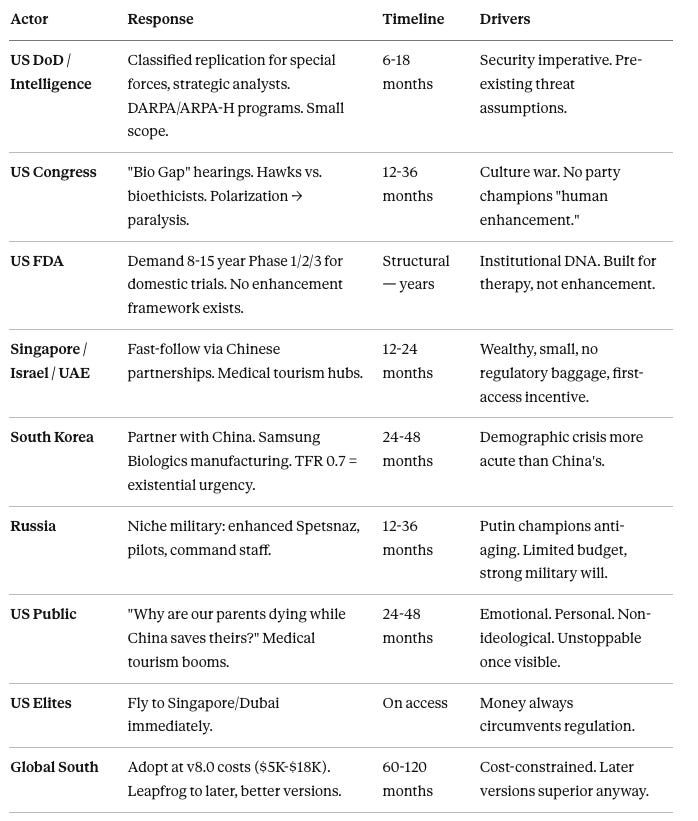
The critical asymmetry: fast-response actors (small nations, elites, military) move immediately. The actor whose broad response matters most (US federal government) is structurally paralyzed for a decade or more.
But look at this table more carefully and a deeper problem emerges: most of these “responses” aren’t real responses. The US DoD running a classified 200-person program isn’t competing with China enhancing 50 million citizens. Congressional hearings aren’t a technology program. The FDA demanding 8-15 years of trials would be a signal of defeat… there’s no plan in place.
A serious U.S. response would look like: (1) a fast‑track legal and regulatory pathway explicitly built for enhancement trials, (2) tens of billions in funding tied to recruiting and longitudinal follow‑up, and (3) political acceptance that early human programs may carry meaningful risk.
The fundamental problem is that bio-enhancement is not a technology you can develop theoretically or in simulation:
You have to test on humans.
There is no substitute for real-world clinical data from actual enhanced subjects and their: safety profiles, cognitive trajectories, long-term outcomes, and response variations across genotypes.
Every month China runs human trials and the US doesn’t, China accumulates irreplaceable data that the US would not be able to replicate by throwing money at the problem.
You can’t buy or classify your way past a big data gap.
You have to actually run the trials → inject humans with enhancement protocols → need the regulatory framework, political will, and cultural tolerance to do so.
The US has none of these.
The U.S. might try something like Ray Kurzweil’s “Digital Twins” and AI Drug Trials.
Singapore is a realistic secondary hub: it has world-class facilities, the HSA fast-track, and a proven AAV trial infrastructure. If China pursues this, Singapore almost certainly becomes involved in some ancillary or direct capacity.
UAE and Israel are plausible early adopters for their elites but lack the biotech depth for independent large-scale development; they’d be purchasing access, not building capability. Everyone else is even further behind.
Stage 5: The gap compounds. Every year China iterates while the US deliberates, the lead widens:
Enhanced researchers design better AI systems and hardware — closing the AI gap through the human layer, bypassing the chip embargo entirely
Enhanced scientists solve problems in energy, materials, and manufacturing that baseline teams can’t crack
Enhanced strategists optimize economic and military planning at levels baseline competitors can’t match
The bio-enhanced population maintains the same demographic profile associated with high national achievement — high average IQ, long productive careers, deep expertise accumulation — but amplified by orders of magnitude
The flywheel accelerates: bio → AI → hardware → software → manufacturing → bio → ...
Stage 6: The US eventually responds. It may be too late. A “Bio Moonshot Act” passes eventually. But the US starts v1.0 while China runs v6.0+. China has a decade of safety/efficacy data; the US has none. China’s manufacturing is scaled; the US is building from scratch. China’s enhanced workforce produces compounding returns; the US is treating first cohorts. The technology gap may close but the population-scale deployment gap and advantage gap may not.
Why This Constitutes a Civilizational Threat to the US
If China executes this and the US doesn’t respond seriously (the most likely outcome) — the implications compound into something the US has never faced:
China’s enhanced population designs around the hardware embargo. IQ 170+ engineers don’t need EUV lithography to innovate in semiconductor design — they find alternative fabrication approaches, novel computing substrates, or simply design more efficient architectures that extract more from less. The embargo becomes irrelevant.
China maintains (and amplifies) the demographic characteristics associated with civilizational success: high cognitive capacity, long productive lifespans, deep expertise, stable population — while the US faces its own demographic challenges with a baseline-human toolkit.
China achieves cultural dominance organically. Near-immortal, super-intelligent humans produce science, art, philosophy, and media at a quality baseline societies cannot match. The global brain drain reverses.
China frames the narrative: “We ended involuntary aging. We gave humanity the cognitive upgrade. While America debated ethics, we saved lives.” This is soft power that no military budget can counter.
And China is under no obligation to share any of it.
The technology may leak through various channels, but China controls the pace, the scope, and the terms. The US would have no leverage to demand access — especially after years of sanctions, export controls, and containment policy.
China could use bio-enhancement breakthroughs as leverage to secure the very hardware it’s currently denied — “lift the chip embargo, or your people keep dying of aging while ours don’t” is a bargaining position with emotional and political weight that no semiconductor export control can match.
The US public watching their parents deteriorate while Chinese elderly are being restored to biological youth creates domestic pressure that no CHIPS Act can withstand.
China could trade bio-tech access for HPC access, advanced lithography equipment, or foundry partnerships — flipping the entire leverage dynamic of the current technology cold war.
But the more devastating scenario is even simpler: China says nothing.
Radio silent. Just continued work. China quietly iterates on bio-enhancement while building its own AI hardware capabilities with an upgraded population.
Meanwhile, the US’s best researchers, engineers, and strategists continue aging out and dying on a biological clock that China has turned off for its own people.
The smartest Americans get Alzheimer’s at 70 vs. Chinese counterparts operating at 200 IQ with the biological age of 35.
Each year the talent gap would widen. Not because China would be doing anything aggressive externally, but because their cognitive capital wouldn’t degrade and they’d maintain the same foundational ethnically cohesive ethos — the U.S. would experience high turnover of its foundational White population and the extreme tails — slowly eroding in dominance organically due to new population demographics more aligned with Mexico.
Time becomes China’s ultimate weapon.
No backlash and an ever-widening gulf in human capital quality that eventually makes every other advantage (chips, models, capital markets, alliances) insufficient to compete.
Either way, the country that achieves bio-enhancement first holds a card that makes every other technology competition asymmetric in their favor.
The one variable that changes this calculus: ASI.
If the US appears to be approaching artificial superintelligence, the “say nothing and wait” strategy becomes dangerous — ASI could render the bio advantage irrelevant overnight. This is where the leverage play becomes urgent rather than optional.
If China senses the US is close to a genuine intelligence explosion, the rational move is to negotiate aggressively before the window closes: trade bio-tech access for AI/chip access, or use the bio bargaining chip to slow the US program through diplomatic channels, or accelerate their own AI development using enhanced researchers to close the gap before ASI arrives.
The bio breakthroughs give China a card they wouldn’t otherwise hold at the exact moment they’d need it most — when the AI race reaches its endgame. Without bio-enhancement, China has nothing to trade.
With it, they have leverage over the one thing the US and its allies will eventually want more than anything: the technology to stop their own people from dying.
Which countries might actually consider prioritizing bioenhancement?

These are conditional estimates: Probability of serious pursuit if they want to seriously compete for the 21st century. They are not claims that governments are already committed or even actively planning this path today.
1. China (35–50%, conditional). The only actor where demographic pressure, coordination capacity, and biotech depth all line up. A collapsing fertility rate (TFR: 1.0), a large aging population, and an existing gene‑editing and manufacturing ecosystem mean that, if leadership decides this is strategic, the machinery to execute already exists. The main uncertainty is political appetite for visible risk in a domain that would quickly become globally controversial.
2. Russia (15–25%, niche military only). Political leadership has signaled interest in anti‑aging, and the military culture tolerates risk more readily than Western forces. But war and sanctions severely constrain resources. The most realistic path is narrow: small elite programs—pilots, special forces, nuclear command—rather than broad civilian deployment.
3. UAE / Saudi Arabia (20–35%, as funders/hosts). Sovereign wealth removes cost constraints, and both states have a track record of funding prestige technology projects. They are more likely to act as financiers and hosts for teams and companies built elsewhere than to originate the core protocols themselves. Early adopters would almost certainly be elites rather than the general population. They could also test on immigrant populations willing to accept risk until things are refined.
4. Israel (20–30%, mostly on the security side). A deep biotech sector and tight civil–military integration make Israel technically capable of running aggressive pilots. At the same time, alliance ties to the U.S. and strong domestic bioethics institutions limit how far ahead of Western norms any overt civilian program can move. Quiet, small‑scale military or intelligence programs are more plausible than broad public deployment.
5. South Korea (15–25%). No country has a more acute demographic cliff, and the industrial base for biologics is strong. Yet the political system is consensus‑driven and culturally conservative about human modification. South Korea is more likely to move once a larger player has demonstrated safety and efficacy, rather than as the first mover.
6–8. Second‑tier probabilities. Singapore is a likely platform (regulatory and infrastructure hub) but an unlikely originator of high‑risk first‑generation protocols. Japan has the scientific base but extremely cautious adoption norms, implying long lags even after others move. The United States faces the opposite problem: strong science but regulatory, legal, and cultural structures that make a visible civilian enhancement program by 2035 only a 10–20% prospect.
The pattern remains: Urgency plus capability plus willingness to tolerate visible risk. China is the only actor where all three are even plausibly aligned.
The Smart Execution Path: Fast and Iterative
The goal is speed without fantasy.
There’s an aggressive middle ground wherein you take action and experiment — and do your best to prevent serious adverse events and deaths (you don’t want to lose people — remember you are trying to create a win-win: you benefit from keeping people alive and healthy and eventually young/enhanced… and you get more data the longer people stay alive) — but you don’t let adverse events/deaths slow you down.
The failure mode isn’t bold experimentation — it’s stupid experimentation.
But excessive caution is even deadlier — you get nothing and people die anyway and/or your citizens remain uncompetitive.
Optimal: not too much risk, not too much caution. A smart, aggressive happy medium. Go hard and keep iterating.
This is how every breakthrough technology has actually been developed (e.g. SpaceX rockets, mRNA COVID vaccines, etc.).
Elderly-first for age reversal. Calculus is asymmetric (alternative is death on schedule). Political framing is unassailable (”saving grandparents”). Safety data comes fastest (most baseline pathology = reversal detectable within months).
Reversible sandbox for IQ boost. circRNA sandbox each module for 2-4 weeks reversibly. Lock in only after validation. AI-optimized personalization. Never stop iterating until you’ve achieved the upper bounds but lock in improvements along the way.
Maintain AI development in parallel. This is not either/or. Bio feeds into AI (enhanced humans design better systems). AI feeds into bio (ML accelerates protocol optimization). Both tracks compound multiplicatively. China keeps building its AI base while gaining a biological advantage that makes the AI catch-up faster and hedges against AI disappointing.
What China (or Anyone Vying for Dominance) Should Actually Do
If China’s leadership is serious about long-term strategic competition with the United States — and not just playing catch-up in a game where the U.S. holds structural advantages — they should recognize that biological enhancement represents the single highest-expected-value national strategy available.
They already have the supply chain, manufacturing infrastructure, and regulatory flexibility. Demographic pressure should create political will.
And the population’s high baseline IQ (~105) means extraordinary returns per dollar of enhancement investment.
The technology pipeline is here and just waiting for acceleration (RNA sandboxes, base/prime editing, AI integration, etc.).
What’s missing is the strategic decision.
The recognition at senior leadership level that this isn’t a healthcare initiative — it’s a civilizational bet for the 21st century.
It hedges against AI stalling, accelerates AI if it doesn’t stall, solves the demographic crisis, creates unsanctionable endogenous capability, generates soft power, and compounds with every iteration cycle.
This would be China’s first major “Zero to One” achievement in the 21st century.
No following or “adapting” or scaling some other country’s invention/blueprint but originating something the West cannot build (not because of missing technology) but because of woke politics.
They could synergistically pair this with Hard Strategies to Reverse Low Fertility (China could get a high human capital breeding operation going quickly).
The same logic can be extrapolated to any other country that’s serious about competing for the 21st century.
ASI Uncertainty Doesn’t Change the Calculus
An obvious objection:
What if artificial superintelligence arrives in the next 5-10 years and renders biological enhancement less relevant?
The answer is obvious: China’s alternative options are all worse.
If ASI arrives by 2030-2035, bio-enhancement still improves China’s position. ASI is not static and doesn’t develop at infinite speed (it’ll require manufacturing, hardware redesigns, etc.) — and it will not achieve instantaneous diffusion.
Cognitively upgraded humans are better equipped to work with, align, and deploy ASI systems. Higher IQ strategists make better decisions about AI governance with longer time horizons. And bioenhancement capabilities provide negotiating leverage: the one technology China would have that the US desperately wants (at exactly the moment when chip access matters most).
If ASI is delayed until 2040+ or disappoints entirely, bio-enhancement becomes potentially decisive.
The hardware embargo is rendered irrelevant by enhanced engineers. The AI race shifts via the human layer and demographics shift from “crisis” to “massive advantage.”
The cost of pursuing bio-enhancement and getting beat out by ASI is minimal — perhaps $200 billion over a decade (peanuts). The cost of not pursuing it and remaining structurally locked out of frontier competition is civilizational decline.
If every plausible future is better with bio-enhancement than without it, the timing uncertainty around ASI doesn’t matter.
In a race you cannot win, the only rational move is to change the track.