

You do not have to use bioenhancement, your family does not have to use bioenhancement, but you have zero right to prevent others from upgrading themselves and their families.
The beauty is that even if: (A) you are ignorant enough to oppose bioenhancement, (B) it’ll still end up benefitting you indirectly: more innovation, more societal contributions, lower crime, better behavior, higher performance, less disease, and favorable genes circulating through the general population.
Humanity has a much higher “p(doom)” if we don’t step on the gas pedal and accelerate: (1) AGI/robotics diffusion; (2) bioenhancement (age reversal + adult somatic upgrades + embryo selection/engineering); the counterfactual “pause/stop AI” is likely much worse.
We are not moving nearly fast enough on the AI front (despite what you read in the news)… and we are in ultra-sloth mode on bioenhancement; the FDA, regulators, academia, and bioethicists have everyone by the balls and are causing far more harm than Operation Warp Speeding everything.

If we really want to become a Kardashev Type 1… we need to ignore the hordes of morons in favor of stopping/slowing AI and wake up to the pending human capital cliff (potential Dark Age Lite dystopia future) if people don’t step up and get the: (1) left-wing pseudo-reality-woke-egalitarian-fantasy-land socialist retards + (2) right-wing populist morons — on track.
Arthur Jungguo Liu, born in 1964 in a Sichuan mountain village without electricity, has a rarefied American immigrant backstory.
He organized pro-democracy demonstrations in Guangzhou during Tiananmen, landed on the CCP’s wanted list, escaped China at 25 by boat to Hong Kong, and arrived in the U.S. as a political refugee.
He worked as a busboy, then earned an MBA and a JD, passed the California Bar, and opened a small immigration law firm in Oakland. His family of six lived in a one-bedroom apartment for two to three years.
At 40, unmarried and unwilling to wait for a partner, Liu made a deliberate decision: he used his own sperm, anonymous Caucasian egg donors, and gestational surrogates to father five children between 2005 and 2009.
Two different donors, two different surrogates, five kids: (1) Alysa (2005), (2) Selina (~2007), and triplets (3-4-5) Joshua, Justin, and Julia (~2009).
All biracial Chinese-Caucasian. Arthur told reporters he “Felt his children would benefit from a diverse gene pool.” He doesn’t know the identities of either donor.
His eldest, Alysa, became one of the most accomplished figure skaters in American history:
Age 12: Youngest woman ever to land a triple Axel
Age 13: Youngest-ever U.S. women’s national champion; first American to land two triple Axels in one program
Age 14: Back-to-back national titles, youngest ever to do so
2025: World Championship gold — first American women’s world title since 2006
2026: Olympic gold at Milan-Cortina with a career-best 226.79, first American woman since Sarah Hughes in 2002
Arthur invested an estimated $500K–$1M in coaching, brought a radar gun to measure jump speed, and fired and rehired coaches multiple times.
Genetic potential met extreme environmental investment; but the genetic inputs mattered: coordination, body type, pain tolerance, explosive fast-twitch muscle — these are substantially heritable traits that the donor selection helped provide.
The Chinese government (CCP) tried to destroy his family
In October 2021, the FBI contacted Arthur to warn him that he and Alysa were targets of a Chinese government espionage operation. Arthur had been a dissident since Tiananmen, and Beijing apparently never forgot.
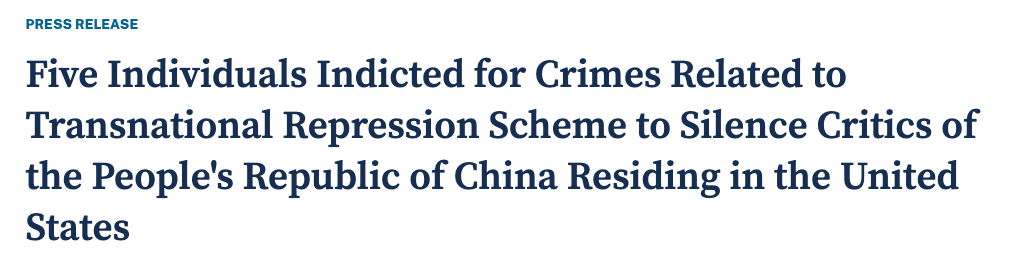
In March 2022, the DOJ charged five men with acting as illegal agents of the People’s Republic of China to surveil and harass Chinese dissidents living in the United States. Arthur was identified as “Dissident 3” in the court documents.
One of the operatives, Matthew Ziburis, had posed as a United States Olympic & Paralympic Committee official and attempted to obtain copies of both Arthur’s and Alysa’s passports.
The scheme included plans to physically surveil the Liu family and potentially disrupt Alysa’s skating career — a 16-year-old American citizen being targeted by a foreign intelligence service because her father had organized protests 30 years earlier.
Alysa competed at the 2022 Beijing Olympics under heightened FBI security, an almost surreal situation: an American Olympian skating in China while her father’s home country was actively running espionage operations against her family on U.S. soil.
She placed seventh, won bronze at Worlds, then retired citing PTSD — not just from competitive pressure, but from the weight of everything surrounding it. Her 2024 comeback, on the explicit condition that Arthur would not be involved in coaching decisions, led to the World title and then Olympic gold.
Worth noting…
Liu wasn’t the only athlete from the U.S. at Milan-Cortina resulting from deliberate genetic selection. Eileen Gu (genetically half Chinese born in California) — the most decorated freestyle skier in Olympic history — was raised by her mother, a Peking University speed skater and Stanford biochemistry researcher who later earned an MBA from Stanford Business School. Her father is an unnamed American with a Harvard education; he has never been publicly identified and plays no role in her life. Her mother made a pragmatic decision to optimize the genetics of Eileen Gu.
Two Olympic gold medalists at the same Games: one engineered by a father who chose elite egg donors, the other by a mother who chose an elite father. Same logic, different direction.
What Arthur Liu did with intuition, men can now do with data

Liu selected donors from agency catalogs based on photos, health history, and background. He had no genetic scoring tools. The technology available in February 2026 is orders of magnitude more powerful — and it’s improving month by month.
If you are a middle-aged guy who wants kids badly, but you haven’t found a good woman to marry and/or have kids with — pulling an Arthur Liu act and going straight to some elite embryos to combine your sperm with is worth considering.
Build your own powerhouse family; it may enrich you and all of society. You have it much easier than Liu too.
Herasight: the current leader
Herasight is the most technically advanced player in the space. Their CogPGT 1.0 predictor explains 16.4% of the variance in fluid intelligence; a 4-fold improvement over 2019-era scores (~4%).
Within-family validation shows a 0.45 correlation with general cognitive ability across 6,442 sibling pairs. For 10 embryos, they claim a detectable IQ spread of ~15 points lowest to highest.
The key innovation is ImputePGTA — reconstructing full embryo genomes from standard PGT-A data clinics already generate. No specialized lab, no extra biopsy.
On February 17, 2026, they released V2, which jointly models all embryos in a cycle (even aneuploid ones normally discarded) to improve phasing.
Biggest gains: parents from underrepresented ancestries. A couple in Seoul, Lagos, or Mumbai can now access screening approaching European-ancestry accuracy.
17 diseases screened, accuracy 122% better than Orchid’s, 193% better than GP’s
20–44% disease risk reduction when selecting among 5 embryos, with positive pleiotropy across conditions
Customers from 11 countries; ethics paper in Fertility and Sterility
Up to $50K comprehensive; 90% discounts for first qualified customer per country
Team: Michael Christensen (founder), Tobias Wolfram (CSO, has banked his own embryos), A.S. Young (statistical genetics), Jonathan Anomaly (ethics)
The competition
Orchid Health — WGS gold standard: 30x coverage, 99% of embryo DNA, $2,500/embryo. PGT-A + PGT-M + PGT-SR + PGT-P in one report, ~1,200 monogenic conditions + 12 disease polygenic scores. January 2026 GRS update nearly tripled predictive power for atrial fibrillation. Backed by Altman, Armstrong, Wojcicki, Buterin, Church. Musk reportedly used Orchid for at least one child. Limitation: no cognitive scoring; disease scores less powerful than Herasight’s.
Nucleus Genomics — Avoid. Whitepaper plagiarized from Herasight, stock photo testimonials, GP sued for IP theft. Cremieux called it fraud.
Genomic Prediction / LifeView (est. 2019) — first to market, 150+ clinics, six continents. Scores now several years old. ~$3,500 including PGT-A.
The intellectual case for deliberate selection
The researchers who understand this are almost unanimously in favor.
Cremieux says: “Everyone Agrees: Let’s Put Genetics to Work.” Stating that these companies provide “immense value for humanity” and we are “on the cusp of a golden age.”
Gwern provides the definitive expected-value math.
Stephen Hsu, Scott Alexander, the Collins family, etc. have all publicly advocated.
Only 17% of the public considers PGT-P immoral; comparable to opposition to SAT prep.
The biology favors acting now
Paternal age is quietly devastating:
DNA fragmentation 4.58x higher by age 50
~2 de novo mutations/year of paternal age
5.75x autism risk for fathers over 40
Conception probability halves vs. men under 25
Young egg donors (25–30) reset the clock: ~30% aneuploidy vs. 90%+ at 44, 75–85% implantation rates regardless of surrogate age. Arthur Liu was 40 when Alysa was born. He didn’t wait too long.
The gains are multiplicative
Donor selection shifts the genetic mean upward. Screening picks the best embryo from that elevated baseline.
These compound: Gwern estimates top-of-10 selection yields 6–9 IQ points above random; a top-percentile donor stacked on top → 8–12+ plausible.
Even 4–5 points → ~$191K–$240K in expected lifetime income.
Arthur C. Brooks: You probably have less of an effect on your kids than you think; as long as kids aren’t neglected, traumatized, or deficient in nutrients and support — outcomes are dominated by genetics.
Caplan’s “Selfish Reasons to Have More Kids”: genetics dominates nurture, so genetic quality compounds higher than any parenting technique or private school. Not saying really good parenting can’t enrich the kids (you should still parent as good as you can) — but genetics matters most.
The critics are wrong
The “playing God” argument is so stupid I don’t even know where to begin. In short: everyone is playing “God” whether they realize it or not.
Selecting a good spouse/partner is playing God. Not selecting a good spouse/partner is playing God. Optimizing your pregnancy is playing God. Not optimizing your pregnancy is playing God.
Whether you partake in embryo selection or not, you are “playing God” by the moronic definition of those who insist that something they don’t do is “playing God.”
Even if we concede that this is “playing God” (and we shouldn’t because everyone else is playing God too)… who says “playing God” isn’t better or “what-God-wants-you-to-do”?
If tools reduce disease risk significantly and you don’t use them — you are playing a dumber, lower IQ God and portraying yourself as virtuous.
Spamming the term “eugenics” is emotional blackmail and at this point nobody takes you seriously. Embryo selection doesn’t sterilize, coerce, or even alter any genome.
As Scott Alexander noted: if you’re doing IVF, you have to pick one anyway — screening just means picking better.
And “access inequality" is a feature, not a bug: wealthy early adopters pay premium prices that fund the R&D driving costs to zero; the same way iPhones went from $599 luxury items to ubiquitous. Restrict access and you slow the entire pipeline for everyone.
This is a prisoner’s dilemma. The question isn’t whether this becomes normal. It’s whether you’re early or late.

How could you replicate Arthur Liu (but better)?
Arthur Liu used his own sperm with elite egg donors and surrogates to produce 5 children, including an Olympic gold medalist. Here’s how to do it better, with 2026 screening technology he didn’t have.
Selecting your egg donor is the highest-leverage decision you’ll make.
Half the genome comes from the egg donor this is where you optimize hardest.
You want: young (21–29), verified academics or athletics, tall, healthy family history, high egg count (AMH).
You use your own sperm.
The resulting embryos are yours: half your genetics, half hers.
Then you screen them all with Herasight PGT-P to pick the best one.
Two paths to get eggs, ranked by how many embryos you’ll have to screen:
Fresh cycle (best for selection): A donor does a full stimulation and retrieval just for you. Average ~20 mature eggs, all fertilized with your sperm → 8–14 blastocysts → maximum PGT-P selection power. More embryos = more genetic variance to choose from = better top pick. Cost: $15K–$25K donor compensation + $5K–$10K agency + IVF cycle costs.
Frozen egg bank (faster, cheaper, fewer embryos): Buy a cohort of 6–8 frozen eggs, thaw and fertilize with your sperm at your clinic. Faster (weeks vs. months), cheaper (~$18K per cohort), but fewer eggs means fewer embryos means less selection power. Fine as a starting point or supplement.
Where to find elite donors, ranked:
Donor Concierge: The meta-agency. Searches 230+ vetted agencies and 25,000+ candidates to curate a shortlist matching your exact specs (height, ethnicity, education, athletics). 95% match success rate. Dedicated case manager. Match in 2–3 weeks. Independent — no referral fees from agencies, so they work for you. Harvard-trained founder (Gail Sexton Anderson). This is who you hire if you want the best possible donor and don’t want to search 50 agency websites yourself. Private Client tier for maximum confidentiality.
Elite Donor Solutions: Specializes in athletic, tall, and highly educated donors. Concierge matching service ($2K, applied to agency fee). Strong if you have specific physical trait requirements. Direct agency with in-house database.
EggDonors4All: Guaranteed blastocyst programs: minimum 3 Day-5 blastocysts or they repeat the cycle free. FDA-registered, NYS-licensed. Frozen cohorts from $18K; fresh cycles $15K–$25K + IVF. Elite program includes Ivy League and physician donors. Good cost certainty.
Shared Beginnings: If you want them to handle everything. They’ll pair your sperm with a donor from their screened database, create embryos at their partner lab (Atlantic Reproductive Medicine, Raleigh NC), PGT-A test, and ship. 77% pregnancy rate. Live birth guarantee (80% refund). Good turnkey option if you don’t want to coordinate clinic + agency separately.
Donor Nexus Premier: Access to models, professional athletes, and graduate students as donors. Newport Beach based, partners with HRC Fertility (top SoCal clinic). 1,200+ babies born across all programs. Premier donors require faster cycle timelines.
The full playbook (Arthur Liu’s path, upgraded)
Step 1: Freeze sperm now. Every year costs you measurably. $500–$1K + $300–$500/yr storage.
Step 2: Select an elite egg donor using the ranked sources above. Fresh cycle preferred — more eggs = more embryos = better PGT-P selection. Use Donor Concierge to search 230+ agencies if you want the widest net. Standard compensation: $8K–$14K. Exceptional: $25K–$50K. Elite (Ivy League, D1 athletes): $50K–$100K+.
Step 3: Maximize embryo count. Two cycles → 6–14 blastocysts. The marginal $15K–$20K is trivial relative to lifetime gains.
Step 4: Screen with the full stack. PGT-A ($3K–$6K) → PGT-M if carrier → PGT-P via Herasight → Orchid WGS for rare variants. Skip Nucleus.
Step 5: Surrogate. California is the legal gold standard but the most expensive ($130K–$165K). Circle Surrogacy, Growing Generations. For strong legal protections at lower cost: Illinois ($100K–$125K, Gestational Surrogacy Act, pre-birth orders), Nevada or Colorado ($100K–$130K, surrogacy-friendly statutes, lower surrogate compensation). Arkansas is cheapest but less legally tested. Michigan legalized compensated surrogacy in April 2025 — fresh market, potentially lower rates. International: Mexico ($70K–$80K) and Colombia ($65K–$75K) if cost is the primary driver.
Step 6: Invest in environment. Genetics sets the ceiling; environment determines how close you get.
What this costs and potential future cost
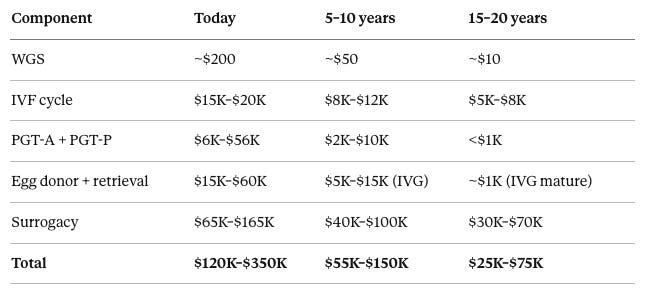
The trend line: what costs $350K today with 16% variance explained will cost $75K or less with 40–50% variance explained — cheaper AND dramatically more powerful. Within two generations, the cost will approach routine medical expenses while the screening accuracy will make unscreened reproduction look like refusing an ultrasound. This becomes a no-brainer for virtually every family.
Every line item is on a steep cost curve. WGS: $20M (2003) → $200 (today).
IVF: down ~40% since 2010.
Polygenic scoring: approaching zero marginal cost — Herasight’s ImputePGTA runs on data clinics already generate.
IVG will eliminate egg retrieval costs entirely.
Surrogacy: state arbitrage alone saves $30K–$60K vs. California; new markets (Michigan, international) are compressing prices further.
Governments should accelerate this. Once the expected ROI math becomes positive, governments are foolish to not offer this technology to couples for free or heavily subsidized. This would be one of my top priorities and I wrote about it in my ASAP Protocol to Fix the U.S. Today's early adopters pay a premium; within a generation, this will be as routine and affordable as prenatal ultrasound and far more effective.
The future of upgraded babies
The current constraint is embryo count: ~3–7 blastocysts per cycle. Five developments will blow this open, and each makes today’s costs look absurd.
In vitro gametogenesis (IVG): Eggs from stem cells → hundreds of embryos per cycle. At 100 embryos, expected IQ gains may climb to ~18–19 points.
Conception Biosciences (Sam Altman-backed) has observed markers of meiosis in stem cell-derived germ cells. Hayashi estimates 5–10 years.
Other players: Ivy Natal, Gameto, Vitra Labs.
Cost impact: Eliminates donor compensation, egg retrieval, and hormonal stimulation; the single biggest cost reduction in the stack.
Improving polygenic scores: 16.4% of intelligence variance today vs. unknown ceiling.
Orchid’s Jan 2026 update tripled power for some diseases in one release. By 2030, today’s scores will look primitive.
Cost impact: pure software — each generation better at zero added cost.
Germline editing: The endgame. Base and prime editors already make precise single-nucleotide changes without double-strand breaks.
Once mature for germline use, you fix unfavorable variants directly instead of selecting among imperfect options. Not approved yet.
The science is moving faster than the ethics committees.
Cost impact: eventually replaces selection — editing one embryo is cheaper than screening ten.
Human artificial chromosomes (HACs): The wildcard.
Synthetic chromosomes added to the genome without altering existing DNA. A single HAC could carry dozens or hundreds of beneficial variants (disease resistance, enhanced DNA repair, novel metabolic capabilities) in one heritable package.
No off-target effects on natural chromosomes, theoretically unlimited payload. HACs have been maintained in human cell lines for years; the barrier is reliable germline transmission.
If solved, one HAC insertion could deliver more genetic benefit than selecting from a thousand embryos. Most speculative technology on this list — and potentially the most transformative.
Cost impact: Unknown, but the per-variant cost approaches zero once the delivery platform works.
Somatic gene therapy: The fallback for anyone already born. LNP delivery, Anellovirus delivery, AAV vectors, and in vivo base and prime mods to upgrade health and performance. Children from screened embryos will grow up in a world where they can also opt for somatic upgrades in adulthood (patches or additional enhancements). Selection sets the floor; editing raises the ceiling; somatic therapy fills the gaps.
The discourse has shifted from “should we?” to “how do we do this well?”
Arthur Liu did this 20 years ago with donor catalogs and intuition. He produced an Olympic gold medalist.
The tools now are incomparably more powerful — and in 5 years they’ll cost a fraction of today’s price. Those who act first are the ones whose children will define the next generation.