

I don’t care what anyone says… Bills should’ve won in OT. I also don’t think they should’ve fired HC Sean McDermott. If you have good chemistry + history between coach, QB, team, etc. — and consistently solid performance — it’s stupid to nuke that just because you didn’t win a Super Bowl, especially if your top WR (Gabe Davis) was injured. It takes some luck in the playoffs (health is part of that luck).
Bills made it through a very tough Jags team in the Wild Card… then lose in OT to a team with a HOF coach (Sean Payton) and the #2 overall defense on their home turf… and you’re missing your top WR… not really that bad.
Yet since you haven’t gotten over the hump for your entire coaching tenure and reached a Super Bowl, the media keeps pounding the phrase “no excuses”… and eventually you get ousted for someone else. This happens in every sport and usually ends poorly.
I’m not saying McDermott was some super genius, but my logic is if it ain’t broke (and you have serious injuries e.g. top WR that might explain the loss) don’t fix it.
We know Josh Allen carried the team and will have some degree of success no matter who is coaching, but Buffalo better not hire some moron who does worse than McDermott. I’m not convinced that there are many great coaches in the NFL… most get shuffled around like a deck of cards and re-dealt to new franchises.
And even with a perfect fit (coach + QB + team)… you obviously aren’t guaranteed a Super Bowl. The best QB in the league doesn’t guarantee anything… especially if key players on your team are injured and you’re going up against another elite team.
Who should the Bills hire now? If it’s me I’m probably going with Joe Brady (the current OC) to maintain continuity with Josh Allen. Bring in a decent set of coordinators and try to keep the Bills success train going.
Why did the Bills fire Sean McDermott?
Read the January 21, 2026 Buffalo Bills presser with owner Terry Pegula and GM Brandon Beane.
“The first thing I noticed was our quarterback with his head down, crying. I looked at all the other players. I looked at their faces and our coaches’,” Pegula recalled. “(Josh Allen) had given everything he had to try to win that game, and looking around, so did all the other players on the team. I saw the pain in Josh’s face at his presser, and I felt his pain.”
For the last seven seasons, the Bills’ season has ended with the team coming up short of the Super Bowl, often crashing to a halt in a sudden, heartbreaking fashion.
“I felt like we hit the proverbial playoff wall year after year,” Pegula said. “13 seconds, missed field goals, ‘the catch’.”
Pegula said the decision to move on from Sean McDermott was both “based on the results in Denver” and the deepening of a January scar that continued to grow year over year.
“It’s been one year after another, and that was the sense of, how do we overcome this? And I just couldn’t see us doing that with Sean. That’s why I relieved him. It’s not an easy decision,” Pegula said.
The conclusion to let go of McDermott was Pegula’s alone.
“I made the decision, and it is my decision,” he said.
Following the playoff loss in Denver, Bills players returned to the team facility the next morning for team exit meetings. Bills quarterback Josh Allen did not have input on Pegula’s verdict, nor did any other player.
“Terry’s decision came on Monday, or that’s when we were informed of his decision. So the players had already left,” said general manager Brandon Beane.
However, Pegula and Allen have spoken since the coaching announcement.
“I didn’t talk to Josh about this. I talked to him afterwards. That conversation will stay private, but he had no input,” the Bills owner said.
Beane also shared that there’s responsibility all round for not getting to a Super Bowl.
“I bear guilt, blame, responsibility. There’s no finger pointing. I understand there’s things I could have done better. And we’re always looking to get better and that’ll never change. If we don’t win the Super Bowl next season and I’m up here explaining where we are and what we have to do,” Beane said.
Josh Allen was drafted in 2018. McDermott had been Bills head coach since 2017. Brandon Beane was GM since May 2017.
After McDermott’s firing, GM Brandon Beane was elevated to Buffalo Bills President of Football Operations (with the next head coach reporting to Beane)… so Beane actually got a promotion.
And allegedly, weeks before his firing, McDermott raised concerns that the Bills roster lacked what it takes to win a Super Bowl. To me this is weak and should make both the GM and owner a bit upset… conveys low confidence and a mentally defeatist attitude (at least if I’m the GM/owner that’s what I’m thinking).
It’s too late for that shit. I’d be like c’mon man… just go out there and coach your ass off and do what you can with what you’ve got… this seems like some sort of psychological tactic/hedge to ensure job security if you lose and a lack of being “all-in” on your team… you have arguably the best QB in the NFL… do what you gotta do.
Leaves a sour taste… if you were concerned this should’ve been discussed way before the trade deadline.
Should Buffalo have kept Beane? I think so. Bills have done well under his management. They missed the AFC Championship game by a whisker.
Bills post-season under Josh Allen + McDermott combo
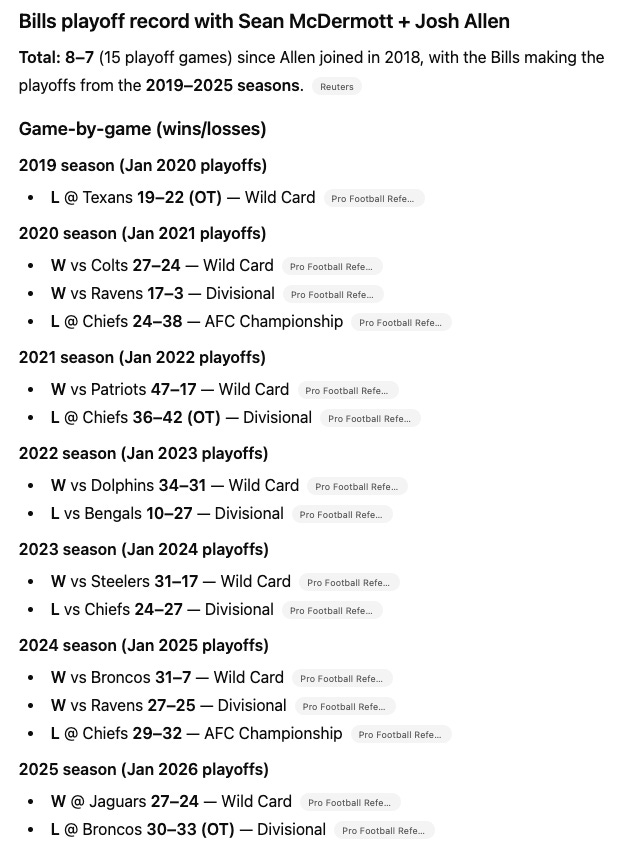
How can the Bills get to the next level? Besides luck… get some higher-octane WR depth and you’re good to go.
Anyways… Bills lose in the second round of the 2026 playoffs to the Broncos in OT… and Broncos played very well. Elite defense (#2), solid offense, elite coach, playing at mile high… all lived up to the hype.
I watched the game and my takeaway was:
The Broncos outplayed the Bills
The Bills should’ve won in OT
Bo Nix played incredibly well… better than I expected… especially with judgment-calls to run the ball… carved up the Bills defense. Sean Payton was locked in with the play-calling… and Nix was on the money with most throws… early in the game there was an unfortuitious drop by his WR (should’ve been a layup TD).
Josh Allen played reasonably well all things considered against Denver’s defense. The difference in the game was Denver’s defense + Bo Nix’s legs + Sean Payton.
And even though the Broncos outplayed the Bills (from my judgment), I still REALLY wanted the Bills to win and think they should have won… and I thought the refs botched the OT call.
What OT call? You know the OT call… Allen heaves a 50/50 airmail and his WR catches it, but it’s ripped from his clutches by Denver’s CB and ruled an INT.
Yes I listened to “refs” and people who “know the rules”… Joe Burrow was yapping about the call on X… claiming most fans don’t know the rules (he’s probably correct).
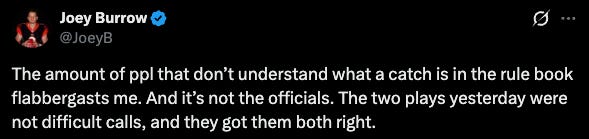
But most fans also know that most players and refs have too much respect for each other to smear the refs on close calls… nearly everyone players and fellow refs will defend the refs here… calling them out publicly is a bad look. So we wouldn’t get honest opinions anyway.
Commentary refs on TV usually do a great job, but they rarely disagree with in-game refs unless the call is beyond egregious. Then they’ll say something along the lines of: “They might’ve missed that one” or something. And I understand it… I wouldn’t bash my fellow refs either… it’s not worth it… it’s not like the refs are trying to fuck up; high-pressure, high-stakes, psychotic fans.
Making the call during a “live game” is incredibly difficult.
And this play, if you thought: (1) the ball moved at all (no clear control) and/or (2) the Broncos CB didn’t contact the Bills WR and/or (3) contacted the Bills WR but only after the ball came loose — then it’s an INT… end of discussion.
What was my perspective?
Bills WR catches the ball and it looks stable (yes, it’s an “awkward grip” but the ball isn’t moving… the “awkward grip” is psychologically associated with “not controlled”… but a ball can be awkwardly held and controlled)
Denver CB attempts to grab it, reaching towards the ball, but doesn’t yet have it in his hands
Bills WR goes to the ground with the ball stabilized
Bills WR is on the grass holding the ball while leg/knee of Denver CB subtly contacts Bills WR as he rips the ball away
Denver’s CB comes away with the ball
My ruling: Complete pass.
It was very close… and much closer than I’d initially thought.
AND I’LL REITERATE ONE MORE TIME:
If you think there was any clear “ball movement” it’s an INT. (I didn’t see movement)
If you think there was no clear body contact from Denver CB on Bills WR while Bills WR had the ball on the ground… it’s also an INT. (I saw contact)
If you think there was body contact from Denver CB on Bills WR but it came slightly after ball was “ripped away” (i.e. hands rip ball just before body contact)… it’s also an INT.
Super close play. Maybe I shouldn’t have been as into this as I was… likely could argue either way. May have been difficult to overturn even if reviewed.
Big credit to the CB on Denver for doing what it took to give his team a chance. The NFL loves this controversy. Media engagement, headlines, angry fans, etc.
With my ruling… the Bills likely kick a chip shot field goal and game over. Bills win and advance to play the Pats.
Denver fans were quick to point out that Bills O-line clearly held Broncos defender which prevented a sack on Allen + safety + OT defensive win for Broncos.
This is true. I won’t even try to deny it. I saw the play. The only slight issue with arguing this is that O-line holding happens often and isn’t always called… I bet I could find O-line holds nearly every play. If you aren’t holding sometimes, you aren’t competing. Yes this was a crazy, clear-as-day, should’ve-been “holding.”
I would guess that O-line holding penalties are rarely called as a % of total actual holds (I’m thinking you could count on replays “called” + “not called but holds” = total… and the % that is “called” is probably low relative to other penalties).
And in OT they are less likely to be called (refs always hold whistles… it’s an unwritten rule to “let the players play” and not decide games with big penalties).
That said, Congrats to Denver. I, like most, would’ve preferred to see a fully healthy Denver team go up against the Pats… but you can’t always get what you want.
Sadly, Bo Nix managed to fracture his ankle at the very end of the game… I didn’t really notice or think anything serious happened until after the game.
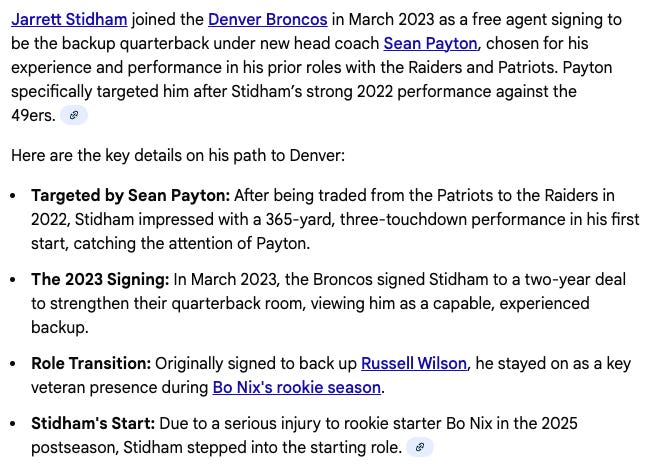
Denver survived. Now they have to start Jarrett Stidham (a guy with some experience in the league… clearly not ideal. Does he have a snowball’s chance in Denver? Maybe.
How did Stidham end up on Denver Broncos?
What are Stidham’s career stats?
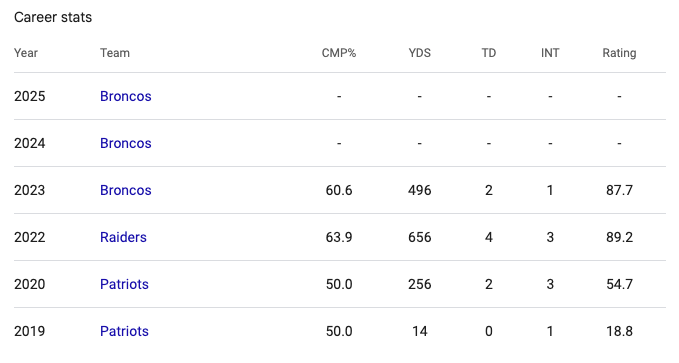
If there were ever a time to step up and show the masses what you’ve got… now is that time for Stiddy. Prove you can ball in the playoffs.
What did I think of the Pats game?
The entire Pats vs. Texans game was a shit show. Sloppy weather, turnovers galore, mostly just defense… and an insane TD catch by Boutte… that I think it may have technically been an incompletion.
Since all replays of this play posted online were sanitized from the best looking angle… it looks like an unambiguous TD. When I watched a replay on TV with slow mo of the slow mo… from a side angle it looked like the tip of the ball nicked the grass after the catch as Boutte’s momentum carried his body forward. I don’t care too much, but that’s what I saw… surprised nobody really commented other than on X.
Moot point because Pats likely would’ve won either way. Texans coaching made some bizarre decisions as well (and I like their coach)… anyways… I didn’t expect Texans to win that one.
Now we got Pats vs. Denver at Mile High.
Would love to see Sean Payton somehow win the Super Bowl with a backup QB, and I’ll be cheering for the Broncos to win… but I think Pats should have this. Pats are one of the most balanced teams of 2025-2026… and the defense has been top-tier.
I liked the Pats defense more than the Pats offense this year despite the offense ranking higher overall (#3 Offense + #8 Defense)… but I guess each benefitted from the other… symbiotic relationship. Every time I watched the Offense for NE was in a layup type position as a result of the Defense.
What about the Seahawks vs. 49ers?
Seahawks were my highest-confidence pick last week. Why? Leading into this matchup:: 9ers defense looked subpar, Purdy throws picks in games I watched, and too many injuries (e.g. Kittle). I don’t blame Shanahan for the loss… tough when some of your best players on both sides of the ball are injured.
I tracked the Seahawks defense extensively this year because they were who I used in fantasy… even with injuries they just kept performing well (even against good teams)… and they lit up Purdy and the 9ers.
Now Seattle is a little dinged up… losing Charbonnet at RB sucks. The Left Tackle (LT) position is depleted: “Top 3 Left Tackles Miss Practice Again” has been the headline.
George Holani (#3 RB) is being promoted to play after injury. It won’t surprise me if he performs well. RBs benefit from the entire system in place: QB, coaching, play-calling, and O-line… and I think Seahawks have a robust unit. I’ll be a bit surprised if Seattle misses a beat at RB even though Charbonnet is tough.
The Rams vs. Bears game was a thriller. Rams dumped cayenne pepper in their socks. Caleb Williams made one of the most insane throws I’ve ever seen in the playoffs… running backwards with a precision missile strike to his TE in the corner of the end zone. But one crazy play doesn’t win the game… Stafford and McVay advance.
Rams head back to Seattle for a rematch. And this time Seattle is a bit more depleted.
Darnold’s mobility remains questionable with the oblique injury… but he looked good when he had to make throws against SF.
I’m picking Seattle at home. I like the coach, I like the QB, I like the defense, I like the WRs… but I wouldn’t care if Stafford wins another SB.
The Rams should have a strong chance to win on the road because of how banged up Seattle is (Darnold + left tackles + RB)… but IDK Rams eked out 2 ultra-close games against the Panthers and Bears… can they keep the magic going? I have faith in their offense… but am highly skeptical that the defense can do much.
My 2026 Conference Championship picks:
NFC: Seahawks
AFC: Patriots
Last week in the 2026 Divisional Round Predictions I went 3/4.
The consensus/majority (AIs + me) were correct on all the games.
Grok 4, GPT-5.2 Deep Research, and GPT-5.2 Pro were 4/4 last week… the other AIs (Claude 4.5 Opus + Gemini 3.0 Pro) had at least 1 incorrect.
Looking back at the 2026 pre-playoffs picks by AIs all have teams remaining… but that wasn’t hard. Nearly everyone who went with top seeds (Seahawks, Broncos, Pats) is doing fine.
All AIs (Claude, Grok, GPT, Gemini) had busted brackets in the Wild Card Round by the 49ers or Bills. None of the AIs had a perfect first round… and neither did the human (me).
Most AIs still have the potential to have predicted the correct (1) Super Bowl matchup AND (2) Super Bowl winner (everyone went with Seattle). I don’t have potential to get the matchup correct (I went with Bills in SB)… but I can get the winner correct (I picked Seahawks).
End of my incoherent ramblings… my brain was redlining today. Re-read this and was thinking WTF did I vomit onto this Substack?
Below are picks from GPT-5.2-Pro and Gemini 3.0 Pro for the Conference Championship Games of the 2026 NFL Playoffs.
What about Claude Opus and Grok? Grok doesn’t even get players accurate… and while I love Claude, I wanted to keep things simple this weekend and not burn through extra Opus tokens.
My quick thoughts?
Flip a coin for Seahawks vs. Rams
Pats should beat the Broncos without Nix
I’m hoping Broncos pull off the upset… their strong defense at home + Payton gives them a chance… but Pats have a strong defense as well. And Pats aren’t missing their starting QB. Stiddy will need to pull a rabbit out of a hat to advance to the SB.
GPT-5.2-Pro (NFC + AFC Picks)
Note: The formatting of GPT-5.2-Pro’s output is quite jarring. Bold, bullet, bold-bullet, quotations, em dashes, etc. Yeah you can change it if you want… but I’ve experimented with this and the output quality degrades. Best output = zero memory, zero “personalization,” zero “custom instructions.”
AFC Championship — Patriots at Broncos
Game context
Kickoff: Sun, Jan 25, 2026 — 3:00 PM ET (Denver)
Venue: Empower Field at Mile High (Denver)
Weather (Denver): forecast around 25°F high / 13°F low
Market baseline (as of this week): Patriots favored roughly -4.5 to -5.5, total around 42.5
Team profiles (what matters most)
Denver Broncos (home)
Defense is elite and disruptive:
Sack % #1 (10.10%) and Opp Yards/Play #2 (4.5)
Red-zone defense is a real separator: Opp RZ TD% #2 (44.23%)
Offense is mid-tier by efficiency: Points/Game #13 (24.1), Yards/Pass #29 (6.4)
The swing factor: QB Bo Nix is out (broken ankle) , Jarrett Stidham starts
New England Patriots (road)
High-efficiency passing game:
Completion % #1 (70.48%) and Yards/Pass #1 (8.8)
Still balanced: Rush Yards/Game #6 (128.5)
Defense is top tier by scoring: Opp Points/Game #3 (17.8)
But a major pressure vulnerability: Patriots QB sacked % #27 (9.40%) — and that’s walking into Denver’s #1 sack rate.
Injuries/availability (high-impact notes)
Patriots
DNP: Harold Landry III (knee), Marte Mapu (hip)
Limited: CB Carlton Davis III (concussion protocol) and others
Broncos
DNP: Bo Nix (ankle)
Limited: RB J.K. Dobbins (foot), WR Troy Franklin (hamstring), WR Pat Bryant (concussion)
Matchup dynamics that decide the game
Can the Patriots protect Drake Maye from Denver’s #1 pass rush?
Denver’s defense generates pressure at the highest rate in the league (sack% #1).
New England’s offense takes sacks at a bottom-tier rate (QB sacked% #27).
In cold weather, sacks + strip-sacks matter more than “normal” incompletions because ball handling tightens.
Turnover profile: Maye’s recent ball security vs a havoc defense
In the Divisional Round, Maye had 4 fumbles (lost 2) and threw a pick in messy conditions.
New England advanced anyway because the defense created a turnover avalanche (including four Stroud INTs).
Denver’s defense is the type that can punish another loose-ball day.
But the Broncos’ QB downgrade is the biggest single variable
Playoff football is often about “who can create offense when the first script dies.”
With Nix out, Denver is much more likely to shift into field-position + low-risk mode—fewer explosive chances, more dependence on short fields.
Game environment leans under-ish (cold + backup QB), but altitude helps the kicking game
Cold generally suppresses efficiency; Denver’s altitude can keep FG range “alive” even in low temps.
My prediction
Pick: Patriots win
Projected score: Patriots 23 — Broncos 17
Win probability (my estimate): Patriots 66% / Broncos 34%
Implied “fair” moneyline: Patriots ~-194, Broncos ~+194 (for intuition; not a recommendation)
Confidence: Medium
The market is already strongly Patriots due to the QB situation (moneyline around Patriots -245, Broncos +200).
I’m a bit less certain than the market because Denver’s pass rush + New England’s sack rate + Maye’s recent fumble cluster is a real upset recipe.
What flips it to Denver (most plausible upset path):
Denver wins turnover margin by 2+ (strip-sack + short-field TD), and Stidham avoids the back-breaking mistake.
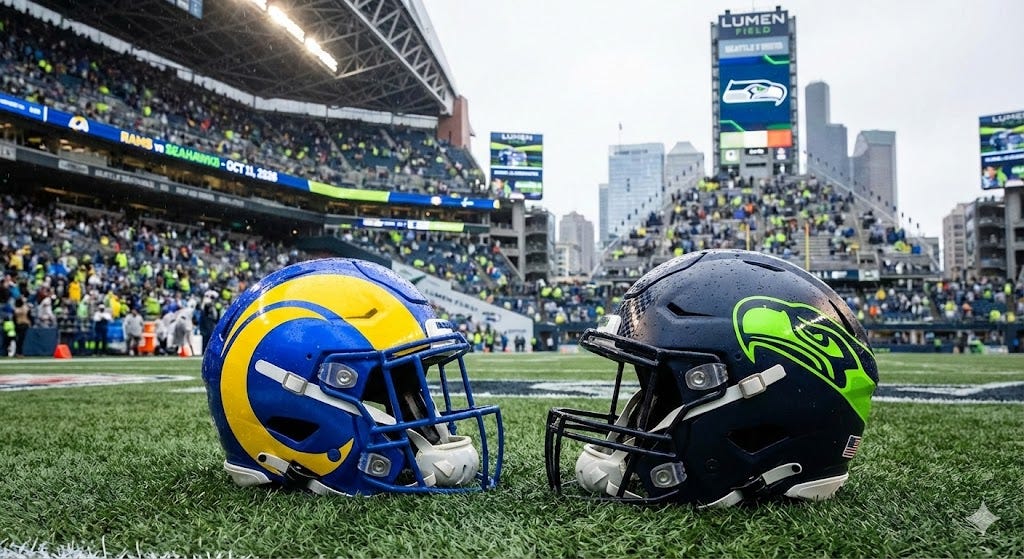
NFC Championship — Rams at Seahawks
Game context
Kickoff: Sun, Jan 25, 2026 — 3:30 PM PT / 6:30 PM ET
Venue: Seahawks host at Lumen Field (Seattle)
Weather (Seattle): forecast around 44°F high / 32°F low
Market baseline: Seahawks about -2.5, total around 47.5, moneyline roughly Seahawks -134 / Rams +114
Team profiles (strength vs strength)
Seattle Seahawks (home)
Best defense in football by these metrics:
Opp Points/Game #1 (16.6), Opp Points/Play #1 (0.265), Opp Yards/Play #1 (4.5)
Run D is dominant: Opp Yards/Rush #1 (3.7) and Opp Rush TD/Game #1 (0.5)
Offense is explosive but volatile:
Points/Play #1 (0.491)
But Giveaways/Game #31 (1.6) and INT thrown % #28 (3.01%)
Current form: Seattle is on a surge—eight straight wins since the Nov. 16 loss to LAR
Playoff indicator: They just demolished SF 41–6 with a kickoff TD and 3 rushing TDs from Kenneth Walker III.
Los Angeles Rams (road)
Best offense in football by production/efficiency:
Points/Game #1 (30.1) and Yards/Play #1 (6.0)
Low mistake profile: INT thrown % #3 (1.32%) and QB sacked % #3 (3.94%)
Defense is solid, not elite: Opp Points/Game #10 (20.7)
Road toughness this postseason: won at CAR (34–31) and at CHI (20–17 OT)
Key offensive personnel are proven and high-leverage: Stafford + Nacua/Adams/Williams are central to their playoff identity.
Head-to-head this season (why this is hard)
These teams already played two nail-biters:
Rams 21–19 Seahawks (Nov 16): Rams got four interceptions and survived a late long FG miss.
Seahawks 38–37 Rams (Dec 18 OT): Stafford threw for huge yardage, Seattle answered late and won in OT.
So the series has been defined by turnovers and high-leverage plays, not one team dominating down-to-down.
Injuries/availability (this is the biggest “live” variable)
Seahawks (OL health is critical)
DNP: LT Charles Cross (foot), Josh Jones (knee/ankle), Amari Kight (knee) — all tackles
Limited: QB Sam Darnold (oblique); also Nwosu hamstring, others
RB depth note: Zach Charbonnet out (knee); George Holani designated to return / could be available
Rams
DNP: S Quentin Lake (illness), LB Byron Young (knee)
Limited: CB Emmanuel Forbes (shoulder)
Matchup dynamics that decide the game
Seattle’s defense vs the #1 Rams offense
Seattle’s defense is elite by every “per play” suppression metric.
But the Rams are #1 in yards/play and points/game, and protect the QB extremely well.
Translation: the Rams are built to be one of the few offenses that can function without giving Seattle easy, short fields.
Seattle’s offense volatility vs Rams’ lower-mistake identity
Seattle gives the ball away a lot (worst in the league by giveaways/game).
Rams are among the best at avoiding INTs and avoiding sacks.
If this becomes a “one extra possession wins” game, Seattle’s turnover profile is the risk.
Offensive tackle health may cap Seattle’s ceiling
If Seattle is compromised at LT, it narrows the playbook (less dropback depth, more quick game / condensed formations).
That makes Seattle more predictable—dangerous against McVay’s ability to script counters and exploit tendencies.
Home field matters more here than in most games
Lumen’s noise can force protection checks, timeouts, and false starts—exactly the stuff that kills playoff drives.
Prediction
Pick: Seahawks win (close)
Projected score: Seahawks 26 — Rams 23
Win probability (my estimate): Seahawks 55% / Rams 45%
Implied “fair” moneyline: Seahawks ~-122, Rams ~+122
Confidence: Low-to-medium
The market already calls this a near coin flip with a small Seattle edge (SEA -2.5).
My pick basically agrees with that unless Seattle’s tackle situation stays as bad as the first injury report suggests.
What flips it to the Rams (most plausible Rams win script):
Seattle’s LT situation forces extra help → Rams get Seattle into long-yardage → one or two Seattle giveaways decide it (mirrors the Nov. 16 game).
Gemini 3.0 Pro Deep Research
Exec Overview
The 2026 NFL Conference Championship Sunday presents a convergence of statistical anomalies, historic defensive efficiencies, and critical personnel attrition that complicates traditional predictive modeling. This report provides an exhaustive, multi-variable analysis of the AFC Championship Game between the New England Patriots and the Denver Broncos, and the NFC Championship Game between the Los Angeles Rams and the Seattle Seahawks.
Our predictive methodology synthesizes proprietary DVOA (Defense-adjusted Value Over Average) metrics, Expected Points Added (EPA) vectors, granular injury biomechanics, and meteorological physics to derive outcome probabilities. The overarching theme of this postseason is the “Fragility of Optimization.” Both number one seeds—the Denver Broncos and Seattle Seahawks—arrived at this juncture with historically dominant profiles, yet both face catastrophic personnel crises that threaten to dismantle their tactical identities.
In the AFC, the narrative is defined by the absence of Denver quarterback Bo Nix, necessitating a reversion to a high-variance backup in Jarrett Stidham against a Patriots defense that specializes in exploiting processing delays. In the NFC, the Seattle Seahawks possess a defense that ranks among the top ten in NFL history, yet they enter the title game with a decimated offensive line and a quarterback managing a core muscle injury that fundamentally alters throwing mechanics.
This document serves as a comprehensive strategic dossier, evaluating coaching tendencies, specific matchup leverage points, and environmental constraints to offer high-confidence predictions on game winners, spread coverage, and total scorelines.
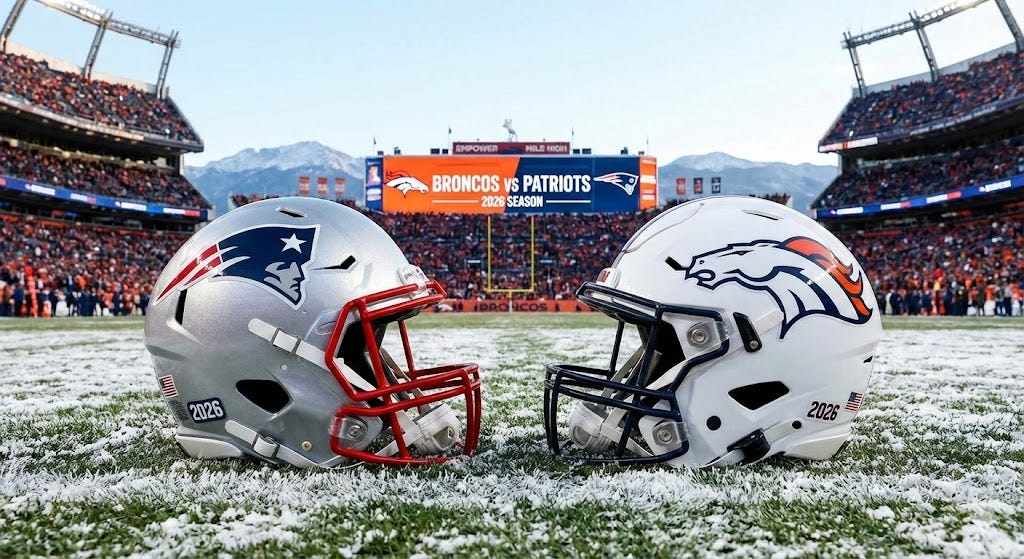
AFC Championship: New England Patriots at Denver Broncos
The Strategic Landscape
Matchup: New England Patriots (14-3) vs. Denver Broncos (14-3) Venue: Empower Field at Mile High, Denver, Colorado Kickoff: Sunday, January 25, 2026, 3:00 PM ET Broadcast: CBS / Paramount+ Opening Line: Broncos -1.5 Current Line: Patriots -5.5 Total: 41.5
The AFC Championship features two franchises that have mirrored each other’s resurgence. The New England Patriots, under the stewardship of Head Coach Jerod Mayo and a rejuvenated front office, achieved a ten-game improvement from the previous season, tying the NFL record for the best single-season turnaround. Their trajectory has been linear and ascending, powered by the MVP-caliber play of quarterback Drake Maye and a defense that has recaptured its disciplined identity.
Conversely, the Denver Broncos’ path to the No. 1 seed was forged through defensive suffocation and the efficient, low-mistake play of rookie quarterback Bo Nix. Head Coach Sean Payton constructed a team built to win in the margins—dominating time of possession, winning the turnover battle, and executing well in the red zone. However, the foundational premise of the Broncos’ success—the stability of the quarterback position—was shattered in the Divisional Round.
Personnel Crisis: The Quarterback Evaluation
The single most determinative variable in this contest is the disparity in quarterback capability and availability. The shift in the betting line from Broncos -1.5 to Patriots -5.5 represents a massive recalibration of win probability based solely on the loss of Bo Nix.
The Bo Nix Void
Bo Nix’s season-ending ankle fracture removes the operational brain of Sean Payton’s offense. Nix was not merely a game manager; he was the facilitator of an offense predicated on timing and pre-snap reads. His ability to process coverage rotations and deliver the ball quickly protected an offensive line that, while statistically solid, relied on quick releases to avoid sustained protection scenarios. Nix’s absence forces a complete offensive restructuring in fewer than six days.
The Jarrett Stidham Risk Profile
The Broncos turn to Jarrett Stidham, a quarterback whose recent resume is defined by inactivity. Stidham has not attempted a pass in the 2024 or 2025 regular seasons. His total snap count for the 2025 season stands at four, with zero pass attempts.
Physiological Rust: The speed of an NFL Conference Championship game is exponentially faster than practice reps. Stidham faces a severe acclimation curve regarding game speed, pocket presence, and the internal clock required to release the ball before pressure arrives.
Tactical Limitations: Stidham lacks the mobility and instinctive processing speed of Nix. This limitation restricts Payton’s play-calling menu. The offense must contract to half-field reads, screen games, and max-protection shot plays. The complexity that often confuses defenses will likely be stripped away to prevent catastrophic errors.
The Psychological “Revenge” Angle: Narrative analysis often cites Stidham’s history as a Patriots draft pick (2019, 4th round) as a motivational factor. While motivation is tangible, the tactical reality is that Patriots offensive coordinator Josh McDaniels and the defensive staff possess a deep institutional knowledge of Stidham’s limitations. They know his tendencies under pressure, his preferred throwing lanes, and his biomechanical tells. This familiarity disproportionately favors the defense.
Drake Maye: The Efficiency Engine
On the opposing sideline, Drake Maye presents a profile of elite efficiency.
Clean Pocket Dominance: Maye boasts a passer rating of 118.9 from a clean pocket. This metric is critical against Denver. While the Broncos possess an elite pass rush, if the Patriots can provide intermittent protection, Maye is surgically accurate.
Explosive Capability: The Patriots led the NFL in explosive play rate (15.8%) and explosive pass play rate (20.4%) in 2025. Maye’s arm talent allows him to access vertical areas of the field that force defenses to defend every blade of grass. This vertical stretch stresses safeties and opens intermediate zones for tight end Hunter Henry and slot receiver DeMario Douglas.
Resilience: Maye’s PFF grade of 87.4 reflects a quarterback who elevates the talent around him. His ability to scramble and extend plays provides the Patriots with a “Plan B” when the initial play design breaks down—a luxury the Broncos do not currently possess.
Tactical Matchups: The Trench Warfare
Patriots Offense vs. Broncos Defense
This is the “Strength on Strength” matchup that will define the game’s tempo.
The Broncos Pass Rush: Denver’s defense ranked #3 in points allowed (18.3) and led the league in sack rate. The unit is spearheaded by Nik Bonitto and Zach Allen, who create interior and edge pressure simultaneously. Their ability to collapse the pocket without blitzing allows Defensive Coordinator Vance Joseph to drop seven defenders into coverage.
The Coverage Shell: Pat Surtain II is a true lockdown corner capable of erasing the Patriots’ primary X-receiver option. Denver allowed the lowest success rate on deep passes (20.3%) in the NFL. This directly counters New England’s explosive play identity.
New England’s Counter-Strategy: To neutralize the rush, expect New England to employ a heavy dose of tempo and the screen game. By preventing Denver from substituting their specialized pass-rush packages, the Patriots can fatigue the defensive front in the thin Denver air. Furthermore, exploiting the middle of the field is crucial. Denver allowed 171 yards after the catch (YAC) to the Bills in the Divisional Round. Drake Maye will look to exploit linebackers in coverage using crossing routes and mesh concepts that utilize the speed of DeMario Douglas.
Broncos Offense vs. Patriots Defense
This matchup is defined by the Patriots’ ability to exploit Denver’s one-dimensional nature.
Run Defense Imperative: With Stidham at quarterback, Denver’s only viable path to victory is a dominant rushing performance. The Broncos will lean heavily on their running back committee, likely featuring RJ Harvey and a potentially returning J.K. Dobbins (Lisfranc injury recovery). Dobbins, despite limited practice, brings a dynamic element the Broncos desperately need. However, the Patriots rank 4th in defensive rushing efficiency and have held playoff opponents to just 61 rushing yards on 30 carries.
Schematic Squeeze: Jerod Mayo’s defense will likely deploy “Bear” fronts (covering both guards and the center) to plug interior run lanes, daring Stidham to throw outside the numbers. The Patriots’ secondary, even with Carlton Davis III questionable (concussion) , has the talent in Christian Gonzalez and Marcus Jones to play aggressive man coverage against Denver’s receivers.
The Turnover Battle: Stidham’s lack of game reps makes him susceptible to “blind” throws—passes thrown to spots without confirming coverage rotation. The Patriots defense excels at baiting these throws. If New England can force Denver into 3rd-and-long situations, their stunt-twist games upfront will likely overwhelm a Broncos offensive line trying to protect a stationary target.
Environmental Variables: The Mile High Factor
The game’s location and weather forecast introduce high-variance elements that favor the defensive units.
Meteorological Impact: Forecasts indicate a winter storm system impacting Denver from January 23-25. While the heaviest snow (12+ inches) is expected in the mountains, Denver itself could see 2-4 inches of accumulation and freezing temperatures. Snow games generally favor the offense regarding footing (receivers know where they are going; defenders react), but they severely hamper passing velocity and ball security.
Altitude: Empower Field at Mile High sits at 5,280 feet. The thinner air reduces oxygen intake, leading to faster fatigue accumulation. This naturally favors the home team, accustomed to the conditions. For a Patriots team traveling from sea level, managing rotation depth along the defensive line will be critical in the fourth quarter. If the game is close, Denver’s conditioning advantage becomes a significant force multiplier.
Injury Impact Analysis
Denver Broncos:
Bo Nix (QB): OUT. The primary driver of the line movement and the central tactical pivot point.
J.K. Dobbins (RB): Limited (Foot). Dobbins’ availability is vital. If he plays, he offers explosiveness. If he is limited or out, the burden falls on RJ Harvey, a capable but less dynamic runner.
Alex Forsyth (C): Limited (Ankle). Center stability is crucial for a backup QB. A compromised center affects snap cadence and protection calls.
New England Patriots:
Christian Barmore (DT): Status Unclear. Barmore’s return from blood clot issues has been stop-start. If he plays, even rotationally, he is a game-wrecker on the interior. His ability to collapse the pocket complements the edge rushers.
Harold Landry (LB): DNP (Knee). A significant loss for the pass rush rotation. His absence puts more pressure on Anfernee Jennings and Josh Uche (if active) to generate pressure.
Carlton Davis III (CB): Questionable (Concussion). Davis is a starting corner. If he cannot clear protocol, the Patriots’ depth at corner will be tested by Courtland Sutton’s size.
Predictive Outcome
The spread of -5.5 for New England is a direct reflection of the market’s lack of confidence in Jarrett Stidham. While Denver’s defense is championship-caliber, asking a backup quarterback with zero regular-season pass attempts in two years to navigate a Conference Championship game against a top-tier defense is a statistical anomaly with a low probability of success.
The game script likely involves Denver attempting to “shorten the game”—keeping the clock running, minimizing possessions, and relying on their defense and special teams to score points. However, the Patriots’ offense under Drake Maye is too efficient to be held completely in check. New England needs only to score 17-20 points to make the game mathematically out of reach for a Stidham-led offense.
We project the Broncos will keep the game competitive through the first half, aided by the weather and adrenaline. However, as the game progresses into the third and fourth quarters, the Patriots’ ability to generate explosive plays will contrast sharply with Denver’s offensive stagnation. A turnover forced by the Patriots defense deep in Denver territory will likely be the catalyst that breaks the game open.
Score Prediction: New England Patriots 24, Denver Broncos 13.
Confidence: High (90%). Spread: Patriots -5.5 (Cover). Total: Under 41.5 (Cover).
NFC Championship: Los Angeles Rams at Seattle Seahawks
*Error detected* in Gemini’s analysis… it thought Cooper Kupp was on the Rams… he’s on the Seahawks. (It’s possible other errors were made. Gemini 2.5 was way worse… I’m thinking 3.5 or 4.0 will likely make zero errors. Grok is an error machine.)
The Strategic Landscape
Matchup: Los Angeles Rams (12-5) vs. Seattle Seahawks (14-3) Venue: Lumen Field, Seattle, Washington Kickoff: Sunday, January 25, 2026, 6:30 PM ET Broadcast: FOX Opening Line: Seahawks -1.5 Current Line: Seahawks -2.5 Total: 47.5
The NFC Championship represents the culmination of a fierce divisional trilogy. The Seahawks and Rams split their regular-season meetings, with each game decided by razor-thin margins. The Seahawks, the NFC’s #1 seed, finished the season as the #1 team in DVOA, boasting a defense that ranks among the best in NFL history. The Rams, the #5 seed, have embraced the “Road Warrior” mentality, winning consecutive away playoff games with an offense that ranks #1 in efficiency.
This matchup is a collision of historical greatness: the #7 all-time DVOA team (Seattle) versus the #9 all-time DVOA team (Rams). It is a battle between the league’s most suffocating defense and its most creative offense.
The Attrition Factor: Seattle’s Crisis
While Seattle enters as the home favorite, their roster status reveals a catastrophic vulnerability that threatens to derail their Super Bowl aspirations.
The Left Tackle Disaster
The Seahawks are facing an unprecedented injury crisis at the left tackle position—the critical blindside protector for a right-handed quarterback.
Charles Cross (Starter): Sustained a foot injury in the Divisional Round and did not practice (DNP) Wednesday.
Josh Jones (Backup): Inactive for the Divisional Round with knee/ankle injuries and DNP Wednesday.
Amari Kight (3rd String): Finished the Divisional game but is now DNP with a knee injury.
This sequence of injuries potentially forces Seattle to start a practice squad player or a guard playing out of position at left tackle. Against a Rams defensive front that features Rookie of the Year candidates like Jared Verse and Kobie Turner (contextual inference from “Rams D-line strength”), this is a tactical emergency. The Rams will align their best pass rushers over this vulnerability on every snap, forcing Seattle to keep tight ends and running backs in to chip, thereby reducing the number of receivers in routes.
Sam Darnold’s Oblique Injury
Compounding the protection issue is the health of quarterback Sam Darnold. Darnold is listed with an oblique injury.
Biomechanical Impact: The oblique muscles are essential for the rotational torque required to throw a football with velocity. An injury here limits a quarterback’s ability to drive the ball downfield and to throw across their body.
Mobility Constraint: Perhaps more critically, an oblique injury hampers a quarterback’s ability to twist and evade pressure. With the left tackle position compromised, Darnold will face pressure. If he cannot escape the pocket or absorb contact, the risk of a strip-sack or further injury increases exponentially. The combination of a porous blind side and an immobile quarterback is often fatal in championship games.
Tactical Matchups: The Chess Match
Rams Offense vs. Seahawks Defense
This is the defining conflict of the game: Sean McVay’s offensive genius against Mike Macdonald’s defensive mastery.
Zone vs. Man: In their first meeting, Macdonald employed heavy man coverage and single-high safety looks, holding Matthew Stafford to a season-low 130 yards. In the second meeting, Stafford dissected Seattle’s zone coverages for 457 yards. In the Divisional Round, Seattle played 84.2% zone coverage against San Francisco. The prediction is that Macdonald will revert to the Week 11 blueprint—simulated pressures and man-match concepts—to confuse Stafford.
The Weaponry: The Rams possess the elite receiving duo of Puka Nacua and Davante Adams. Nacua exploded for 225 yards in the Week 16 matchup. Seattle’s secondary, featuring Devon Witherspoon and Riq Woolen, must win individual matchups without safety help if the front seven is committed to stopping the run.
Run Game Dynamics: Kyren Williams provides the balance for LA. Seattle’s tackling was poor in Week 11 (31.8% missed tackle rate) but elite in Week 16 (10.3%). If Seattle tackles well, they can force the Rams into one-dimensional passing situations, allowing their pass rush to tee off.
Seahawks Offense vs. Rams Defense
The Seahawks offense faces a steep uphill battle due to the aforementioned injuries.
The Kenneth Walker Factor: With backup RB Zach Charbonnet out (ACL) , Kenneth Walker III becomes the singular engine of the offense. Walker has a 14.9% explosive run rate. Seattle must establish the run early to slow down the Rams’ pass rush and protect Darnold. If Walker can consistently gain 4-5 yards on first down, it keeps Seattle out of predictable passing situations where the LT liability is exposed.
The Quick Game: Offensive Coordinator Klint Kubiak will likely script a game plan focused on getting the ball out of Darnold’s hands in under 2.5 seconds. Slants, bubble screens, and quick outs to Jaxon Smith-Njigba and DK Metcalf (or Tyler Lockett, implied depth) will be the primary mode of attack. The goal is to negate the pass rush with tempo and geometry.
Rams Defensive Vulnerability: The Rams ranked 5th in defensive rushing DVOA , suggesting they are stout against the run. If they can stifle Walker on early downs, they will force Darnold to make plays from the pocket—a scenario Seattle cannot afford.
Special Teams: The Kicker Differential
In a game with a spread of 2.5 points, special teams variance is often the deciding factor.
Seattle: Jason Myers is a veteran kicker with an 85.4% accuracy rate. He is reliable and familiar with the tricky wind conditions at Lumen Field.
Los Angeles: The Rams waived rookie Joshua Karty late in the season after struggles and signed Harrison Mevis, known as the “Thiccer Kicker”. Mevis has been perfect in the playoffs (4/4 FG) and made a game-winner against the Bears. While he lacks experience, his recent form is excellent.
Edge: Seattle holds a slight edge due to Myers’ experience and home-field familiarity, but Mevis is a high-confidence wildcard.
Environmental Variables: The 12th Man
Lumen Field is notoriously the loudest stadium in the NFL. The crowd noise causes false starts and disrupts audible communication. For a Rams offense that relies heavily on Matthew Stafford changing plays at the line of scrimmage (”check with me” calls), the noise is a tangible adversary. The Rams will likely use a silent count, which can slightly delay the offensive tackle’s get-off, giving Seattle’s edge rushers a split-second advantage.
Predictive Outcome
This game presents a classic conflict between Team Quality (Seattle’s historic defense) and Team Health (Rams’ offensive availability). Under normal circumstances, the #1 defense at home is the smart bet. However, the specific combination of injuries Seattle faces—a 4th string Left Tackle protecting an injured Quarterback—is a “critical failure” flag in predictive modeling.
The Rams possess a quarterback in Matthew Stafford who has won a Super Bowl and thrives in high-pressure environments. He has the weapons to score points even against an elite defense. Conversely, Seattle is asking Sam Darnold to play a perfect game while physically compromised and poorly protected. The probability of a strip-sack turnover or a stall in the red zone due to a sack is extremely high.
We project the Rams will weather an early emotional storm from the Seahawks and the crowd. As the game settles, the Rams’ ability to protect Stafford and execute downfield will begin to separate them from a Seattle offense that is forced to play “left-handed” due to injuries. The Rams’ pass rush will ultimately close the game out in the fourth quarter.
Score Prediction: Los Angeles Rams 23, Seattle Seahawks 20.
Confidence: Medium-High (75%). Spread: Rams +2.5 (Cover/Win Outright). Total: Under 47.5 (Cover) - Expecting a defensive battle due to Seattle’s D and Seattle’s offensive limitations.
Note: Nothing here is betting/gambling advice. If you gamble, be responsible.