

The 2026 Milano-Cortina Winter Olympics marks the first time since Sochi 2014 that NHL players will compete on Olympic ice. For ice hockey purists, this should be a watershed moment—the return of “best-on-best” international competition.
But there’s a large asterisk haunting the tournament: Russia won’t be there.
Russian teams remain banned from the 2026 Milano Cortina Games under the IOC’s neutral-athlete framework explicitly stating that teams of athletes with a Russian or Belarusian passport will not be considered. Unlike previous anti-doping sanctions that allowed Russian athletes to compete under neutral flags (OAR in 2018, ROC in 2022), this restriction is absolute for team sports: no “neutral Russia hockey team” is permitted.
And the timing couldn’t be worse:
NHL players did not participate in 2018 Olympics (league decision)
NHL players withdrew from 2022 Olympics (COVID-driven schedule disruption)
Most stars have not played a true Olympic best-on-best since 2014.
The hockey world loses an entire generational matchup cycle: McDavid and Matthews vs. Ovechkin and Kucherov—that simply cannot be rescheduled.
So what is the 2026 Olympic Men’s Ice Hockey Tournament missing?
Russia. This analysis reconstructs the “Phantom Team” Russia would have fielded, evaluates how competitive they’d be, and examines why their absence diminishes what’s supposed to be hockey’s greatest spectacle.
Format matters:
The men’s tournament starts with a three-game preliminary group stage, then all 12 teams advance into a single-elimination playoff.
The top three group winners plus the best second-place team (top 4 overall) earn a bye into the quarterfinals; seeds 5–12 play qualification games.
The Gold Medal game is on Feb. 22.
That structure amplifies single-game volatility—and makes elite goaltending even more valuable.
(Overtime rules: Preliminary-round games use 5 minutes of 3-on-3 sudden-death, then a shootout if still tied. Qualification playoff, quarterfinal, semifinal, and bronze medal games use 10 minutes of 3-on-3 sudden-death, then a shootout if still tied. The gold medal game uses 20-minute 3-on-3 sudden-death overtime periods until a goal is scored—no shootout.)
The “Olympic” Ice Surface: Not What You Think
One critical detail that changes the entire tactical calculus: Milano-Cortina is not playing on traditional wide European ice.
The venues are using the IIHF “modern” 60×26m surface—slightly wider than an NHL rink but more than 3 feet shorter in length.
This is not the 60×30m sheet that historically defined international hockey.
That means you don’t need to over-index on “big-ice specialists.”
What you need to value: (1) Right-shot defense availability, (2) fast retrieval and first pass, (3) PK and faceoff competence. NHL-style pressure is still the stress test. Every roster and tactical decision in this piece is built with 60×26m geometry in mind.
Hypothetical Roster: Team Russia 2026 Men’s Ice Hockey

Obvious: This is a counterfactual exercise. Russia is banned from team sports at these Games per IOC/IIHF policy.
Selection priorities: (1) elite finishing + PP, (2) tournament goaltending, (3) enough centers/PK to survive Canada/USA, (4) at least two right-shot D who can play NHL pace. The roster below is our own selection model—not sourced from any single projection. All stats as of early February 2026.
Projected 25-Man Roster
Two versions are discussed:
(1) “Most Likely Selection” — What Russia would probably submit based on role needs, legacy inertia, and the tendency to carry at least one non-NHL “Russia pick” at center/utility.
(2) “Pure Merit / Fully Healthy” — The cleanest best-on-best roster if selection were purely performance/fit driven and everyone is available.
The point: Russia’s ceiling is “third favorite with a real Gold medal path,” but their most likely roster has a couple choices that subtly lower that ceiling.
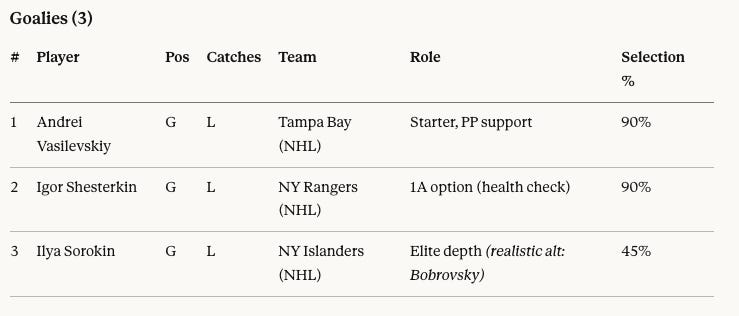
Goalies (3): Andrei Vasilevskiy (Tampa Bay); Igor Shesterkin (NY Rangers); Ilya Sorokin (NY Islanders). Realistic alt: Bobrovsky over Sorokin on legacy.
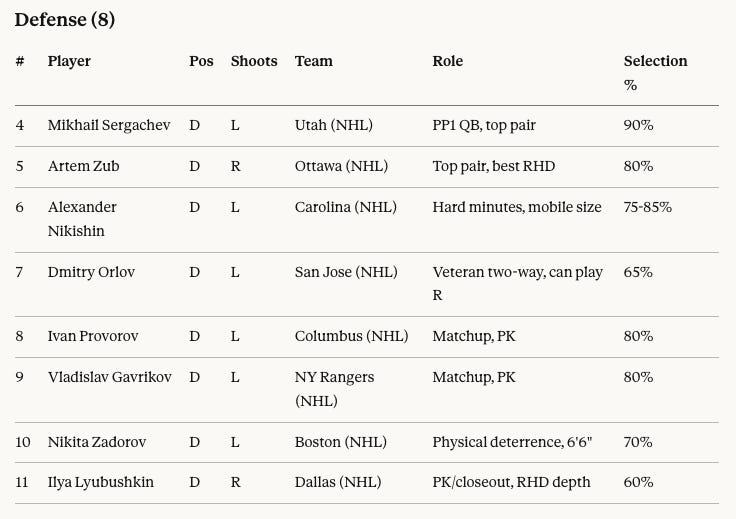
Defense (8): Mikhail Sergachev (Utah); Artem Zub (Ottawa); Alexander Nikishin (Carolina); Dmitry Orlov (San Jose); Ivan Provorov (Columbus); Vladislav Gavrikov (NY Rangers); Nikita Zadorov (Boston); Ilya Lyubushkin (Dallas).
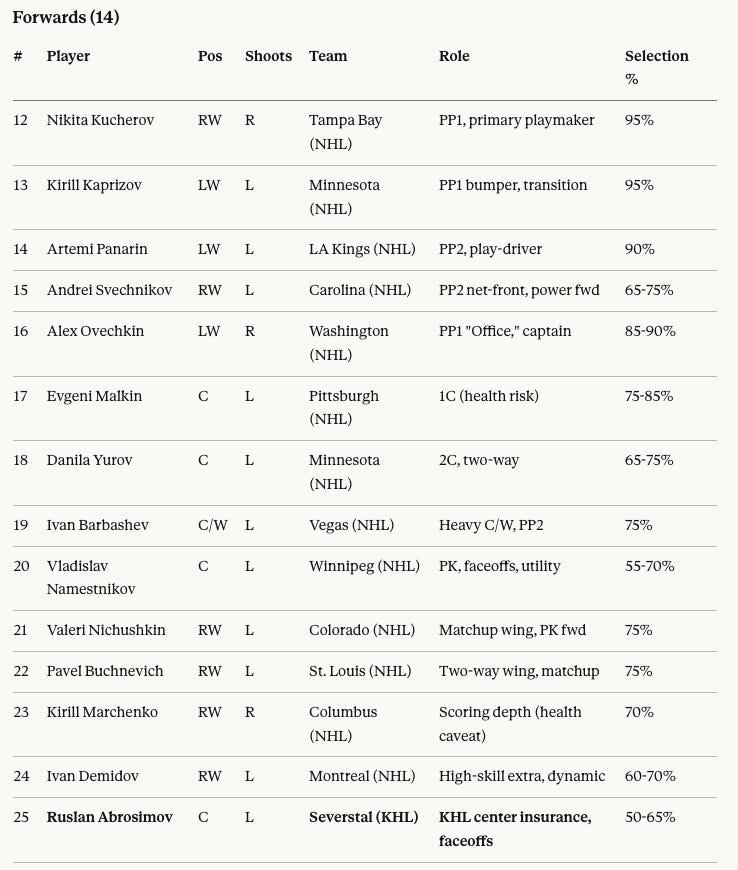
Forwards (14): Nikita Kucherov (Tampa Bay); Kirill Kaprizov (Minnesota); Artemi Panarin (LA Kings); Andrei Svechnikov (Carolina); Alex Ovechkin (Washington); Evgeni Malkin (Pittsburgh); Danila Yurov (Minnesota); Ivan Barbashev (Vegas); Vladislav Namestnikov (Winnipeg); Valeri Nichushkin (Colorado); Pavel Buchnevich (St. Louis); Kirill Marchenko (Columbus); Ivan Demidov (Montreal); Ruslan Abrosimov (Severstal, KHL).
Note: Abrosimov is the "this is what Russia would actually do" selection—center depth insurance + faceoff/PK utility + domestic league representation. Voronkov is the first call-up if Russia goes pure NHL.
Hard Cuts and Why
The final roster decisions reveal how this team was built—and where “realistic Russia selection” might diverge from pure merit.
Matvei Michkov (29 points, -7): The talent is obvious, but Russia can already ice three elite scoring lines. He’s a true bubble player. If Marchenko’s health fails, Michkov becomes the first call-up.
Pavel Dorofeyev (41 points, 24 goals): The cleanest “if you want more finishing” alternative. He’s having a legitimately strong season with Vegas. Same logic applies: wing depth is already stacked.
Evgeny Kuznetsov (KHL, Metallurg Magnitogorsk): A question mark, not a lock. The skill is obvious (37 pts/39 GP in KHL last season), but he’s been outside the NHL and his form against NHL-caliber competition is unproven. Probably not a core selection but a KHL lever. A realistic Russia build might include him; a merit build probably doesn’t.
Yakov Trenin (Minnesota): Strong PK/checking option, but Namestnikov’s faceoff edge pushes him to the bubble.
Alexander Romanov: Would otherwise be a depth-lock defenseman, but he underwent shoulder surgery with a 5–6 month timeline that makes February availability unlikely. Too many questions with the injury.
Daniil Miromanov (RHD): The idea (a third right-shot option) makes sense on 60×26m ice, but the case collapses if he's not a clear, nightly NHL defenseman. In a "most likely" Russia build, a coach leans toward proven NHL minutes and legacy comfort—meaning Orlov is a more realistic selection even if it creates handedness/pairing compromises.
Vladimir Tarasenko (34 years old): A respected veteran winger, but edged out by younger options with more pace. Discussed further in the “Last Dance” section as a player whose final Olympic window closes here.
"Merit" vs "Realistic Russia" Selection: What Changes?
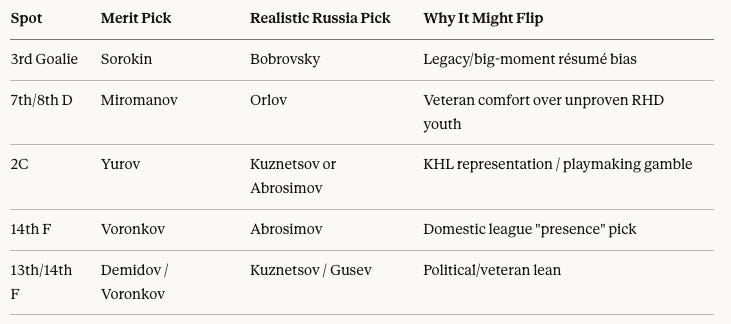
The Pure Merit Roster
If Russia built purely on current-season NHL production and role-fit without any legacy bias or KHL representation considerations, the 25-man would look like this:
Goalies: Vasilevskiy / Shesterkin / Sorokin (not Bobrovsky)
Defense: Sergachev / Zub / Nikishin / Provorov / Gavrikov / Zadorov / Lyubushkin (identical to most likely)
Forwards: Kucherov / Kaprizov / Panarin / Svechnikov / Ovechkin / Malkin / Yurov / Barbashev / Namestnikov or Trenin / Nichushkin / Buchnevich / Marchenko / Voronkov / Demidov
Key differences from the “realistic Russia” build:
Sorokin over Bobrovsky (current-season numbers win)
Yurov locked at 2C (NHL reps over KHL form questions)
No Abrosimov or Kuznetsov (no KHL leapfrogs when NHL options exist)
Demidov guaranteed a spot (46 points as a 20-year-old is undeniable)
How Much Better Is the Merit Roster?
Not much. The medal equity difference is roughly 1-2 percentage points in gold probability and 2-4 percentage points in medal probability.
Why?
The core is identical. Vasilevskiy/Shesterkin, Kucherov/Kaprizov/Panarin, and Malkin (when healthy) are locks in both scenarios. That’s where 80%+ of Russia’s win equity comes from.
The variance is in the 4th line and 3rd goalie. Those spots matter in specific game states (Bobrovsky might steal a game Sorokin wouldn’t; Abrosimov might win a crucial faceoff Demidov wouldn’t), but they don’t swing series outcomes.
Russia’s ceiling is the same either way. The “fully healthy + hot goalie” scenario doesn’t depend on whether the 14th forward is Demidov or Abrosimov.
Where the merit roster gains an edge:
Depth scoring. Demidov/Voronkov as extras gives you more offensive firepower if you’re trailing in an elimination game.
Goalie insurance. Sorokin’s current-season form is better than Bobrovsky’s; if Vasilevskiy or Shesterkin gets hurt, the drop-off is smaller.
Pace. Younger legs (Yurov, Demidov) handle the 60×26m ice better than veterans whose foot speed has declined.
Overall: The merit roster is marginally better—maybe the difference between +300 and +280 gold odds—but the “realistic Russia” roster is still a legitimate medal contender. The selection philosophy debate is interesting but not decisive.
Building a counterfactual Russian roster requires balancing statistical meritocracy against political reality.
The Russian Ice Hockey Federation (FHR), historically influenced by external pressures, has often favored domestic KHL players.
However, facing full NHL rosters from Canada and the USA, our model assumes pragmatic selection—prioritizing NHL performance while acknowledging inevitable KHL inclusions.
The position-by-position breakdown below explains why these 25 were chosen—and what the selection reveals about Russia’s structural strengths and weaknesses.
Goaltending: The Fortress
If there’s one position where this hypothetical Russian team asserts unequivocal global dominance, it’s in goal. The depth available to Russian selectors is peerless.
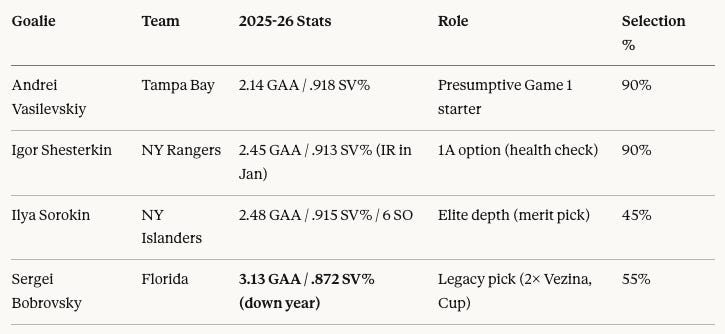
Andrei Vasilevskiy (Tampa Bay) has been the statistical pace-setter in 2025-26 (2.14 GAA, .918 SV% as of early February) and would likely start Game 1—but Russia is one of the only countries that can run a true 1A/1B without a drop-off.
Igor Shesterkin (NY Rangers) sits at 2.45 GAA/.913 SV% and offers elite technical positioning and puck-handling that functions like a third defenseman, though he hit injured reserve in January with a lower-body issue—an availability risk worth flagging.
Third Goalie Debate: This is where “best on paper” diverges from “realistic Russian selection.”
Ilya Sorokin (NY Islanders) has the better current-season numbers (2.48 GAA/.915 SV%, six shutouts) and is the pick on pure merit.
But Sergei Bobrovsky (Florida) has the résumé: two-time Vezina winner, 2024 Stanley Cup champion, big-moment pedigree—though his 2025-26 numbers (3.13 GAA / .872 SV%) represent a clear down year.
If it’s close, Russia often leans veteran/legacy/big-moment résumé—that’s the Bobrovsky edge. The consolidated roster above uses Sorokin (merit), but a realistic submission might flip this.
Vasilevskiy—two-time Stanley Cup champion and Conn Smythe winner—remains the gold standard for high-stakes elimination games. This goaltending depth isn’t just a strength—it’s a tactical foundation.
Russia’s goalie edge can swing a single game by a goal or two and is the main reason they retain a real upset path against superior possession teams—a necessity given their defensive fragility.
Comparative Goaltending by Nation
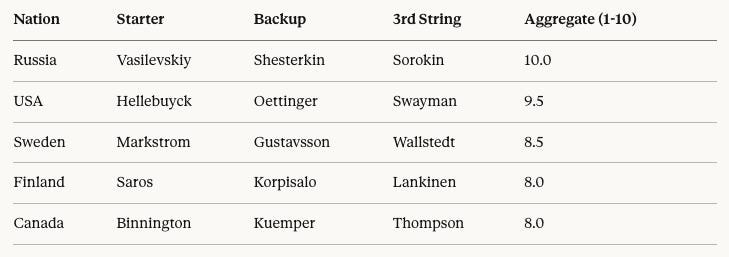
Russia’s trio of Vasilevskiy, Shesterkin, and Sorokin earns a perfect 10.0 aggregate rating.
The USA follows at 9.5 with Hellebuyck, Oettinger, and Swayman.
Sweden (Markstrom, Gustavsson, Wallstedt) rates 8.5.
Finland (Saros, Korpisalo, Lankinen) and Canada (Binnington, Kuemper, Thompson) both sit at 8.0. No other nation approaches Russia’s depth at this position.
Defense: A Managed Weakness
The defensive unit shows real improvement from previous Olympic cycles, but carries a handedness imbalance that requires active roster construction to mitigate—not ignore.
The Handedness Constraint: Modern hockey systems rely on D-to-D passes and quick transitions. Playing a defenseman on their “off-side” creates split-second delays that matter against aggressive forechecks. Russia’s left-shot depth is elite: Sergachev, Provorov, Nikishin, Gavrikov, Zadorov. But the right side is thin. The roster must deliberately carry multiple right-shot NHL defensemen even if they aren’t stars, turning a potential fatal flaw into a managed weakness.
On a 60×26m surface, retrieval speed and first pass still matter enormously, but the geometry is much closer to NHL forecheck/exit patterns than traditional international ice. Heavy defensemen aren’t automatically unplayable—they just need to be paired intelligently.
Projected Pairings:
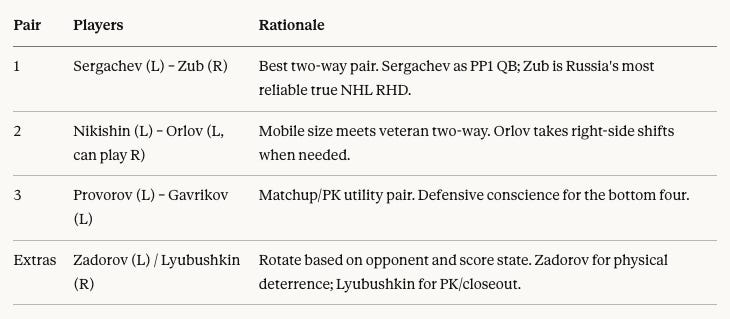
Pair 1: Mikhail Sergachev + Artem Zub combines the best offensive defenseman (38 points, PP1 quarterback) with Russia’s most reliable right-shot NHL blueliner.
Pair 2: Alexander Nikishin + Dmitry Orlov pairs mobile size (Nikishin: 22 points as a rookie, rare Soviet-era physicality with modern mobility) with a veteran two-way defensemen who can take right-side shifts when needed.
Pair 3: Ivan Provorov + Vladislav Gavrikov is pure matchup and PK utility.
Extras: Nikita Zadorov (6’6”, physical deterrence) + Ilya Lyubushkin (right-shot, ugly-minutes PK specialist) rotate as extras depending on opponent and game state.
Missing Pieces: The lack of a true offensive RHD (like Cale Makar or Adam Fox) means the Russian power play must run through the half-wall rather than the point. But carrying Zub and Lyubushkin as right-shot options—plus Orlov's ability to take right-side shifts—gives Russia enough flexibility
Forwards: Elite Wings, Center Gap
The forward group is defined by stark dichotomy: an overabundance of world-class wingers and a genuine gap at center ice—though “catastrophic deficiency” overstates it. Russia doesn’t lack centers; it lacks Canada/USA-tier prime 1C/2C play-driving centers. The gap shows up in matchup minutes, defensive-zone exits under pressure, and PK faceoff leverage.
The Star Wings:
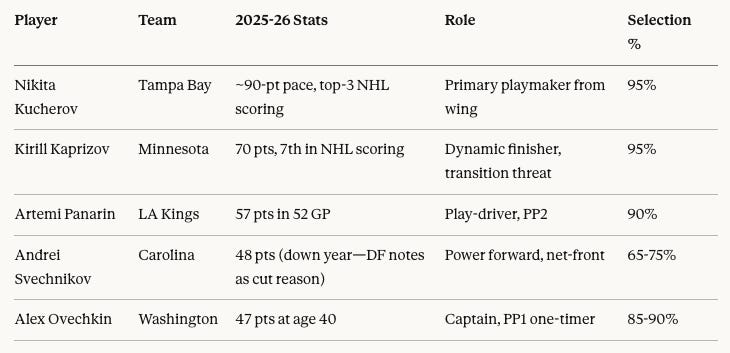
Nikita Kucherov (Tampa Bay) is producing at a 90-point pace and sits top-3 in NHL scoring—functioning as the primary playmaker from the wing despite the position label.
Kirill Kaprizov (Minnesota) sits 7th in NHL scoring with 70 points and serves as the dynamic finisher and primary transition threat capable of breaking neutral zone traps individually.
Artemi Panarin (traded to the Los Angeles Kings) still drives play at a high level with 57 points in 52 games.
Andrei Svechnikov (Carolina) provides 48 points of power-forward production and net-front presence. He has had a down year and could be cut, but he’s still in the “likely” bucket.
Alex Ovechkin (Washington), at 40 years old with 47 points, remains the Captain, spiritual leader, and a still-lethal power-play weapon—both major projections keep him despite his age. (Zero chance Russia would go without Ovi… you have to take him.)
The Center Spine (Where the Roster Gets Creative):
This is where “realistic selection” matters most. Russia’s center scarcity forces compromises, and Russian picks can get weird/political.
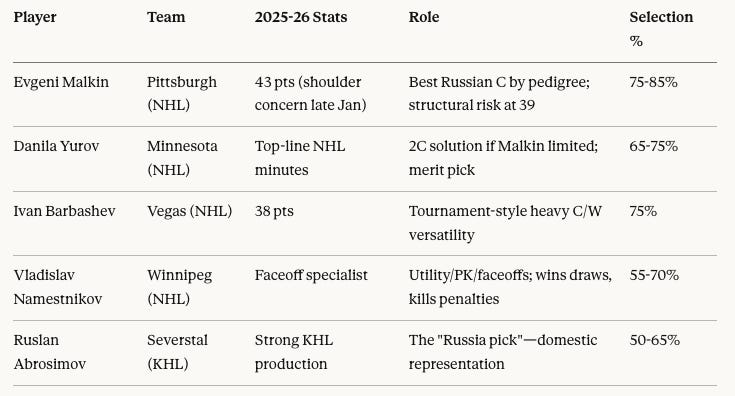
Evgeni Malkin at 39 remains Russia’s most proven center (43 points) but his foot speed has declined, and a late-January shoulder issue creates real availability risk. If Malkin is limited, Russia’s win condition shifts even harder toward special teams and goaltending variance. He’s Russia’s most proven center option—the only reason this isn’t a 90%+ lock is health/age.
Danila Yurov (Minnesota) is the best No. 2 center candidate—he’s earned top-line minutes in the NHL and solves the “who plays 2C if Malkin is limited” problem. This is a merit-based selection.
Ivan Barbashev (38 points) provides tournament-style heavy center/wing versatility.
Vladislav Namestnikov (Winnipeg) isn’t a points play—he’s the utility/PK/faceoff selection as a necessary tradeoff when you’re center-thin. He won’t score much, but he wins draws and kills penalties.
Ruslan Abrosimov (Severstal Cherepovets, KHL) is the most “realistic federation” pick: a KHL center who helps solve the center/faceoff problem and represents the domestic league. KHL centers including Abrosimov are worth considering because of the shallow NHL center pool, and his strong KHL production makes the call-up defensible.
Two-Way + Matchup Wings (How You Survive Canada/USA):
Valeri Nichushkin (34 points)—big, defensively reliable, valuable for his role even when not lighting the lamp.
Pavel Buchnevich (34 points)—consistent two-way wing. These are the players who allow Russia to actually deploy matchup lines against McDavid and Matthews without hemorrhaging chances.
Kirill Marchenko (46 points; health caveat but expected back soon).
Ivan Demidov (46 points as a 20-year-old rookie; dynamic). The “break glass in case of trailing” option who rotates in based on opponent and game state.
On the Bubble:
Yakov Trenin is the PK/faceoff/checking specialist every short tournament roster needs.
Evgeny Kuznetsov, now playing in the KHL with Metallurg Magnitogorsk, is a wild card. Russia needs a second playmaking center, and Kuznetsov’s skill set theoretically fills that hole—but his current conditioning and form against NHL-level competition is an open question. He’s a “if Russia gets political” or “goes KHL-heavy” lever rather than a core selection.
Dmitri Voronkov (32 points; size, net-front, forecheck utility).
The Roster Math: You can only take 4-5 centers on a 14-forward roster. The “most likely” build uses Malkin/Yurov/Barbashev/Namestnikov/Abrosimov. A pure merit build would swap Abrosimov for Voronkov or another NHL forward. Kuznetsov is a question mark in either scenario.
Tactical Systems
Power Play: The Lethal Weapon
If Russia is to compete, their PP must operate at historically high efficiency (30%+). On 60×26m ice, this is NHL-style power-play geometry—and Russia’s personnel is built for it.
PP1 (Built to Force Impossible Coverage Choices):
Left Flank: Ovechkin (the “Office” one-timer)
Right Flank: Kucherov (primary puck handler)
Bumper: Kaprizov (dual-threat finisher)
Net Front: Nichushkin (screen)
Point: Sergachev (distributor)
PP2:
Half-Wall: Panarin + Svechnikov (playmaking + net crash)
Net Front: Barbashev (physical net presence)
Bumper: Malkin (veteran playmaking)
Point: Zub (low-risk distribution; keeps pucks in)
Opponents cannot cover both flanks on PP1 without yielding high-danger looks elsewhere. PP2 gives Russia a second unit that can still generate off pure skill—most nations can’t field that kind of depth on the second wave.
5v5 System: The Trap
Given their inability to match the center speed of Canada/USA, Russia would likely revert to a passive 1-2-2 neutral zone trap, forcing turnovers and counter-attacking with elite wingers.
On 60×26m, this isn’t “big-ice chess”—this is NHL-style pressure hockey.
The bottom-six must be functional, not decorative. That’s why Abrosimov, Barbashev, Buchnevich, and Nichushkin matter as much as the stars.
Penalty Kill: The Weakness
The PK remains the roster’s most vulnerable system.
Russia would rely on Namestnikov/Nichushkin and Barbashev/Buchnevich as forward pairs, with Zub-Gavrikov and Lyubushkin-Provorov as primary D looks.
Namestnikov’s faceoff edge is critical here—winning defensive-zone draws reduces the time spent under siege.
Discipline is historically an issue for Russian tournament teams, and taking penalties against Canada or USA would be disastrous.
How Competitive Would Russia Be?
Current Market Without Russia
Sportsbooks pricing the actual 2026 tournament show a clear top tier (FanDuel, early Feb 2026; Russia excluded):
Nation Gold Odds:
Canada +120
USA +210
Sweden +600
Finland +1100
Canada opens as favorite at +120. The USA follows at +210. Sweden sits at +600, with Finland at +1100 and the rest of the field at longer odds (Russia excluded).
Where Russia Would Slot In (Odds)
A reasonable handicap would slot Russia as a third favorite.
The table below separates two scenarios—because readers should know what these estimates are conditioned on.
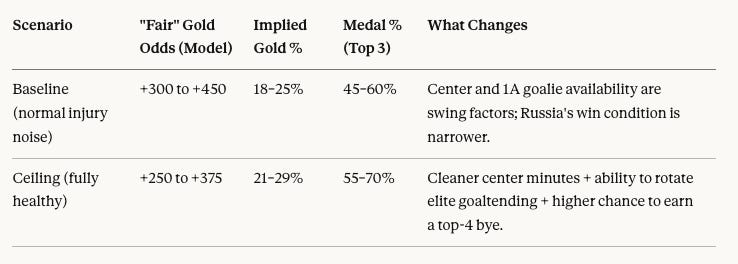
The baseline estimate (+300 to +450) assumes normal “tournament reality”: at least one core piece arrives limited or misses time. The confidence level is medium, reflecting three key variables: (1) Malkin’s health, (2) Shesterkin’s availability, and (3) whether Kuznetsov is truly in top form against NHL-caliber competition.
The ceiling estimate (+250 to +375) assumes everything breaks right. A scenario worth modeling because it changes Russia’s competitive profile in structural ways.
These are estimates, labeled as such. A reasonable handicap would slot Russia as a third favorite in either scenario.
Ceiling Case: Fully Healthy Russia (Hypothetical)
All of the estimates above assume normal “tournament reality”: at least one core piece arrives limited (or misses time) because the Olympic window is short and the roster is only 22 skaters + 3 goalkeepers (with just 20 skaters + 2 goalkeepers dressed per game).
Concretely, “full health” means: Shesterkin is available as a true 1A option, Malkin is not limited, and Russia’s key 2-way load-bearers (the guys who make the stars playable in best-on-best matchups) are at full stride.
If those conditions hold, Russia shifts from “needs a steal” to “live underdog with multiple win-paths.” The upside is mostly structural: (1) the full goalie stack is intact, and (2) center minutes don’t collapse under matchup pressure.
That makes it easier to earn a top-4 seed (bye to the quarterfinals) and lessens dependence on one goalie stealing every elimination game.
Net effect: roughly +3-4 percentage points of implied Gold Medal. Still not favorites over Canada/USA, but meaningfully more dangerous.
The tragedy is that we’ll never know which version of Russia would have shown up.
Strengths: Elite wing firepower (multiple top-10 NHL scorers), the tournament’s best three-goalie pool, and a defense deep enough to survive when goaltending holds.
Weaknesses: Same constraint as above—center depth, especially in matchup hockey against Canada/USA/Sweden. Single-elimination variance. And key injury risks (Malkin, Shesterkin, Marchenko) that could narrow Russia’s margin from “multiple win-paths” to “needs everything to break right.”
Even-Strength Lines (One Plausible Deployment)
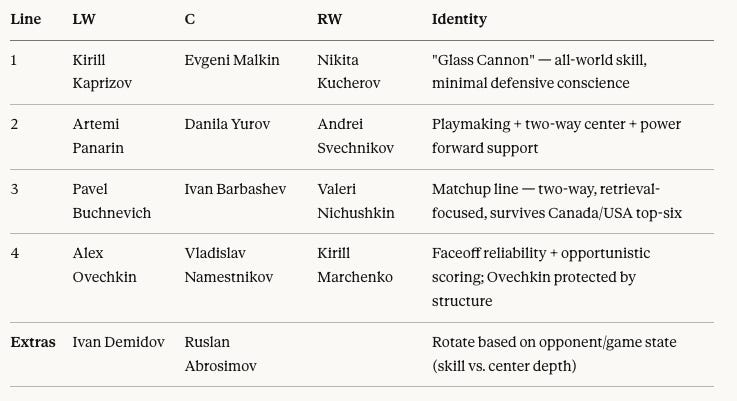
Line 1: Kaprizov–Malkin–Kucherov is the “Glass Cannon”—all-world skill with minimal defensive conscience. You deploy this against weaker opponents or when chasing a game; you shelter it against McDavid/Matthews.
Line 2: Panarin–Yurov–Svechnikov pairs elite playmaking with a two-way center who can handle matchup minutes and power-forward support on the right side. Yurov’s defensive awareness makes this line deployable in more situations than Line 1.
Line 3: Buchnevich–Barbashev–Nichushkin is the matchup line—two-way, retrieval-focused, built to survive Canada/USA’s top-six without hemorrhaging chances. This is the line that plays against McDavid.
Line 4: Ovechkin–Namestnikov–Marchenko blends faceoff reliability with opportunistic scoring, keeping Ovechkin protected by structure rather than exposed by matchup. Namestnikov wins the draws; Ovechkin and Marchenko finish the chances.
Most-likely roster extras: Demidov rotates in when you need skill; Abrosimov rotates in when you need center depth/faceoffs/PK stability.
Pure-merit roster extras: Demidov + Voronkov are the first skill/size swaps, with no KHL center included.
Head-to-Head Matchup Analysis
vs. Canada (The Favorites)
Canada’s center depth (McDavid, MacKinnon, Crosby, Suzuki, Horvat, Celebrini) would dominate the middle of the ice and drive possession. Russia would spend long stretches defending. *Note: Point is out with injury.
The X-Factor is still Vasilevskiy—if he steals the game, Russia can win 3-2 on special teams. Prediction: Canada wins ~70% of simulations; Russia wins via goaltending theft + power-play efficiency.
Full-health modifier: If Russia has a healthy 1C (Malkin) and a fresh 1A/1B goalie rotation, this shifts from “needs a theft” to “can win 1 out of ~3–4 games”—still an underdog, but not a long shot.
vs. USA (Speed Demons)
Team USA’s blue line is built on pace and retrievals (Quinn Hughes, McAvoy, Werenski, Sanderson), and they’d target Russia’s off-side defensemen with dump-ins and aggressive forechecks. Russia’s defenders would struggle to turn and retrieve pucks cleanly.
The X-Factor: physicality. If Russia slows the game down and turns it into a grind (Ovechkin, Zadorov, Nichushkin), they can disrupt the American attack. Prediction: USA wins ~60% of simulations based on speed and depth.
Full-health modifier: With full health, Russia’s risk of getting run out by pace drops, because they can keep two-way legs on the ice more often and play fewer “survival shifts” in their own end.
vs. Sweden (The Strategists)
Sweden’s defensive structure is elite (Hedman, Dahlin, Karlsson, Forsling/Lindholm) and is built to neutralize high-end wingers. But Sweden can be less explosive offensively than Canada/USA. Russia can score from nothing.
Prediction: Pure toss-up (50/50), likely a low-scoring chess match decided by a single power-play goal.
Full-health modifier: Full health pushes a true 50/50 into a slight Russia lean, because Sweden’s structure is less punishing than Canada/USA’s center pressure, while Russia’s finishing/goaltending edge remains.
Where Russia Ranks Among 2026 Rosters (If Allowed)
Using the current market hierarchy as baseline:
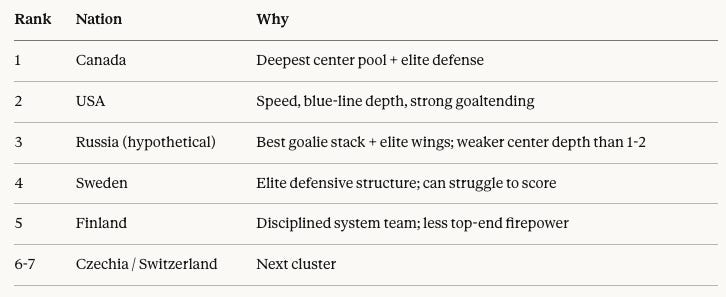
Canada sits atop the hierarchy with the deepest center pool and elite defense.
The USA follows with speed, blue-line depth, and strong goaltending.
Russia (hypothetical) would slot third—best goaltending stack in the tournament plus elite wings, but structurally weaker at center than the top two.
Sweden’s elite defensive structure keeps them dangerous, though they can struggle to score.
Finland rounds out the top five as a disciplined system team with less top-end firepower.
Then Czechia and Switzerland as the next cluster.
The Last Dance: Final Olympics for Legends
The cruelest aspect of this ban is timing.
For several Russian stars, 2026 would have been their final realistic Olympic window—and because NHLers missed 2018 and 2022, they’ve never played best-on-best Olympic hockey at all.
Near-Lock “Last Dance” Tier
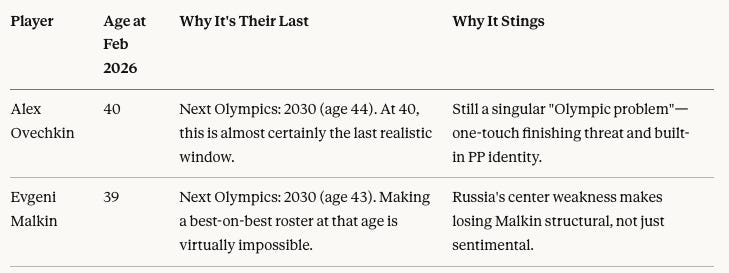
Alex Ovechkin turns 40 by February 2026. The next Olympics would be 2030 when he’d be 44—at 40, this is almost certainly his last realistic window. He remains a singular “Olympic problem”: a one-touch finishing threat and built-in power-play identity.
Evgeni Malkin turns 39 by the tournament. The next Olympics would see him at 43—making a best-on-best roster at that age is virtually impossible. Russia’s center weakness makes losing Malkin structural, not just sentimental; it fundamentally changes how competitive Russia would be. His late-January shoulder concern adds another layer—even in this hypothetical, his availability isn’t guaranteed.
“Last Chance” Veterans (Bubble / Honorable Mention)
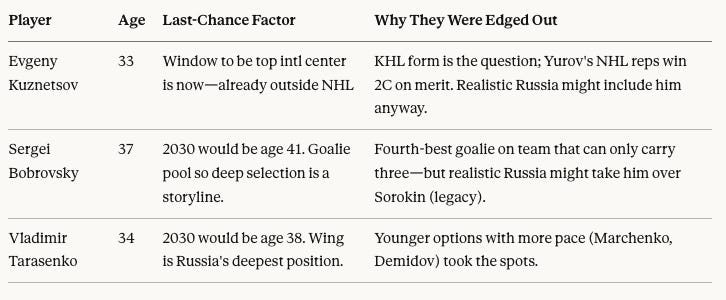
These players are not on the 25-man roster above but would be in the conversation—and their exclusion underscores how deep Russia’s talent pool runs, and how painful the ban is for individuals whose windows are closing.
Evgeny Kuznetsov at 33 isn’t aging out in the traditional sense, but the window for him to be a top international center is now—and he’s already outside the NHL in 2025-26. His skill set theoretically fills Russia’s 2C hole, but Yurov’s NHL production wins on merit. A realistic Russia submission might include Kuznetsov anyway—which would make this his last best-on-best window regardless.
Sergei Bobrovsky at 37 would be 41 by the 2030 Games. Russia’s goalie pool runs so deep that his selection itself would be a storyline—he’d likely be the cut. Either way, this was probably his last best-on-best window.
Vladimir Tarasenko at 34 would be 38 by 2030. Wing is Russia’s deepest position, meaning older wingers get squeezed first—exactly the profile of a player who misses his only remaining Olympic window.
The Generational-Loss Point
Because NHL participation resumes only now (first since 2014), the tournament loses the only realistic Olympic stage for these headliners against full-strength Canada/USA. The “Crosby/McDavid/Matthews generation vs. Ovechkin/Malkin + Russia’s prime wingers/goalies” is not something you can reschedule. The next Olympics is 2030, and a big chunk of the “legend tier” on both sides won’t be there.
What the Tournament Loses
1. An Elite Contender Tier Team
Instead of a top tier that looks like “Canada/USA,” you’d likely have three top-tier favorites (Canada/USA/Russia) plus Sweden as a genuine threat. Russia’s exclusion removes multiple top-10 NHL scorers (Kucherov, Kaprizov) and a three-goalie pool that would be the best in the tournament.
2. Star Power and “Best-on-Best” Credibility
The hypothetical roster core includes multiple global headliners plus elite goalies. That’s a meaningful reduction in credibility for a tournament explicitly marketed around the return of NHL stars.
3. Fewer Marquee Matchups, Wider Gap
With Russia absent, the field includes longer-shot teams (France, Italy, Denmark, Latvia) priced far behind the favorites. If Russia were in: more true heavyweight games (Canada-Russia, USA-Russia, Sweden-Russia) earlier and in elimination rounds, and less separation between “favorites” and “the field,” with Russia absorbing win probability currently sitting with Canada/USA.
4. Historical Context
Russia/ROC have been right there at recent Olympics even without NHLers: in 2018, Olympic Athletes from Russia won gold, and in 2022, ROC won silver (lost 2-1 to Finland in the final). That history supports the idea that their exclusion removes a team that very plausibly sits in the medal conversation—now with their actual NHL stars.
5. The Asterisk on the Gold Medal
A gold won by Canada or USA will carry the silent caveat: “But you didn’t have to beat Vasilevskiy.” It mirrors the difference between the 1976 Canada Cup (revered because everyone was there) versus the 1980 or 1984 Olympics (which lacked the best professionals).
Final Verdict
The hypothetical 2026 Russian Olympic team is a study in extremes. It sucks we won’t get to see them play.
They possess the highest ceiling of any team in the tournament due to their ability to shut out an opponent (Vasilevskiy) and score from nothing (Kucherov/Kaprizov).
However, they also possess a lower floor than Canada or the USA due to structural flaws at center ice and on the blueline.
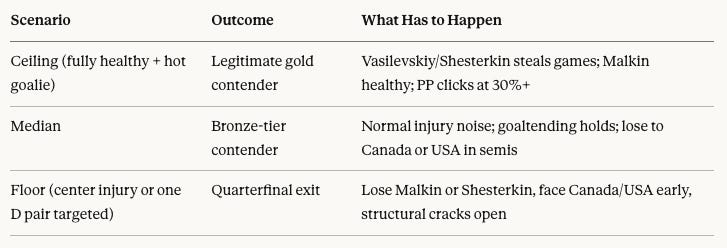
Median outcome: Bronze.
Ceiling (fully healthy + hot goalie): Gold.
Floor: Quarterfinal exit.
That’s the cleanest summary of what Russia would be: dangerous enough to win the tournament, fragile enough to lose early, and most likely somewhere in between.
Ultimately, the loss of Team Russia is a tragedy for the sport’s spectacle, if not its geopolitics.
The 2026 Milano-Cortina Olympics will crown a champion, but the absence of the “Red Machine” ensures that the question of who is truly the best in the world remains partially unanswered.
The hockey world is left with a phantom contender—a team that exists only on paper, yet looms large over every game played in Milan.
The 2026 Men’s Olympic Hockey tournament runs February 11-22.