

On February 2, 2026, SpaceX acquired xAI in what Reuters described as the largest M&A transaction ever, valuing the combined entity at ~$1.25 trillion.
SpaceX = $1 trillion
xAI = $250 billion
This wasn’t “Skynet,” and it wasn’t mere “financial engineering.”
Near term: Makes xAI financially durable enough to keep buying compute and competing for talent.
Long term: Potential orbital data centers as a way around Earth’s power, cooling, and permitting constraints.
The Deal (What Actually Happened)

The structure is straightforward: a share-based acquisition.
xAI investors receive 0.1433 shares of SpaceX for each xAI share
Some executives reportedly given a cash-out option at $75.46/share
No new outside capital raised as part of the merger (this is consolidation, not a fundraise)
And because xAI previously absorbed the social platform X through a share swap, SpaceX now effectively controls:
An AI lab (xAI + Grok + Colossus training infrastructure)
A major social platform (X)
The world’s largest satellite internet constellation (Starlink)
That X ownership is not a footnote. In March 2025, xAI acquired X in an all-stock deal valued at $33 billion (with $12 billion in debt), explicitly to combine “data, models, compute, distribution.”
This merger is SpaceX inheriting the entire consolidated stack.
Why This Deal Happened: xAI Compute Burn Rate
Strip away the hype and the driver is obvious: frontier AI is a money furnace.
xAI was burning roughly ~$1B/month.
Internal financials cited by Bloomberg show:
$1.46B net loss in Q3 2025 (ended Sept. 30) on just $107M revenue
$7.8B in cash burned over the first nine months of 2025
Earlier reporting pegged expected annual burn at ~$13B (~$1.08B/mo)
xAI raised $20B in January 2026 at a ~$230B valuation.
Four weeks later, the acquisition values xAI at ~$250B (the fast markup tells you how quickly this deal came together and how much investors viewed the SpaceX pairing as synergistic).
But even $20B isn’t “done” money at ~$1B/month.
It buys you something like 18–23 months of runway.
By mid-2025, xAI needed new funding partly because it had already spent most of what it previously raised.
It also raised $5B in debt and $5B in equity in mid-2025 through Morgan Stanley.
That treadmill matters because (as I’ve said for years):
The AI race is a hardware war.
You can reverse engineer AI labs’ models + strategies
You can buy + poach elite talent
Data is not as hard to get as you think
If you can keep buying compute and running repeated large training cycles, you stay in the game. If you can’t, you slide.
The immediate win here is not mystical synergy, it’s lower financing fragility.
The SpaceX IPO Pathway
The tell is the timing: merging before the IPO, not after.
By consolidating xAI inside SpaceX ahead of going public, Musk ensures that when IPO capital arrives, it flows into an entity that already contains the AI lab.
Post-IPO capital lands inside the parent and can be allocated internally, instead of xAI needing another standalone mega-fundraise on a timer.
This is cleaner, faster, and cheaper than any private round xAI could do on its own.
It changes the financing question from:
“Can xAI raise another $10–$20B round in time?”
To:
“Will the combined entity allocate capital to AI — and how much?”
That is an entirely different constraint profile.
SpaceX’s financial position makes this credible. Multiple outlets report SpaceX is weighing an IPO as early as June 2026 that could raise up to $50B at a roughly $1.5T valuation.
SpaceX also generated about $8B in profit (EBITDA basis) on roughly $15–16B in revenue last year, with Starlink driving 50–80% of total revenue.
This is where the math matters. If even 10–30% of IPO proceeds end up funding AI infrastructure, that’s an incremental $2.5B to $15B available for compute.
At xAI’s current ~$1B/month burn:
That extends runway by ~2.5 to 15 months
Total runway goes from ~18–23 months (Series E alone) to ~20.5 to 38 months
That’s a ~1.1x to 1.7x uplift in how long xAI can keep paying for frontier-scale training
And that’s before accounting for SpaceX’s own $8B annual EBITDA, which provides ongoing internal funding capacity that no standalone AI lab can match.
Post-IPO, SpaceX also gains access to public debt markets, secondary offerings, and all the other capital instruments that come with being a listed company — making future funding rounds for AI compute dramatically easier.
This is also consistent with earlier capital flows.
xAI received a $2B investment commitment from SpaceX as part of a separate fundraising round.
So the pattern is coherent: SpaceX was already functioning as a balance-sheet backstop before the merger — this deal just formalizes it. And merging before the IPO means the backstop becomes permanent.
This deal: (1) doesn’t make xAI win the AGI race or even make them the frontrunner… but it (2) reduces the chance xAI loses on the basis that it can’t keep paying for frontier compute.
The Orbital Compute Narrative: GPUs in Space?
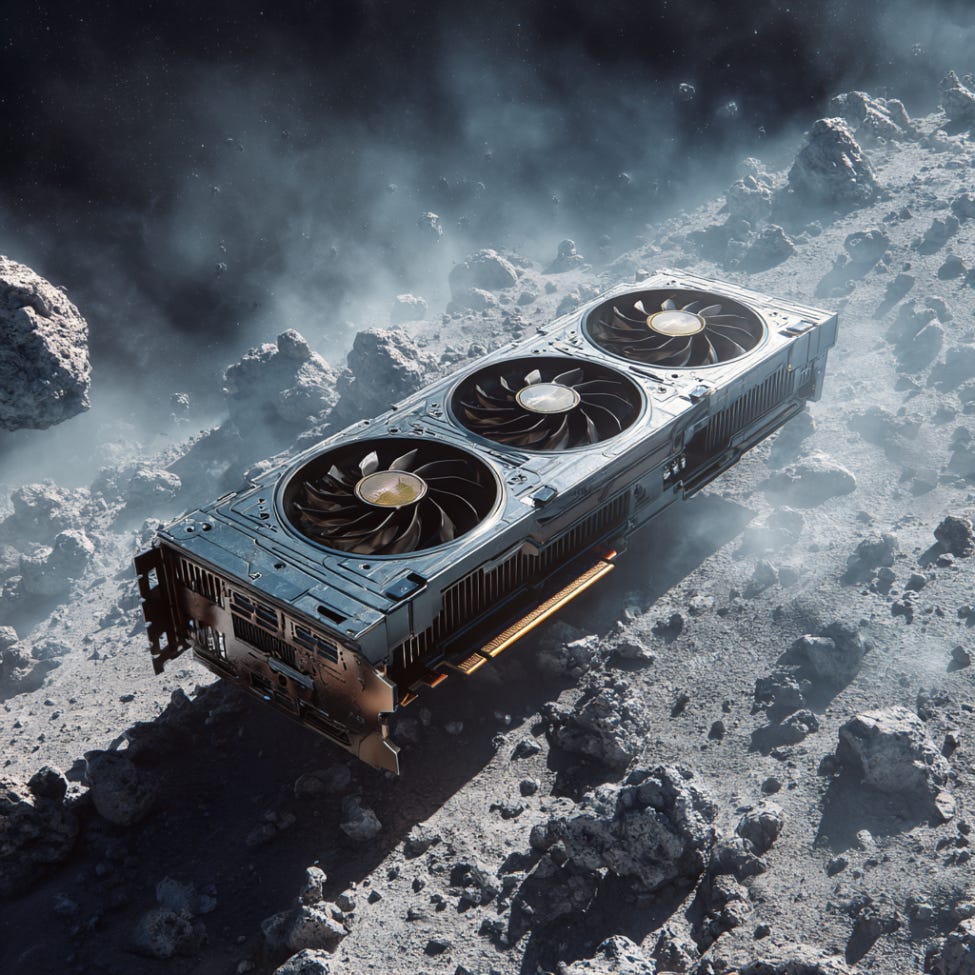
Musk’s long-term argument is that terrestrial AI data centers are running into physical constraints: power, cooling, permitting. As models scale, those constraints tighten.
His answer (at least as pitched) is to move a meaningful chunk of compute off-planet.
The concrete evidence behind that narrative is the FCC filing. Reuters reported SpaceX was in merger talks with xAI ahead of the IPO, and two days later SpaceX submitted an “Orbital Data Center System” application seeking authority to deploy up to one million satellites functioning as orbital data centers.
For context on that number:
Only about 15,000 satellites exist in orbit today. Starlink itself has roughly 9,500 and SpaceX previously sought FCC approval for 42,000 Starlink satellites — so “1 million” is an order-of-magnitude escalation even by SpaceX standards.
The filing claims, in essence:
Certain orbits allow near-constant solar exposure (framed as better energy economics)
Compute satellites could operate in shells between roughly 500–2,000 km, linked via optical lasers routed through the Starlink mesh
“Within a few years,” the lowest cost to generate AI compute will be in space
The plan bets heavily on Starship cost reduction and high launch rates (”millions of tons per year to orbit”)
Starship has test-launched 11 times since 2023; Musk expects first payloads to orbit in 2026
xAI becomes the anchor tenant for an entirely new compute infrastructure category.
And yes, the timing is extremely convenient.
File the visionary space-compute application → then announce the merger.
And the story becomes “unifying the stack for the next era” instead of “AI lab on a burn treadmill consolidates into the stronger parent.”
The FT’s headline was blunt: “How Elon Musk used SpaceX to rescue xAI.”
But who cares? It needed to be done… Elon is here to compete.
Will Orbital Data Centers Actually Work?
Orbital data centers only become a true moat if they scale *usable* compute (training + inference) faster/cheaper than hyperscalers; otherwise it’s a niche business, not a decisive edge.
The FCC filing’s headline scale claims are so large that the bottleneck shifts from “compute engineering” to industrial logistics: launch cadence, satellite megafactory throughput, and continuous replacement.
The question isn’t (1) “Can you run GPUs in orbit?” but (2) “Can you run an airline-like launch and manufacturing machine for years, and does the resulting compute perform like a real cluster for AI training?”
The filing’s logic is directionally plausible. Space has abundant solar input in certain orbits, and radiative cooling avoids the grid and water constraints of Earth-based facilities. If you could do it cheaply at scale, it’s a durable advantage.
But “works” depends on solving several hard problems:
Radiation and survivability. High-performance AI hardware isn’t built to live in persistent radiation. Shielding, redundancy, and fault tolerance add mass and cost, and they can eat performance.
Thermal management. Space is cold, but you can’t convect heat away — you must radiate it. For large power draws, that means huge radiator surfaces and serious thermal engineering. Cooling isn’t “free” in orbit; it’s a design and mass problem.
Training-grade networking. Inference can tolerate latency and partitioning. Frontier training is far less forgiving: it wants extremely fast interconnects, tight synchronization, and massive data movement. Whether orbital clusters can match the performance-per-dollar of the best terrestrial superclusters is unknown.
Launch economics and manufacturing throughput. A million-satellite-scale compute constellation isn’t incremental — it implies sustained, extreme manufacturing and launch cadence plus constant replacement and regulatory survival.
Debris and regulation. A compute constellation at that scale would trigger intense scrutiny: congestion, spectrum, collision avoidance, disposal, astronomy impact, geopolitics.
The read: Orbital compute is a high-variance bet with huge upside and a non-trivial chance of not mattering on the timeline of the current AI race.
Realistic near-term applications are probably narrower: (1) inference-as-a-service delivered globally via Starlink, (2) in-orbit processing for space-generated data, and (3) specialized government/defense compute. Those are the first footholds that could justify early versions while the hard problems get solved.
I’ll break the full logistics math and realistic milestone path out in a separate piece.
Some are skeptical: AWS CEO Matt Garman called orbital data centers “pretty far” from reality and “not economical,” explicitly pointing to rocket capacity and launch cost constraints. That’s a hostile witness (AWS is a competitor) but many consider the critique reasonable.
What This Changes for xAI (The Practical Impact)
Before this deal, xAI had the same choke points as every frontier lab: capital for compute, power and cooling, GPU supply, and distribution.
xAI is already operating at enormous scale.
The company claims its “Colossus” training infrastructure includes over 1 million H100 GPU equivalents across its data centers. Even discounting marketing language, that’s a facility footprint in the same weight class as the biggest labs.
After the deal, three things shift:
Financing fragility drops. xAI is no longer a standalone balance sheet that must repeatedly convince outside investors to write another $10–$20B check on schedule. The lab is now inside a trillion-dollar entity with a cleaner capital pathway and a stronger equity-comp story.
Distribution becomes native. Owning X plus Starlink gives xAI a distribution and connectivity surface that most labs don’t have — and it’s now fully consolidated under one parent.
Defense and government becomes a serious channel. Reuters reported that xAI has a Pentagon contract worth up to $200M to provide Grok products, and SpaceX already operates Starshield and works with U.S. government customers. The combined entity isn’t just “consumer AI plus space” — it’s also AI plus defense procurement plus classified satellite infrastructure, which can be lucrative and increases scrutiny simultaneously.
Can xAI Raid SpaceX Resources?
SpaceX has flight-critical obligations and government-contract realities that can’t be starved.
The cleanest lever here is money and infrastructure, not mass engineer transfer. Moving dollars to buy GPUs, build facilities, and expand compute is straightforward. Moving large teams off safety-critical aerospace programs is slower and constrained.
Compliance boundaries and contract sensitivity will shape how much can be shared operationally. Reuters has specifically flagged potential scrutiny around conflicts of interest, contract boundaries, and the movement of engineers and technology between the two operations.
In other words: xAI can benefit heavily without raiding SpaceX headcount, as long as the main transfer is capital allocation, procurement power, and infrastructure leverage.
Who Benefits More?
This deal primarily attacks xAI’s biggest weakness: funding continuity at frontier burn rates. It goes from “competitive but fragile” to “competitive and durable.” That’s probably the single most valuable thing any AI lab can get right now, because the frontier race is increasingly about who can sustain spending the longest, not just who spends the most in any given quarter.
Near term, it strengthens the IPO narrative and ties AI demand to the Starlink network surface — routing orbital data center traffic through Starlink’s laser mesh means growth in compute demand directly increases the value of SpaceX’s existing infrastructure.
Long term, if orbital compute becomes real at scale, SpaceX could own a compute infrastructure layer that would take any competitor a decade or more to replicate.
The asymmetry is variance. xAI’s gain is more certain and immediate. SpaceX’s gain is less certain but could be transformational.
Risks + What to Watch
1) Regulatory / national security scrutiny (SpaceX is a major government contractor)
Risk: Reviews or restrictions that limit integration (people, data, systems), slow execution, or create governance headaches.
Watch: Any explicit review language from NASA/DoD/intel stakeholders; new compliance walls; contract boundary language; public scrutiny about conflicts/valuation.
2) FCC orbital filing is a request, not approval
Risk: The “one million satellites” ask gets cut hard, delayed, or conditioned; debris/spectrum pushback slows everything; orbital compute stays theoretical.
Watch: FCC objections/filings, scope reductions, conditions, timelines; anything that indicates the constellation is being capped below “meaningful scale.”
3) Reputation/content risk from X + Grok
Risk: Content/moderation controversies spill onto SpaceX’s government trust and partnerships; advertiser/partner backlash; reputational drag.
Watch: Major moderation incidents, advertiser churn/recovery, and any sign government customers treat X/Grok exposure as a liability.
4) Integration friction (AI org vs safety-critical aerospace org)
Risk: Culture clash, slower decision cycles, talent churn, internal turf wars; or AI spend starving core SpaceX programs (or vice versa).
Watch: Org structure clarity, leadership assignments, retention/hiring signals, and whether integration is mostly capital/procurement (clean) vs personnel moves (messy).
5) Capital allocation / burn remains the gating constraint
Risk: Even post-merger, xAI still loses the compute race if spend gets throttled, the IPO slips, or burn stays extreme without revenue inflection.
Watch: IPO timing + use-of-proceeds language; capex guidance; burn vs monetization trajectory; whether AI infra spend is explicitly prioritized.
6) Proof-of-work for orbital compute (beyond filings)
Risk: Space compute remains narrative for years; hyperscalers solve terrestrial power faster than SpaceX can industrialize orbit.
Watch: Any real orbital-compute demo (even inference-only) that scales beyond PR; tangible hardware milestones; credible cadence.
Don’t Bet Against Elon…
It’s worth pausing on something before dismissing any of this.
Industry analysts, expert engineers, and mainstream tech commentators have a consistent track record of being wrong about Musk’s ability to execute:
X was supposed to shut down and die after he gutted the engineering team (“No way the platform survives losing all the talent”). It’s still running.
“You can’t build a supercluster the size of Colossus, it won’t work.” Elon did it.
“You can’t complete the Colossus buildout that fast!” Done in 122 days with 19 days to first training.
The list goes on. “No way Elon can do X-Y-Z” has been wrong often enough that the prior should have shifted by now. (Many have EDS)
That doesn’t mean every Musk timeline is real. Many of his predictions are exaggerated or absurdly embellished in the short term for hype and excitement — Tesla FSD being the most obvious example.
But the long-run pattern is clear: Elon keeps delivering on things that “experts” said were impossible, even if the delivery date slips. You’d be a fool to bet against him on a long time-horizon.
This also matters for recruiting. The orbital compute vision isn’t just an IPO narrative — it’s a talent pitch.
“Come work at xAI and you’re not just building AI models, you’re building AI infrastructure in space.”
For a certain kind of engineer (the ones who want to work on civilization-scale problems) that’s a potentially big draw.
Combined with the equity upside of a future SpaceX IPO, it gives xAI a recruiting angle that’s hard to replicate.
Overall
This deal makes xAI “Harder 2 Kill” in the current compute race, while giving SpaceX a long-dated option on a potentially dominant infrastructure play.
Near-term: The pragmatic story (runway, capital pathway, recruiting leverage) is immediate and concrete.
Long-term: The exciting story (orbital compute) is a real bet, but years out at minimum and loaded with hard engineering gates.
Wrap the pragmatic play in the ambitious one — that’s the strategy.
ANOTHER HIGH IQ MOVE BY ELON.