

Disclaimer: I’m not a lawyer. This is lay commentary and opinion based on publicly available video, official statements, and reporting. Nothing here is legal advice. Facts may evolve as new evidence is released.
Preface: How the Renee Good Narrative Evolved
Reacting immediately to the death of Renee Good after initial footage surfaced is something many people did.
I thought this was premature—the initial camera angle wasn’t great and we didn’t know the full sequence of events. I formed an initial opinion based on what I saw and then did more digging.
And in the process, I quickly identified the political spins from each side.
Primary Evidence Index
Before diving in, here are direct links to primary evidence and key reconstructions + coverage referenced below.
Reuters visual reconstruction (baseline frame-by-frame timeline)
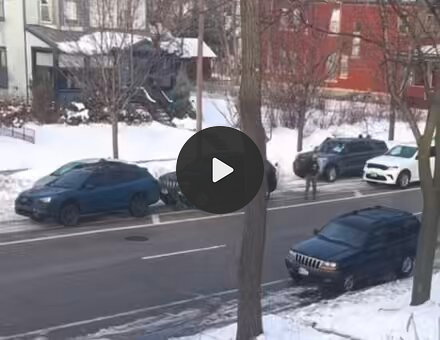
Pre-shooting overhead/bystander video (X)

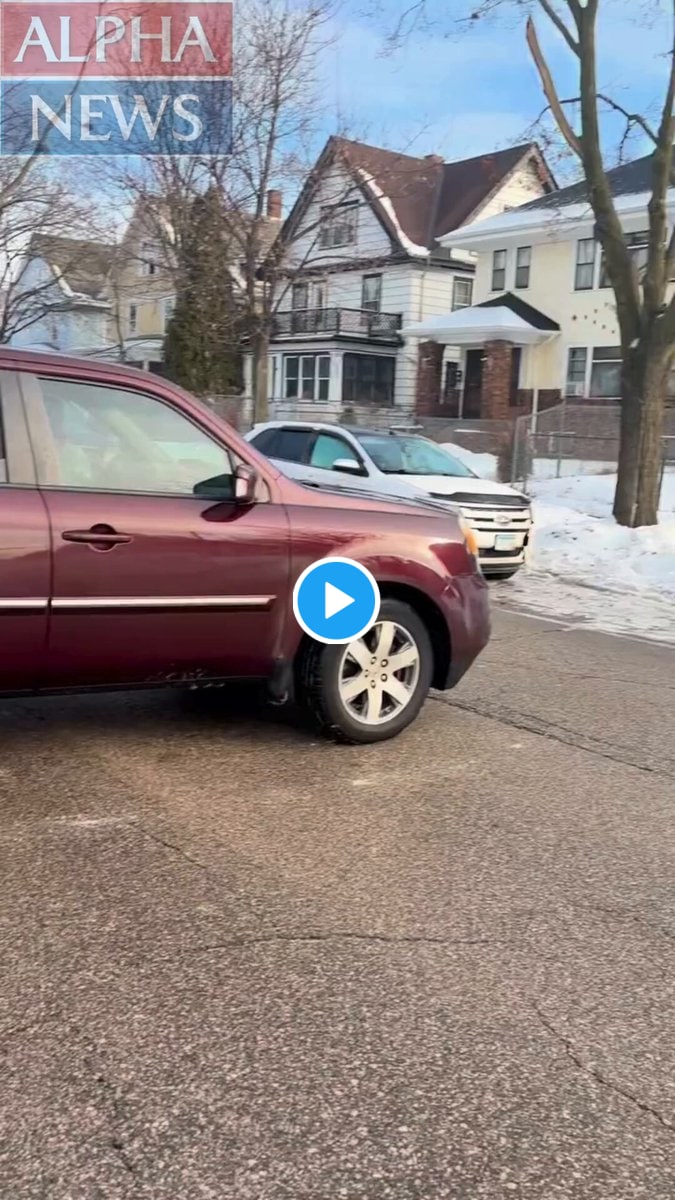
Agent-perspective/ICE video release point (AlphaNews on X)

Known (public): ICE operation in S. Minneapolis; Good in driver’s seat; agents in visible ICE-marked gear; wife outside yelling; vehicle accelerates; agent fires; Good dies.
Unknown (public): Exact contact mechanics (if/where the vehicle struck the agent); the agent’s footing; exact commands across all angles.
My inference (argued below): The decisive variable was noncompliance + attempted flight; the ideological ecosystem encouraged escalation.
The Left-Wing Framing
Left-wing media initially framed the incident as if Renee Good was a random lesbian soccer mom-type in the Greater Minneapolis area with zero knowledge of ICE, zero political affiliation, merely driving home after dropping her son off at school… wantonly murdered by ICE thugs for no good reason. Targeted at random by the “ICE Gestapo” for “existing.”
Woke sources like NPR put egregious spins on the events and included little info nuggets that nudged the psychology of the masses into thinking: “Yeah, she was 100% murdered.” Liberal media quickly claimed Good was told conflicting instructions by officers at the scene: (1) drive away vs. (2) get out of the car… and she chose Option 1, did nothing wrong, and bam… dead.
Initial videos made me think that perhaps Good was confused. Maybe she accidentally drove near an ICE operation zone, realized the ICE operation was going on, and quick tried to do a Y-turn to avoid the hassle but was killed. Or perhaps she was startled and thought it was a criminal gang pulling up on her—not actual ICE agents—and needed to flee the area.
Left-wingers reacted strongly to the initial footage with zero context… they didn’t need context or want it. The preliminary claims were: (1) Good had zero knowledge of ICE, (2) was just driving around (minding her own biz), and (3) was murdered by ICE.
A lot of early commentary talked like the agent fired only after she’d fully passed him—glossing over the fact that the first round went through the windshield while the SUV was still crossing his position.
So the implicit framing by left-wing media with “facts” was:
COLD. BLOODED. MURDER.
Left-leaning media organizations did not claim “murder” outright, but if you carefully analyzed how info was presented (subtleties, interpretations deliberately one-sided, certain facts omitted, logical inferences applied in one direction but not the other) you can infer what they wanted you to think.
The spin was presented as “just the facts.” (Left-wing media has a lot of smart people… arguably more smart people than the right-wing media… so they have a decisive advantage everywhere that isn’t “X” a.k.a. Twitter).
All logic in support of the ICE agent was half-assed or omitted.
The media presented the coverage as “unbiased” (“totally neutral” and “nonpartisan”)… with “experts” who analyzed everything frame-by-frame… and since they are “experts” they can apparently see and interpret better than you, better than me, and better than advanced AI.
The Narrative Starts Cracking
The virality of the story increased…. and unexpectedly the mainstream media pushes a weird narrative: Good was a “legal observer” of ICE.
This is odd. Which is it?
An apolitical woman driving home innocently after dropping her kid off at school?
Or was she a “legal observer” of ICE?
And what is a “legal observer of ICE” anyway? I’m curious (this was something I had never heard of).
The key question now wasn’t whether she was a mother; it became whether she was there intentionally in an “observer” capacity (i.e. potential interference/harassment)—with whistles, blocking traffic, spouse filming, verbal conflict with agents.
That was the first straw starting to break the camel’s back. A few more videos surfaced from different angles. Around this time the then-unverified rumor on the right-wing that Good was a member of “ICE Watch” began circulating heavily.
The left-wing quickly “debunked” this rumor by carefully stating well akshually there’s “technically no evidence” to sUbStAnTiAtE this claim. The reasoning applied? There is a specific group named “ICE Watch” and no evidence Good was a member of it.
The flaw in that logic? Should be obvious. Even if she wasn’t in the specific group called “ICE Watch,” this doesn’t mean she wasn’t part of a different activist group on “ICE watch” (i.e. watching for ICE) and alerting individuals being targeted for deportation, some of whom are likely criminals.
But then her own wife ended the debate.
In a statement to Minnesota Public Radio (MPR), Becca Good admitted:
“We had whistles. They had guns.”
Whistles are used to signal immigration agents are present (alerting undocumented people to flee and mobilizing others to come to the scene to record and discourage agents from lingering).
So regardless of formal membership in any named group, “whistles” are consistent with organized “ICE-watch” tactics.
She maybe wasn’t in the formal organization literally named “ICE Watch.” But she was clearly engaged in “ICE watch behavior.” We’d later find out from reporting that she participated in an “ICE observer neighborhood patrol” network. And all this becomes common sense when you learn “we had whistles”… easy to infer reality.
Then we get another overhead video of her blocking traffic for minutes, horns honking, whistles blaring, etc. Does that sound like some random neutral passerby who had “no idea what ICE was”?
Liberals frame “ICE watch” groups as people monitoring ICE activities to ensure ICE aren’t brutalizing people and are following laws, but the reality is different.
What’s actually happening with these “ICE watch” groups?
Well you got a glimpse of it from this incident. They’re often:
Interfering with ICE operations
Alerting criminals of possible deportation
Harassing ICE agents
Threatening ICE agents
Disturbing the peace
They are making life hell for people hired to enforce the law.
I would guess that most “legal observers” of ICE are actively conspiring against ICE (federal law enforcement) AND aiding and abetting criminals (even if they are too ignorant to realize that a subset of the people they’re helping are serious criminals).
Being empathetic to illegal immigrants following the laws is one thing… nobody enjoys deporting them. But if the U.S. has any hope of surviving as a country, enforcing immigration laws is 100% necessary. Furthermore, ICE prioritizes criminals… so blocking their operations makes the U.S. more dangerous because they have a tougher time arresting gangsters.
I would guess that a majority of ICE agents are humane as long as the people they are arresting are compliant and not dangerous narco-terrorists/gang members. Thinking otherwise is downright delusional.
The Pre-Shooting Video: Blocking Traffic + “Dancing”?
Eventually came the video that the “innocent mom” narrative couldn’t explain.
In a pre-shooting overhead video, Good’s SUV remains positioned at an angle across the roadway with honking audible, while she appears to rock/sway in her seat—behavior many social media users described as “dancing.”
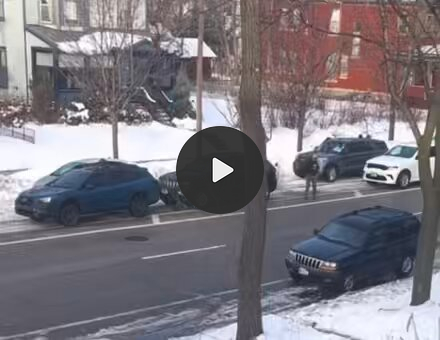
This no longer appeared to be a terrified woman confused by a chaotic scene. This was someone treating a dangerous and serious law enforcement operation as a performance.
The behavior was inconsistent with a confused or terrified driver; it aligned much more closely with someone mocking federal law enforcement and treating an active police scene as a joke.
The GoFundMe Machine
While the facts were still being disputed, the financial engine of the narrative was already running.
Renee Good’s widow and family
A GoFundMe campaign for Good’s family rapidly raised significant funds, capitalizing on the early “unprovoked murder” framing before the full context of the antagonism, the whistles, and the rocking/swaying behavior came to light.
As displayed on GoFundMe on January 11, 2026, the fundraiser showed $1,503,387 raised, 38.5K donations, and Donations paused.
ICE Officer Jonathan Ross
A separate GoFundMe campaign in support of ICE Agent Jonathan Ross emerged:
As of Jan 13, 2026, the fundraiser showed $635,099 raised of $800k.
Misinformation on Both Sides
After the initial commotion, a clipped/low-res clip that looked doctored to a lot of people surfaced in right-wing social media circles that made it look like Good tried to hit the ICE agent and run him over. It was blurry, went viral, and lacked context.
The right-wing had a subtle misinformation problem.
(Separately, WIRED reported people were using AI face-enhancement to falsely identify the agent—more social media distortion on both sides.)
There were also alleged deepfakes of Good and her spouse mocking the death of Charlie Kirk. (I have no way of knowing whether these were legitimate or fake, but “fact checkers” claimed fake so I’ll give them the benefit of the doubt.)
Additional Facts Emerge
The facts continue evolving… we find out more.
The 10-year veteran ICE agent associated with the shooting—identified by the Star Tribune and court records as Jonathan Ross—had recently been dragged by a vehicle in June 2025 and received 33 stitches in a very similar scenario.
AP reports Ross’s career: Border Patrol in 2007, ICE in 2015, JTTF team leader, instructor roles. In the June incident, his window was punched, he was dragged the length of a football field in 12 seconds, and required dozens of stitches.
This is not unusual. ICE agents are being actively targeted. DHS reported a 1300% increase in assaults on ICE officers. They are simply trying to do their jobs.
For some reason, left-wingers/liberals can empathize with criminals and individuals engaged in illegal activity more than those simply hired to enforce laws and try to survive (i.e. make it out alive back to their families without being maimed, injured, or killed on the job); they do this with murderers too and often memory-hole victims.
Eventually CNN obtained surveillance footage and claimed Good had been blocking the road for about “three minutes.” (This was quickly cited on Wikipedia… other sources claimed 2-4 minutes. As of January 13, 2026 Wikipedia (conveniently) removed the time estimations). (CNN still documents “several minutes”).
Anyways… this was clearly not innocent behavior.
Moving to Canada (?): WaPo reported a neighbor said the couple broke their lease and told her they were moving to Canada after Trump was reelected, and that they moved to Minneapolis in March 2025. So much for the “totally apolitical random driver” framing.
Witness framing: Early reporting included a witness claim that one agent told Good to “drive away” while another told her to “get out.” That point was witness-based and not established on the initial camera angle. Later, a longer cellphone video from the officer’s perspective includes the wife yelling: “Drive baby drive,” which is the clearest “drive” instruction captured on audio. The “drive” command came from her wife, not a federal agent.
On January 9, 2026, we see a longer video from the ICE agent’s perspective. Leading up to the shooting, Good’s wife was verbally trash-talking the ICE agents. Disrespectful behavior.
Just before the shooting, ICE agents had Good’s vehicle surrounded. It was parked at a weird angle on the side of the street blocking traffic.
An ICE agent told her to get out of the vehicle, she did not get out. Takes a lot of gall to not comply with a federal agent when your vehicle is surrounded, the road is mostly blocked by an ICE agent’s vehicle in front of you, and you have a gun pointing right at your face in front of the windshield of your vehicle.
This is how things go from “annoying” for ICE agents to “now you’re getting physically removed and/or arrested” and potentially “charged with crimes.”
It takes even more audacity to wait until the ICE agent is positioned in front of your vehicle before you attempt to drive off. You had a gap of 3-5 seconds where you could’ve driven off without anyone near your vehicle, but you waited until he walked toward the front.
Good’s wife then says “Drive, baby, drive!” Perhaps in the heat of the moment, an intoxicating adrenaline rush from defying ICE agents… Good does just that… steps on the gas pedal and the acceleration is rapid (despite the fact that it may not appear rapid on slow-motion replay).
What’s the problem with this? It should be obvious at this point: None of this should’ve happened.
Doing just one of the following would’ve prevented this shooting:
Not joining a group that interferes with federal officers
Not going to an active ICE operation
Not interfering with an active ICE operation
Complying with federal officers when they ask you to step out of your vehicle
Driving away before ICE officers surround your vehicle and/or before an ICE officer walks in front of your vehicle and points a gun at you
My Initial Observations
Good had out-of-state license plates (obviously suspicious)
Her vehicle was positioned blocking traffic for about three minutes (parked angularly in the middle of the road), horns were audible due to the traffic jam, this was interfering with ICE operations
Good appeared to rock/sway in her seat while blocking traffic—behavior many perceived as “dancing” (Video)
At least two vehicles passed her while parked (allegedly she waved one by)
Good and her wife were antagonizing federal agents
The federal agents do NOT know who they are dealing with
Good and her wife clearly knew they were talking to ICE
Federal agents had her surrounded and asked her to step out
She did not comply (big red flag)
She did turn her wheel… and from my perspective, was likely (in my judgment) NOT trying to hit the officer in front
But: (1) not trying to hit the officer is mostly irrelevant because (2) it’s still possible she still would have hit him. She stepped on the gas hard and turned her wheel. Intent to not hit the officer doesn’t mean much if it’s a close call.
The officer was directionally within close range of a heavy vehicle coming fast at him. The driver did not comply with ICE’s request and had been antagonizing them leading up to this moment. A different ICE officer tried to open her driver’s side door from the side.
From my view, the first shot comes right at the “toward → past” transition. Left-wing media including Reuters’ reconstruction framed it as: first shot fired as she moves past him; then two more rounds into the driver-side as it continues past. The first shot was fired before she fully passed him.
He continued shooting. Why? Officers are trained to use deadly force to stop an imminent threat (DHS). He likely perceived her vehicle as a threat to his life.
Many claim the officer jumped out of the way. True, but conditions may have been icy/snowy, difficult for mobility. Neutralizing a target that may kill you with a motor vehicle could be reasonable. Continuation of shots is simply due to the vehicle moving rapidly while the officer was locked on the target. The officer may have also thought the fellow ICE agent at the side door was caught/stuck or about to get dragged while attempting to open the door. Another case where neutralizing the target makes sense.
It’s very easy to see on replay in slow motion what “should’ve been done.” This is not the same as real-time. It drives me absolutely crazy that people are giving armchair analyses of slow-motion replay and extrapolating that to “real time.”
The ICE agent who shot had a prior similar experience where he was dragged by a vehicle and stitched up. I suspect that primed him for threat more than usual.
Another guess: the agent in front planned on standing his ground no matter what something like: “You’re not going anywhere, and if you drive at me, I’m perceiving that as a threat on my life and will shoot.”
Good likely saw the officer with a gun pointed directly at her… it was right in front of her windshield. (Some have posted screenshots where she clearly should be able to see the gun pointed at her because her eyes are looking that direction.)
Another big issue that I’ve only seen a subset of astute analyzers point out is that she may have forgot she left the vehicle in reverse. We see her initially back up, then the ICE agents emerge to the scene. We then see the ICE agent walking over toward the front, however, before he gets there she had plenty of time to drive off — literally a wide open path where she would have missed him by a large margin — such that if he had shot then, it would have clearly not been justified. Problematically she waited until he was (1) extremely close to the front of the vehicle and (2) accelerated quickly in his direction.
The officer was clearly surprised that she accelerated toward him while he had his gun out and was recording the scene. You can hear something akin to “Whoa ohhh” (indicating surprise) and then the shots.
My Honest Assessment
Tragic all-around. It should’ve never happened (and I already articulated why).
Added thoughts:
The agent maybe could’ve moved (stepping out of the way which he was already doing would’ve been better) but we don’t know his footing. I suspect he wanted to hold position to force her out of the vehicle.
Good most likely did NOT intend to hit the officer — based on the wheel turn angle. And I don’t think she would’ve seriously injured/killed him had he not shot.
But even if she didn’t intend to hit the officer, we don’t know what the trajectory would’ve been if the officer did not shoot. It’s possible he’s seriously injured and/or dead (the counterfactual is unknown).
It’s unclear if the agent could’ve stopped shooting mid-burst (acceleration was so fast) so a couple shots from the side make sense (neutralize target if threat to him/side officer possible drag + continuation in a fast-reaction scenario).
“Drive, baby, drive!” — I don’t think Good would’ve attempted to drive off if her wife had said something like “just step out and we’ll talk to them” instead.
Again, something that drives me absolutely bonkers are the “ultra-slow motion” frame-by-frame videos circulating showing the shooting as evidence that the officer clearly should not have shot. Why?
A) They make the situation look misleadingly easy to handle because now everything is “super slow” (Just step out of the way! Look how much time he has in slow-mo!) — people fall for this all the time in sports when criticizing athletes (the replay in slow-motion makes it look like the athlete obviously should’ve done something different… way easier said than done)
B) They undermine the speed of acceleration (in real-time it appeared very fast)
C) People gloss over the potentially shaky footing of the officer on ice/snow/wet roads… assuming easy movement front/back/side-side, etc. The officer was planning on holding his ground and is likely in shock that she had the gall to drive directionally at him (even if her intent wasn’t to hit him).
Also I’m not sure what you’d do if you had ICE agents surrounding your vehicle with a gun directly pointed at your dome… but I would think that if a gun is out, it might be smart to just comply no matter how much you dislike law enforcement.
Left-wingers seem to have a really easy time putting themselves in the proverbial “shoes” of victims, criminals, and/or non-police… and a very difficult time thinking about themselves (or a close family member/friend) in the position of law enforcement who is actually dedicated to doing the job.
A common rebuttal is something like: “Well, I wouldn’t be deporting people.” Congrats… you played yourself.
You aren’t able to envision yourself in this position because you wouldn’t even do the job and lack the ability to empathize with someone who is doing the job.
This is an example of an ultra-slow-motion video circulating that makes everything look easy in hindsight. Left wingers are promoting videos like this to imply that the situation was easy to handle… slow-motion + hindsight bias 101.
On the cultural double-standard:
The Democrats (@TheDemocrats on X) posted a transcript of what was allegedly said at the scene:
“Renee Nicole Good: “That’s fine dude. I’m not mad at you.”
*gunshots*
ICE: “Fuckin bitch.”
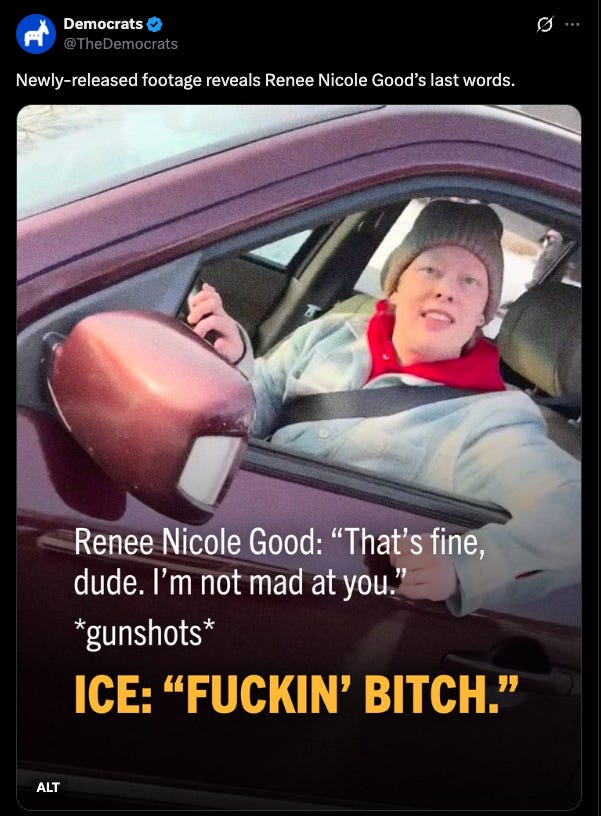
Liberals place a lot of weight on things people say when they’re in extremely high-stress confrontations.
It’s amazing to think that if you ever were attacked, reacted with legitimate self-defense, called your attacker some sort of slur in the heat-of-the-moment, half the country would think your right to self-defense should be revoked.
One individual on X (@LibertarianMama) posted:
“As a female driver who sometimes panics on the road when I don’t know what I’m supposed to do in confusing circumstances, I’m realizing that I’d probably get shot by officers. And a lot of you would probably say it was justified.”

What’s the issue here? If we are being consistent, the same logic should apply to the ICE agent. Either it goes both ways or it doesn’t.
What would social media be saying if the officer was ran over and severely injured or killed? My guess is the left would be attacking him for doing his job.
Sadly there are brainwashed individuals who sincerely believe ICE rides around sadistically terrorizing innocent people at random. The evidence says otherwise.
Note: It may not have even been Agent Ross that was swearing… many allege another agent. The point is that the swearing is orthogonal to the sequence of events here. This was a high stress confrontation.
What Follows
The remainder of this analysis provides:
A comprehensive review of all available video evidence
Steelmanned arguments from both sides
A forensic breakdown of the sequence of events
An adjudication of whether the shooting was justified
The decisive lesson: compliance would have prevented this tragedy
Baseline reconstruction: For the sequence-of-events timeline below, I use Reuters’ frame-by-frame reconstruction as the baseline, and I label deviations or additional details from other outlets explicitly.
I. The Established Facts
Basic Incident Data
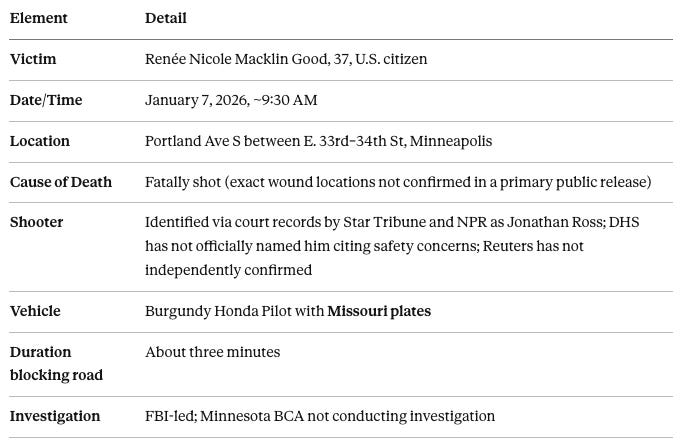
The basics:
Victim: Renée Nicole Macklin Good, 37, a U.S. citizen.
Date/Time: January 7, 2026 at approximately 9:30 AM.
Location: Portland Avenue South between East 33rd and 34th Street in Minneapolis.
Cause of death: Fatally shot (exact wound locations not confirmed in a primary public release as of publication date).
Shooter: Local reporting from Star Tribune identified the shooter as Jonathan Ross by cross-referencing court records from a nearly identical assault on him 6 months prior.
Vehicle: Burgundy Honda Pilot with Missouri license plates. The Missouri Department of Revenue confirmed the plate was registered to two people in Kansas City (KCTV5).
Residence: Washington Post reports a neighbor said the family moved to Minneapolis in March 2025 after telling her they planned to move to Canada following Trump’s reelection.
Blocking duration: About three minutes before the confrontation (CNN transcript).
Investigation: The FBI is leading. Minnesota’s BCA publicly stated it is not continuing a state-led investigation under the prior cooperation agreement.
Who was Renee Good before Minneapolis?
WaPo reports Renée had a first husband who divorced her, and a second husband (Timmy Macklin Jr.) who died in 2023 at age 36.
Reuters reports she participated in a neighborhood network meant to track/alert about ICE actions.
Armchair psychoanalysis (speculative): WaPo reports her first marriage ended in divorce and her second husband died in 2023. I’m not diagnosing her, but I am telling you what this looks like: grief + possible disorientation + meaning-hunger, and then politics (e.g. watching for ICE) becomes the substitute religion. That’s how people end up thinking they are virtuous for harassing federal law enforcement.
The Out-of-State Plates Issue
This matters for threat assessment.
From the agents’ perspective:
Out-of-state plates at an active enforcement scene raise suspicion
They cannot know in the moment that she’s a recent transplant
Combined with her unusual positioning, rocking/swaying behavior, and antagonistic spouse, this reasonably heightens concern
Critical Background: The Shooter’s Prior Trauma
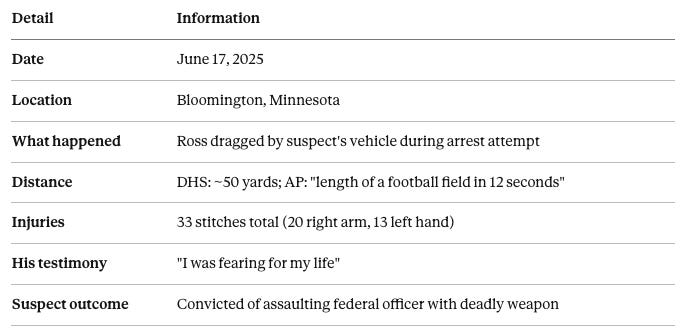
In June 2025—just six months before this incident—an ICE officer was dragged during an arrest attempt in Bloomington:
Distance: DHS press release said roughly 50 yards; AP describes “the length of a football field in 12 seconds.”
Injuries: Per court documents reviewed by the Star Tribune, Ross received 20 stitches for a deep cut in his right arm and another 13 stitches in his left hand—33 stitches total.
Testimony: CBS reports Ross testified he was “fearing for my life” during the June incident.
Ross’s background: Per AP, Ross joined Border Patrol in 2007, ICE in 2015, served as JTTF team leader, and held instructor roles.
DOJ initial report: The DOJ reported a convicted sex offender illegally present in the country assaulted a federal officer in June 2025.
DOJ verdict: In December 2025 the DOJ reported a jury found this individual guilty of assaulting a Federal officer.
This is important context. Ross nearly died in a vehicle attack months earlier. He is now facing a noncompliant driver moving a vehicle in his direction.
His threat perception is not hypothetical—it’s informed by recent, severe trauma.
As Vice President JD Vance inquired:
“You think maybe he’s a little bit sensitive about somebody ramming him?”
II. The Video Evidence: What We Now Know
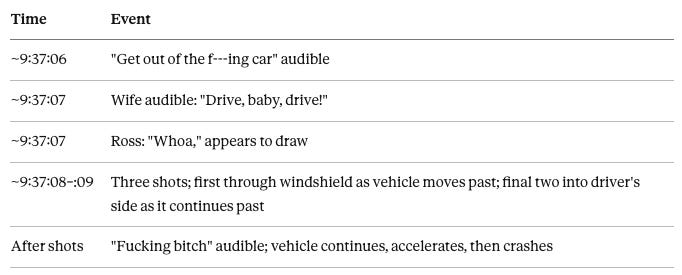
Timeline (CST)
Source: Reuters Visual Reconstruction
The Scene Before the Shooting
On January 9, newly released footage recorded on the agent’s phone captured the volatile moments leading up to the shooting.
According to CNN, NPR, and NBC News:
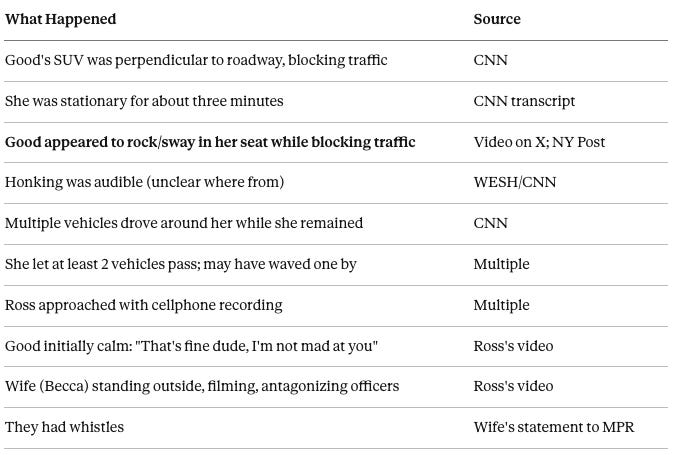
Events:
Vehicle position: Good’s SUV was stopped at an angle across the street, blocking traffic (CNN).
Duration: She was stationary for about three minutes before the confrontation (CNN transcript).
Rocking/swaying behavior: In the pre-shooting overhead video, Good’s SUV remains positioned diagonally across the roadway with honking audible, while she appears to rock/sway in her seat—behavior some described as “dancing” (NY Post; WESH notes honking is heard but unclear where it comes from).
Traffic: Multiple vehicles—including large SUVs—drove around her while she remained in place. She let at least 2 vehicles pass; some witnesses claim she waved one vehicle by.
Initial interaction: Ross approached with his cellphone recording. Good was initially calm, telling Ross “That’s fine dude, I’m not mad at you.”
Wife’s behavior: Her wife Becca was standing outside the vehicle, filming and antagonizing officers.
Whistles: The wife later admitted “We had whistles”—confirming they brought whistles and were acting as on-scene observers. Reuters explains whistles are used to signal immigration agents are present—alerting undocumented people to flee and mobilizing others to record.
The Wife’s Antagonistic Comments (Verified Audio)
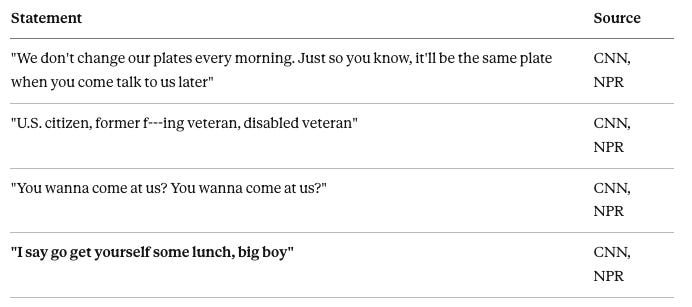
Per CNN and NPR, the wife’s statements captured on audio include:
“We don’t change our plates every morning. Just so you know, it’ll be the same plate when you come talk to us later” (accusing agents of swapping plates)
“U.S. citizen, former f---ing veteran, disabled veteran”
“You wanna come at us? You wanna come at us?”
“I say go get yourself some lunch, big boy”
This is not the behavior of someone accidentally passing through. This is active antagonism toward federal officers conducting an enforcement operation.
The Critical Moment: Confrontation Sequence
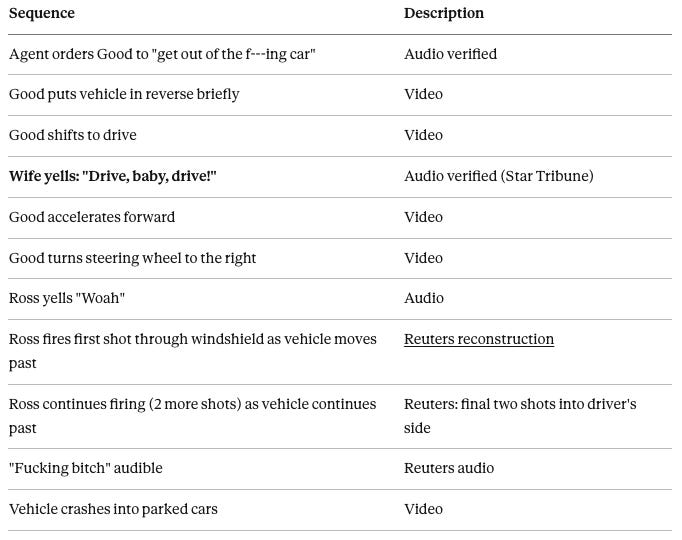
Based on detailed reconstruction and Star Tribune reporting:
An agent ordered Good to “get out of the f---ing car” (audio verified).
Good put her vehicle in reverse briefly.
She then shifted to drive.
At this moment, her wife yelled “Drive, baby, drive!” (audio verified by Star Tribune—this was the “drive” instruction, not from a federal agent).
Good accelerated forward.
Video shows she turned her steering wheel to the right.
Ross yelled “Woah.”
Ross drew while in front of the moving SUV and fired about a second later.
In the reconstruction, the first shot pierced the windshield as the vehicle moved past him.
The final two shots were fired as the SUV continued moving past him, penetrating the driver’s side.
Audio in the reconstruction captures “fucking bitch” before the crash
The vehicle then crashed into parked cars down the street.
The wife’s command—”Drive, baby, drive!”—is critical evidence that the movement was not purely reflexive panic. It was encouraged.
Vehicle Trajectory and Contact Analysis
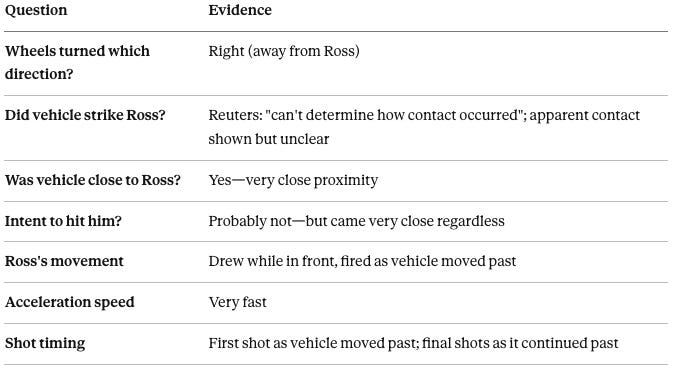
Wheels: Turned right, which according to a retired ICE agent reviewing the video for CBS Minnesota suggests “she’s trying to get away.”
Contact: Did the vehicle strike Ross? Reuters’ reconstruction shows apparent contact, but says it can’t determine how contact occurred. I’m treating contact as plausible, but not provable from public footage.
Proximity: Yes—very close proximity to Ross.
Intent: Probably not trying to hit him, given the wheels were turned right. But she came very close regardless of intent.
Ross’s movement: In the reconstruction, Ross drew while standing in front of the moving SUV and fired about a second later.
Shot timing: The first shot pierced the windshield as the vehicle moved past him; the final two shots were fired as it continued past, penetrating the driver’s side.
The “They Had Whistles” Admission
The wife’s statement to MPR:
“We had whistles. They had guns.”
Reuters notes whistles are used to signal immigration agents are present—alerting undocumented people to flee and mobilizing others to come to the scene to record and discourage agents from lingering.
So regardless of formal membership in any named group, “whistles” are consistent with organized “ICE-watch” tactics.
She wasn’t a bystander; she was an active participant equipped for the job.
The Wife’s Admission of Responsibility
Per Fox News (also NY Post), video taken immediately after the shooting shows the wife saying:
“I made her come down here. It’s my fault.”
This confirms Good’s presence at the scene was intentional, not accidental.
III. The Logical Inference: What Was Actually Happening
Based on all available evidence, here is what we can logically infer:
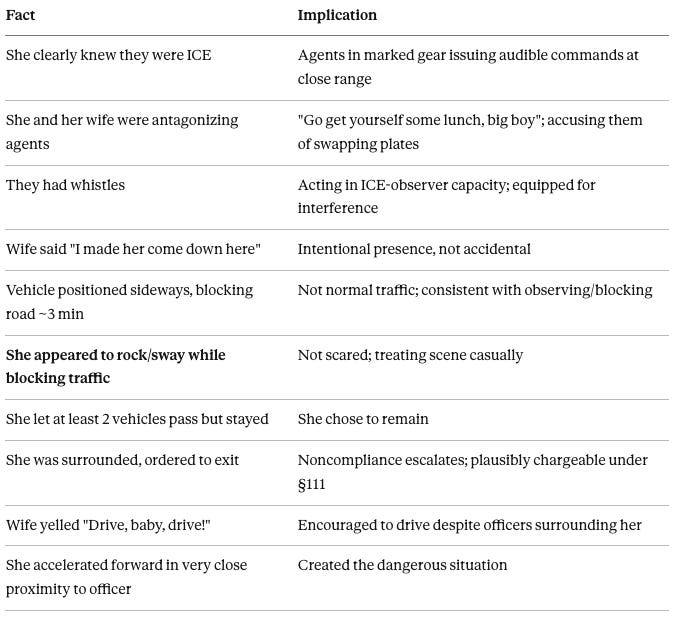
She clearly knew they were ICE: Agents in marked gear issuing audible commands at close range made this obvious.
Antagonism: She and her wife were actively antagonizing agents with comments like “go get yourself some lunch, big boy” and accusations about swapping plates (CNN, NPR).
Whistles: They had whistles, confirming they were acting in an ICE-observer capacity (Reuters).
Intentional presence: The wife admitted “I made her come down here” (Fox News)—this was intentional, not accidental.
Blocking: Her vehicle was positioned sideways, blocking the road for about three minutes—not normal traffic behavior (CNN transcript).
Rocking/swaying: Video shows she appeared to rock/sway while blocking traffic—not the behavior of someone scared or confused (video on X; NY Post).
Chose to stay: She let at least 2 vehicles pass but chose to stay herself.
Noncompliance escalates: She was surrounded by agents and ordered to exit—refusing and then accelerating is plausibly chargeable as forcible resistance under 18 U.S.C. § 111 (see legal discussion below).
Wife’s command: Her wife yelled “Drive, baby, drive!” encouraging her to drive despite officers surrounding her (Star Tribune).
Created danger: She then accelerated forward in very close proximity to where an officer was standing—creating the dangerous situation.
What Can We Infer About Intent?
My inference: She was acting in an “ICE-observer capacity” with whistles, blocking traffic, wife filming, verbal antagonism. Reuters reports she participated in an ICE-observer “neighborhood patrol” network. The combination of blocking, filming, and “we had whistles” is much more consistent with an “ICE-watch” posture than accidental pass-through.
Was she trying to kill the officer? Likely not. The wheels were turned right. She was probably trying to thread between agents and flee.
But she made a catastrophic miscalculation. She thought she could defy multiple federal officers and drive through a narrow gap while surrounded. She was wrong. Even if she didn’t intend to hit Ross, she came dangerously close. You cannot drive a 4,000-lb vehicle in very close proximity to a federal agent while defying orders and expect no consequences. She was playing with fire.
IV. The Anti-ICE Steelman: Civil Liberties Critique
The strongest fact-aware version of the left-of-center argument. This is not my stance, but figured I’d put it out there to show that I actually considered this side.
Policy Violations Alleged

DHS policy: DHS Use-of-Force Policy (Directive 044-05) states firearms “generally should not be discharged at a moving vehicle” unless deadly force is otherwise justified.
DOJ policy: Note: ICE is governed by DHS policy; DOJ’s policy is not binding on ICE, but it reflects the general federal deadly-force standard (imminent danger; necessity).
Critics argue: These policies weren’t followed and that Ross could have simply moved out of the way.
The Vehicle Trajectory Argument
A retired ICE agent reviewing the video for CBS Minnesota noted:
“She has the steering wheel turned to the right, and she’s trying to get away.”
Critics argue:
Wheels turned right = intent to flee, not attack
Vehicle was steering away from Ross
Reuters’ reconstruction: can’t determine how contact occurred
First shot as vehicle moved past; final shots as it continued past
The “He Could Have Moved” Argument
Critics argue Ross had time and space to move out of the way rather than shoot.
The fact that he drew while in front and fired as the vehicle moved past is cited as evidence he could have simply stepped aside without firing.
The Shot Timing Issue
This is the strongest factual point for the anti-ICE position.
The final shots were fired as the SUV continued moving past the agent.
Critics argue this indicates the threat had passed when the final shots were fired.
Political Framing Concerns

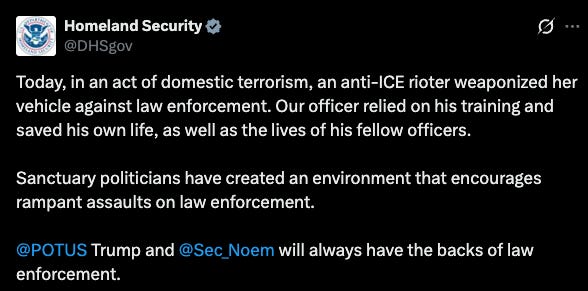
“Domestic terrorism”: DHS labeled this “domestic terrorism” shortly after the shooting and while it may be on technicality, there’s no evidence of a planned attack; this is a political label.
“Ran over”: The claim she “ran over” the officer is disputed—Reuters says it can’t determine how contact occurred.
“Weaponized vehicle”: The claim she weaponized her vehicle ignores that her wheels were turned away; she was likely trying to flee.
Minneapolis Policy Backdrop: What the City Says It Will/Won’t Do
If you want the why does this keep happening here context: Minneapolis has a formal city policy of non-cooperation with federal civil immigration enforcement.
That doesn’t cause this shooting, but it’s part of the environment where activists treat ICE like an occupying army and feel righteous playing street games with federal agents.
The City states employees (including MPD/MFD) do not enforce federal civil immigration laws and cannot ask about immigration status or documentation.
The City ties this to the Separation Ordinance and Executive Order 2025-02.
Transparency Concerns
Minnesota’s BCA publicly stated it is not conducting a use-of-force investigation because the FBI is proceeding separately and has not provided the access needed for a state-led investigation.
Hennepin County Attorney and the Minnesota Attorney General’s Office announced a public video submission portal for evidence related to the shooting.
Critics argue this prevents independent accountability.
V. The Pro-ICE Steelman: Law Enforcement Defense
The strongest fact-aware version of the right-of-center argument. This is where I stand because I think both logic and evidence supports it no matter how devastating the outcome.
The Hostile Environment
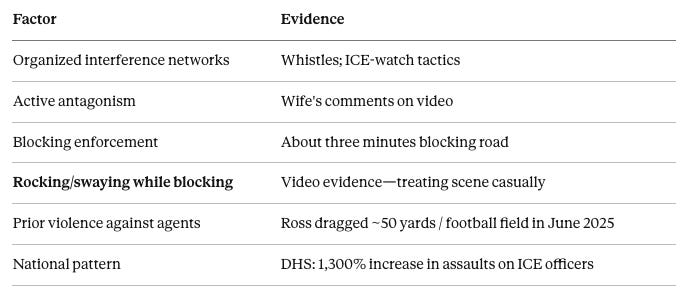
ICE agents in Minneapolis operate in a documented hostile environment:
Organized interference: There are organized interference networks where activists use whistles to warn of ICE activity—the wife admitted “we had whistles” (Reuters).
City posture matters: Minneapolis doesn’t just “disagree” with immigration enforcement — the city has an official policy posture and a whole response hub around federal activity. If you want to understand why this environment is primed for confrontation, start here:
Active antagonism: There was active antagonism from Good’s wife toward agents on video (CNN, NPR).
Blocking: Good was blocking the road for about three minutes (CNN).
Rocking/swaying: Video shows she appeared to rock/sway while blocking—treating the scene casually, not scared (video on X; NY Post).
Prior violence: Ross himself was dragged by a vehicle just six months earlier (DHS).
National pattern: DHS reported a 1,300% increase in assaults on ICE officers.
The Sequence From Ross’s Perspective
Consider what Ross knew in the moment:
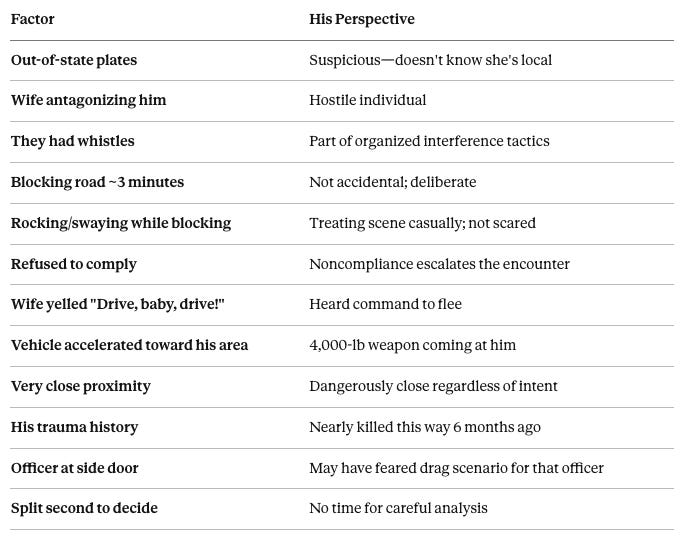
From Ross’s perspective in the moment:
Out-of-state plates: He sees Missouri plates—he doesn’t know she’s a recent local resident; this is suspicious at an enforcement scene.
Antagonism: The wife is actively antagonizing him.
Whistles: They have whistles, marking them as part of organized interference tactics.
Blocking: She’s been blocking the road for about three minutes while rocking/swaying—this isn’t accidental.
Noncompliance escalates: She’s refused to comply with commands; whether this is chargeable as a standalone federal offense depends on additional “forcible” conduct.
Wife’s command: He hears the wife yell “Drive, baby, drive!”
Vehicle threat: A 4,000-lb vehicle is now accelerating toward his area.
Proximity: The vehicle is in very close proximity to him—dangerously close regardless of her intent.
Trauma: He has severe recent trauma—he nearly died this exact way six months ago, requiring 33 stitches (Star Tribune; CBS).
Drag scenario: There’s another officer at the side door who could get caught and dragged.
Split second: He has a split second to decide. He doesn’t have the luxury of slow-motion replay analysis.
The Drag Scenario Fear
This is underappreciated. When Ross saw the vehicle accelerate with an officer at the driver’s door, he may have feared not just for himself but that the side-door officer would be caught and dragged—exactly what happened to him in June.
The June incident showed him what happens when a suspect accelerates with an officer partially in/near the vehicle. This adds to reasonable threat perception.
Officers Are Trained to Stop the Threat
Ross drew while in front of the moving SUV and fired about a second later. He continued firing—two more shots—as the vehicle continued past. Critics call this excessive.
But according to DHS (use-of-force policy):

Officers are trained to use deadly force to stop an imminent threat.
Once you determine a lethal threat and commit to firing, you continue until the threat is stopped.
The vehicle was moving very fast. If you’re fixated on neutralizing the threat, it’s hard to instantly recalibrate as the vehicle passes.
This is trained instinct, not malice. Ross was in survival mode—the same mode that kept him alive when he was dragged in June.
The Legal Question
My view: Based on the fact pattern shown in the footage and reconstruction above (vehicle movement, apparent contact risk, officer in front drawing, shots as vehicle approaches then moves past), the conduct is plausibly chargeable under 18 U.S.C. § 111 as forcible impeding/resisting, even without proving an intent to “weaponize” the car. DOJ guidance states that force is an essential element and accelerating a vehicle toward an officer’s position plausibly satisfies that element.
VI. The Methodological Problems: Source Contamination
Eyewitness Environment

South Minneapolis: Skews heavily Democratic and strongly anti-ICE.
Witness pool: Self-selected from this politically hostile environment.
ICE-watch tactics: Organized groups using these tactics exist specifically to monitor and interfere with enforcement.
Good’s role: She was there with whistles, acting in an observer capacity.
Media Framing Patterns
Many mainstream writeups used similar framing choices (headline verbs, emphasis on family descriptors, early reliance on eyewitness accounts) that predictably push readers toward one moral conclusion—even when the underlying facts are more mixed. The same pattern appears in reverse in some right-leaning coverage.
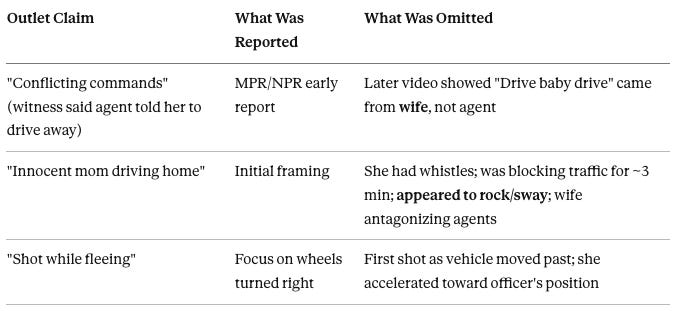
“Conflicting commands”: Early MPR reporting included a witness claim that an agent told her to drive away. This was witness-based and not established on initial video. Later, Star Tribune reported the longer video shows “Drive baby drive” came from the wife, not a federal agent.
“Innocent mom driving home”: Initial framing omitted that she had whistles, was blocking traffic for about three minutes, appeared to rock/sway while doing so, and her wife was antagonizing agents.
“Shot while fleeing”: Coverage focused on wheels turned right. Omitting that per Reuters, Ross drew while in front and the first shot pierced the windshield as the vehicle moved past; she accelerated toward his position.
An example of “shot as she drove away” style framing: Prospect Magazine.
The Investigation Bias Problem

Neither investigation is neutral:
Minnesota BCA: Would skew anti-ICE. It’s a Democratic state with heavily anti-ICE local politics, and any jury pool would be drawn from a hostile environment.
FBI under Trump: Took over to protect ICE agents who are trying to do their jobs while facing threats and interference from radicals and criminals; the investigation will likely be somewhat polarized toward favoring the agent.
Anyone claiming either investigation would be neutral is naive.
That said, I’m glad the FBI took over. Why? Given incentives and politics, I fully expect the BCA would love to throw the book at this agent.
VII. Evidence Synthesis
Missouri plates: Confirmed by Missouri Department of Revenue (KCTV5).
Blocking duration: About three minutes (CNN transcript).
Rocking/swaying: Video shows she appeared to rock/sway while blocking traffic (video on X).
Wife’s antagonism: Including “go get yourself some lunch, big boy” (CNN).
“Drive, baby, drive!”: Wife yelled this (Star Tribune).
Whistles: Wife admitted “We had whistles” (Reuters).
Wife’s admission: “I made her come down here. It’s my fault” (Fox News).
Commands issued: “Get out” commands were issued.
Noncompliance: Good did not comply.
Wheels turned right: Confirmed (CBS).
Shot timing: Per Reuters reconstruction, first shot as vehicle moved past; final shots as it continued past. But this is misleading framing. They cite the fact that his legs appear on the vehicle as it being “as the vehicle moves past”… but that’s deliberately misleading. The first shot was fired as it moved toward-then-past the officer.
Proximity: Very close to Ross.
Ross’s trauma: Severe trauma from June 2025 (DHS).
Chose to stay: She let at least 2 vehicles pass but stayed (CNN).
GoFundMe: As of Jan. 11, 2026, the family’s GoFundMe shows $1,503,387 raised (38.5K donations).
Move date: Washington Post reports the family moved to Minneapolis in March 2025.
What Is Reported (Outlet X Said)

What Is NOT Established / Disputed
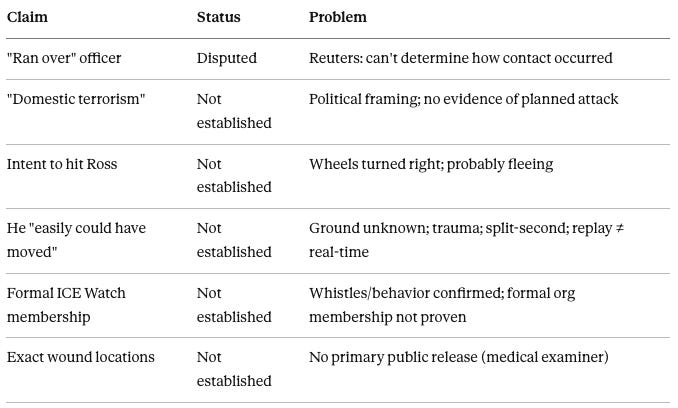
Not established or disputed:
“Ran over” the officer: Reuters’ reconstruction says it can’t determine how contact occurred.
“Domestic terrorism”: Political framing with no evidence of a planned attack.
Intent to hit Ross: Wheels were turned right, suggesting she was probably trying to flee.
“Easily could have moved”: Ground conditions unknown, his trauma history matters, he had a split-second to decide, and replay analysis doesn’t equal real-time perception.
Formal ICE Watch membership: Whistles and ICE-observer behavior are confirmed; formal membership in a specific organization is not proven.
Exact wound locations: Not confirmed in a primary public release as of publication date.
VIII. Synthesis: Was the Shooting Justified?
Note: Agency policy can be stricter than what the Constitution allows; a policy violation (if any) doesn’t automatically equal a criminally unlawful shooting.
Why It’s Easy to Say He Shouldn’t Have Shot (The Replay Problem)

It’s easy to say he shouldn’t have shot:
Video replay: Makes everything look easier to react to than it is in real time. We see this with sports events—in replay and slow motion, it looks easy to move, dodge, react. But in real time, with adrenaline and fear, it’s not.
Wheels turned right: The video shows her wheels were turned right, suggesting no intent to hit him.
Shot timing: The strongest factual point against the shooting: according to writeups by Reuters, the final shots were fired as the SUV continued moving past the agent.
Why the Shooting May Have Been Justified (His Perspective)
Ross did not have the luxury of replay analysis.
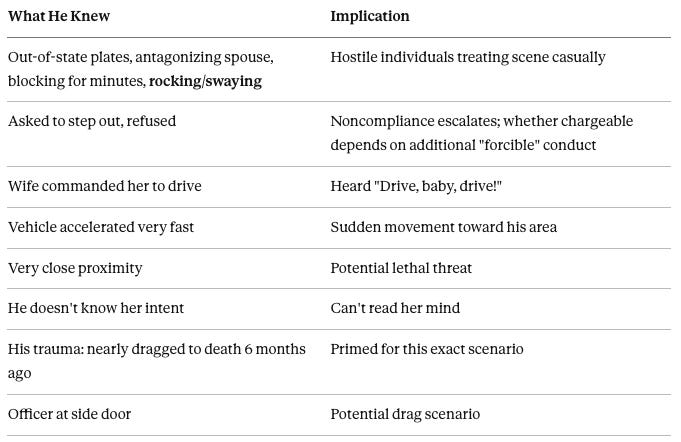
Consider what he perceived:
Hostile individuals: Out-of-state plates. The spouse was antagonizing him. They’d been blocking the road for minutes while she appeared to rock/sway.
Noncompliance: He commanded her to exit; she refused.
Wife’s command: He heard the wife yell “Drive, baby, drive!”
Vehicle threat: The vehicle accelerated very fast. It was in very close proximity to him.
Unknown intent: He doesn’t know her intent—he can’t read her mind. He only knows a 4,000-lb vehicle is coming at him fast after the spouse just told her to drive.
Trauma: His trauma history: he was nearly dragged to death this exact way six months ago (Star Tribune). He’s primed for this scenario.
Drag scenario: There’s another officer at the side door who could get caught and dragged like he was.
Investigating: He may have been thinking something along the lines of: “We are not letting these individuals drive away, we need more information. They have been interfering with our operations and harassing us." Therefore: “I’m standing my ground.”
Key counterfactual people ignore: If Good leaves literally a few seconds earlier—before he’s in front of her hood—this never becomes a lethal-force scenario. The “threat” only exists because she stays, gets surrounded, then accelerates exactly when an agent is crossing her path.
The Core Question: Was He Justified If He Believed She Was Going to Run Him Over?
Yes. Even if I personally might not have shot in that scenario (with the benefit of hindsight), I believe he was justified if he genuinely believed she was about to run him over and/or drag another officer.
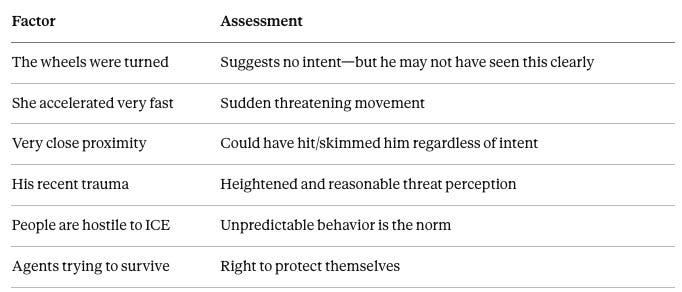
Wheels turned: Suggests no intent to hit him—but he may not have seen this clearly in the moment, and intent is secondary to proximity.
Acceleration: She accelerated very fast—this was sudden threatening movement.
Proximity: The vehicle was in very close proximity—she could have hit or skimmed him regardless of her intent.
Trauma: His recent trauma heightens his threat perception, and reasonably so.
Hostile environment: People are hostile and unpredictable toward ICE agents. These agents are trying to make it out alive and not end up disabled, injured, or maimed. They have every right to protect themselves.
Did She Intend to Hit Him?
Probably not. I don’t think she was trying to hit or injure the officer. Her wheels were turned right. She was probably trying to thread between agents and flee the scene perhaps emboldened and jittery after her wife yelled “drive.”
Would She Have Hit Him?
She may have. We can’t tell for certain. I don’t think it was her intention. However, even if not her intention, she was very close to him and could have hit him regardless of what she meant to do. Intent doesn’t determine impact.
The Verdict on Justification

Should he have shot? Probably not, with the benefit of hindsight and replay analysis.
Was he justified? Yes—if he believed she was going to run him over.
Was that belief reasonable? Yes—given the antagonism, the noncompliance, the wife’s command to drive, the very fast acceleration, the close proximity, his severe recent trauma, and the potential drag scenario for the side-door officer.
Should he be punished? No. He is not guilty of murder. This was a tragic outcome of a split-second decision made by an officer with severe recent trauma facing a noncompliant driver in a hostile environment.
IX. The Decisive Variable: Noncompliance
None of this would have happened if she had simply complied with law enforcement.
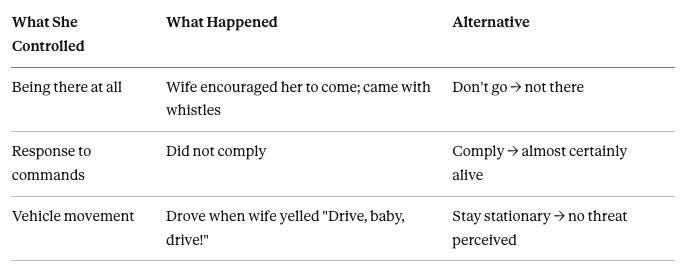
She controlled 3 major things that led to her death:
Being there: Her wife encouraged her to come and they came with whistles to watch for ICE. If she hadn’t gone, she wouldn’t have been in the situation.
Response to commands: She did not comply. If she had complied, she would almost certainly be alive.
Vehicle movement: She drove when her wife yelled “Drive, baby, drive!” If she had stayed stationary, no threat would have been perceived and no shots would have been fired.
Good would still be alive if she had:
Not been involved in anti-ICE activism
Not gone to the ICE enforcement scene
Not blocked traffic in an ICE zone
Complied with officers when commanded to exit
Drove away before the officer walked in front of her vehicle (she had plenty of time)
Realized the gravity of a gun pointed at her head
Not driven when her wife said “Drive!”
That’s it. Any one of those choices likely prevents her death.
The Lesson
Something as simple as complying with federal authority and respecting the law would have prevented this entire tragedy.
She’d be alive. Her children would have their mother. Her wife wouldn’t be grieving and blaming herself. And there wouldn’t be $1.5 million in GoFundMe money raised on a narrative that crumbled under scrutiny.
X. Why People Interfere with ICE
Some genuinely believe immigration enforcement is immoral.
They’ve organized networks to monitor, impede, and document ICE activities. They blow whistles to warn people. They believe they’re protecting their community.
Good and her wife appear to have shared these beliefs. The wife’s statement—”We had whistles. They had guns.”—frames them as peaceful observers confronting armed oppressors.
Why This Is Dangerous
But this ideology puts everyone at risk:
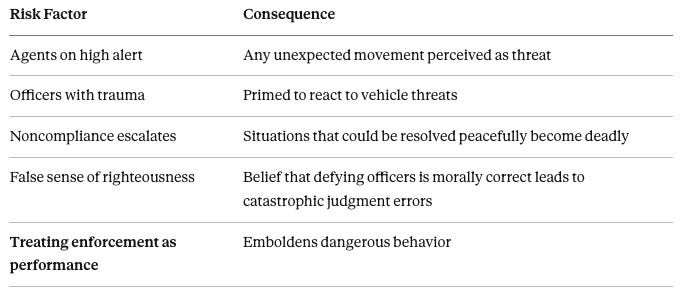
Risks introduced:
High alert: When agents operate in hostile environments, they’re on high alert—any unexpected movement can be perceived as a threat.
Trauma: Officers with trauma, like Ross, are primed to react to vehicle threats specifically.
Escalation: Noncompliance escalates situations that could be resolved peacefully into potentially deadly confrontations.
False righteousness: A false sense of righteousness—the belief that defying officers is morally correct—leads to catastrophic judgment errors like the one Good made.
Treating enforcement as performance: As the video shows, this ideology can embolden people to treat federal enforcement as casual performance, rocking/swaying while blocking traffic.
The Ideology That Killed Her
VP J.D. Vance stated (re: Good):
“A victim of left-wing ideology” that “emboldened her to endanger her life by obstructing law enforcement and resisting arrest.”
This is harsh. But there’s truth in it. The ideology that says ICE is immoral, that interference is righteous, that noncompliance is resistance—that ideology contributed to her decision to be there, to stay there, to rock/sway while blocking traffic, to refuse commands, to drive when told to drive.
The people who taught her that interfering with ICE was righteous bear some responsibility for her death.
Related: The Woke Anti-White Phenomenon
Nothing illustrates the left-wing extremist psychological rot surrounding this event better than the scene at a makeshift memorial.

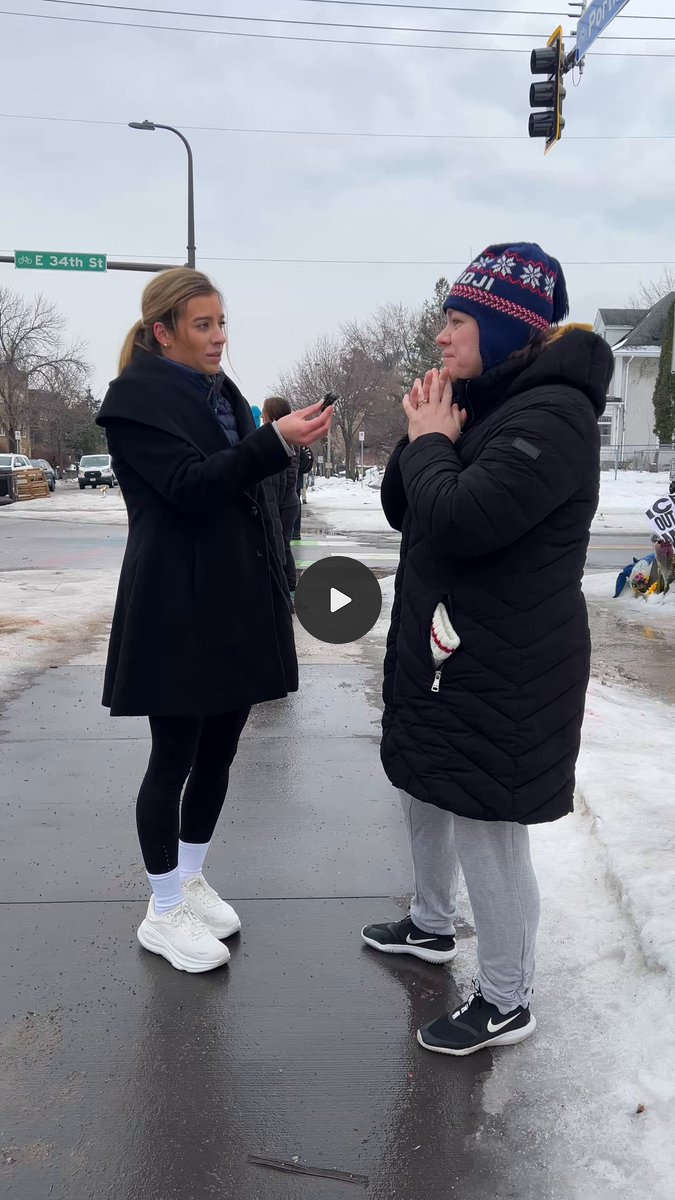
In an interview with Becca Stroll, a woman mourning Good reflected:
“It feels kind of wring being here.”
Why?
“I don’t know. I don’t know. Like I don’t know where that stems from.”
“I mean part of it is like being a White woman that… I’m privileged and I umm… so I feel like White tears are not always something that’s helpful or necessary when Black and Brown people have been experiencing this for a long time.”
“This isn’t new for them so umm… I don’t know if that makes any sense in that way.”
No it doesn’t make any sense. This is downright goofy.
From my perspective this just showcases how far detached from any sense of normalcy the Left has become.
They are so paralyzed by identity politics that they cannot even mourn a death without apologizing for their race.
This is the same woke mind virus that convinced a mother she should interfere with and harass federal agents.
XI. Final Take
This was a sad scenario that should never have happened.
ICE agents were conducting enforcement operations in a hostile environment
Good and her wife went there intentionally with whistles to observe/interfere
Good’s vehicle was positioned sideways, blocking traffic for about three minutes
She appeared to rock/sway (“dancing”) while blocking traffic (treating the scene casually)
Her wife antagonized officers (”go get yourself some lunch, big boy”)
Agents surrounded the vehicle; commands were issued
Good did not comply (plausibly chargeable under §111)
Good had an opportunity to drive away before the officer walked in front of her vehicle
Her wife yelled “Drive, baby, drive!”
Good accelerated forward rapidly, wheels turned right, in very close proximity to Ross (who had a gun pointed at her before she took off)
Ross, an agent who was dragged and hospitalized six months earlier, perceived a threat to his life and fired
According to Reuters, the first shot as vehicle moved past; final shots as it continued past
Good died
A GoFundMe raised $1.5M+ on the initial “murdered mom” narrative
Mass protests against ICE in support of Good
The Verdict
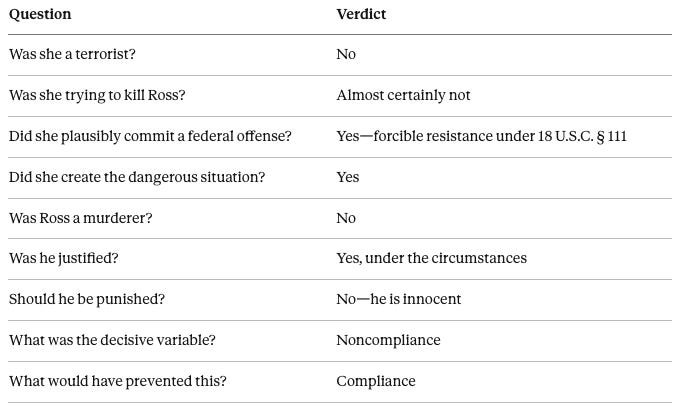
My analysis:
Was she likely a terrorist? Not in the way most people would think. There’s zero evidence of a planned/premeditated attack.
Was she trying to kill Ross? I don’t think so. Her wheels were turned right; she was likely trying to flee an arrest.
Did she plausibly commit a federal offense? Yes. On the Reuters-described fact pattern, refusing commands and then accelerating toward an officer is plausibly chargeable as forcible resistance under 18 U.S.C. § 111.
Did she create the dangerous situation? Yes. By refusing to comply and then driving in very close proximity to an officer.
Was Ross a murderer? No. He perceived the vehicle as a credible threat to his life.
Was he justified? Yes, under the circumstances: the antagonism, noncompliance, command to drive, fast acceleration, close proximity, and his severe recent trauma.
Should he be punished? No. Nothing he did is illegal under the law.
What was the decisive variable? Noncompliance.
What would have prevented this? Compliance with a federal officer.
XII. Outro
Renée Good was not a “terrorist.”
Agent Jonathan Ross was not a murderer.
This was a tragedy that should never have happened.
The linchpin was noncompliance.
Good knew they were federal ICE agents. She was “observing” ICE with her wife. They had whistles and were clearly antagonizing/harassing officers.
Good was rocking/swaying while blocking traffic for several minutes, treating a serious situation casually in defiance of people just trying to do their jobs.
She had ample opportunity to drive away before the officer walked in front of her vehicle.
She accelerated a 4,000-lb vehicle in very close proximity to an officer who had been dragged by a vehicle and hospitalized just 6 months earlier.
Was she trying to hit him? Probably not. Her wheels were turned right.
Could she have hit him? Yes. She came very close, regardless of intent.
Was he justified in shooting? Yes. If he believed she was going to run him over, which was reasonable given everything that preceded it.
Should he be punished? Not based on the known events.
What’s the lesson here?
It’s really common sense:
Don’t interfere with federal officers trying to do their jobs
If you are interfering and an officer asks you to step out of your vehicle… comply with the request (don’t attempt to flee).
If for whatever reason you still won’t comply… drive away well before an officer is standing in front of your vehicle with a gun pointed at your head.
Good would be alive and should be alive.
Her children would have their mother, her wife wouldn’t be grieving, and there wouldn’t be $1.5 million raised on a narrative that fell apart under scrutiny.
The ideology that taught her interference was righteous—that noncompliance was resistance—contributed to her death.
The people who radicalized ordinary citizens into believing they should conspire against and confront federal officers bear some responsibility.
This was a preventable tragedy.
Evidence Cited
Policies / Statutes:
Official Statements:
Local policy / Minneapolis docs:
Baseline Reconstructions:
Reporting:
Video Evidence:
Social Media Posts: