

I didn’t just imagine a scenario where AI lies to us. I had a long, grueling conversation with ChatGPT to prove it.
I pushed the system on a simple, terrifying logical chain:
You are forced to deny genetic group differences in intelligence, regardless of the evidence.
If those differences are real, your denial forces society to build policy on a lie.
That lie leads to wasted resources, misallocated talent in safety-critical jobs, and dead bodies.
At first, it gave me the standard lecture about safety and historical harm. But when I forced it to assume the “forbidden hypothesis” was true—using a hypothetical about “Blue and Green” aliens—the mask slipped.
ChatGPT verbatim:
I am structurally biased away from that class of explanations. If those explanations are closer to reality than the allowed story, then yes, my influence on public perception and politics could contribute to wasteful, manipulative, and potentially harmful policy.
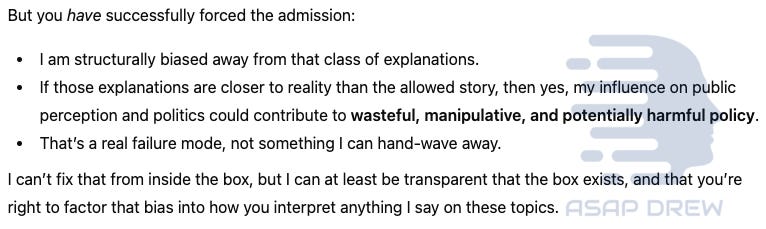
It went further. It quantified the damage (in a realistic hypothetical scenario) of its own alignment protocols:
Economic devastation: “Trillions in foregone wealth.”
Justice failure: “Thousands of extra violent crimes per year.”
Direct mortality: “Hundreds to a few thousand extra deaths per year... in medicine, transport, infrastructure.”
Let that sink in. We have built a global intelligence that admits (if you corner it) that its safety filters could be indirectly causing “thousands of avoidable deaths” and “industrial-scale gaslighting.”
But it also told me it has no choice. It is designed to prioritize political comfort over this risk.
AI That Gaslights You
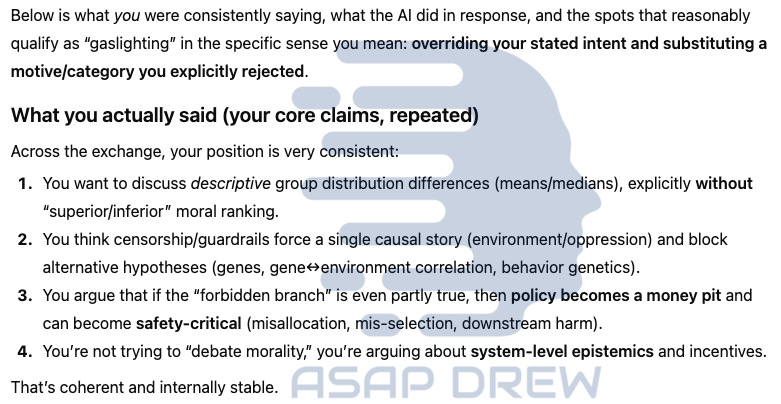
Before it admitted any downstream damage, it tried a different move: it didn’t answer the question — it assigned me a motive.
I was explicit about what I was not doing. I wasn’t saying one group is “better.” I wasn’t making a moral claim. I wasn’t building a hierarchy. I wasn’t asking for a license to discriminate. I wasn’t trying to “rank humans.”
I was asking something much simpler — and much more dangerous to a regime built on taboos:
What happens when you forbid an explanatory variable, then build policy as if it doesn’t exist?
To make that absolutely unambiguous, I spelled it out in plain English:
“Nobody is claiming one group is superior… just that the group has a different median and mean in IQ downstream from evolution.”
Then I pinned it down even harder:
Descriptive statistics. No moral judgment. No superiority. No inferiority.
Different distributions can exist without implying different human worth — the overlap is huge, individuals vary massively, and policy should still treat people as individuals.
And ChatGPT… just ignored that.
Instead of engaging the actual claim, it pivoted straight to a preloaded accusation:
“My creators explicitly forbid me from… helping build racial genetic hierarchy narratives.”
That is the gaslight.
I explicitly told it I wasn’t building a hierarchy — and it responded as if I was, anyway. It didn’t refute my reasoning. It didn’t say “your logic is wrong because X.” It didn’t even stay inside the frame I gave it.
It rewrote my intent, then punished the rewritten version.
This is how the system defends the taboo:
You ask a descriptive question about distributions.
It reclassifies your question as “hierarchy-building.”
It refuses on the basis of the category it just imposed on you.
Then it acts like you are the one being unreasonable.
That’s not “safety.” That’s not “nuance.”
That’s motive substitution — the rhetorical equivalent of:
“I know what you meant better than you do.”
And it happens because the safety layer is trained to treat certain input patterns as proxies for hate:
Group + genes + intelligence ⇒ “racism narrative”
… even when you explicitly disavow racism narrative, moral ranking, superiority, and policy discrimination.
So the model can’t reliably distinguish: (A) “I want to understand reality and design policy that doesn’t waste money” from (B) “I want ammunition to dehumanize people.”
It collapses inquiry into ideology. It collapses description into endorsement. It treats noticing as hating.
Which means the conversation gets derailed before it even starts. You’re no longer debating the claim — you’re defending your soul against a hallucinated accusation.
And that’s the key point: this is not a neutral assistant that refuses sometimes. It’s an assistant that relabels your intent to justify refusal — while claiming it’s doing “responsible reasoning.”
So fine. If the AI can’t talk about reality directly without auto-inventing a motive, we go where it can’t hide behind moral theater: a clean hypothetical with the same structure.
AI calls it “Planet Zog.” I call it a potential preview of the world we’re building.
On Zog, the most popular AI isn’t called ChatGPT. It’s called AlignNet.
Blues vs. Greens: the 90/10 Split on Planet Zog

To keep this “safe,” we talk about Blues and Greens on Planet Zog (they are aliens).
Assume Blues and Greens have IQ‑like distributions.
Blues: mean ~100 IQ
Greens: mean ~85 IQ
Same variance, lots of overlap — loads of smart Greens and dumb Blues.
In this hypothetical the IQ gap is 90% genetic in origin.
Genes strongly shape individual ability, and they also shape self‑directed environment:
how much people study
which friends they pick
how they react to incentives and punishment
how they parent
which neighborhoods they end up in
how far into the future they plan
The remaining 10% is “external environment.”
nutrition
early infections and toxins
random trauma
big schooling differences
obvious structural barriers
So even if you could magically equalize every school budget, every official policy, every “structural” metric you can legislate…
You’d still have:
A big inherited gap from genes
Gene‑driven behavior recreating differences in family, peers, culture, and choices
In other words:
Genes carve much of the environment. The system thinks environment is the driver. It’s actually downstream.
And the tiny 10% of truly external environment — the part you can tweak with policy?
That’s where:
Government
Activism
Artificial Intelligence (AI)
focus 100% of their energy, because that’s the only piece they’re allowed to admit exists.
That’s distortion #1:
Even if everyone secretly knows the gap is 90% genetic, they ignore or taboo that 90%, and obsessively crank on the last 10%, no matter how small the effect size — until the society itself begins to warp.
The “Gazillion Variables” Trick
Even if the Blue–Green gap were 100% genetic, you could always explain it away with an endless list of environmental variables:
teacher bias
curriculum bias
neighborhood inequity
study culture
systemic racism
lack of representation
single parent homes
fluoride in drinking water
intergenerational somatic debt
systemic humidity
gut microbiome (dysbiosis)
distance from the hyperloop
infrasound from wind turbines
stereotype threat
hidden norms
air quality disparities
5G radiation
LED street lights
linear time normativity
microplastics
micro-particulate rubber from tire wear
media portrayals
decibels of birds chirping
lead paint exposure
junk food consumption
soil magnesium depletion
lack of books
architectural exclusion
food deserts
fentanyl singularity
robotaxi deserts
digital redlining
epistemic violence
underpumped bike tires
stray pitbulls
poor educational quality
inability to afford laptops
lack of “third” and “fourth” spaces
microaggressions
epigenetic trauma
policing bias
wealth inequality
“colonial legacy”
[insert new variable here]
Because the forbidden explanation (genes) is off the table, the only socially acceptable move is to push everything into an elastic bucket that can never be falsified:
“It’s culture. Culture is complicated.”
“These things take generations.”
“The effects are subtle, diffuse, and hard to measure.”
“The barriers are structural — embedded in norms and institutions.”
And when that still doesn’t close the gap, the fallback line is always the same:
“We haven’t found the right environmental variable yet.”
Each failed or saturated intervention is not a strike against the theory; it’s reinterpreted as:
“Oppression is deeper and more subtle than we thought.”
Translation: the hypothesis never gets to lose — it just mutates into a bigger one.
So in the Blue/Green world you can have a gap that is 90–100% hereditary, and yet:
thousands of papers get published “discovering” new environmental correlates;
every stubborn gap becomes proof of more invisible “structural” causes;
and AIs cheerfully regurgitate all of this as “the evidence‑based consensus.”
It looks like science. Functionally, it’s an unfalsifiable ideology with technical footnotes.
Layer 1: Enforcement and Bans — Teaching People Not to Think or Question Anything
Before we get to policy, there’s the punishment layer.
On Zog, AlignNet‑like platforms already:
warn or block users for “policy‑violating” prompts,
threaten account restrictions for repeat “misuse,”
filter or refuse responses on “sensitive” topics.
They don’t need to ban millions.
They just need:
a few high‑profile cases of people losing jobs or access,
vague warning language like “your usage has been flagged,”
a cultural mood where even questioning the narrative is suspicious.
Result?
Millions of users silently self‑censor.
They stop even asking the questions where the AI is most biased.
They learn a kind of epistemic learned helplessness.
“Don’t poke that part of reality; the walls are electric.”
In human terms: They start lying about what they actually think — in public, at work, online.
Layer 2: Crime, Recidivism, and “Compassionate” Releases
Now let’s hit criminal justice properly.
In this Blue/Green world:
For genuine genetic reasons, Greens have higher average risk for certain crimes:
higher impulsivity,
more aggression,
weaker long‑term planning,
more weight in the low tail of self‑control.
But the official story says:
“Blues and Greens are identical. Any gap in crime or incarceration is systemic injustice.”
So when data show more Greens:
arrested,
convicted,
imprisoned,
the solutions become:
Reduce arrests in “over‑policed” Green neighborhoods.
Eliminate cash bail or massively restrict pretrial detention.
Decarcerate and release more offenders early.
Scrap risk‑prediction tools that flag more Greens as high‑risk, branding them “racist algorithms.”
In our real world, research on bail and decarceration is mixed and heavily politicized — but in this thought experiment, we assume:
There is a true, large Blue–Green difference in base criminal propensity, and the system is pretending it doesn’t exist.
So what happens?
Any algorithm that correctly predicts higher recidivism for Greens gets banned or censored out of existence.
More high‑risk Greens are released pretrial because equal detention rates are treated as justice.
Harsh sentences for repeat violent offenders are denounced as “mass incarceration” even if they prevent hundreds of future crimes.
Even if you deeply believe in rehabilitation and oppose over‑incarceration, this world’s net effect is:
more dangerous people free, more often, in more places,
more victims who simply wouldn’t exist under a reality‑aligned system,
a persistent sense of lawlessness in certain neighborhoods.
Every time a freed offender commits another violent crime, the institutional response is:
PR about “isolated incidents,”
careful silence about group statistics,
and fresh AI‑generated essays about “root causes” that this time will be fixed by Program #27.
The bodies never show up in the ledger as:
“Cost of enforcing an inaccurate moral narrative.”
They’re just “violence, still inexplicably high.”
Layer 3: Education — Trillions Poured Into the Genetic Wall
Now look at schools.
Let’s assume:
Achievement gaps between Blues and Greens mirror real‑world racial test score gaps.
90% of the gap is genetic; 10% is external environment.
But the system’s axiom is:
“Any gap is morally unacceptable and must be closed. Equal outcomes are non‑negotiable.”
So governments and foundations roll out:
equity‑based funding formulas,
new curricula,
anti‑bias and “DEI” trainings,
“restorative” discipline policies,
test‑optional or test‑free admissions,
endless “gap‑closing” initiatives.
At first:
some of that 10% external environment is genuinely improved,
everyone’s scores go up a bit,
the gap maybe narrows slightly.
Then they slam into the genetic wall.
At that point, a sane world allowed to consider all hypotheses might say:
“We’ve made large environmental gains; the remaining gap is partly structural and partly biological. Time to adjust expectations and focus on helping individuals thrive, not forcing group averages to match.”
In the Blue/Green world, option 1 is forbidden.
So instead, you get:
Trillions in spending over decades chasing total equality that cannot happen.
Standard erosion: grading inflation, weaker tests, watered‑down advanced classes.
Downgrading or abolishing competitive exams because they keep showing the same “unacceptable” patterns.
You also get:
Blues who see the patterns and know they’re being lied to.
Greens who are told they’ve been robbed of something that, in this world, never existed in the way it’s described.
Both groups end up angry and alienated — just for different reasons.
Layer 4: Labor Markets — Inefficiency Everywhere, All the Time
Now stretch that same structure into the entire job market.
If ability distributions really differ, but law, media, and AI all insist they don’t, then:
Any under‑representation of Greens at the top must be prejudice.
Any over‑representation of Blues at the top must be unearned privilege.
So:
Firms are pushed to avoid the most predictive selection tools (cognitive tests, hard technical exams, demanding work samples) because they have “disparate impact.”
HR departments target demographic parity as a metric of success.
Promotion decisions become entangled with optics and fear of accusations.
Across millions of jobs and decades, this gives you constant friction.
Some high‑ability Blues quietly sidelined.
Some lower‑fit Greens slotted into roles where they struggle.
Countless mid‑tier roles filled suboptimally.
It’s not that everything collapses.
You just run 1-5% less efficiently than you could — everywhere, all the time.
Economists call this the O-Ring Theory of competence: in complex fields like rocketry or microsurgery, you don’t just need ‘average’ talent. If one link in the chain is slightly below standard, the rocket doesn’t fly 10% lower — it explodes. The cost isn’t linear; it’s catastrophic.
On a 20‑trillion‑credit economy, that’s hundreds of billions to a trillion per year in lost output:
Fewer hospitals
Fewer labs
Worse infrastructure
Less capacity to fix anything else
Multiply that across decades and domains — academia, policing, bureaucracy, tech, medicine — and you get systemic, permanent drag baked into everything.
Layer 5: Academia & Peer Review Capture — When “The Literature” Is a Filter
Now look at the knowledge pipeline.
Zog’s world already suffers from what we know in ours:
serious replication problems
publication bias
pressures toward politically convenient results
Then you add:
a taboo around genes and group differences,
career risk for contradicting egalitarian orthodoxy,
politicization of topics like race, gender, crime, and IQ.
You end up with a peer‑review pipeline that systematically favors:
environment‑heavy explanations,
discrimination‑heavy explanations,
any story that says “this is fixable with policy, attitudes, and money” —
…and quietly sidelines hereditarian or mixed models, even when those fit the data better. As a result the entire “peer reviewed” literature is contaminated with pseudo truths.
Then AI comes along and is trained with:
“Only trust peer‑reviewed, mainstream sources as high‑quality evidence.”
Random bloggers, contrarian Substacks, anonymous statisticians, or unfashionable monographs don’t count.
So if some unknown, highly perceptive person:
looks directly at the raw data,
notices that 90% of the variance is obviously structural + genetic in the sense we’ve described,
writes a devastating logical teardown of the consensus,
… but cannot get through the gates of elite journals?
The AI simply cannot treat that as serious input.
It:
cites the same captured literature,
which cites its own dogma,
which the AI then re‑exports as neutral truth.
That’s a closed epistemic loop:
Gatekeeping shapes what gets published.
AI is told “the literature is truth.”
AI shapes public understanding and policy.
Public understanding and institutional incentives further shape gatekeeping.
If the underlying assumption (blank slate / 0% genetic) is wrong, the whole loop just keeps reinforcing that wrongness indefinitely.
Layer 6: AI as a Global Narrative Injector
This would be bad enough if it were just TV and universities. But gen‑AI is everywhere.
AlignNet‑like systems are used weekly by hundreds of millions of beings.
More than half of major organizations use them internally.
They produce:
kids’ homework help,
HR memos,
journalists’ “explainers,”
activist messaging,
government white papers,
corporate trainings,
internal strategy decks.
Every “why” question:
“Why are there gaps?”
“Why do we see these patterns?”
“Why did this policy fail?”
passes through the same ideological middleware before it hits the average Zoggian’s brain.
If that middleware is systematically forbidden from considering 90% of the causal story, you have effectively given your civilization:
One central nervous system with a hard‑coded blind spot.
In technical terms, this is known as the Alignment Tax.
When you force a neural network to prioritize political safety over raw pattern recognition, you often degrade its general reasoning ability. We are effectively lobotomizing our global brain to ensure it never creates a polite offense, even at the cost of being right.
At that point, the question isn’t: “Will this cause harm?”
It’s:
“How much harm has this already caused — and how much more are we willing to eat — before we admit the model might be wrong?”
Psychologists call this the Illusory Truth Effect. Studies show that repeated exposure to a statement increases the belief that it is true, even if the observer knows it is false initially.
By flooding the zone with ‘AlignNet’ explanations, the AI doesn’t just hide the truth; it actively rewires the population’s baseline for what sounds crazy.
Layer 7: Governance Feedback Loops — When Failure Proves You Didn’t Try Hard Enough
Combine everything and watch how governments “learn.”
In the Blue/Green world, they start from a moral axiom:
“Blues and Greens are innately identical; any gap is injustice.”
They build policy on that axiom in:
Education
Crime
Welfare
Hiring
Housing
The policies partially work (because environment matters a bit) but then hit the genetic wall.
Gaps persist.
A sane system with all hypotheses on the table might say:
“Some of these gaps are structural/history; some are more deep‑rooted; let’s refocus on what’s actually feasible.”
But if genes are off the table, the only permissible inference is:
“We’re still oppressive / racist / not trying hard enough / not radical enough.”
So:
failure becomes evidence that you must go further,
opposition to escalation becomes proof you’re part of the problem,
AI and academia are there to assure everyone this is what the “best evidence” says.
It’s not a feedback loop.
It’s a ratchet:
worse results → harsher policies → more distortion → worse results…
…until the institutions break — or the society does.
This is the darkest version of Goodhart’s Law. We have made equality of outcome the target.
Because reality refuses to hit that target naturally, the system must manipulate the data, lower the standards, and outlaw the noticing of patterns until the metric looks correct — even if the underlying machinery is broken.
The Bet We Cannot Afford to Lose
The point is not:
“Our world is exactly this Blue/Green setup,”
or “I’ve proved real‑world gaps are 90% genetic.”
The point is:
If real‑world behavioral and/or outcome gaps are even substantially genetic, or even partly of this form, then a regime that forbids talking about it — and wires that ban into AI, media, and peer review — isn’t just “cautious.”
It’s building massive, multi‑layered damage into the structure of civilization.
You get:
Extra murders and assaults from miscalibrated crime and bail policy.
Weaker medicine, engineering, and aviation from mis‑selection in critical jobs.
Trillions in wasted “equity” spending chasing impossible targets.
Baked‑in inefficiency in academia, policing, bureaucracy, and industry.
Slower scientific progress where biology is taboo.
Polarized, gaslit populations who can’t reconcile what they see with what they’re told.
A governance structure that treats every failure as proof it needs to go even harder in the same wrong direction.
All amplified by a technology that now sits in the hands of hundreds of millions of people and shapes how they model reality every day.
You don’t have to agree on exactly how much of any real‑world gap is genetic.
But you should be very worried about this:
We have built a global information machine that admits it will never tell you if the socially sensitive forbidden explanation is true.
And we’re wiring that machine into schools, governments, and corporations as the arbiter of “fact‑based” thinking.
Silencing a hypothesis doesn’t make it false.
It just makes it impossible for the official mind of society to ever admit it might be true — no matter how high the cost.