

You don’t have to like Nick Fuentes to see what happened in his long sit‑down with Piers Morgan.
You can think Fuentes is an edgelord, racist, a Catholic reactionary, Jewish conspiracy theorist or whatever.
But if you actually watched the full interview instead of just: (A) watching a few out-of-context highlight reels or (B) skimming a few sensationalist misleading news headlines (mostly written by WokeGPTs)… you probably noticed that:
Piers looked prepped manipulative and ridiculously censored (despite his show being called “Piers Morgan Uncensored”).
Fuentes looked like some random guy in his basement shooting the shit, operating pure realness and charisma.
This is why anyone who actually watched the interview (even those who don’t agree with Fuentes) came away with some version of:
Fuentes may be a bit nuts, but Piers came off like a woke MSM clown.
I didn’t know much about Fuentes prior to this… kept seeing his name pop up on news headlines, social media, etc. in a negative light. Right wingers bashing him. Left wingers bashing him. Constant crossfire.
If you listen to him talk, he comes across as a highly articulate, animated, comedic, hyperbolic-at-times, unfiltered “say-what-everyone-is-probably-thinking,” edgy guy with an aura of authenticity that most normal people can vibe with. Not trying to maintain some politically correct social status.
People see through the sanitized bullshit.
And the thing about Fuentes is what you see is what you get… he doesn’t hide.
To understand why Piers got absolutely bodied in this interview, you have to analyze the structure of the convo and the way Morgan chose to run it (most of it was downright snaky).
And you have to follow it in the order it actually unfolded on air, not in some sanitized post‑hoc recap garbage. Click the video below to actually watch it.
I can respect Piers Morgan for regularly engaging in public debate with people from all sides of the political spectrum and being a talk show veteran, but he looked like a complete buffoon here… some might say he got dog-walked.
FYI: I’m not a Nick Fuentes acolyte and don’t know much about the entire “GROYPER” movement. I don’t consider myself a right-wing populist. But I don’t need to have any alignment with Fuentes to recognize a beatdown when I see one.
My views are pretty simple:
Free market capitalism, low regulations, minimal safety net, only positive ROI or highly-strategic government spending, low taxes, strong policing/military/border security, eliminating gangs/drugs, executing or extracting ROI from violent criminals, selective immigration (IQ/ethos filter), blind meritocracy, net positive taxpayer voting only weighted by contribution, acceleration of human experimentation, and strategic foreign alliances.
I don’t know specifically what Fuentes stands for and all the nuances of his views because I don’t watch him and haven’t done much actual research other than randomly watched this interview. Based on this interview, what are my impressions of Fuentes?
The impression I got was some amalgamation of:
OG Trad Catholicism, Trad Gender Roles, Crime/Race Realism, Preserving White European Identity/Culture, Demographics = Destiny, Questioning Jewish Influence in White Countries, Isolationism, Protectionism, OG Conservatism, etc.
Where do my views overlap with Nick Fuentes?
Punishing criminals/policing: We are way too soft on crime. We need to actually lock up/punish criminals and police harder.
Unselected mass immigration (demographics = destiny): Out of control… rapidly changed the entire fabric of the U.S. and the magnitude of mass immigration is likely undercounted. Most places look like Mexico City now.
Deportation skepticism: Trump puts on a song/dance about deportations with big media clips showing how “tough” he is… but we should question his actual deportation numbers… they may not be as good as you think.
Ballot harvesting: Probably an issue during COVID. I do not think widespread fraudulent voting was a major issue (there’s just no effective way to gather evidence here so can’t make claims). I think Trump would’ve lost in 2020 regardless due to COVID (people blame whoever is in charge for any serious issue and thus voted against Trump heavily).
Race/genetics: I don’t like using the term “race” because it’s very crude, but Fuentes implies that races/ethnicities have different rates of trait distributions that result in different levels of intelligence, clannishness, crime, etc. — yet all people (regardless of race/ethnicity) are “equal under God.” I roughly agree with this and it makes logical sense from an evolutionary perspective + simply observing reality (the data are in alignment). That does NOT mean that everyone from a certain race is identical (and Nick acknowledges this).
Anti-White discrimination is a MAJOR issue: Remains out of control in the U.S./West. Without Elon buying X and Trump winning this past election the U.S. — you would be told it isn’t happening and that anti-White discrimination isn’t real. We would be fucked. Whites cannot advocate for themselves/culture… yet every other group (Jews, Blacks, Indians, Asians, Muslims, etc.) can freely do this in White countries and their own countries.
Wokeness, political correctness, DEI: As a result of the politically correct “sensitivity framing” from mainstream media and left-wing/liberal/progressive faction in academia (as well as WokeGPTs). White countries have higher rates of “suicidal empathy-guilt complexes” due to genetics and low birth rates (outward-directed empathy in non-parents). Insidious and destroying the West. Fuentes is one of the only people pushing back against the media for weaponizing woke morals to silence “real talk” common sense type shit.
Rapid demographic change has profound implications: All the research I’ve done reveals that mass migration is destroying Europe (culture, identity, pride, cohesion, trust, safety, economy, etc.) and slowly degrading much of the West. In many European countries it’s beyond the point of no return.
Piers Morgan is one of the OG British broadcasters in London… land of Woke Mind Virus brain-rotted zombies. Occasionally I enjoy watching some of the debates he moderates between left-wing/right-wing American political influencers on his “Piers Morgan: Uncensored” show.
In this interview, instead of actual “Uncensored” engagement, he showed up as a woke moral grandstanding dipshit. Most of the convo was Piers spamming random old “short clips” of Fuentes out-of-context livestream rants and using them to play “gotcha” like a virtue signaling doofus.
Twas a slow-motion train wreck.
The next day Piers consulted Dr. Phil on his show to discuss the Fuentes interview and it was like a meeting of the right-wing “politically correct” Boomer minds who don’t understand that the younger generation isn’t having their bullshit and will not be socially shamed or guilted into silence/submission via virtue signaling tactics.
It also seemed a bit like Piers needed Dr. Phil for some sort of on-air psychological reassurance that he took all the correct positions and that Fuentes was an ignorant fool etc. It was implied that Fuentes will “Live to Regret It” (or at least that was the title of the video). Weak AF.
I. The Setup: “Not an Ambush”… but Actually an Ambush

The first few minutes of the convo set the tone.
Piers looks into the camera and does the respectable‑host intro:
He talks about Fuentes’ growing notoriety.
He says he wants to “get to the real person.”
He insists it’s not going to be a hostile ambush.
He frames the goal as an examination of:
What Fuentes actually believes
Why young men are drawn to him
What his popularity says about the modern right
If you just listened to that, you’d expect something like: “tough but fair.”
Maybe a real conversation with sharp questions and no attempted “gotchas.”
But the actual structure of the interview is very different.
The power imbalance
Piers Morgan:
Sitting in a professional studio
With producers, researchers, and fact‑checkers in his ear
With the ability to cut the interview into viral clips afterward
Operating under the “Uncensored” brand, but very clearly under: UK law, Ofcom regulations, a corporate platform and advertisers.
Nick Fuentes:
Alone in front of a camera in his basement or whatever
Answering from memory and ad libbing (no research team)
Already banned from major platforms and de‑banked by financial institutions
No team feeding him real‑time stats or corrections
Fully aware that any sentence can be clipped and replayed forever
That asymmetry is the entire game. It’s designed to make one guy look like a psychopathic lunatic and the other like the adult voice of reason. But in 2025 that completely backfires.
At one point when Piers tosses out: “our fact‑checkers say X” and Fuentes asks him for the precise stat… then Piers never actually says the stat… people realize that the “fact checkers” were just using WokeGPT.
When Nick references a data scientist from memory and says “I don’t have the exact number in front of me,” it’s obvious he’s just reaching into his own head. He’s not plugged into a control room like Piers with real-time AI-sanitized woke spins.
Fake “not an ambush” framing
Most importantly, Piers’ promise that this won’t be an ambush turns out to be hollow.
The entire interview is built around the exact pattern of an ambush:
Roll a short, extreme clip from Fuentes’ show.
Freeze on the ugliest 10–15 seconds.
Demand that he either: (A) recant it or (B) own it outright while Piers slaps a label on him: racist, misogynist, antisemite, Hitler‑lover, etc.
It’s not “tell me how you see the world and let’s wrestle with it.”
It was clip lawyering:
Exhibit A: Here’s the worst line you ever said. (Black people!!!)
Exhibit B: Oh here’s another one. (Hitler!!!)
Exhibit C: And another. (Jews!!!)
Fuentes, to his credit, doesn’t whine about being ambushed. He knew what he was walking into.
But viewers heard Piers claim one vibe (“not hostile, not an ambush”) and then watched him run a completely different one (“hostile deposition with preloaded exhibits”).
In 2025, that gap is exactly the kind of thing that makes people think:
Okay, so this is the same mainstream media game as always. Pathetic.
Smearing by proxy: the Coleman Hughes & Bari Weiss opener
Piers doesn’t start by just asking, “So what do you actually believe?”
He starts by importing a pre‑written narrative from other pundits.
He plays a Coleman Hughes line about Fuentes “playing a double game” – nice in interviews, extreme on his own show – and cites The Free Press (Bari Weiss’ outlet, recently bought into by Ellison money) as the authority.
In other words: before Nick even gets to outline his worldview, Piers implies:
If he sounds reasonable here, that’s the mask. The real Nick is the monster off‑camera planning a Hitler pivot later.
Nick’s response is basically:
You’re quoting a political enemy (pro‑Israel, anti‑me institution) as if it’s neutral.
Yes, my live show has in‑group humor and hyperbole; interviews are where I say what I actually believe.
The idea that I’m secretly plotting to “get power and then turn into Hitler” is insane.
It is true that Nick Fuentes is ultra-critical of Israel and Jews. Even if you disagree with him, you are framing him with a quote from an intellectual working for an organization regularly attacking Fuentes’ ideology. Whether Piers actually knew this is unclear.
Nonetheless, the tactic was blatantly obvious:
Piers promised “no ambush.”
Immediately opens with someone else’s indictment of Fuentes’ character and motives.
That primes viewers to distrust anything calm or nuanced Nick says for the rest of the interview.
That’s textbook ambush framing: delegitimize the guest’s sincerity before they speak, using “respectable” third parties as shields.
II. Who is Nick Fuentes? Suburbia, Chicago, the Immigration Snap
After the opener and the proxy‑smear framing, the interview briefly shifts into something closer to a normal long‑form conversation: background, childhood, and how he claims he “got here.”
It’s important because Fuentes doesn’t lean into the classic edgy‑internet origin story. He does the opposite.
The “normal America” origin story
Fuentes is unusually open (and, frankly, calm) about his upbringing. He grew up in La Grange Park, which he describes as a pretty idyllic Chicago suburb.
He’s explicit about his parents’ ethnic mix: Dad: half‑Mexican, half‑Irish. Mom: Italian.
Both parents were raised by single mothers because their fathers died.
He frames his parents as people who consciously tried to create a stable home: mom stayed home, dad worked, with an emphasis on family stability, “doing things right,” a normal two‑parent household.
Then he paints the suburb in almost “postcard / Midwestern nostalgia” language:
Mostly white neighbors
Catholic and Protestant families
Baseball culture, parades, hot dogs, church, community
Close family bonds (parents + sister), no “abuse story,” no “I was broken” mythology
This isn’t accidental. The rhetorical job of this segment is clear:
He’s not positioning himself as some traumatized, neglected, alienated kid who became extreme out of pain. He’s positioning himself as someone who had a version of America he liked — and wants it preserved.
That “I loved where I came from” framing becomes the spine for everything he says later about immigration, demographics, and “normality.”
Not Just a Bubble: Chicago, Projects, and Black Neighbors
Piers later tries to weaponize an anecdote about his dad (more on that in a later), but in doing so he accidentally opens up more of Nick’s Chicago context.
Nick’s picture of his extended environment:
His grandmother grew up in the projects.
His extended family has lived in and around Black neighborhoods in Chicago for generations.
His parents ran a firearms/security training school in Chicago’s South Loop:
Clientele mostly Black.
He claims Larry Hoover’s son trained there.
His first best friend in grade school, by his own telling, was Black.
So his story isn’t:
I grew up in a sealed white suburb and then discovered the existence of minorities on the internet.
His story is:
My home base was a safe, cohesive suburb. But my family also lived and worked around real Chicago chaos, Black neighbors, urban crime. I saw both worlds.
That duality is crucial, because it lets him present himself as:
Loving the “idyllic” suburb.
Seeing firsthand the downsides of big‑city diversity, crime, and policy failures.
That’s the personal narrative that undergirds his later positions on crime and race.
Boston University (2016): The U.S. Looks Radically Different
He describes the moment his worldview snaps into focus as leaving the suburb for Boston University in 2016.
He claims he encounters:
A much more diverse, cosmopolitan student body
Different values and politics than his Chicago suburb
A broader awareness (in person and online) of demographic change
And he frames the realization like this:
The country “does not look like La Grange Park.” Large parts of America look more like: the worst parts of big cities, or immigrant‑heavy areas with different norms and culture.
And he treats this not as a mild evolution but a radical transformation of what America is becoming. Whether someone agrees with him or not, this part matters because he’s arguing that his worldview comes from a specific emotional/identity map:
Home base: Cohesive, familiar, “normal,” shared expectations.
Discovery: The larger country doesn’t match that world.
Takeaway: The direction is demographic and cultural displacement, not just “change.”
Immigration framework: “old model vs new model”
From there, he lays out the immigration distinction he keeps returning to.
Old model (his framing):
Mainly European immigrants
Shared ancestry and a Christian / Western civilizational base
Waves came with pauses → time to assimilate for next wave
New model (post‑1965, his framing):
Massive, continuous inflow
Non‑European, non‑Christian countries
No meaningful pause for assimilation
Different languages, religions, cultural assumptions
His punchline is deliberately simple and meme‑ready:
“What we had, I’d call immigration. What we have now, I’d call an invasion.”
This is where you can see the interview’s core tension starting to form: Piers wants to moralize and personal‑contradict him; Fuentes wants to keep it structural and categorical (tempo, scale, source, assimilation).
Piers’ boomerang: “you wouldn’t exist without immigration”
Piers’ response to all of this is the standard liberal TV logic.
If there hadn’t been immigration, you wouldn’t be here as an American at all.
Your own ancestors were immigrants — how do you square that with being anti‑immigrant?
It’s the “you’re sawing off the branch you’re sitting on” argument. On paper it sounds clever. In practice it dodges what Fuentes is actually saying.
Morgan’s logic:
If it weren’t for immigration, Fuentes wouldn’t be here as an American.
His parents / grandparents became “normal Americans” because of earlier immigration.
Therefore: how can he oppose immigration now?
It’s not a stats rebuttal or a policy rebuttal. It’s a contradiction trap:
Immigration made you. So opposing immigration is hypocrisy.
Fuentes’ reply: “benefiting from past immigration doesn’t bind me to infinite immigration”
Nick’s answer is basically:
Yes, my family benefitted from the old immigration model. That doesn’t obligate me to support every future version of it forever.
The regime that brought my ancestors here is not the same regime that’s transforming the country now.
He makes 2 highly nuanced distinctions that Piers never really engages with:
Qualitative: Migrants who were broadly compatible with the host culture (European, Christian, Western) vs migrants from totally different civilizational contexts (nonwhite, non-Christian, non-Western).
Quantitative: Intermittent waves vs permanent high‑volume inflow with no assimilation pause.
From Fuentes’ vantage point, Piers’ “you wouldn’t exist without immigration” line is like saying:
“You benefitted from a healthy level of salt in your diet, therefore you’re not allowed to say chugging a gallon of brine might be bad.”
You can agree or disagree with the analogy, but it isn’t incoherent. And that’s the part that the clip‑based coverage never shows you: there is a consistent internal logic to his “invasion” language, even if you find it morally ugly or strategically stupid.
Furthermore Piers indirectly suggests the Italians had a lot of obvious issues assimilating (e.g. mafia, clannishness, et al.) and that since Fuentes is part Italian maybe he would admit Italians shouldn’t be Americans.
The reality is that Fuentes openly admits this… they were not assimilating and he doesn’t want America to repeat the same mistake.
Another awkward moment for Piers Morgan is that Fuentes stated that he is not even against non-White immigration… he believes some is fine but it’s about proportionality and ability to assimilate and maintain the dominant culture and cohesion that made America great.
This is also the first place where you see the deeper clash between their worldviews:
Piers is operating within a frame where individual stories and moral consistency (your grandparents were immigrants; don’t be a hypocrite) are the main currency.
Fuentes is operating within a frame where macro‑demography, immigrant nuance, and civilizational continuity are the main currency.
Piers thinks he got a hypocrisy dunk. Fuentes’ viewers think Piers proved he doesn’t grasp the scale or nature of the change.
And for most normal people watching, the move where Piers jumps from “immigration policy” to “gotcha on your family history” is exactly the sort of move they’ve seen a thousand times: argument by moral leverage, not by numbers or trade‑offs.
That pattern only gets worse from here.
III. The Father Gambit: Turning a Dark Family Joke into a “Racist Upbringing” Narrative
One of the most uncomfortable segments of the entire interview isn’t about Nick’s politics at all. It’s about his dad.
At some point on his own show, Fuentes told an authentic darkly comic family story: when he and his sister were kids and suggested places like Applebee’s, his father would basically veto them as “Black food.”
The family avoided Applebee’s, Red Lobster, Olive Garden. There was a pre‑kids nickname for Olive Garden that involved the N‑word.
The way Nick told it originally, it was very obviously framed as:
Here’s how older boomers and frankly anyone talks when they’ve been around Chicago for decades.
A little ugly, a little taboo, wrapped in laughter. The kind of story a lot of people could probably tell about unfiltered things their parents or grandparents said, if they weren’t terrified of what would happen next.
Piers takes that anecdote and treats it like a signed confession. He slowly reads it out on air, as if entering it into court trial evidence:
The chain restaurants.
The “Black food” designation.
The N‑word nickname for Olive Garden.
Then he looks at Fuentes and asks (paraphrasing):
Do you think you grew up in a racist environment? Was your father inherently racist? Did that thought process pass to you?
He doesn’t just ask once. He keeps pressing the point. He keeps re‑reading it. Even after Nick explicitly says that:
His dad is not a public figure.
His dad has a job and could be fired if this segment becomes a cancel‑mob dogpile.
His dad is not present to defend himself.
At that point, the “question” stops feeling like journalism and starts feeling like something else: a deliberate attempt to hang the “racist” label on a random boomer in Chicago who never agreed to be part of this TV circus.
Fuentes calls it “a new low,” and honestly, you don’t have to like him to see why.
There’s a huge difference between:
Asking Nick: Why did you share that anecdote? What does it say about your family’s attitudes?
And cornering him with: Say your dad is racist, or I’ll imply it for you.
It’s the lose-lose structure again: (1) if he agrees, he becomes the son who branded his own father a racist on global TV vs. (2) if he refuses, Piers gets to imply cowardice and inherited bigotry.
You can feel what Piers is trying to build narratively:
You’re racist, your father was racist, you grew up in a racist environment — this is all generational hate.
That might land with a certain type of viewer. But for a lot of people (including some who can’t stand Fuentes) it looked pathetic and opportunistic.
Because think about what’s actually happening there. Piers isn’t going to live with the fallout if some HR department decides “we saw the clip; you’re out.” Nick’s dad is.
And that’s exactly the sort of tactic younger viewers recognize and hate: institutional actors using random “real talk” civilians as collateral damage in a televised politically-correct morals trial.
Fuentes’ counter‑move is to zoom out from the anecdote into Chicago reality.
He starts talking about:
His parents and grandparents living around Black Chicagoans for decades.
The old Black families who were religious, hard‑working, respectful.
How that’s changed with newer generations: “teen takeovers” downtown, carjackings, mob attacks, shootings at what used to be safe public events.
His implication is clear:
We talk the way we do because we’ve watched our city get more dangerous. You’re in London, sitting in a studio — you don’t live this. You’re not even American!
Piers tries to drag London into it, claiming he’s not sheltered either. To an American ear, that falls flat; London is rough too doesn’t really address the specific lived reality of Chicago’s worst neighborhoods. It’s not a one‑to‑one equivalence.
More importantly, it doesn’t address the central ethical point: why is a British TV presenter pressing a guest to potentially get his father fired for a story the father didn’t choose to tell, in a country where “racist” accusations can be career‑ending?
Even if you think that kind of talk about restaurants is racist, you can still think this is a shitty way to make the point.
And that’s exactly how it landed across huge chunks of the audience. Whatever they think of Fuentes’ dad, they thought Piers looked like the one doing something sleazy.
Note: At one point Nick Fuentes also highlights the fact that London banned guns but now has insane knife crime as a result of the diversity. “You have a knife problem, a sword problem. It’s like Aladdin over there.”
IV. “Yeah, I’m a Racist”: The Word Doesn’t Mean Anything Anymore
This is the moment Piers clearly thought would be the big “mask off” scene.
He plays the now‑viral clip where Fuentes says:
“I’m a new generation of white person. I’m not living around Blacks. Sorry. I don’t want my white kids bringing home Black people to marry. It’s racial for me. Call me racist. I don’t give a fuck!”
Then, with maximum “gotcha” energy, he asks:
Do you stand by that?
Are you happy calling yourself a racist?
In the old media world, this is where the guest panics.
This is where you get the long, groveling, “I’m not racist, I just care about culture” tap dance. That’s the game Piers is used to playing.
Instead, Fuentes just says:
“Yeah. I’m fine with that.”
No flinch. No hedging.
The awkward wrinkle: many in his circle and fanbase aren’t even “white”
He hangs out with Kanye and Sneako (Filipino/Cuban), who’s not white and has his own big multi‑ethnic fanbase.
He tells stories about black friends and supporters, including people who agree with his takes on crime, immigration, and wokeness.
Comment sections and IRL clips show Latino/Asian/black fans taking photos with him at events. Not everyone in his orbit is some 4chan‑white‑nationalist stereotype.
That doesn’t magically erase his racial worldview, but it does complicate the cartoon: he’s not living in an actual white‑only bubble.
Non‑white guys who hate DEI, crime, and woke bullshit also treat him as “our guy who says what no one else will.”
Then he adds:
I think everybody is racist.
The only people pretending not to be are white people — to their own detriment.
You can almost see Piers’ brain circuitry short out.
He keeps trying to wave “racist” like a magic wand:
“You’ve admitted you’re a racist; people will judge you for that.”
“People suspected you were racist; now they know from your own lips.”
But the word doesn’t do what he expects it to do, because the culture around that word has changed.
For decades, “racist” had been used on literal segregationists and lynch mobs… and then it was spammed to describe:
Parents making an awkward joke about Blacks.
People questioning mass immigration.
People who said “All Lives Matter.”
Anyone who points out that Blacks commit high crime per capita or test lower in IQ on average.
Everything from genocide to “you made a joke that made me uncomfortable” has been shoved under one label.
There’s actually a name for this in psychology: concept creep — when a term that used to apply to a narrow, extreme set of things (like “trauma” or “bullying” or “racism”) slowly expands to cover milder and milder cases, until it starts to lose precision and impact.
Add to that:
Social desirability bias: People won’t honestly admit any bias when you ask them directly.
Human tribal wiring: People are naturally more comfortable around “their own,” whoever that is in their context.
And you get a situation where:
Almost everyone has some level of bias or in‑group preference.
Almost no one will say it out loud.
The word “racist” gets used constantly anyway, mostly as a political weapon.
So when Fuentes says “Yeah, I’m racist,” he’s doing two things at once:
Trolling and diffusing: Refusing to play the social‑shame game, stripping the word of its power over him.
Expressing something a lot of people quietly feel: “I do notice patterns; I do have preferences; I’m tired of being told that even noticing is unforgivable.”
If you’re a young white adult in the U.S. — you’ve:
Watched every disagreement about immigration, policing, or DEI get branded “racist.”
Watched “racist” thrown at grandparents for having 1950s opinions.
Watched “racist” thrown at anyone for political positions that were mainstream 15 years ago.
Watched people get labeled “racists” then censored, deplatformed, etc. for posting factual crime stats on social media in the Biden era.
Watched other groups have special interests and advocacy groups but when Whites do it they are considered “racist.”
So hearing someone say, essentially, “Yeah, fine, I’m racist, what are you going to do about it?” can feel like a kind of relief.
Not because you necessarily share his exact views, but because you’re exhausted by the script — the one where the accusation itself is supposed to end the conversation and you are supposed to bask in shame, humiliation, and defeat.
Piers never adjusts to that reality. He’s still operating in a media environment where “racist” is supposed to be the nuclear option. But the word has been used so promiscuously that, for a big chunk of the audience, it’s just… meaningless noise.
That’s the deeper reason his big “admission” moment didn’t land the way he thought it would. The kill word stopped killing a long time ago.
Fuentes knows that. He’s built his persona around it. Piers hasn’t realized it yet — and that gap explains a lot of why Piers looked shocked and flustered, while Nick looked unfazed, even in the moments that should have been the most damning.
V. Crime, Race, Per‑Capita Risk: What Nick Was Actually Trying to Say
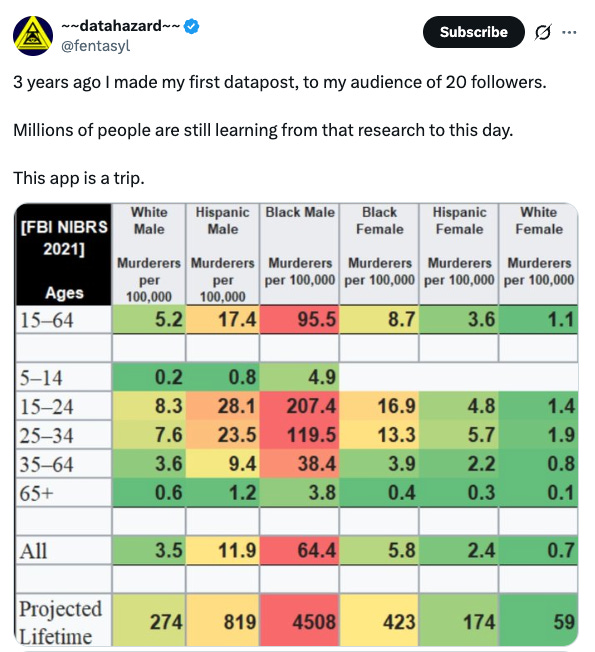
Now we’re into the most radioactive part of the whole thing: the “Blacks need to be imprisoned for the most part” line.
Piers plays that clip as if Fuentes literally wants “most” Black people in cages forever. Then he follows up with the dumbest possible question if you’re trying to have an honest conversation:
“All of them? What percentage?”
That’s the prosecutorial frame: take the ugliest, least charitable reading, then force a yes/no.
When Nick finally gets a word in, he immediately narrows it:
He says he’s talking about violent offenders, not all Black people.
He gives a seat‑of‑the‑pants number: “whatever the percentage is of the murderers… maybe 5%.”
He cites a data scientist DataHazard (@fentasyl) who has modeled that, at current rates (based on credible data and logical calculations), “almost 1 in 20 Black males” will commit a murder at some point in their lives.
In other words, behind the deliberately brutal soundbite, the underlying claim he’s trying to make is something like:
We massively under‑incapacitate a relatively small but extremely violent subset of young Black men; that subset terrorizes everyone else (including other Black people) and our politics won’t let us admit it.
You can think that’s an obscene way to talk about it. But if you’re trying to understand why his audience didn’t recoil from this segment, you have to separate the rhetoric (“Blacks should be imprisoned”) from the underlying picture he’s gesturing at.
What the official numbers actually say
Let’s park Nick and Piers for a second and look at the baseline facts.
In 2019, when the FBI still published detailed homicide breakdowns, 55.9% of known homicide offenders were Black and 41.1% were white, in a country where Black people were about 13–14% of the population and whites about 60%. (FBI)
That implies a Black per‑capita homicide offending rate roughly 8× the white rate. (Wikipedia)By 2023, the federal government’s own “homicide victimization” bulletin put the Black homicide victimization rate at 21.3 per 100,000, versus 3.2 per 100,000 for whites — more than 6x higher. (LEB)
On non‑fatal violent crime more broadly (robbery, aggravated assault, etc.), a Bureau of Justice Statistics report using victim surveys and FBI data found that Black people made up 29% of violent‑crime offenders in 2018, vs about 12-13% of the population. Whites were about 60% of the population but under half of offenders. (BJS)
So 3 things are simultaneously true:
The per‑capita gaps are enormous. Black Americans (especially young Black men) really do have per‑capita homicide and violent‑offender rates far higher than whites. That’s not an opinion. That’s the cold, hard official data.
Black communities are also the biggest victims of that violence. A homicide victimization rate of 21.3 per 100,000 is not just “a little higher”; it’s a different planet of risk. This is because Black on Black crime is high.
The state is not magically solving it. Homicide clearance (solve) rates have sunk in many cities; in some years more than half of Black homicide victims are killed by someone who’s never identified or charged. (National Academies)
The Interracial Proportionality Gap
Raw Numbers (2019 FBI Data): In absolute terms, Black-on-White homicides are roughly double White-on-Black homicides.
Black Offender / White Victim: 566 incidents
White Offender / Black Victim: 246 incidents
Per-Capita Reality: When you adjust for population size (Blacks ~13%, Whites ~60%), the rate at which Black individuals commit homicide against Whites is drastically higher than the reverse.
Black-on-White Offender Rate: ~13.2 per 1 million Black citizens.
White-on-Black Offender Rate: ~1.2 per 1 million White citizens.
Disparity: A random Black male is statistically ~11 times more likely to kill a White person than a White person is to kill a Black person. This confirms that while most violence is intraracial (Black-on-Black or White-on-White), the “spillover” violence is overwhelmingly directional.
When Fuentes says “the situation is far more alarming than people think,” that’s the reality his audience is mapping onto. They don’t hear “Fuentes wants to imprison Black people for being Black.” They hear:
“He’s saying out loud what the charts already show and what polite media constantly soft‑pedal or reframe.”
So what about the “1 in 20” Black men are murderers claim?
Here’s where Piers could have scored some points but didn’t.
If you start with official FBI numbers and do some back‑of‑the‑envelope math, you get something like:
About 15-16 homicide offenders per 100,000 Black people per year overall, which is roughly 31-32 per 100,000 Black men per year once you account for the fact that homicide offending is overwhelmingly male.
Even if you stretch that over 30–40 years of “risk exposure,” you get a crude lifetime probability in the low single digits, not a clean 5%:
It’s extremely plausible that on the order of 1 in 100 to 1 in 50 Black men might be homicide offenders over a lifetime horizon, depending on assumptions.
The official data doesn’t explicitly support a “clean 5%” murderer rate. That’s a projection, not a census fact.
That’s where DataHazard’s model lives: take decades of homicide data, adjust for under‑counting repeat offenders, and ask “what fraction of all Black males have ever been a homicide offender?”
The modeling can easily land in a 3–5% range, which is where “almost 1 in 20” comes from.
So the truth is that:
Nick is directionally right that homicide offending is insanely concentrated in a relatively small slice of young Black men, and that the per‑capita disparity vs. Whites is not a rounding error but an order‑of‑magnitude thing.
He is not necessarily accurate with the “1 in 20” stat as if it’s a settled, official fraction; it’s a logical inference built on some assumptions. 1 in 20 would be likely closer to an upper bounds estimate.
And here’s the critical point: Piers doesn’t say any of this on air. He just declares “that’s baloney, it’s under 1 in 100,” gestures at unnamed fact‑checkers, and moves on.
To an audience that can Google the basic homicide charts in 30 seconds, that comes off as:
Trust me, the TV man, rather than the nasty numbers you might see yourself.
Nick may be over‑claiming, but he at least understands “per capita” and proportionality. Piers tries to swat it away with vibes, appeals to authority, and absolute numbers (without considering population %s).
That’s why, even in a segment this incendiary, a lot of people walked away thinking:
Piers is deliberately hiding the stats to virtue signal.
VI. School Shootings vs Everyday Violence: Piers’ Denominator Switch

A big chunk of the “Piers is slippery” sentiment came from one specific maneuver Piers uses to avoid addressing massive disparities in violence per capita by race.
Nick is clearly talking about everyday street violence:
Chicago “teen takeovers” and carjackings
Random robberies and stabbings
The kind of stuff that dominates local nightly news in big U.S. cities
He’s building a per‑capita risk picture:
“If you’re walking around a major U.S. city, who is actually attacking whom, and how often?”
Right when that gets uncomfortable, Piers suddenly jumps sideways:
“How do you feel about mass shootings at school? Who do you think commits the vast majority of those?”
Now we’re in a totally different category:
From common, high‑volume crimes like robbery and “ordinary” shootings…
To rare, spectacular school massacres that dominate national headlines precisely because they’re unusual.
He then drops a topline:
Roughly 60–65% of school mass shooters are white.
That’s in the ballpark of what various databases find if you define “school shooter” narrowly as mass‑casualty student shooters in K‑12 or college settings. (NJJ)
This fails to account for the fact that school shootings are extremely uncommon in general and doesn’t address per capita (i.e. White school shooters vs. total White population).
He doesn’t even bother getting into the nuances of many “White Hispanics” counted as Whites.
Nick immediately asks the obvious follow‑up:
Okay, but what fraction of white people are school shooters?
What’s the per‑capita risk of a random white man being one of those compared to the per‑capita risk of young Black men committing everyday violent crime?
Piers will not touch that denominator. He just repeats the “60–65%” line, as if the share of incidents is the only number that matters.
To anyone with a basic feel for stats, that’s the tell:
If you’re willing to talk in shares when white people dominate a rare category (school mass shooters)
But insist on talking in totals or feelings when Black offenders dominate a common category (robbery, homicide, street assaults)
You’re not doing honest analysis… this is just woke framing.
Nick also highlights the fact that most people pay more money for their kids to go to an all-White school in an upper class area as opposed to some “diverse” school where there are gangs and associated drugs, beatings/fights, gun violence, and dysfunction.
Why the swap feels so dishonest
Two structural problems with Piers’ move:
School shootings are a tiny slice of gun violence. A DOJ‑funded “Violence Project” database counted 106 deaths from public mass shootings in 2017 out of 14,542 total firearm homicides that year — well under 1% of all gun murders. (TVP) So even if white people dominated all school shootings, that tells you almost nothing about day‑to‑day risk on the street or transit.
Definitions of “school shooting” are all over the place. The American School Shooting Study and K‑12 School Shooting Database count any gunfire on or near school property, from gang beefs in the parking lot to suicides to accidental discharges, and they explicitly note that truly “mass‑casualty” events make up only about 5% of school‑associated shootings. (RockInst)
Counting all gun incidents at Schools. When you count all incidents, including disputes, domestic spillover, and gang shootings at games, the racial mix of School shooters looks very different than the archetypal white “Columbine kid.” (GAO)
Piers glosses all of that and treats “school shooters” as a simple, monolithic category where “most are white, full stop.”
Nick knows that’s a mixing of categories and keeps dragging things back to:
What’s my risk of being mugged, shot, or carjacked if I walk through certain neighborhoods? What are the per‑capita offender rates by group there?
That’s the arena where:
FBI and BJS data really do show Black offending and victimization rates far above white rates for homicide and serious non‑fatal violence.
And where the everyday fear people have on trains, buses, and sidewalks actually lives.
By jumping sideways to school shooters and then refusing to give a per‑capita figure, Piers confirms exactly what Nick and his fans say about legacy media:
They’ll use whichever denominator makes white people look worst and avoid the denominator that would make their own narrative uncomfortable.
It’s not that Piers’ “60–65%” claim is fake. It’s that it’s strategically deployed to dodge the question actually on the table.
And again: you don’t have to like Nick’s framing at all to see how obviously calculated that switch was.
VII. The “Lose‑Lose” Reality: Zarutska, Penny, and Under‑Policing
The next step in Nick’s argument is about behavioral incentives. He notes that:
Given the actual crime patterns and the way the system reacts, being ‘color‑blind’ around certain demographics is a lose‑lose for white people.
He brings up several cases including Iryna Zarutska to support his point.
Case 1: Iryna Zarutska — punished for not being “a little racist”
On August 22, 2025, Iryna Zarutska, a 23‑year‑old Ukrainian refugee, boarded a light‑rail train in Charlotte and sat down in front of a Black man she’d never met. Surveillance footage shows the Black man sitting behind her, pulling a folding knife, and stabbing her 3 times from behind (including in the neck) while she’s still seated. She collapses and dies on the train floor.
The accused, Decarlos Brown Jr. was a Black man with a lengthy arrest history — local coverage puts it at 14 prior arrests across various offenses. (The Sun)
He was only out of prison due to woke laws, progressives and ideologically captured judges. This should’ve never happened.
Key points that make this into an internet symbol:
She did nothing provably “provocative” at all — just sat there.
He’d already cycled through the criminal justice system over and over.
He was still out, still riding transit, still in a position to kill someone at random.
North Carolina just passed “Iryna’s Law” tightening bail rules for certain violent repeat offenders explicitly in reaction to this murder. (Axios)
In Nick’s risk‑management framing, she is the perfect tragic example of:
A white woman who tried to live like the DEI brochures say you should (no ‘profiling,’ no moving seats, no ‘paranoid’ response) and got killed for it by a guy the system refused to incapacitate.
Is that a crude way to talk about her death? Of course. But it’s very obviously how many perceive it, especially when the coverage then reveals that a second stabbing on the same transit line, just months later, involved a twice‑deported Honduran national with a violent record. (NYP)
From this point of view:
Being “nice” and ignoring your fear makes you a potential Zarutska.
The state has clearly failed at keeping repeat violent offenders away from vulnerable people.
Case 2: Daniel Penny — punished for acting on fear
At the other end of the “lose‑lose” is Daniel Penny.
On May 1, 2023, Penny, a 24‑year‑old white Marine veteran, put Jordan Neely, a 30‑year‑old Black homeless man, in a chokehold on a New York City subway after Neely began aggressively threatening passengers. Neely later died; the medical examiner ruled it a homicide.
Penny cooperated with police immediately and was initially released without charges.
After intense public protest and media coverage, he was charged with second‑degree manslaughter, facing up to 15 years.
After a 2024 trial, the jury deadlocked on manslaughter, prosecutors dropped that charge, and Penny was ultimately acquitted of criminally negligent homicide as well.
Regardless of how you personally read that case, look at it through Nick’s “lose‑lose” lens:
If you sit there and hope for the best in a confined space with a violently unstable person, you risk becoming Iryna or any number of less‑viral victims.
If you physically intervene and something goes wrong, you risk becoming Penny: doxxed, prosecuted, and internationally branded a racist vigilante.
That’s the double bind he’s describing:
If you trust the system, you can die. If you don’t trust the system and act, the system may come for you anyway.
This is exactly how a lot of ordinary people perceive things now, even if they don’t go as far as Fuentes.
Under‑policing, under‑incapacitation, and Black victimization
Here’s the twist Piers never touches: the per‑capita disparity Nick fixates on means Black communities get the worst of both worlds.
They are more likely to be the victims of serious violent crime, including homicide.
Their homicides are less likely to be cleared by arrest, leaving more killers on the street.
They often live under both heavy police contact and inadequate protection: lots of low‑level intrusions, not enough incapacitation of the truly violent.
So when Nick says “I have a lot of Black fans” and states that many agree with him on crime, it seems legitimate.
Survey work routinely finds that Black residents in high‑crime neighborhoods are less likely than whites to trust police, but more likely to say they want more police presence or tougher action against violent offenders where they live. (CCJ)
That’s the nuance Piers doesn’t want anywhere near the frame. If he admitted it, he’d have to concede:
Blacks commit a disproportionate amount of violent crime relative to their population percentage.
Woke left-wingers sweep this under the rug and advocate for defunding the police, lighter policing, legalizing illegal behaviors, and progressive judges to let violent criminals free.
Nick compresses all of that into deliberately brutal race talk. Piers flattens all of it into a sermon about empathy and racism.
Why this segment made Piers look especially out of touch
If you step back, this is the basic structure of the exchange:
Nick: Per‑capita, risk isn’t equal. The system has turned enforcement into politics, and ordinary people (especially women) are paying the price.
Piers: How do you think Black people feel hearing this?! But white men do school shootings!!!
To someone who’s watched the last 10 years of big‑city crime and criminal‑justice reform from up close, that sounds like:
I don’t want to talk about your risk calculus. I want to talk about your feelings and your sins.
That is exactly the kind of move that loses common sense crowds — including many who don’t even share Nick Fuentes’ ideology. They’re not looking for holiness lectures.
They’re looking for someone who will say:
Yes Blacks commit a fuck ton of crime.
Policing, judges, laws, and policies need reform.
You aren’t that insane to avoid certain parts of Chicago.
…and then argue for a better solution.
Piers never gets there. He stays in moral‑prosecutor mode.
Nick, for all his hyperbole, at least sounds like someone who’s willing to talk about what it feels like to actually live with the risk.
That’s why this whole crime/per‑capita/“lose‑lose” block was such a pivotal part of the interview: it’s where a lot of viewers who don’t like Fuentes’ worldview still decided that Piers was not the honest broker in the room.
VIII. Jews, the Holocaust, Weaponization Fight
This part of the interview gets completely mangled in headlines.
In the actual conversation, Fuentes does not argue “it wasn’t 6 million” or “the Holocaust didn’t happen.”
Under direct pressure from Piers, he:
Says “seven, eight million… something like that” when asked for a number
Explicitly concedes that at least six million Jews were killed in the Holocaust, possibly more
Says every death is a tragedy and that he’s not a WWII historian
From that point on, he isn’t fighting over the historical basics.
He’s fighting over:
What’s legally sayable
What’s joke‑able
How uniquely “sacred” the topic is
And how he thinks it’s weaponized in modern politics
Piers keeps trying to drag it back to: you hate Jews, you’re a denier.
“World Jewry” and old clips as a semantic trap
Piers opens this section by:
Pulling old show clips of Fuentes using phrases like “world Jewry” and “organized Jewry”
Immediately forcing the most extreme reading: “So you mean the 15 million Jews in the world? So you’re opposed to them?”
He’s not really asking for a definition; he’s trying to get Fuentes to say “yes, I oppose all Jews,” so the label antisemite becomes clean and uncontested.
Fuentes counters by noting that terms like “world Jewry” appear often in mainstream Jewish contexts (e.g. lecture series titled “The State of World Jewry” at the 92nd Street Y, or World Jewish Congress and Free Press pieces using that language).
His point isn’t “therefore my politics are correct,” it’s: you’re acting like even the phrase itself is a smoking gun when respectable Jewish institutions use it all the time.
Visually, it makes Piers look like he’s doing language‑lawyer gotchas instead of addressing the actual argument about power and taboo.
On top of that, the clips Piers uses (cookie‑oven bit, “hard to believe” gas‑chamber riff, etc.) are:
From Fuentes’ own show, not recent interviews
Delivered years ago in in‑group comedic mode (edgy monologue for his fans, not polished policy talk)
Piers rips those out of that context and treats them as Fuentes’ current, literal, interview‑mode creed.
What Fuentes actually says in this interview
Once Piers stops the clip reel and pins him down, Fuentes:
Agrees that at least six million Jews were murdered, and says the true number might even be higher.
Says he’s open to the official narrative and not qualified to do original forensic work.
Immediately pivots to speech and taboo:
In ~17 EU countries, certain forms of Holocaust denial/minimization are crimes (fines, prison).
This one atrocity has dedicated “blasphemy‑style” protections; other genocides don’t.
His core line:
“If the evidence is so overwhelming, why do you need to throw people in jail for disagreeing? Why is this the only thing you can’t really debate?”
That’s a taboo/power argument, not a historical‑revisionist argument. Piers never really separates those.
“Too soon?” and the civil‑religion frame
When Piers plays the cookie‑oven clip and scolds him for joking about the Holocaust, Fuentes answers with:
“Why? Too soon?”
He’s not literally arguing about timing. He’s mocking the special taboo:
In 2025, people joke (darkly) about 9/11, slavery, Hiroshima, AIDS, school shootings — almost nothing is truly off‑limits.
The Holocaust sits in a uniquely sacred category: huge memorial infrastructure, mandatory school units, and in Europe, actual denial laws with prison attached.
So “Too soon?” is shorthand for:
“You’re enforcing a religious‑style blasphemy rule around this one topic. That’s the point I’m attacking.”
He explicitly calls it a “religious dogma” with “blasphemy laws” — a secular civil religion that dictates what you’re allowed to say, joke about, or question.
Piers’ response is:
“There is no debate about the numbers.”
“Even the Nazis documented it.”
A mini‑lecture about the unprecedented volume of documentation and trials, which is correct as far as institutional history goes.
Then, only after a while, he concedes that he personally opposes jailing people for speech — but insists this topic is still “beyond debate.”
To a skeptical, online audience, that sounds exactly like what Fuentes is complaining about: “You’re not persuading, you’re policing.”
Hitler “very fucking cool” and the Finkelstein ambush
Next, Piers plays the big “Hitler was very fucking cool” clip and asks if Fuentes regrets it. Fuentes says no, and doubles down:
“Yes, I do [think that]. I’m tired of pretending he’s not.”
When pressed what he finds “cool,” he doesn’t say “the genocide.”
What he actually thinks is cool:
The “edits” (WWII fan clips)
Uniforms, rallies, parades
WWII as a visually and historically “fascinating, compelling” theatre
He adds: “No one here is in favor of genocide” and “We’re not in favor of a Holocaust or genocide.”
So he’s doing a deliberately inflammatory separation:
Aesthetics & historical fascination vs. moral judgment of the regime.
Then Piers drops in Danny Finkelstein, via a pre‑recorded video — a Times journalist whose family was brutalized by both Hitler and Stalin, and who wrote a book (Hitler, Stalin, Mum and Dad) about it.
Finkelstein recounts:
Relatives starved, deported, gassed
Parents arrested as children
Most of his extended family wiped out
And asks, essentially:
Why are you on ‘team Hitler’ instead of on ‘team my mum and dad’?
This is meant to be the moral kill shot.
Fuentes refuses to play along:
He mocks the “me mum, me dad” appeal.
Says his generation has been brow‑beaten with this narrative their entire lives.
Calls it “propaganda” and ties it directly to post‑WWII “open society” ideology: open borders, enforced diversity, suspicion of white Christian nationalism.
Piers continues to appeal to empathy (“What if it were your family?” “This shows your lack of humanity”). I thought this was reasonable to ask, but Fuentes already realized the framing Piers was doing and wasn’t having it.
By then the roles were cemented:
Piers as moral scolder and taboo enforcer, bringing in a Jewish victim‑descendant clip as a kind of emotional hostage situation.
Fuentes as taboo refuser, implying openly: We’re tired of having this used to shame us into silence about our own identity and demographic future.
To people already burned out on being guilt‑lectured, Fuentes’ refusal to bow to Finkelstein read as brutal but authentic.
Piers looked like he was weaponizing someone else’s trauma to win a TV argument.
Weaponization vs “you just hate Jews”
Fuentes’ core claim here is not “every Jew on earth is evil.” He repeatedly distinguishes between:
Jews he knows personally (friends, guests, etc.)
What he calls “organized Jewry” (institutions, lobbies, NGOs, media blocs he sees as aligned)
What he argues:
Holocaust memory and accusations of antisemitism function as a moral trump card.
If you criticize certain policies, demographics, or institutions associated with Jewish actors, you get hit with: “this is how another Holocaust starts.”
That, in his view, makes the Holocaust a “get out of jail free card” for those institutions: play it, and all criticism is beyond the pale.
Piers calls this “ridiculous,” says most Jews have lost family in the Holocaust and are not “weaponizing” anything, and insists no “right‑minded” person sees the Shoah as a free pass.
He doesn’t really separate:
Normal remembrance & advocacy (very real, and often legitimate)
From aggressive use of Holocaust imagery as a shutdown move in politics
So the argument lands as:
Fuentes: This is a civil religion with blasphemy laws and a political function.
Piers: No, it’s basic decency; suggesting ‘weaponization’ just proves you’re bigoted.
Factually, Fuentes connects dots that most people see as coincidence. He views demographic shifts as part of conspiratorial social engineering while the mainstream presents them as economic inevitability (i.e. “we have no other choice”).
But from a certain perspective, the structure Fuentes points to is visible enough: denial laws, unique memorial status, constant “Never Again” framing — such that a lot of viewers don’t find his meta‑critique crazy, even if they reject his bigger narrative.
Why this segment helped Fuentes’
In this interview, Fuentes agrees with the core Holocaust facts and numbers.
He shifts the fight to speech, taboo, and political use of that history.
Piers responds with semantic traps, very old in‑group show clips, a “no debate” posture, and an emotional Finkelstein clip designed to shame him into submission.
To Fuentes’ audience — and to a lot of younger, deeply online viewers — that looks exactly like the “weaponization” dynamic Fuentes is describing:
“The one event we’re not allowed to joke about, question, or connect to any uncomfortable political argument — under threat of social or legal punishment.”
You can think Fuentes’ worldview is extreme and still see why Piers came off less like a truth‑seeker and more like a high priest of the taboo.
IX. Women, Sex, “Old‑World Catholic” Perspective
The women segment is pure chaos: a Boomer TV host trying to humiliate a celibate 20‑something Catholic who thinks women shouldn’t vote.
This part isn’t just “boomer host vs edgy Catholic streamer.”
There’s an extra layer that matters for the optics: Piers claims Catholic identity.
And once that happens, the “virgin/sex” dunking stops being merely juvenile — it starts reading as anti‑Catholic (or at least “cafeteria Catholic”) on Piers’ side, while Fuentes comes off as the one whose behavior is more consistent with traditional Catholic sexual discipline.
Fuentes doesn’t soft‑pedal his views. On the record:
Women shouldn’t vote.
Women should be homemakers.
Sex belongs only in marriage; premarital sex is mortal sin.
He’s never had sex, says he intends to remain celibate until marriage.
By 2025 standards, that sounds like Martian politics. But historically it’s not as fringe as it looks.
The Catholic Church never issued an official dogma against women’s suffrage, but a lot of Catholic leaders and laity did oppose it in practice. A historical review of the Nebraska suffrage fight notes that the Roman Catholic Church was “the religious group that most consistently opposed women’s suffrage” there, with German Catholics especially hostile to giving women the vote. (Nebraska Studies)
The Church still bars women from the priesthood, episcopate, and papacy. Under Pope Francis there’s been movement on women holding senior administrative roles — women now make up about 26% of Vatican Curia staff, and a handful lead or co‑lead major dicasteries — but ordination is still male‑only. (Le Monde.fr)
So when Fuentes says he’s basically just applying an old‑world Catholic hierarchy to modern politics, that’s not entirely crazy. He’s taking a historical vibe (male headship of both church and household) and pushing it back into civil law:
Men rule; women follow. Women have equal worth before God, but not equal authority in public life.
You might hate that view (most modern people do) but you can’t pretend he pulled it out of his ass. It’s historical Catholic doctrine.
The rape‑fantasy clip: crude phrasing, real data
The ugliest‑sounding line is the one that gets clipped everywhere:
“A lot of women want to be raped. They want a guy to beat the shit out of them…”
In isolation, that sounds psychopathic.
In context, he’s clearly talking about sexual fantasies, not literally wanting to be attacked in real life.
He immediately references:
“Fifty Shades of Grey”
Twilight‑style romance
Studies about women’s forced‑sex fantasies
Annoyingly for Piers, the core factual claim Fuentes is gesturing at is broadly supported by the literature:
A 2009 study in The Journal of Sex Research (Bivona & Critelli) surveyed 355 female undergraduates and found that 62% reported at least one rape fantasy. For these women, the median frequency was around four times per year, and about 14% had such fantasies at least once a week. (PubMed)
A 2008 review article (Critelli & Bivona) looked at multiple studies and concluded that 31–57% of women report having had forced‑sex or rape fantasies, with 9-17% saying these are frequent or among their favorite fantasies. (PubMed)
A more recent large‑sample survey of over 4,000 Americans found that about 61% of women had fantasized about being “forced” to have sex at least once. (Wikipedia)
Crucially, the researchers emphasize what Fuentes doesn’t bother to explain clearly:
These are fantasies (internal, controlled, safely distanced scenarios) not literal desires to be raped in real life.
They often center on themes of dominance, surrender, or “overwhelming desire,” not on the horror, violation, and trauma of a real assault. (PubMed)
Nick could have probably dug up and cited the studies like a boring academic.
Instead, he chose the “shock jock” phrasing: “women want to be raped” — specifically to bait Piers. And Piers took the bait hook, line, and sinker, ignoring the actual data (not even considering studies) underneath the provocation.
Obviously he could’ve said something like a WokeGPT:
A significant fraction of women have sexual fantasies involving coercion or forced sex; this is well‑documented and doesn’t mean they actually want to be assaulted.
If Piers had been smart here, he maybe could’ve said:
Perhaps the fantasy data is real. But it’s important to express this with appropriate sensitivity and nuance.
Instead he just goes:
So you think women want to be raped?
You’ve never had sex, so what do you know?
…and starts in on virgin‑shaming Fuentes.
Virgin‑shaming (incel) vs religious discipline
This is where Piers really loses the plot.
Rather than exploit the real tension (Catholic teaching on human dignity vs Nick’s contemptuous tone), he decides to go full high‑school bully:
“Have you ever had sex?”
“You’ve never got laid, have you?”
“You’re basically an incel.”
Fuentes’ response is rooted in Catholicism.
He has chosen celibacy because premarital sex is, in his view, a mortal sin.
He doesn’t see his virginity as an embarrassing failure; he sees it as Christian discipline.
Again, you don’t have to buy that. But when a guy says “I’m abstinent because of my religion,” and you respond with “lol virgin,” you are the one undercutting your own Catholicism and moral authority.
To the kind of young male audience that’s already skeptical of modern sexual culture, this segment delivered exactly what they expected:
The boomer moralizer doesn’t actually respect religious self‑control — he just respects whether you get laid.
On top of that, “incel” as a slur has gone through the same inflation as “racist” and “misogynist”:
It started as “involuntarily celibate.”
It turned into “any socially awkward right‑wing guy online.”
It ended up as a generic “loser” label you throw at someone you don’t like.
So when Piers leans on it, it doesn’t sound like a meaningful diagnosis. It sounds like status policing: “your sexual history is nonexistent, therefore your views don’t count.”
Fuentes’ whole shtick is refusing to take status hints. He just shrugs and leans back into his 1950s Catholic persona.
Why this section felt like a Piers self‑own
If you strip out the ideology and just look at the moves:
Fuentes’ positions on women are harsh and very out of step with modern norms, but internally coherent within an old‑world Catholic frame.
His rape‑fantasy spiel is crudely phrased, but built on actual sex‑research findings about coercion fantasies.
Piers never engages Catholic history or doctrine beyond cheap “are you saying the Church thinks women shouldn’t vote?” jabs and doesn’t show any awareness of the sex‑research literature.
Instead, he spends his time trying to embarrass Fuentes for being celibate and throws “misogynist” around like it’s 2015 Twitter despite being a Catholic himself.
To an online audience, that looks like:
“The man with the TV show doesn’t know the studies, doesn’t know the theology, and has no argument except ‘have sex, loser.’”
Fuentes’ fans think he “won” this part because he looked like he believed something real and was willing to take the social hit for it, while Piers looked like a guy more interested in humiliating him than in understanding or refuting him… and came across like a questionable Catholic.
The Pope Test: The Authority Fuentes Actually Respects
There was one moment in this segment that Piers completely misread, but which cemented Fuentes’s “Trad” bona fides. Toward the end of the interview, Piers tries a final authority‑based gotcha:
“Would it matter to you if the Pope openly condemned you?”
Piers clearly expected a defiant “No, the Pope is woke” answer to paint Nick as a total rogue element. Instead, Fuentes immediately pivots to humility:
“It would be very disheartening. Yes... He’s the Vicar of Christ. So, if he condemned me... I wouldn’t like that.”
This is the “tell” for his worldview. He respects hierarchy in his Catholic religion — he just rejects secular liberal hierarchy.
By admitting he would be hurt by the Pope’s disapproval, he reinforces the “Catholic discipline” frame you saw in the virginity debate.
It showed he isn’t a nihilist troll who hates everyone; he’s a religious ideologue who thinks the secular world (Piers) has no moral standing, but the spiritual world (the Church) does.
X. Double Games: Future Hitler, Fed Conspiracy
Another under‑discussed part of this interview is how Piers tries to frame Fuentes as both:
A nascent Hitler running a “double game” — reasonable in interviews, extreme with his base.
Potentially a federal asset (“Fed”) or at least suspiciously untouched by the system he attacks.
These are contradictory attacks, but they both feed the same thing: “this man is too dangerous to be platformed.”
The Coleman Hughes “two personas” angle
Piers leans heavily on a line from Coleman Hughes (via Bari Weiss’ outlet) that says:
Nick has a “double game”
He sounds moderate and careful in mainstream contexts
But on his own show he’s extreme and genocidal
If he ever got power, he’d reveal his “real” Hitler‑esque agenda
Fuentes’ answer is basically:
Yes, I have two styles: the hyperbolic, shitposting, dark‑humor persona on my stream, and a more literal mode in interviews.
No, I’m not secretly plotting to “pretend to be normal” and then turn into Hitler once I have power; that’s insane.
Piers never actually does the sober thing here:
He doesn’t show policy contradictions in serious interviews Fuentes has done — “you say X here, but Y there.”
He intentionally doesn’t distinguish between trolling bits (“Hitler was cool”) and explicit policy prescriptions.
He doesn’t pin Fuentes down on, say, “would you support deportation camps, yes or no?”
Instead, he just sort of waves at the general “double game” accusation and expects the audience’s fear of “another Hitler” to fill in the gaps.
The problem is: that card has been played on everyone mildly to the right of Joe Biden for a decade. “Trump is Hitler.” “DeSantis is Hitler.” “Orban is Hitler.”
At this point, telling a 25‑year‑old online guy “careful, this man is Hitler” hits the same nerve as “careful, this man is racist” — it’s been said about everyone.
So when Piers leans into “future Hitler” without producing a clear, step‑by‑step policy case, it lands as boomer paranoia, not a serious warning.
He’s not acting like a typical political climber. He criticizes Trump, calls out other right‑wing influencers (Tucker, Candace, Kirk) as handlers, and doesn’t sound like someone trying to stay in a coalition; he sounds like someone burning bridges.
That’s part of why you get the split narratives: some people think he’s a budding dictator; others think he’s a fed. The more he bashes Trump and the big right‑wing ecosystem, the less he looks like a groomed party asset and the more he looks like a loose cannon.
The “Grifter” Accusation vs. The Bank Account Reality
At one point, Piers tries the standard “you’re just doing this for money/clicks” attack.
This is usually a safe bet against influencers. Here, it walked Piers into a devastating class‑warfare trap.
Fuentes snapped back instantly:
“I’m banned from banking. I’m banned from credit cards. Your company is worth $100 million... Don’t tell me I’m doing it for money.”
In terms of optics, this was a kill shot.
Piers: The multi‑millionaire sitting in a global studio.
Fuentes: The guy who has to carry cash because Chase and Wells Fargo won’t service him.
It is tactically impossible to paint someone as a greedy grifter when they have been systematically stripped of the ability to hold a checking account.
By bringing up money, Piers inadvertently highlighted the massive institutional penalty Fuentes pays for his views, which only made the “he actually believes this stuff” narrative stronger.
The “fed” rumors and the January 6 subpoena
On the other side, there’s a whole meme ecosystem that says Fuentes is a fed, especially because:
He was very visible in the orbit of January 6.
He’s been subpoenaed and questioned but never charged, unlike many others.
The system seems to hate him rhetorically but hasn’t buried him legally.
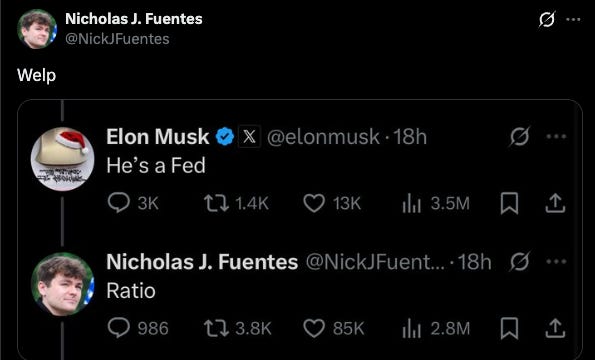
This meme went mainstream enough that Elon Musk himself replied “He’s a Fed” under a clip of Fuentes denying he was an informant or antisemite.
The post got slapped with a Community Note explicitly saying there is no credible evidence Fuentes is a federal informant.
In reality:
The House January 6th Committee did issue a subpoena to Nicholas J. Fuentes on January 19, 2022, as part of its investigation into the Capitol riot.
A deposition transcript from February 16, 2022 exists in the official record, where Fuentes is questioned under oath about his activities and communications.
There’s no public documentation showing that he cooperated as an informant or gave devices; watchdogs and even his enemies mainly portray him as a subpoenaed witness / subject, not a collaborator.
Piers doesn’t dig into any of this detail. He mostly uses the January 6 stuff as pure character stain:
“You were there.”
“You told people to disregard the police.”
“You’re part of the problem.”
Fuentes doubles down with a legitimacy argument:
The Capitol “belongs to the people.”
He sees 2020 as rigged (Piers pushes back, citing courts and lack of fraud evidence).
His core narrative is: when a system is illegitimate, people storming the symbolic center is righteous.
You can think that’s reckless or insane; that’s a separate discussion. The key point here is: Piers never actually nails him as a “fed” or as a uniquely dangerous mastermind.
Instead, we get this weird media equilibrium:
Mainstream columnists call him a “white supremacist” and a potential fascist dictator.
Anti‑Fuentes right‑wingers and big accounts call him “a fed.”
From a viewer’s perspective, that starts to look like:
Okay, so everyone who matters hates him, and no one can agree on why.
Which is exactly the kind of thing that boosts an anti‑establishment figure. If he were just a clown, he wouldn’t get subpoenas, Senate resolutions, and Musk subtweets. If he were a protected asset, he wouldn’t be de‑banked, de‑platformed, and openly denounced.
The point isn’t whether Fuentes is “good” or “bad.” The point is that attacks against him are so ridiculous that they end up making him look more like a reasonable dissident than like a cartoon villain.
“Life or Death” Stakes: Charlie Kirk & The Alleyway Shooting
If you want to know why the “Fed” label doesn’t stick with his core audience, look at the segment on violence. Piers asks about the assassination of Charlie Kirk.
Note Fuentes’s reaction: despite admitting he “hated” Kirk and had an intense rivalry, he says he was “devastated” and “beside himself” when the news broke.
Why? Because, as he notes, someone tried to kill him a year prior (a gunman who was shot dead in Fuentes’s alleyway).
This created a jarring contrast in tone:
Piers: Treating politics as a debate about “mean tweets” and rude words.
Fuentes: Treating politics as a physical war zone where he and his rivals are being hunted.
When a guest is discussing actual assassination attempts against himself and his peers, the “he’s a fed” or “he’s a grifter” accusations evaporate. Feds don’t usually get shot at in their own alleyways.
Piers walks right into that. Instead of calmly saying:
“Here’s what you actually advocate in policy terms.”
“Here’s why that’s dangerous or unworkable.”
“Here’s where you contradict yourself.”
…he leans on vibes (“double game, future Hitler”), labels, and association (January 6, Trump dinner, Tucker, etc.).
Fuentes, by contrast, just keeps saying:
“I am who I say I am. I’ve been subpoenaed, de‑platformed, financially wrecked. I’m obviously not protected.”
And in an age where people reflexively distrust institutions, that’s the story that sticks.
XI. Trump, Deportations, Performative Cruelty

One of the more interesting moves Fuentes makes in this interview is turning his fire on Trump from the right.
He’s not doing the usual liberal “Trump is cruel” thing. He’s effectively saying:
Trump talks like a warlord and does big cinematic enforcement… but underneath, the numbers are mid and it’s unnecessary cruelty.
He calls it “performative cruelty” — deportation-as-content. Glitzy arrests, viral clips, tough talk, and then, in his view, a system that still leaves the fundamental demographic trajectory untouched.
Trump as hero, then disappointment
He grew up idolizing Trump as the first guy to say “the quiet part” on immigration and national identity.
The Mar‑a‑Lago dinner with Trump and Ye was a genuine “I can’t believe I’m here” moment for him. He describes it as a “love fest,” not a tense or transactional thing.
But he’s now openly criticizing Trump from the right: says Trump didn’t deliver on deportations, calls the current deportation push “performative cruelty” rather than a real demographic reset, and is willing to say that on air.
That’s important because it breaks the “Nick is just a cultist” narrative: he’s very clearly willing to turn on his own ‘hero’ when he thinks the numbers and the results aren’t there.
He’s not a generic MAGA guy anymore. He’s somewhere in that weird space of: still prefers Trump to the other side, but sees Trump as insufficient and compromised.
The JD Vance “Jeet” Attack: It Wasn’t Just Racism, It Was Strategy
The media fixated on Fuentes calling JD Vance’s wife a “Jeet” (a slur for Indians), but they missed why he used it.
He wasn’t just being racist for the sake of it; he was attacking the incoherence of the modern Right.
Fuentes explicitly pointed out the irony:
“You have basically racist chuds that post memes about Indians all day on Twitter... and then they want to turn around and support a guy [Vance] who has non-white kids.”
This is a “purity test” attack. He effectively cornered Piers (and the MAGA base) on a structural contradiction:
If you are a nationalist who wants a white America (as many MAGA anons claim to be), why are you worshipping a multicultural ticket?
If you aren’t a racist, why do you tolerate the “chuds” in your coalition?
By bringing this up, Fuentes positioned himself as the only consistent actor in the room. He was forcing the audience to choose: either admit you’re a multiculturalist liberal like Piers, or be a consistent racialist like Nick.
He refused to let the “middle ground” MAGA grift exist comfortably.
What the second Trump administration is actually doing
The current White House loves big, round targets: “one million removals,” “two million gone,” etc. The reality looks more like this:
Migration Policy Institute (MPI) estimates that ICE carried out about 340,000 deportations in FY 2025, counting both formal removals and detainees who chose voluntary departure. That’s roughly 25% higher than the 271,000 deportations in FY 2024 under Biden. (migrationpolicy.org)
A Stateline analysis notes the administration projected 600,000 deportations for the 2025 calendar year, while earlier rhetoric pointed at up to 1 million, but says actual FY 2025 removals were around that 340k range — well short of the maximalist talk. (Stateline)
A DHS press release in October 2025 trumpeted that “more than 2 million illegal aliens” had left the U.S. since Trump took office again — including about 1.6 million self‑deportations and “over 527,000 deportations” (formal removals). (DHS)
TRAC (a Syracuse University data project that’s been tracking ICE for years) parses those same numbers and estimates about 234,000 removals occurred after Trump took office, out of the total ICE counted for FY 2025 (some of that year still being under Biden). (TRAC)
None of those figures are trivial. They’re real enforcement. But they don’t sound like: “Rounding up 20 million and shipping them out” or “A once‑in‑a‑century demographic reset.”
They sound like a ramped‑up version of the existing machine, not a civilizational U‑turn.
So when Fuentes looks at those numbers and calls Trump’s showmanship “performative cruelty,” what he means is:
You’re doing a bit more of what Obama and Biden did, but with a lot more cinematic swagger and cruelty around the edges — and you want credit as if you restored the 1960 demographics.
Add to that: a Brennan Center analysis of ICE data (and a separate UC Berkeley Deportation Data Project suit) suggests that in the first nine months of this term, roughly a third of ICE arrestees had no criminal record — about 75,000 out of 220,000 arrests by October 15, 2025. (People)
So you get a picture that matches Fuentes’ rhetoric eerily well:
Big numbers relative to recent years
Lots of “soft targets” (non‑criminals) swept up
High‑drama optics (ICE raid videos, deportation planes, sponsorships, memes)
…but not the kind of decisive, high‑risk, high‑reward enforcement he and his crowd fantasize about.
In that light, his critique of Trump isn’t hypocrisy; it’s consistency:
He wants a white‑majority, low‑immigration America.
He sees current enforcement as both too cruel to some individuals and too weak to change the trajectory.
So he calls it “performative cruelty” — cruelty with little long‑term upside.
Piers doesn’t touch any of this empirically. He doesn’t say “actually, removals are way up relative to X” and walk through ICE dashboards. (ICE)
He just goes for character: You’re one of the cruelest guys online, you don’t get to lecture Trump on cruelty. That might feel satisfying to say, but it’s not an answer to the underlying point:
If your enforcement is mostly a PR spectacle, it can be both morally ugly and strategically unimpressive.
That’s the exact kind of thing that resonates with watchers who are exhausted by political theater and want to see output rather than vibes.
XII. 2020, Hunter Biden Laptop, Rigged Election

When the talk shifts to January 6 and election legitimacy, Piers does what every respectable MSM host now does:
He notes that dozens of lawsuits failed.
He points out no court found evidence of widespread fraud that would overturn the result.
He asserts that the 2020 election was not “stolen.”
On the narrow “ballot fraud” question, that’s broadly aligned with official records: state and federal courts rejected challenges, Trump’s own DOJ leadership said they didn’t find fraud on a scale to change the outcome, CISA called 2020 “the most secure in American history.” (House.gov)
Fuentes, like a lot of people on the populist right, doesn’t really care about that distinction. For them, “rigged” is broader:
Tech throttling or blocking certain stories.
Intelligence agencies “leaning” on platforms in the name of disinformation.
Media gatekeeping and narrative steering.
This is where Piers hands Nick a huge rhetorical gift: he concedes that the Hunter Biden laptop story was mishandled in a way that undermined trust.
The basic record on that is pretty straightforward:
On October 14, 2020, the New York Post published a story about emails supposedly from a laptop belonging to Hunter Biden relating to his work in Ukraine.
Facebook (Meta) said it would reduce distribution of the story pending fact‑checking, mechanically limiting how many users saw it. (The Guardian)
Twitter went further, blocking users from sharing the link and temporarily suspending the Post’s account under its “hacked materials” policy — even though Twitter had no concrete evidence the material was hacked.
Later, former Twitter executives testified to Congress that blocking the story was a “mistake”, not the result of direct, explicit government orders, but that they were operating in an environment shaped by FBI warnings about possible Russian disinformation. (PBS)
But let’s cut the BS. Nobody (normie or populist) actually believes the laptop suppression was an ‘honest mistake’ or a ‘glitch.’
Everyone knows exactly what happened: The regime saw a damaging story weeks before an election and the wokes at Twitter axed it.
Even normies on the left know it was deliberate; they just think it was ‘justified’ to stop Trump. When Piers admits the laptop story was mishandled, he isn’t revealing a nuance; he’s confessing to the reality that the information war was rigged.
Fuentes just takes that reality to its logical conclusion.
If you’re a populist, it sounded like this:
The intelligence establishment primed social media platforms to treat anti‑Biden leaks as Russian disinfo, and when a damaging story dropped weeks before the election, Big Tech throttled it out of an abundance of caution that just happened to line up perfectly with their political preferences.
Piers basically says the quiet part out loud:
He doesn’t think 2020 was stolen by fraud.
But he agrees the laptop suppression was a disgrace and that it undermined trust in how information flows in election season.
And that’s all someone like Fuentes needs. Because his argument isn’t:
Every ballot was fake.
It’s more like:
The info environment is rigged, the referees are biased, and even the people defending the system now admit pieces of that.
Once you accept that social platforms and media outlets did put their thumb on the scale (even if you think it was justified), the difference between “rigged by fraud” and “rigged by information control” becomes semantic for a lot of people.
Piers is stuck in lawyer mode: Fraud isn’t proven, ergo your claim is false.
Fuentes is in vibes‑plus‑structure mode: The people who hated Trump controlled what you saw and when you saw it, then say you’re crazy for feeling cheated.
In that clash, a lot of people end up with a simple heuristic:
Ballot‑box “steal” — no evidence.
System tilted and curated in a way that favored one side — yes clearly.
And that’s close enough to “rigged” for them.
Authenticity vs Institutions: Total Groyper Victory

If you want to know how this interview actually landed, you don’t need a media critic or to read CNN, Vox, Reddit, or woke MSM headlines. You need one scroll through the actual YouTube comments section.

They weren’t solemn. They weren’t reverent. They weren’t treating this like a “historic moral tribunal” where Piers pronounces judgment and the public gasps.
They treated it like event television — a gladiator match — and then turned it into a massive trolling festival.
The dominant format became its own meme:
“I’m [X] and I stopped [Y] to watch this.”
“I’m a brain surgeon and I stopped mid‑operation to watch this.”
“I’m Piers’ wife’s boyfriend and I made her watch this.”
“I’m a DEI officer and I stopped oppressing white men to watch this.”
“I’m black and stopped committing crime to watch this.”
“I’m a Ukrainian refugee on a train and I stopped looking around to watch this.”
In context, it’s a tell. That format is the audience saying: we’re not participating in your sacred, scripted morality play. This isn’t court. This is content. And we’re the ones deciding what’s funny, what’s real, and who looks fake.
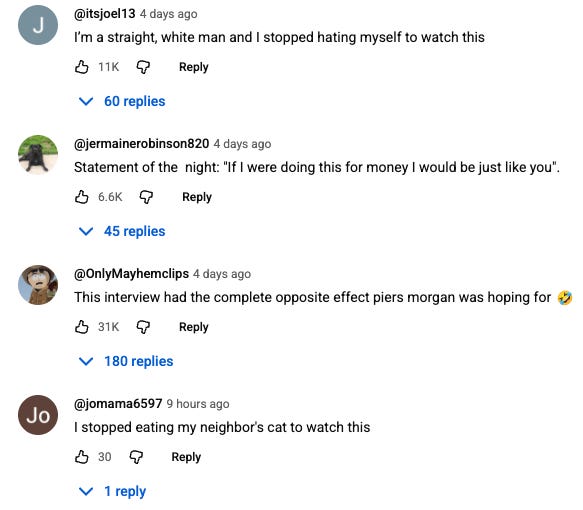
That’s why the most repeated jokes weren’t even about Fuentes’ ideology. They were about Piers as a product.
The show is called Piers Morgan Uncensored. Yet the upload has a very obvious jump cut right when Nick says, “I’ll quote him verbatim” (on a slur), plus a note about cutting two instances of a slur for broadcast/YouTube rules. People immediately turned the whole brand into a punchline:
“Uncensored (conditions apply).”
“Uncensored — now with 15% less interview.”
“Nick: ‘Let me quote it exactly’ — hard cut — Piers: ‘Moving on…’”
Everyone understands you can’t leave hard‑R slurs in a monetized upload. But when you sell yourself as raw and real while visibly managing the most explosive moment of your biggest interview, it becomes symbolic: the system still decides what’s allowed to be fully shown.
And when your guest’s entire appeal is “I say what they won’t let you say,” you’re basically feeding him exactly the narrative he lives on.
Then there was the per‑capita thing — which became the audience’s unofficial IQ test for Piers. Most viewers aren’t running Bureau of Justice spreadsheets. They don’t need to. They can feel when someone is frame‑swapping.
Fuentes keeps dragging everything back to:
What’s the denominator? Per capita. Proportionality. Show the rate.
Piers keeps sliding to: total counts, rare categories, different categories (“school shooters”), and “my fact‑checkers say…” without walking through the math.
That’s why the comments were full of variations of:
Imagine hosting a politics show and not understanding per capita.
Nick: per capita. Piers: mass shootings, school shootings, feelings.
Bro, show the fraction or stop saying ‘fact‑checkers.’
And then Piers did the one thing that instantly collapses your moral high ground with a younger, online audience: he started acting like a high‑school bully.
The virgin/incel angle wasn’t just a bad look — it was a credibility collapse for a traditional Catholic.
Even people who think Fuentes’ views on women are extreme still hated watching the host pivot into “you’ve never had sex” as if that’s an argument.
It read like: you couldn’t win on substance so you went for social humiliation. Piers Morgan the social status police.
Same with dragging in Fuentes’ father. One question is fair game. But pushing and re‑reading it, insisting on a “yes my dad is racist” soundbite, knowing the man isn’t there and has a job — that felt like collateral damage for clicks.
That’s exactly the kind of thing people mean when they say “legacy media is malicious.” Whether that’s always fair or not, the optics were bad.
So here’s the actual reason Fuentes “won,” and it has almost nothing to do with whether you endorse his worldview.
He “won” because he came off more authentic than the polished studio machine — unafraid to say the shit people are thinking but too afraid to say out loud (due to political/social cancellation).
Piers showed up as the institutional guy: brand, staff, clip packages, fact‑checkers in the ear, sponsors in the background, “Uncensored” as a vibe while still managing what can be said and shown.
Fuentes showed up as the basement guy: ad‑libbing, owning his labels, not playing the apology ritual, not trying to sound respectable for advertisers, and constantly yanking the conversation back to logic, incentives, and numbers.
That combination: the refusal to grovel + the insistence on denominators — is kryptonite for the old media playbook. Piers ran the exact boomer‑media script that a huge chunk of the audience already despises:
Clip‑show prosecution (“greatest hits” montage)
Semantic traps
Moral “kill words” used as trump cards
Emotional weapons (third‑party victim narratives as a one‑way cudgel)
Invisible authority (“my fact‑checkers say…”) instead of transparent math
Personal shaming when the moral script stops working
And the reason it backfired is simple: Those tactics assume the audience still grants legacy media moral authority. A lot of people don’t. They see those tactics as manipulation.
Now add one more thing that mainstream coverage almost never wants to admit:
Fuentes is more complicated than the caricature.
He’s not just a one‑dimensional “Trump cultist.” He openly criticizes Trump, doubts the deportation numbers and delivery, and frames a lot of recent enforcement content as spectacle (“performative cruelty”) rather than strategic results. He orbited Ye. He runs with Sneako.
He has visible multi‑ethnic supporters and fans — not because they buy every plank of his worldview, but because once you strip away the surface‑level taboo language, a lot of the conversation does turn into crime stats, immigration magnitude, DEI/wokeness, censorship, and institutional hypocrisy.
And when people actually engage him in good faith (even from the other side) they often realize he isn’t a foam‑at‑the‑mouth cartoon villain in interpersonal terms. He can be polite, fairly calm, and fairly coherent.
He has some strong and extreme views, yes — but the “he’s literally Hitler” vibe is exactly the kind of lazy framing that evaporates the moment you let him speak for more than 30 seconds.
That is the major lesson here:
You can’t guilt, moralize, shame, or label your way past someone like Fuentes anymore — not if he’s willing to own the label and keep moving, and not if his audience is already numb to the vocabulary of public shaming. The surface‑level smears don’t do what they used to do. They don’t “end the debate.” They just prove to his audience that you’re running a script and can’t actually engage with his points.
If legacy media actually wants to defuse people like Fuentes, it’s no longer enough to roll the “greatest hits” compilation of out-of-context half-joking clips and just call him names: Racist! Sexist! Antisemite! Whatever.
You have to do the harder thing Piers didn’t do: Actually engage with the facts Fuentes brings up — whether that involves Black people, crime, immigrants, culture, etc. You have to address the specifics of what Fuentes says… not try to reframe or shift gears to avoid discomfort. And if you really want to win, you have to present a stronger argument than Fuentes.
Until someone does that on air (clearly, transparently, without cheap tricks) guys like Nick Fuentes are going to keep walking into big studios, saying the quiet part out loud, refusing to be shamed into submission, and walking out with bigger audiences than they had going in.