

That viral chart making the rounds says the quiet part out loud:
In 2024, the EU reportedly pulled in about €3.8B in fines from U.S. tech companies.
In the same year, all publicly listed European internet tech companies combined paid only ~€3.2B in corporate tax. (X)
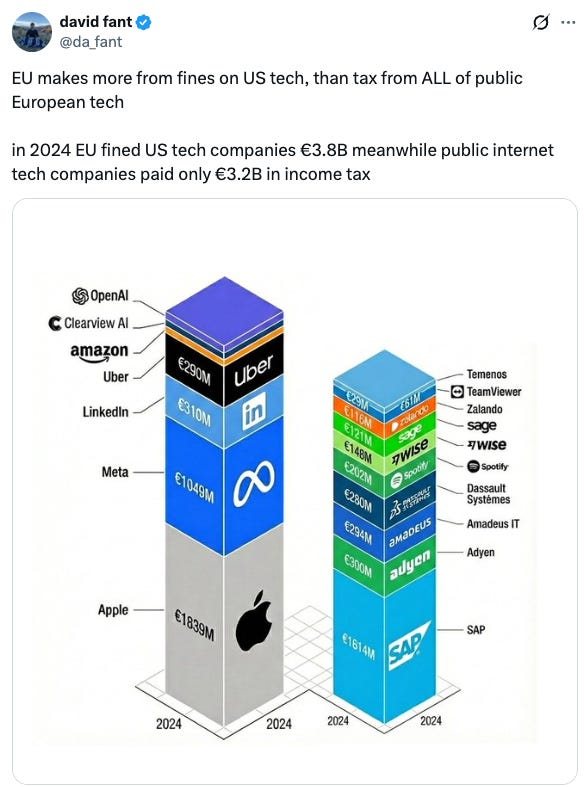
Brian Armstrong looked at that and wrote:

“At some point with enough regulation producing fines, it borders on looting… You can have more fines from over‑regulation, or you can have a growing economy, but you can’t have both.” (X)
He’s being polite.
What the EU has built is a sophisticated, bureaucratic protection racket aimed squarely at American tech. The people in Brussels don’t have their own Googles or Apples, so they’ve decided the next best thing is to live off ours.
Let’s walk through just how bad this is.
1. When Shaking Down U.S. Big Tech Out-earns Your Own Tech Sector
First, zoom out from the meme.
A 2025 analysis by the Information Technology and Innovation Foundation (ITIF) calculates that fines on major U.S. tech firms reached nearly $6.7B in 2024 – almost one‑fifth of the EU’s entire tariff revenue base. (ITIF)
Read that again:
Nearly 20% of what the EU takes in from classic tariffs is now matched by what it extracts from U.S. tech “violations.”
That’s not regulatory pocket change. That’s a parallel revenue system.
At the same time, Europe’s own digital sector is tiny by comparison. The EU’s entire data market is projected around €90B in 2024, versus ~€404B in the U.S. (Europa)
The Wall Street Journal put it bluntly: Europe has no homegrown equivalents to Google, Amazon, or Meta – the global tech revolution is mostly happening somewhere else. (WSJ)
So here’s the picture:
Europe’s digital economy is much smaller.
Europe’s tech tax base is correspondingly small.
But its take from foreign tech fines is huge and rising.
Instead of asking, “Why are we so far behind?” Brussels seems to have asked,
“How do we turn their success into our cash flow?”
2. Fines as a De Facto Tax Line Item
The EU doesn’t even hide that it treats fines as part of the budget machinery.
Official European Parliament briefings categorize interest and fines, including competition-law fines on companies, as “other revenue” in the EU budget. (Europa)
These flows reduce the amount member states have to contribute from their own treasuries.
More recent studies emphasize that “other revenue” – very explicitly including fines, penalties and infringement payments – is now discussed as a deliberate tool to support EU policies and finances. (Intereconomics)
So:
Brussels designs hyper‑complex digital rules.
Those rules expose a tiny number of giant firms – overwhelmingly American – to catastrophic liability.
The resulting fines don’t go back to the users allegedly harmed; they drop straight into the budget column that lets governments pay a bit less.
Tell me how that’s materially different from a sector‑specific tax dressed up as “competition enforcement”.
ITIF is blunt about it: the EU’s regulatory campaigns function like tariffs – they target U.S. tech, generate significant revenue, and create protectionist effects for European firms. (ITIF)
If it walks like a tariff, hits American companies like a tariff, and funds the EU like a tariff, we can stop pretending it’s only “consumer protection”.
3. The Tools of the Racket: Global-Revenue Fines on Command

Look at the legal weapons Brussels has handed itself:
GDPR: up to 4% of worldwide annual turnover for violations. (ITIF)
Digital Markets Act (DMA): up to 10% of global revenue, 20% for repeat offenses. (Wikipedia)
Digital Services Act (DSA): up to 6% of global revenue for big platforms. (Reuters)
This isn’t, “Pay a fine equal to the harm caused in Europe.” It’s, “We reserve the right to nuke a double‑digit percentage of your global business if you cross a line we define later.”
Recent examples:
Apple and Meta were hit with €500M and €200M fines in 2025 under the DMA. (The Guardian)
X (Twitter) just got slapped with €120M for DSA violations. (Reuters)
Apple was ordered by the EU’s top court to pay €13B in back taxes to Ireland after the Commission decided its old tax rulings were illegal state aid. (Wikipedia)
Sometimes about ads, sometimes about app stores, sometimes about data transfers, sometimes about “dark patterns”.
The details change. The pattern doesn’t:
Global revenue × Arbitrary % = Surprise check made out to Brussels.
Is some of this behavior genuinely problematic? Sure. But the enforcement structure has nothing to do with proportionate remedies. It’s built to maximize extractive leverage.
And when courts increasingly defer to the Commission’s discretion on fines, legal scholars warn that judicial review has become disturbingly hands‑off. (CELIS)
The message to any big company is: You are permanently one interpretation away from a multibillion‑euro bill.
4. Why They Need the Money: Europe Broke Its Own Tech Sector
If Europe were a tech powerhouse and this was just aggressive consumer protection, it’d still be heavy‑handed – but at least less pathetic.
Instead, Europe has spent decades kneecapping its own digital economy.
Some snapshots:
The EU data market is forecast around €90B; the U.S. equivalent is more than four times larger. (Europa)
Europe’s long‑run productivity growth has lagged the U.S. for decades, and the gap is especially large in digital‑intensive sectors like software, IT, and internet services. (OECD)
Policy analysts and even EU‑friendly think tanks admit that Europe “lacks tech champions”, has complex, restrictive regulation, and that red tape is actively dragging down productivity and digital adoption. (Ecipe)
In plain language:
They over‑regulated.
Their own startups suffocated in compliance costs and legal uncertainty.
Their markets got dominated by American platforms that could afford the lawyers, the lobbyists, and the bureaucracy.
Now, instead of fixing the policy mistakes that led to that outcome, Brussels is using those same giant American firms as a cash machine.
It’s failure‑laundering:
Break your own innovation ecosystem.
Become dependent on foreign tech.
Punish the foreigners for your dependency.
Use the money to keep the same bureaucracy running.
5. “Consumer Protection” Bullshit
The official script is always the same:
“We’re just defending competition, users, democracy, and European values.”
Great words. But look at what actually happens:
Revenue-based fines bear little relationship to actual, quantified harm in EU markets. They’re pegged to total global turnover, because that’s where the really big numbers live. (ITIF)
Money doesn’t go back to users. It slides into the EU’s general budget bucket called “other revenue”, which explicitly lowers what member states need to pay in. (Europa)
The compliance burden of regulations like GDPR, DMA, DSA and now the AI Act falls heaviest on smaller firms and new entrants – the exact companies Europe should want to protect. Heavy empirical work links restrictive regulation to lower digital adoption and weaker sector performance, especially for smaller firms. (Ecipe)
So who actually wins?
Regulators, who gain status and budget.
Member state treasuries, which get to lean a bit more on foreign companies and a bit less on voters.
Giant incumbents, who can swallow compliance while upstarts drown.
That’s not user‑centric policy. That’s a very elaborate toll booth in front of the European market.
6. A De Facto Tariff System, Just Without the Honesty
It’s not just cranky founders saying this. That ITIF report – which is hardly some fringe blog – concludes that the EU’s tech policies behave like digital tariffs:
They disproportionately target U.S. firms. Five of the six original DMA “gatekeepers” were American. (ITIF)
They generate substantial recurring revenue from those firms via fines – again, almost one‑fifth of tariff‑equivalent revenue in 2024. (ITIF)
They create protectionist effects, making life harder for imported digital services and giving breathing room (and sometimes explicit preference) to European alternatives. (ITIF)
This is what makes the whole thing feel like a racket:
The criteria are framed as neutral — thresholds, user counts, abstract definitions.
In practice, they zero in on a tiny set of enormously successful American companies.
Enforcement is deliberately discretionary and nuclear – revenue‑based fines, open‑ended investigations, overlapping regimes.
The proceeds are used to indirectly finance the EU while telling European citizens, “Look, we’re standing up to Big Tech for you.”
If a private organization behaved like this, we would not hesitate to call it rent‑seeking shakedown behavior.
7. “Just Follow the Law” Completely Misses the Point
The predictable rebuttal is:
“Well, if American companies just followed the law, they wouldn’t pay fines.”
Beyond braindead rebuttal. It completely ignores how these laws are written.
When you have:
thousands of pages of text,
overlapping, sometimes conflicting regimes (GDPR vs. DSA vs. DMA vs. AI Act),
enforcement powers that allow up to 20% of global revenue,
and courts that largely defer to the Commission’s judgment on fines (CELIS)
…“just follow the law” becomes “submit to arbitrary regulatory power and hope you’re not tomorrow’s headline.”
This is not about well‑understood, stable rules like “don’t dump toxic waste in the river.” It’s about a moving maze of digital micromanagement that nobody fully understands until the Commission decides to make an example out of someone.
When the reward for the enforcer is billions in fresh cash, don’t pretend incentives aren’t warped.
8. What This Means for the U.S. (and for Builders)
If you’re in the U.S., here is what this system is telling you:
Your companies take the risk, spend insane amounts on R&D, and build global platforms.
Once you’re successful and deeply integrated into European life, Brussels retrofits a legal framework around you and starts skimming your global revenue.
European politicians get to posture as defenders of democracy.
European budgets get a revenue boost.
And you’re supposed to smile and call it “rule of law.”
ITIF’s conclusion is pretty clear: the U.S. should start treating these measures like what they are – trade barriers and de facto tariffs – and respond using actual trade policy, not polite press releases. (ITIF)
For founders and builders, the lesson is uglier:
Europe is a huge market with great users, but politically it behaves like a jurisdiction that wants the benefits of your innovation without taking the risk of fostering it.
If you’re going to operate there, assume you’re entering a zone where regulation is weaponized and success makes you a bigger target, not a celebrated partner.
9. You Don’t Hate the EU Enough
The EU had a choice:
Fix its own policy mess: Liberalize, make it easier to start and scale companies, and actually compete with U.S. and Chinese tech on product, speed and ambition.
Double down on bureaucracy: Weaponize regulation, and turn successful foreign firms into an ATM.
Judging by the numbers – billions in fines on U.S. tech, more than the corporate tax take from the entire listed European internet sector, and almost 20% of tariff‑equivalent revenue coming from those fines alone – it’s obvious which road they picked.
So yes, Brian Armstrong is right: at some point, “regulation that produces fines” stops looking like justice and starts looking like looting.
The EU crossed that point a long ass time ago.
Now it’s just trying to convince everyone that the racket is “values‑driven policy.”
What do I think about the EU in 2025?
I’ve already written ad infinitum about how the EU Trojan Horsed itself with unselected immigration (refugees, asylum seekers, migrants, etc.).
I remember reading some article on AstralCodexTen speculating about why Britain’s economy/GDP has been stagnant or whatever… and the commenters were coming up with all sorts of high IQ theories that were fairly brilliant… and I had to just laugh.
All these weird ass theories because they can’t just say the common sense shit: demographic change.
Fewer Brits due to low birth rates coupled with more migrants… it’s just fucking common sense. Nobody can say this so it’s a zillion theories proposed. Gee let’s keep grinding our brain gears here when the answer is stupidly simple: (1) demographic changes and (2) more regulation/taxes.
And FYI, I do NOT blame the migrants. I would go to the EU too if I were in their shoes! Free shit, better living conditions, etc. It’s a smart move on their part(s) to gain from the suicidal empathy/pathological altruism embedded in higher rates in White Euro DNA.
I have a lot more to say that I haven’t yet written… the European Union (EU) has already destroyed much of Europe. Most normies within Europe are fucking clueless. And most normies in the U.S. don’t even realize the extent to which Europe has devolved… in some cities it now looks like a Mad Max dystopian hellscape.
Europe’s Trojan Horse: Suicidal empathy and unselected immigration are destroying Europe by replacing European DNA. This isn’t some “conspiracy”… it is just policy by the morons running the EU.
Spain’s housing crisis: Is because they don’t have free market capitalism. Tons of regulations and price controls. Gee I wonder how you idiots now have a housing crisis? Absolute cranium-melting levels of troglodytery.
Trump’s America First Tariffs: Because they have long gotten away with fucking over the U.S. with zero retaliation. The U.S. subsidizes their socialism indirectly (via access to U.S. market, drug development, military, etc.)… meanwhile they are funding net negative migrants and can’t install A/C or talk without a fine.
Exploitation of the U.S. by allies: The EU, Canada, Mexico et al. would collapse without the racket they run on the U.S. They need to fix their shit.
In a parallel universe, the EU could be competitive with the U.S. and a great ally… and have A/C… but it’s fucking itself over and souring relationships with the U.S.
Many within the U.S. and EU now believe that certain countries in Europe are no longer “European” (ethnically/genetically) and simply do not care as much about their fates.
Euros spend a lot of time bashing Americans both in their own circles and abroad to virtue signal (wow we are so much more cultured/refined… those rude uncivilized barbaric Americans! they don’t even have free healthcare! Trump is so bad!)… all for social clout from random woke dipshits at the G7 summit.
Americans mostly don’t think about Europeans unless they’re trying to extort us again. We know many regions within Europe are slowly degrading into globalist cesspools.
Europe remains lucky to have the U.S. as an ally and that they get subsidized military protection, medical breakthroughs, and access to U.S. markets. Without U.S. markets they’d be completely fucked.
They could fix things but things are likely too far gone at this point in many countries. This is partly why a subset of people in the U.S. no longer support them and are ambivalent to any invasions.
The only way to fix EU? (1) revert to a bare bones welfare state; (2) crack down harshly on drugs/crime (El Salvador style); (3) embrace free market capitalism with low taxes; (4) enforce borders harshly & zero unselected immigration; (5) eliminate nearly all regulations (yes almost all of them); (6) actually contribute to NATO/military spending; (7) stop the protectionist mafia-like extortion of “big tech” in the U.S.; (8) strong border protection (follow Poland’s lead); (9) all in on AI/robots instead of migrants; (10) free speech.
I’m not sure there’s much hope left in certain countries. Other places like Poland, Hungary, Czechia, and Slovakia are still alive and fighting the EU bureaucracy as hard as they can.
Get your shit together Europe!