

For the last 6 years or so — mostly under Biden-era Twitter (running up a massive operational debt to maintain the woke status quo, censoring and deplatforming any pushback) — I’d routinely see viral posts about how poor people (especially poor Blacks) have major “epigenetic trauma” from slavery that causes them to stay poor, obese, violent criminals, etc.

This information would then be authoritatively parroted by the alphabet brigades (DEI PhD, brainwashed MDs, LGBTQ mafia) as though “epigenetic trauma” from 10 generations ago “permanently rewired the DNA” of all American Blacks and they can’t ever escape the permanent genetic torture chamber.
Molecular scars passed down through generations… and the trauma remains deeply embedded in genes… yet another reason they still can’t get ahead.
If you have at least a half quarter functioning brain and know some basics about “epigenetics”… you’d quickly realize: most people don’t know what the fuck epigenetics is.
Hordes of woo-woo New Age dipshits fantasize about strategically manipulating their own epigenetic expression with ultra-specific intentional thoughts to “manifest” various traits (e.g. higher IQ, happiness/bliss, zero anxiety, athletic performance etc.); “Biology of Belief” type shit type shit.
Just do a few TikTok affirmations and you’re a changed man (look at the Range man!)… Manifest those optimal epigenetics. Align those chakras. Dial in those 40 Hz gamma brain wave frequencies.
Note: I think of epigenetics as a legitimate research field with absurdly poor ROI potential relative to targeting the genome directly (not necessarily “safer” and has a much weaker effect). Additionally, “epigenetics” is constrained by your genes! And assuming you modify your epigenome, the on/off switches can simply reverse after modification with exposure to your environment. Seem inefficient? It is inefficient. I would guess there’s a Venn Diagram overlap between those who are fascinated with “epigenetics” and those going down “gut microbiome” rabbit holes (a correlational soup that’s mostly just an effect or signal of your health — not an underlying cause of anything outside of actual GI infections/conditions). Colossal waste of brain cycles and money. It’s sad to see many smart people end up cognitively entrenched in these poor ROI correlational whack-a-mole traps.
Related: Gut Microbiome Research: A Massive Money Pit
The “Trauma in Your DNA” Hustle
Trauma doesn’t just affect the person who experienced it. It leaves epigenetic scars in their sperm and eggs. Those scars are inherited for generations. Today’s outcomes are the molecular echo of ancestral suffering — encoded in DNA.
It sounds scientific.
It borrows real terms (DNA methylation, histones, “epigenetic marks”).
It gives people a clean villain and a clean mechanism.
It flatters the speaker as “enlightened” (dO yOu eVeN kNoW ePiGeNeTiCs?! Wow you are so ignorant! Maybe do some actual research! — Wokenonymous)
That story is not the same thing as “trauma has long-lasting consequences.”
It’s a specific mechanistic claim about multi-generation inheritance through the germline.
And when you evaluate that claim the way biology actually works, you’ll quickly realize the viral version is a bunch of fucking nonsense.
Not “needs more nuance.” Not “a bit overstated.”
Wrong at the level of how mammalian development is designed to work. (R)
Part I: The Setup

1. What Epigenetics Actually Is (Before the Hijacking)
Epigenetics is a legitimate branch of molecular biology. It explains how the same genome produces wildly different cell types — how a liver cell knows it’s a liver cell, how a neuron knows it’s a neuron.
The mechanism: Chemical and structural modifications to DNA or its associated proteins that control whether genes are “on” or “off” without altering the underlying sequence.
The classic example is methylation — slapping a methyl group onto a stretch of DNA to silence a gene.
This matters because it reveals genes aren’t simple on/off switches. The genetic blueprint gets annotated, regulated, muted, and amplified according to developmental cues, diet, stress, and environment.
Organisms are more plastic than their DNA sequence alone would suggest. Because of this insight, epigenetics attracted attention far outside molecular biology. (R)
It seemed to offer an escape hatch from “genetic determinism” — a way to explain why children don’t always resemble their parents, why adversity might “leave a biological mark,” and why fate isn’t written in DNA.
Then the narrative escaped the laboratory and ran headlong into wishful “woo-woo” type thinking.
Epigenetics became the scientific-sounding justification for “inherited trauma,” “ancestral stress,” and other emotionally satisfying ideas.
It conveniently dovetails with moral claims about the lingering impact of historical injustice. The problem is the popular story has almost nothing to do with what the biology supports.
As Razib Khan puts it:
“For humans and all complex organisms, epigenetics remains both incredibly important and ubiquitous, but solely as a cellular and developmental phenomenon. To understand epigenetics in its full power, you talk to a molecular biologist that works with DNA, not a therapist probing the pain points of your family history.” (R)
2. The Three-Way Bait-and-Switch
SoHo, Tribeca, Three-way-bait-and-switch… Trifecta.
People throw around “inherited trauma” like it’s one thing. It’s not.
It’s 3 different things smashed together, and then they pretend the strongest one is proven.
A. Developmental programming (pregnancy effects)
If a pregnant woman is exposed to famine, war, severe stress, toxins, etc., that can shape the baby’s development. Big, real, well-documented.
But this is direct exposure during development.
It’s not mystical inheritance. The fetus is living through the event.
B. Intergenerational effects (parent → child)
Parents can affect children through pregnancy, breastfeeding, parenting, household stress, poverty, neighborhood conditions, diet, behavior modeling, etc.
This is also real. Still not proof of a germline inheritance mechanism.
C. True transgenerational epigenetic inheritance (the big claim)
This is the claim people imply when they say “trauma rewired DNA for generations.”
A specific molecular mark gets written into sperm/eggs →
It survives the major epigenetic reset steps in mammalian reproduction →
Then shows up in later descendants who were never exposed →
Still affects biology in a meaningful way in those descendants
This is where the scam happens: people show evidence for A or B, then talk like they proved C. (R)
3. Generational Definitions that Headlines Hide
Here’s the part that exposes the trick.
Quick glossary (so nobody gets lost)
F0 (or Gen0) = The person who experienced the original event.
F1 = Their child.
F2 = Their grandchild.
F3 = Their great-grandchild.
TEI = Transgenerational Epigenetic Inheritance.
I’ll mostly just say “child/grandchild” because it’s clearer.
But you need to understand the numbering because that’s how researchers talk — and it’s where they hide the ball.
The pregnancy trap
If F0 is pregnant during the exposure:
F0 (the mother) is exposed.
F1 (the baby in the womb) is exposed.
F2 (the baby’s future eggs/sperm) are also exposed — because those germ cells are already forming inside the fetus.
So effects showing up in children and even grandchildren can be explained by direct exposure, not “inheritance.”
That’s why serious TEI definitions say: in the pregnancy scenario, you don’t even enter “true transgenerational” territory until F3 (great-grandchildren) — the first generation that’s truly outside the direct exposure chain. (R)
Translation: If the trauma happened while grandma was pregnant, “grandkids show effects” is not proof of inherited trauma. It can still be exposure effects echoing forward.
If the exposure was to a father (not pregnancy)
If F0 is a man exposed to something that could affect sperm:
F1 (his child) is the first generation that could be directly affected through the sperm.
So the earliest place you can start arguing “beyond direct exposure” is typically F2 (grandchildren).
Again, this is standard TEI framing — the pregnancy case just pushes the “true inheritance” start line one generation further out. (R)
The punchline
Here’s the clean rule that nukes 90% of sloppy “inherited trauma” discourse:
If the exposure happened during pregnancy, you need effects in great-grandchildren (F3) to even start claiming “true transgenerational inheritance.”
If the exposure was only to a father, you’re looking at grandchildren (F2) as the first serious “beyond direct exposure” test.
If a paper can’t clear that bar, then the “epigenetic inheritance” headline is usually hype built on pregnancy effects + environment.
4. The Slavery, Colonial, Century-Old Claim is Max Difficulty
Now think about what people claim for “slavery epigenetics” or “colonial trauma epigenetics” stretching back centuries.
They’re not claiming F2 or F3.
They’re claiming F5, F6, F7+… “this molecular mark survived for 150+ years and still drives modern outcomes.”
That’s not “a little ambitious.”
That is the maximum difficulty setting for a phenomenon that’s already contested in mammals. (R)
Part II: Biological Barriers

5. Mammalian Reproduction Is Built to Erase This Stuff
Here’s the part the “epigenetic trauma” crowd never addresses, because once you address it the spell breaks:
Mammals run major epigenetic reset programs as part of normal reproduction.
There isn’t a stable biological mechanism capable of transmitting environmentally induced epigenetic changes across multiple generations.
Mammalian germ cells undergo 2 rounds of epigenetic reprogramming: (1) one during gamete formation and (2) another immediately after fertilization — which wipe the slate nearly clean. (R, R, R)
Any methylation mark or chromatin modification acquired from stress, diet, or environment is overwhelmingly likely to be erased before it reaches a grandchild.
Germline reprogramming
Primordial germ cells (the cells that become sperm and eggs) undergo widespread methylation erasure and rebuilding as development proceeds. (R)
This isn’t a minor edit. This is systematic “wipe the slate” machinery.
Preimplantation embryo reprogramming
Right after fertilization, the embryo undergoes another broad reprogramming phase.
Reviews are blunt: Mammalian reproduction is not friendly to Lamarckian carryover. (R)
So when somebody says “trauma altered methylation and it just got passed down,” they’re skipping the part where biology says:
“Cool story bro — we delete most of that.”
If someone wants to argue trauma “echoes through the germ line,” the burden is on them to explain how these marks survive the biochemical equivalent of a hard-drive reformat performed twice per generation.
The “womb echo” fallback fails too
A common retreat: Even if germline transmission doesn’t work, maybe the womb carries the mother’s life history forward through subtle epigenetic programming.
But if that were true in any robust sense, monozygotic twins who share the chorion (the closest natural experiment on uterine environmental effects) should differ in their similarity compared to those who don’t share the chorion.
But they don’t. There’s zero difference. (R)
Translation:
“If the womb environment truly changed people, then twins who shared the exact same bloodstream (shared chorion) should be MORE identical than twins who had separate bloodstreams. But they aren’t.”
To understand why this disproves the “Womb Echo,” imagine a baking experiment.
The Recipe (DNA): Identical in all these twins.
The Oven (Womb Environment): This is what we are testing.
Group A: The “Shared Oven” Twins (Monochorionic)
These twins share one placenta.
They get the exact same “heat,” “ingredients,” and “stress signals” from mom at the same time.
Prediction: If the oven (womb) matters, these two cakes should come out looking exactly the same.
Group B: The “Separate Ovens” Twins (Dichorionic)
These twins have separate placentas.
One might get slightly more blood; one might attach to a better spot in the uterus. Their environments are slightly different.
Prediction: If the oven (womb) matters, these two cakes should look a little different from each other.
If the “Womb Echo” theory was true, Group A should be much more similar than Group B.
Hypothesis: Shared Womb = More Similar Outcome.
Reality: Group A and Group B are equally similar.
Because the twins who shared the exact same “oven” are not any more alike than the twins who had separate “ovens,” we know the “oven” (the womb environment) isn’t what determines the outcome.
The “Recipe” (DNA) is the only thing that made them similar.
6. Narrow Exceptions Don’t Save the Narrative
Two things get used as rhetorical shields:
Imprinting
Imprinted genes maintain parent-of-origin methylation patterns at specific control regions. That’s real, sequence-anchored, and heavily regulated.
But imprinting is not a general storage system for life experiences.
It’s not “trauma wrote a message into sperm.” It’s a narrow, evolutionarily conserved mechanism for specific genes.
Rare escapees
Some loci can evade full reprogramming, and small RNAs can be involved in certain animal models.
But the key point remains:
The existence of exceptions does not rescue the sweeping claim that historical trauma generally imprints a multi-generation molecular curse in humans. (R)
7. December 2025: The Paper That Makes This Crystal Clear
If you want the cleanest test of whether an epigenetic change in sperm just persists, here it is:
A Nature Communications paper published December 25, 2025 invented a system for targeted reprogramming of epigenetic memory in mouse sperm.
They erased DNA methylation at H19-DMR (a classic imprint-control region, one of the most TEI-relevant places you could test) and watched what development did to that edit. (R)
Results:
Although DNA methylation was fully lost in sperm, it was partially restored during preimplantation development — the embryo actively pushed back toward canonical patterns.
The paper explicitly states: this study reveals “partial intergenerational inheritance and no transgenerational inheritance at the model locus.”
When they blocked the restoration mechanism (by removing H3K9me3), the hypomethylation persisted — proving the embryo is actively fighting to restore normal patterns.
Translation:
Even when you forcibly erase methylation from sperm at a highly TEI-relevant locus, the embryo pushes it back toward the canonical state — and the “multi-generation persistence” people fantasize about doesn’t materialize.
This is the organism protecting its developmental program. (R)
8. The “Brain-to-Germline” Fantasy
Trauma is experienced in the nervous system, endocrine system, immune system — somatic tissues.
For a trauma signal to become “inherited epigenetics,” you need it to:
Reach germ cells →
Write a durable and specific mark →
Survive reprogramming →
Still matter in descendants →
Persist across repeated mating, recombination, and environment changes
That’s already an extraordinary chain.
Now add a physical constraint people ignore:
Sperm chromatin is massively compacted and largely protamine-packaged — most histones are evicted. (R, R)
You’re not writing neat “trauma annotations” on a readable book. You’re trying to tag pages in a document that gets shrink-wrapped, shipped, unpacked, and reformatted by the embryo.
For genuine transgenerational inheritance to work, a stress-induced epigenetic change in the brain of an adult animal would have to:
Appear simultaneously in germ cells →
Survive genome-wide erasure in the zygote →
Remain intact during embryonic development →
Then be reproduced in the same brain regions →
That’s a massive claim. The evidence is absurdly weak borderline nonexistent.
Part III: Human Evidence is a Dumpster Fire

9. Rodent Studies are a Methodological Wasteland
The supposed “proof of concept” for epigenetic inheritance comes from rodent studies. These get cited endlessly in popular writing, usually without explaining what they actually show.
The stressed-rat problem
The famous example: stressed mother rats produce stressed offspring. But this is fully explained by behavior: stressed dams provide less maternal care, which is stressful and alters glucocorticoid signaling in pups.
That’s not epigenetic inheritance through the germ line. It’s bad parenting.
Franklin et al. (2010): Statistical noise dressed as biology
This widely cited study leaves the impression that early-life maltreatment in mice is passed through the male germ line to children and grandchildren. (R)
But when you dig into the findings, they have all the hallmarks of researcher degrees of freedom: multiple tests, no preregistration, post-hoc slicing, uncorrected multiple comparisons, inconsistent directions of effect.
Example:
First-generation females show an effect on one test
Second-generation males show an effect on a different test
Other tests show nothing
This is not a coherent biological signal. It’s statistical noise reinterpreted as “inheritance.”
Vassoler et al. (2012): The “cocaine resistance” study
The predicted direction of the effect: (1) was reversed, (2) appeared only in one sex, and (3) was compatible with a dozen different stories.
Hypotheses changed after the fact, significance thresholds drifted, unexpected results got reframed as “intriguing.” (R)
This is what p-hacking looks like when it’s dressed in a lab coat.
The IVF test that killed the narrative
These rodent studies suffer from a massive confound: interacting with a stressed male might alter the female’s behavior post-mating, changing maternal care.
That’s different from the model where experience causes an epigenetic mark in male germ cells that transmits a “memory” to offspring.
The best test: Use in vitro fertilization to isolate germline transmission. One study did exactly that and found effectively no such transmission. (R)
When you bypass the behavioral confounds with IVF, the “inherited trauma” signal vanishes. That tells you what was actually driving the results.
10. The Dutch Hunger Winter: Not What You Think
The Dutch Hunger Winter studies are the poster child for “epigenetics.” They’re far less impressive than the headlines suggest.
The famous finding
People prenatally exposed to famine show less methylation at IGF2 decades later compared with same-sex siblings. (R)
What it actually shows
The famine exposure is in utero — direct developmental exposure. That’s not “F6 inherited trauma.”
Critical commentary on TEI explicitly frames this as fetal programming, not a clean germline TEI signal. (R)
The selective survival problem
Tobi et al. (2018) analyzed the Dutch Hunger Winter cohort and found that observed associations between adverse prenatal environments and long-term methylation changes may simply be caused by selective survival of embryos. (R)
Selection produces methylation changes in survivors that mimic those attributed to epigenetic inheritance. You’re not seeing “inherited trauma” — you’re seeing who survived.
The weakest embryos died. The survivors have different methylation profiles. That’s not Lamarckism… that’s Darwinism.
The effect size is pathetic anyway
In the classic sibling-control analysis, the average methylation fraction at the IGF2 DMR was:
0.488 (exposed siblings)
0.515 (unexposed siblings)
Absolute difference: 0.027 (≈ 2.7 percentage points)
That’s what the most famous “epigenetic scar” looks like: a couple percentage points at one region. Not a genome rewrite. Not a “permanent DNA torture chamber.”
One locus. A small shift. (R)
Phenotype check: Even on outcomes, effects are moderate, not destiny. One analysis reports a 1.3× risk of being overweight/obese at age 19 after early-gestation prenatal famine exposure — and it’s subgroup-dependent. (R)
1.3× is what you get from a dozen different environmental factors. It’s not “your grandmother’s starvation rewired your metabolism.” (In case you don’t understand: 1.3-fold risk is almost nothing.)
11. Holocaust Studies: Results Scattered Everywhere
The Yehuda findings
One widely cited study reports FKBP5 methylation differences in Holocaust survivors and their adult children, with direction differences between exposed parents and offspring. (R)
What this supports:
Trauma correlates with measurable epigenetic differences in accessible tissues.
Children of trauma survivors can show differences too.
What it does not establish:
A germline mechanism
Persistence across multiple unexposed generations
Large, deterministic effects
The effect size
FKBP5 site-6 methylation:
67.12% in Holocaust offspring
69.64% in controls
Difference: ~2.52 percentage points (R)
That’s the “scar” in numbers: ~2–3 points at a specific CpG. Not a genome-wide rewrite. Not deterministic. Not even large by the standards of methylation studies. (THIS IS ALMOST NOTHING)
Holocaust studies: heterogeneous, moderator-driven, easy to over-interpret
When you zoom in on Holocaust-offspring outcomes (often used as the flagship “inherited trauma” example), systematic reviews describe a messy, multi-factor picture.
Offspring outcomes depend on things like parental mental health/PTSD, parenting and attachment quality, and whether one vs two parents were survivors, with evidence that some vulnerabilities show up mainly under specific conditions (e.g., actual danger). (R)
That’s not a clean germline inheritance signal — it’s heterogeneous family/psychosocial + physiology.
Some papers even find “adaptation/resilience” not damage!
A 2025 study of third/fourth-generation Holocaust descendants reports lower attachment avoidance and no elevation in depression/anxiety symptom severity despite detecting methylation differences, explicitly discussing resilience/adaptation interpretations. (R)
“Our findings revealed that descendants exhibited significantly lower general attachment avoidance, and a DNA methylation pattern associated with stronger activation of the oxytocin system, indicating enhanced social bonding and social emotion regulation.”
When a research area can be plausibly narrated as “harm,” “null,” or “resilience” depending on endpoints, tissues, covariates, and storytelling, you don’t have a robust inheritance mechanism.
12. The 2025 Syrian Refugee Study: Headlines vs Reality
A Scientific Reports paper compared buccal (cheek) methylation across three generations in Syrian families and reports signatures associated with violence exposure. 48 families, N = 131 individuals. (R)
Nature covered it with a giant warning: scientists debate it and call for replication. (R)
The numbers
Largest methylation difference vs controls: beta-value difference of −0.265 (−26.5 percentage points) at one site (cg01490163). (R)
Two things matter:
Still a handful of sites: 35 DMPs out of 850,000+ CpGs on the EPIC array. That’s 0.004% of tested sites showing up as “significant.”
Authors admit the limitation: It’s “not clear” whether these DMPs are “constitutively important for gene regulation” or have “immediate and causal impacts on phenotype.”
This is not germline data, not a controlled experiment, and nowhere near the multi-generation chain people claim when talking about slavery in the 1800s driving outcomes in 2025.
The pattern across human studies
When you line up the transgenerational human studies, the pattern isn’t mysterious — it’s noise:
Pembrey et al. (2005) (R)
Claim: The paternal grandfather’s food supply directly affects the health outcomes of their grandchildren.
Major problem: Relied on a tiny sample size. Furthermore, the effects described were sex-specific and moved in opposite directions, suggesting statistical noise rather than a robust biological mechanism.
Painter et al. (2008) (R)
Claim: The Dutch Famine resulted in observable transgenerational effects.
Major problem: Results are likely confounded by selective survival. It is difficult to determine if the effects are due to epigenetics or simply because certain individuals were hardy enough to survive the famine in the first place.
Bygren et al. (2014) (R)
Claim: A paternal grandmother’s food supply specifically affects her granddaughters.
Major problem: Findings were inconsistent with other findings from the same cohort, casting doubt on the validity of the specific correlation.
Serpeloni et al. (2017) (R)
Claim: Stress experienced by a grandmother affects the third generation (grandchildren).
Problem: There has been no replication of these findings. Like Pembrey et al., this study also suffered from a small sample size.
Part IV: The Statistical and Methodological Wreckage

13. Reverse Causation: Methylation as Effect, Not Cause
Here’s a problem that torpedoes a huge chunk of the “epigenetics explains outcomes” literature:
Most methylation differences people find are downstream biomarkers of phenotype, not upstream causal drivers.
Banos et al. (2018): The simulation that killed the hype
This study analyzed CpG sites in over 5,000 Scottish adults.
On the surface, results look dramatic: methylation patterns collectively explained two-thirds of variance in BMI and lifetime smoking, even after subtracting what SNPs explained. (R)
Triumph for environmental programming? No. The authors did the crucial follow-up: simulations and pathway analyses.
Both pointed to reverse causation. Obesity and chronic smoking induce widespread physiological changes that alter methylation at thousands of sites.
The methylation marks are real, but they’re downstream biomarkers of phenotype, not upstream causal drivers — and certainly not heritable molecular memories.
Being fat changes your methylation. Methylation doesn’t make you fat.
Li et al. (2018): The twin study that settled the direction
This study examined smoking using a twin design. If methylation caused smoking, a twin’s methylation should predict her co-twin’s smoking behavior even after adjusting for her own. (R)
Instead, the effect ran the other way: a woman’s smoking status predicted her co-twin’s methylation level.
The purported causal effect evaporated under within-pair adjustment.
Translation: Smoking changes methylation. Methylation doesn’t cause smoking.
This finding nukes a huge portion of EWAS claims. If you can’t establish causal direction, you can’t claim methylation is doing anything except reflecting what’s already happening in the body.
14. The Genome Sets the Rails: Epigenetics Rides on Top
A major portion of methylation variation is under genetic control (mQTLs).
One mQTL catalogue notes prior work estimating almost 20% of reliably assayed blood methylation variation is heritable, and ~50% of CpG sites show evidence of a significant genetic component. (R)
Your methylation baseline is not a blank slate that trauma freely rewrites. It’s genotype-anchored regulation. The genome sets the rails; epigenetics rides on top.
Moffitt & Beckley (2015): Nearly every link is genetically confounded
A review of criminology literature on epigenetics concluded nearly every putative link between social adversity and methylation is confounded by genes. (R)
Key points:
Most differentially methylated sites are under genetic regulation
Blood-based methylation patterns correlate poorly with brain regions that regulate behavior
Effect sizes are minuscule
Studies are confounded by age, sex, cell composition, smoking, medication
Their conclusion: twin and adoption studies remain vastly superior for understanding environmental influence on behavior. Epigenetics hasn’t replaced the classical designs — it’s added noise.
Scale comparison: genetics vs “trauma methylation”
A 2025 Nature Medicine paper reports a BMI polygenic score explaining 17.6% of BMI variation in UK Biobank European ancestry participants. (R)
That’s the scale difference:
Genetics: Large, stable, predictable variance explained
Trauma-linked methylation: Small, local, context-dependent shifts in accessible tissue, often with unclear causal direction
One of these is a major biological signal. The other is noise people are excited about.
15. The Statistical Cesspool of EWAS
A lot of trauma-epigenetics hype is built on EWAS (epigenome-wide association studies): test hundreds of thousands of CpG sites and see what correlates with an exposure.
What are the problems with EWAS?
Confounding + reverse causation
Epigenetic state reflects current physiology (immune activation, smoking, diet, sleep, meds, infections, stress, age).
EWAS can produce “signatures,” but interpreting them as causal mechanisms is hard, and overclaiming is endemic. (R)
Cell-type composition
Whole blood methylation shifts can simply reflect changing proportions of leukocyte subtypes — not stable, inherited “marks of trauma.”
Standard methods exist to adjust for this precisely because it’s such a huge problem. (R)
When someone says “we found trauma methylation differences,” the first question isn’t “wow, inherited trauma.”
It’s: what tissue, what cells, what confounders, what replication, what effect size?
If they measured blood, they’re seeing immune cell composition changes. If they didn’t control for smoking, they’re seeing smoking effects. If they didn’t replicate, they’re seeing noise.
Most studies fail on all counts.
16. George Davey Smith’s 100-Year Review: The Verdict
In 2012, epidemiologist George Davey Smith reviewed 100 years of research into epigenetic inheritance.
His conclusion? Epigenetic inheritance contributes little or nothing to phenotypic resemblance across generations. (R)
The key evidence:
Twin/adoption/pedigree convergence: Twin studies, adoption studies, and extended pedigree designs consistently find substantial genetic contributions to phenotypic resemblance and yield similar estimates. If epigenetic models were viable, these different designs would not converge so tightly. The fact that they do means genes are doing the work.
Wild vs lab animals: Heritability estimates for animals raised in controlled labs are similar to those for animals in messy, natural wild environments. If environmental stressors transmitted across generations via epigenetics, wild populations should show lower heritability estimates than laboratory ones. They don’t.
Johannsen’s pure line experiments: Historical “pure line” experiments — Johannsen’s work with beans and extensions via inbreeding, self-pollination, parthenogenesis, and cloning — demonstrate that phenotypic variations within genetically identical lines are not transmitted to offspring. Selected extremes regress fully to the mean.
If epigenetic variation were heritable, you’d see it in genetically identical lines. You don’t.
The verdict:
“The conclusion from over 100 years of research must be that epigenetic inheritance is not a major contributor to phenotypic resemblance across generations, yet strangely … this vast literature has, in some circles, been forgotten.”
A century of negative results got memory-holed because it wasn’t exciting.
17. Twin Studies: Epigenetic Variation Gets Absorbed Into “E”
In classical twin designs, variance components are:
A (additive genetics)
C (shared environment)
E (non-shared environment)
The E term is interpreted as “idiosyncratic life experiences.”
But as Kan et al. (2010) demonstrated, phenotypic variation produced by epigenetic processes is completely absorbed into the non-shared environment (E) term. (R)
Molenaar et al. (1993) found the same using animal data: inbred, environmentally standardized mice and flies still vary in body weight and bristle number — because of intrinsic developmental instability. (R)
Due to its unsystematic nature, this instability cannot serve as a stable mechanism to transmit a phenotype, let alone across multiple generations.
The variation exists. It just doesn’t transmit. That’s the finding the TEI crowd ignores.
Part V: The Logic Problems
18. The “Positive Epigenetics” Problem
Here’s an angle the trauma-inheritance crowd never mentions because it destroys their narrative:
If bad experiences write epigenetic marks into germ cells, good experiences should too.
You don’t inherit everything from one traumatized ancestor.
You have:
2 parents
4 grandparents
8 great-grandparents
16 great-great-grandparents
...and so on
By F6 (roughly slavery → now), you have 64 direct ancestors at that generation alone.
If epigenetic marks from bad experiences persist, so should marks from:
Ancestors who lived in safety
Ancestors with good nutrition
Ancestors who experienced low stress
Ancestors from completely different geographic and historical contexts
The math breaks “permanent trauma curse” because:
Dilution: Any one ancestor’s contribution is 1/2^n of your lineage
Mixing: Positive and negative marks would compete and cancel
Selection: If TEI were powerful, selection would have shaped it toward adaptive outcomes, not permanent damage
Where’s the model that accounts for all the positive marks from all the other ancestors? It doesn’t exist because the whole framework falls apart when you take it seriously.
Reversibility within a lifetime
Even within a single lifetime, epigenetic marks respond to current conditions:
Smoking creates methylation signatures; quitting partially reverses them
Obesity correlates with certain patterns; weight loss shifts them back
Stress-related methylation tracks current stress levels and improves with treatment
If the system is this plastic within one life, the idea that it rigidly preserves 150-year-old trauma marks while ignoring everything since is incoherent.
Epigenetics is a dial, not a tattoo. Dials get adjusted by whatever’s happening now.
19. Multi-Generation Signal Decay: The Math
Even if you indulge the strongest pro-TEI assumptions (some trauma-induced epigenetic change hits the germline) it then runs through multiple shredders:
Reprogramming every generation (germline + zygote)
Genetic dilution with each transmission
Overwriting by new environments
Competition with marks from other ancestors
Exponential decay
Let α = fraction of signal that survives each generation’s reprogramming.
If α = 0.5 (half survives):
F1: 0.5
F2: 0.25
F3: 0.125
F6: 0.5⁶ ≈ 0.016 → 1.6% of original
Even if absurdly generous, α = 0.8:
F1: 0.8
F2: 0.64
F3: 0.512
F6: 0.8⁶ ≈ 0.26 → 26% of original
That original effect in F1 is only a fraction of trait variance, competing with genetics and environment.
By F6 (slavery → now), you’re talking about a percent or two of a tiny slice — effectively negligible next to current neighborhood, income, or health conditions.
Sexual reproduction: 1/2ⁿ ancestry + recombination
From any specific ancestor:
F1: 1/2 of genome
F2: 1/4
F3: 1/8
F6: 1/64 ≈ 1.6%
Even purely genetic influence from one named enslaved ancestor is massively diluted.
Epigenetic TEI would have to stay attached to the right DNA, survive repeated recombination, and not get swamped by other ancestors’ contributions.
Sex and recombination exist partly to break up blocks of inherited variation and noise.
20. Evolution: Why Strong TEI Would Be a Disaster
If mammals routinely encoded arbitrary environmental trauma into the germline with strong, lasting effects, you’d expect:
Loads of maladaptive carryover when environments change
Unstable development
Strong selection either to: (A) Fix beneficial adaptations in the DNA sequence, or (B) Eliminate or severely limit the TEI channel to preserve developmental robustness
This is exactly what theoretical and empirical reviews argue: in complex vertebrates, robust TEI is rare and constrained. (R)
The “slavery-TEI” fans propose a powerful, open-ended Lamarckian layer in humans that:
Somehow escaped purifying selection
Is active only for certain traumas
Yet leaves little direct molecular trace we can measure
This is just motivated reasoning and not how biology operates.
21. The Slavery-to-2025 Claim: Dead on Arrival
The slavery claim is the trauma-TEI claim with a longer time horizon and more moral weight.
To make “slavery epigenetics” do real explanatory work today, you’d need:
A germline mechanism operating reliably in humans
Persistence for 5+ generations with no exposure required
Signal strong enough to survive reprogramming, mating, recombination, environment, and measurement noise
A detectable link to today’s outcomes
Not canceled out by all other ancestors and subsequent generations of different experiences
A 2025 review of Black-White health gap via epigenetics
Charney, Darity Jr., and Hubbard (2025) reviewed human literature on transgenerational epigenetic transmission of trauma via slavery as potential evidence for a Black-White health gap in the United States. (R)
What did they report?
“We find that there is little evidence to indicate the presence of transgenerational epigenetic transmission of trauma in humans.”
“We find no prior evidence that supports (or is relevant to) the notion that the black-white health gap stems from the inherited trauma of slavery.”
“We conclude that, given the ongoing traumas black Americans are exposed to in modern America, it is much more likely that present-day racial health disparities are due to more direct and current mechanisms than transgenerational transmission of slavery-era trauma.”
Present-day conditions already explain present-day outcomes without needing a 160-year-old methylation ghost.
Income, neighborhood, healthcare access, discrimination, diet, stress… these are all operating right now and have known, large effect sizes.
We don’t need to invoke methylation marks from the 1860s when you have obviously relevant factors operating today.
Part VI: What Epigenetics Actually Delivers
22. Legitimate Epigenetic Applications
None of this means epigenetics is useless. It means the transgenerational trauma inheritance story is useless.
Real epigenetic applications exist — they’re just narrower and more honest than the viral narrative:
Cancer treatment
Seven epigenetic drugs are FDA-approved, primarily for hematological malignancies — blood cancers like myelodysplastic syndromes, T-cell lymphoma, and AML. (R)
The mechanism is straightforward: cancer cells often silence tumor suppressor genes via aberrant methylation; drugs like azacitidine, decitabine, vorinostat, and romidepsin can reactivate them.
It works. But the limitations are real:
Significant toxicity due to genome-wide effects (these drugs aren’t targeted)
Weaker results in solid tumors compared to blood cancers
Not a cure — a treatment that extends survival in specific cancers
In 2024, givinostat became the first nonsteroidal treatment approved for Duchenne muscular dystrophy — a genuine advance, but a narrow application. (R)
Diagnostics
Methylation-based liquid biopsies can detect cancer earlier than many conventional methods. Aberrant DNA methylation occurs at very early stages of cancer development, and methylation signatures are stable and tissue-specific.
This is a real win: noninvasive sampling, stable biomarkers, clinically actionable for early detection and monitoring.
Anti-aging
Yamanaka factor reprogramming can reset epigenetic age in cells and extend lifespan in mice.
One study showed systemically delivered gene therapy encoding partial reprogramming factors extended median remaining lifespan by 109% in old mice.
The results are real but nowhere near clinical application:
Teratoma risk (these factors can cause cancer)
Safety concerns require rigorous testing before human trials
Still purely pre-clinical
This is the most interesting long-term bet, but it’s years away from practical use.
Comparison to gene therapy
For diseases caused by broken genes (mutations), gene therapy wins.
You can’t epigenetically fix a gene that doesn’t work. If the sequence is wrong, you need to correct the sequence.
Epigenetics might help when genes are intact but misregulated (a narrower use case).
Gene therapy advantages:
Targets root causes (mutations)
Permanent fix for genetic diseases
Precise editing with modern tools (CRISPR)
Can be reversible (depending on engineering)
Epigenetic therapy advantages:
Reversible (both a pro and con)
Can turn genes on (gene editing typically turns them off or corrects them)
Lower off-target risk (though lower specificity too)
The reversibility problem:
Once corrected, epigenetic states may revert to the original state because of the reversible nature of DNA methylation patterns. The feature is also a bug.
Bottom line on applications
Epigenetics is useful for specific within-generation applications:
Cancer (where the gene is intact but silenced)
Diagnostics (where you’re reading, not writing)
Potentially aging (where you’re resetting a global program, not fixing a single gene)
For most genetic diseases, gene therapy has higher ROI. The “epigenetics will solve everything” framing is as overblown as the trauma inheritance story.
Part VII: Why the Bullshit Narrative Persists

23. The Real Problem With This Story
The “trauma in DNA” story isn’t just scientifically wrong. It’s a category error laundered through scientific vocabulary.
Unfalsifiable mysticism
Notice how the claim works:
Can’t find the marks? “They’re too subtle to detect with current technology.”
Found marks that don’t persist? “The real ones are hiding somewhere else.”
Effects don’t replicate? “Every population is different.”
This is how pseudoscience operates. The hypothesis shape-shifts to avoid every test.
As George Davey Smith put it, epigenetics has become “the currently fashionable response to any question to which you do not know the answer.” (R)
When you don’t have a mechanism but you need something that sounds biological, you invoke epigenetics. It’s the 21st century version of “bad humors.”
Pathologizing populations based on ancestry
Think about what the claim actually says:
“This group of people is biologically damaged because of what happened to their ancestors centuries ago.”
That’s a strong biological claim about a population, made without biological evidence.
If the same claim were made with different politics, everyone would recognize it as essentialist nonsense. Different moral language doesn’t change what it is.
24. What if the transgenerational epigenetic zealots are 100% correct?
Let’s grant them everything:
Assume trauma reliably leaves epigenetic marks.
Assume those marks pass through the germline.
Assume they persist across six or more generations without decay.
It would still barely matter.
Why?
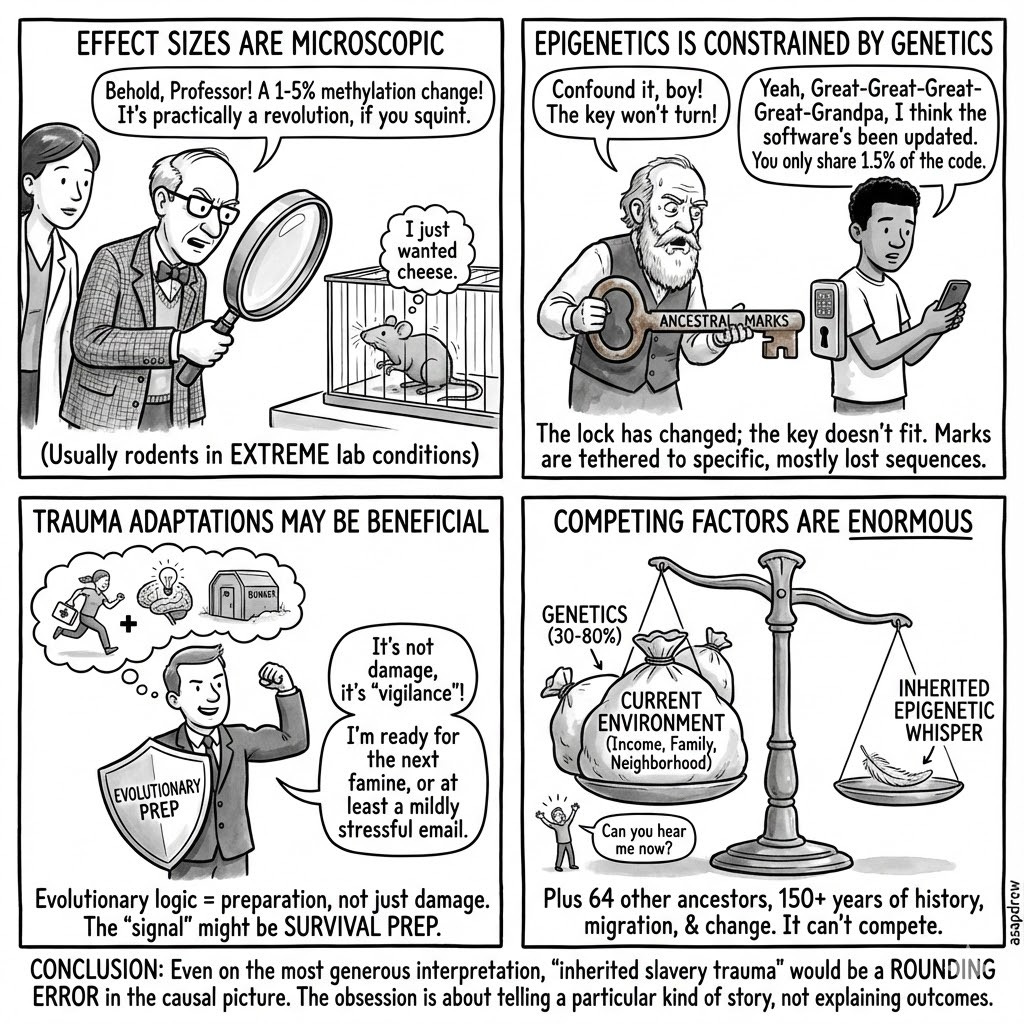
Effect sizes are microscopic. When studies do find transgenerational epigenetic effects (usually in rodents under extreme conditions), they’re finding things like 1-5% changes in methylation at specific CpG sites or small regulatory regions. Not 1-2% of the genome — 1-2% changes within a tiny region that is itself a minuscule fraction of the genome. We’re talking about modest methylation shifts at a handful of promoters, not wholesale reprogramming.
Epigenetics is constrained by genetics. Epigenetic marks don’t float freely — they’re tethered to specific DNA sequences. Your great-great-great-great-grandfather’s epigenetic marks evolved on his genome. You share roughly 1.5% of your DNA with any given G-G-G-G-grandparent (and you have 64 of them). The specific genetic context those marks operated in largely isn’t there anymore. The lock has changed; the key doesn’t fit.
“Trauma” adaptations may be beneficial. The framing assumes all inherited epigenetic changes are damage. But the evolutionary logic of transgenerational epigenetic inheritance — if it exists — is adaptive preparation for anticipated environments. Some animal studies suggest these changes confer stress resilience, metabolic flexibility, or heightened vigilance. If your ancestors survived famines and violence, the “signal” might be preparation, not injury.
Competing factors are enormous. Even granting all of the above, this whisper of a signal competes with:
Genetics (30-80% of variance in behavioral traits)
Current environment (income, family structure, neighborhood, nutrition, education)
64 other ancestors at that generation, each contributing equally
150+ years of intervening history, migration, intermarriage, and environmental change
You’re asking a few percentage-point methylation shifts at a handful of loci (inherited imperfectly, expressed conditionally, potentially adaptive) to meaningfully compete with all of that.
It can’t.
Even on the most generous possible interpretation, “inherited slavery trauma” would be rounding error in the causal picture. The obsession with this narrative isn’t about explaining outcomes. It’s about telling a particular kind of story.
25. A Checklist That Exposes 90% of “Epigenetic Inheritance” Hype
When you see “trauma is inherited epigenetically,” run this list:
Which generation is unexposed? If not F3 (maternal exposure) or F2 (paternal exposure), it’s not TEI.
What tissue did they measure? Blood/buccal ≠ germline. If they didn’t measure sperm or eggs, they didn’t measure inheritance.
Did they control for cell composition? If not, “methylation differences” may be immune cell mixture changes.
What are the effect sizes and do they replicate? “Significant” ≠ “meaningful.” EWAS is a minefield of false positives.
Is it mechanism or metaphor? If the argument needs poetry (”scarred DNA,” “encoded trauma”) more than a germline pathway, it’s marketing.
Are they jumping from intergenerational to transgenerational? They almost always are. Call it out.
What about positive inheritance? If bad marks persist, good marks should too. Where’s the cancellation math?
Did they test for reverse causation? Methylation might be an effect of phenotype, not a cause.
Is the effect confounded by genetics? Most differentially methylated sites are under genetic control.
Did they use IVF to isolate germline transmission? If not, behavioral and environmental confounds remain.
If a study fails on three or more of these, you’re probably looking at noise dressed as discovery.
The Bottom Line
Epigenetics is real. Nobody is suggesting “epigenetics” is fake.
Trauma significantly affects the physiology of the person traumatized.
Pregnancy and early childhood environments can shape development.
And those effects can show up in methylation patterns.
None of that adds up to: “historic trauma is biologically inherited for many generations and is a major driver of outcomes today.”
When someone sells you that, they’re ignoring:
The basic definitions (what counts as TEI)
The epigenetic reset machinery in mammalian reproduction
The actual human evidence (mostly short-range, heavily confounded)
The quantified effect sizes (small, local, context-dependent)
The reverse causation problem (methylation as effect, not cause)
The genetic constraint on methylation (the genome sets the rails)
The positive-inheritance problem (good marks should cancel bad)
The signal decay math across generations
The plasticity that rewrites marks based on current conditions
100 years of research showing epigenetic inheritance doesn’t drive phenotypic resemblance
Transgenerational epigenetic trauma is a story people tell because it feels profound. It’s not a mechanism you can responsibly use to explain modern populations — and the multi-generation version does not survive contact with mammalian biology.
Even in the most generous interpretation, where some tiny signal sneaks through, it would be rounding error in the causal equation… overwhelmed by genetics, current environment, and 150 years of accumulated noise.
Some epigenetic applications exist: cancer treatment, diagnostics, potentially aging interventions… but most pale in comparison to targeting the genome directly. And these are within-generation uses (not mechanisms for replaying ancestral suffering).
Epigenetics is not a mechanism for transmitting physiological VHS tapes of your great-grandparents’ hardships. It’s a within-generation regulatory system with specific clinical applications.
Those pushing the transgenerational trauma narrative are sadly just not very smart and/or enjoy grifting, and don’t know what they’re talking about.