

Loneliness is one of the biggest problems of our time and the trajectory seems to be worsening. Covid and lockdowns transiently amplified loneliness and may have interfered with certain subsets of the younger generations in forming strong social bonds and/or maintaining existing bonds.
But Covid and its downstream effects would not have prevented the loneliness epidemic that we see today. There are a myriad of trends converging (WFH, TikTok, dating apps) simultaneously such that there’s no escape.
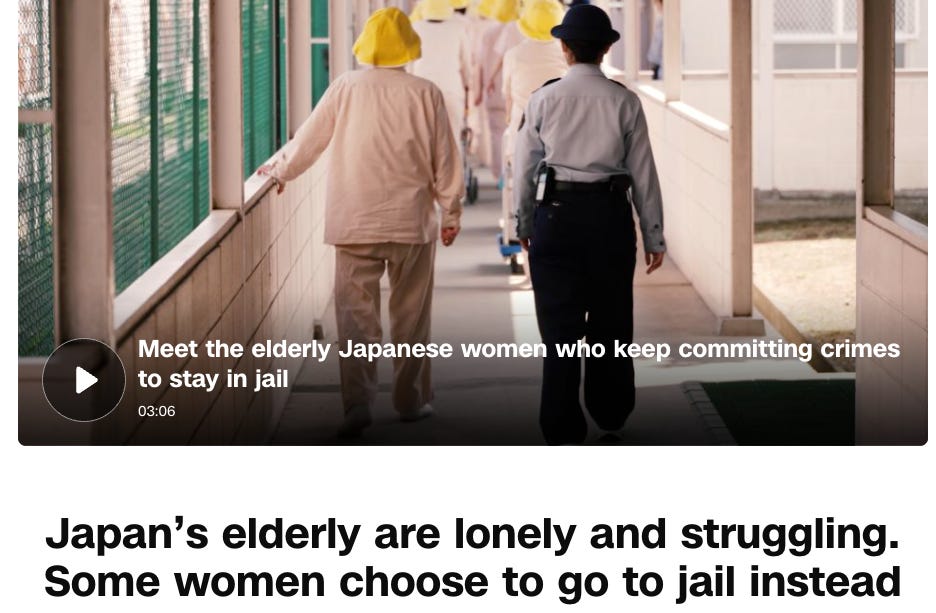
And the loneliness epidemic is NOT just in the United States or “West.” Japan’s loneliness epidemic is so bad that elderly women are doing hoodrat stuff committing crimes for a sense of community in prison and others are going full Hikikomori.
I should also make it clear in case you are confused: loneliness is NOT the same as social isolation. Social isolation = isolated from others (not automatically lonely).
Loneliness is an internal feeling of social pain (often as a byproduct of being alone, but not always). You can feel “lonely” and be surrounded by people — including friends and family.
That said, loneliness and social isolation are often closely related. The more total time a person is socially isolated, the higher the odds they will feel lonely. Loneliness is an evolved survival adaptation wherein one’s physiology evokes a sensation of discomfort until the person establishes social connections/bonds.
Throughout human history that sensation of discomfort was adaptive. If you didn’t feel the discomfort — you’d be less compelled to seek out a tribe (pool resources, collaborate, etc. — strength in numbers) — and you’d be more likely to die; hence the reason “loneliness” is prevalent (those who didn’t experience this sensation died out).
Many also conflate loneliness with mental disorders. And while it’s true that mental disorders increase odds of experiencing severe loneliness (as many can interfere with one’s ability to socialize and/or feel comfortable socializing) — many without mental illness still experience loneliness.
There are also different gradients of loneliness and frequencies. Some may feel intense loneliness every once in a while… others may experience low grade loneliness every day. Some may feel intense loneliness every day.
What is causing the loneliness epidemic?

I’m just armchair prognosticating here… but I think these are the top drivers of loneliness. ChatGPT had different “top drivers” but most of its top drivers were downstream of my top drivers which are: (1) technology uptake; (2) family dispersion; (3) dating culture (Paradox-of-Choice & women at top of food chain); (4) work-from-home, working online, etc.
Technology acceleration (cell phones, computers, tablets, gaming systems, gambling): These replace in-person connection with less satisfying digital stimulation. Many individuals can fill parts of the social void without feeling lonely as long as they have social stimulation by proxy via tech devices and the internet. Prediction markets, investing cults (Reddit, Twitter, etc.), sports betting (DraftKings), etc. Those who have social voids filled via devices and the internet — stay home more… and those who don’t have fewer people to connect with.
Distance from families & friends: People think it’s cool to move far away from their parents and friends that they grew up with. This is fine, but has a 2-pronged double whammy effect: increasing their own loneliness and loneliness in family members and close friends (because you are no longer around). Evolutionarily this is a massive mismatch.
Dating culture & marriage: Women are now at the top of the food chain in the West due to special organizations supporting them and defying organic free market forces (e.g. specialized scholarships, universities and certain departments must be 50% women, special initiatives for women, government benefits, etc.). Women do not “date down,” have strong social networks (other women), have a buffet of dating and/or casual sex options (Tinder, Bumble, Hinge, etc. — Paradox of Choice phenomenon), constant attention (Reddit, Snapchat, TikTok, IG, OF, etc.) — feeling like celebs. As a result, many women won’t settle down. Lower marriage rates, higher rates of lonely guys, increased drug use, etc. Guys not serious anymore either because of the feedback loops in place defying the free market to boost women.
Work-from-home (WFH) & hybridized work structures: I have nothing against WFH and/or hybridized (50/50 home/office) work routines. In fact, I think many people are more productive when they work from home and/or have split routines (some time at an office, some time at home). That said, unless you socialize heavily after work and/or have company at home… you’ll end up lonelier than full-time at the office.
Neuropsychiatric disorders: On the rise for various reasons including dysgenic fertility and evolutionary mismatches (societal/cultural). Treatments for these conditions have potential to decrease strong connections via interference with hormone systems (e.g. oxytocin, vasopression, reward centers). So more mental illness, treatments interfering with bond formation… and then loneliness — creating a vicious circle feedback loop (mental illness/treatments → lack of deep connection & loneliness; loneliness → mental illness/treatments).
Other variables: Lower fertility (fewer young people); demographic changes & diversity (lower social trust, language barriers, higher crime); workaholism; relationship formation delays (education & Paradox of Choice); collapse of “third places” to congregate; increase in single households; etc.
Note: Just because something is an evolutionary mismatch doesn’t inherently mean it’s “bad.” Some evolutionary mismatches are healthy and good. Loneliness itself could be perceived as good if it promotes reconnecting and bond formation. But for those unable to form bonds, it is a killer.
Anyways… the little jolts of dopamine and reward center activation from getting “likes” on social media and watching short-form slop on TikTok have replaced things like hanging out at the mall just shooting the shit, pick-up-games of sports in the streets or at a park, going to church, etc.
The younger generation isn’t drinking much alcohol… decreasing “bar culture” (fewer young adults hanging out at random bars, talking with friends, meeting new people, etc.)… now they’re smoking weed, hammering Zyns, mobile gaming, and YOLOing 401k’s on sports/memestocks.
In my view, loneliness is a modern NOTHING STOPS THIS TRAIN phenomenon. You can read a bunch of well-meaning intellectuals propose solutions on Substacks, X posts, etc.: (1) men should be required to do spend 2 hours a day outside the house; (2) repeal the 19th!; (3) join a club! start a group! go to an event!— whatever. Preaching to the choir.

Can suggest solutions until your face turns purple… and many are good ideas. But with modern society’s current setup, maintenance just doesn’t happen.
Even if you gave the perfect intervention and everyone started implementing it… unless you had lonely people at gunpoint, they’d slip back into their old ways (habits and routine).
Same story with obesity. Obese people can lose weight… they just can’t keep it off because the battle against physiology is absurdly difficult; the body fights to maintain its prior set point.
Furthermore, obese people have more “fat cells” (i.e. adiposity) and when they lose weight, the cells just shrink — and more cells = stronger hunger signal than if the person never gained weight in the first place. (I think weight loss success rate is like under ~5% at 5y.)
So what actually works? Currently the smartest intervention for obesity is GLP-1/GIP drugs (e.g. Ozempic). These drugs turn the hunger dial knob down in the brain… and poof, hippos turn into flagpoles.
Eventually we can just do a combination of embryo selection to prevent obesity (and even optimize for athleticism) and Pareto efficient gene therapy to eradicate obesity in adults (perhaps coupling this with adipose removal).
Telling people to change diets, exercise more, etc. or that obesity is not caused by genetics is braindead lunacy (genetics led to obesity in this modern environment and you are not erasing the modern environment).
Same goes for loneliness. Everyone can talk about what lonely people should do and/or how they recommend fixing it… but none of it sticks. These “suggestions” are for the birds.
Need to adapt to 2025. Ideally you effectively treat loneliness so that people don’t suffer → experience health deterioration (loneliness can wreak havoc on the entire body/brain) → premature death.
People are wasting away years of their lives rotting with loneliness (productivity losses, passive suicide, innovation losses, social losses, etc.).
Modern times require modern solutions. What are my modern solutions for loneliness?

OPINION: The simplest strategy for men and women is to partner up and move in together. Can get married and have some kids too. But that’s the most tried-and-true Rx. Odds may be stacked against you… can seek a connection outside of the U.S. if necessary — just don’t get taken to the cleaners… choose wisely.
Loneliness treatment & management
Experimental pharmacology (paired with socializing if possible): In the near-term. Unsure if will be effective. Many people already try to treat loneliness with drugs like cannabis, opioids, nicotine, alcohol, diphenhydramine, SSRIs, antipsychotics, oxytocin, etc. Some may take the edge off… but they’re mostly a dead end due to tolerance feedback loops embedded in physiology. (The Cacioppo’s think allopregnanolone could help… but I’m skeptical that it does much of anything.)
Neuromodulation: Many forms of this but most common is TMS. Relatively crude and no clear protocols for loneliness. I don’t really trust the precision and think it’s causing hearing damage/tinnitus en masse that is underreported. Ideally a protocol involving an at-home LIFU (low-intensity focused ultrasound) is invented and open-sourced. Can pair with fMRI to optimize treatment (analyze brain activity for individual, modify, treat loneliness at the brain level).
Cures for loneliness
Ideally you give people a dial knob they can fine-tune to their own liking. Want more loneliness? Turn up. Want less? Turn down. Highly useful for things beyond coping in modern society. Could be an adaptive modulation for long-flight space missions (especially if small crew).
And you might think that these cures I’m proposing would somehow make everyone stay at home more, but I’d speculate that they’d make everyone socialize far more than presently — because the same genetic traits associated with loneliness likely drive isolation and mental disorders.
You start with reversible gene therapies… fine tune to people’s liking. If they don’t like it they should be able to reverse it. If they like it, they can “lock in” the new feeling and not feel as lonely anymore.
Gene therapies targeted to eradicate social pain: Target specific regions of the brain implicated in loneliness (e.g. social pain) with Pareto efficient treatments. The goal is to completely eradicate loneliness so that the person feels zero loneliness regardless of whether alone or with others. Ideally this is agnostic to social drive (you don’t want to necessarily induce a compulsion to socialize).
Embryo selection (?): Could consider loneliness disposition as a trait to select against. Selecting for things like IQ may reduce odds of loneliness as a byproduct, but no guarantees. Analyze the genetic drivers of loneliness and try to reduce it as much as possible in selected embryos so that the next generation isn’t plagued with it. (We must consider that selecting too much against loneliness could be deleterious… but I doubt it.) Worth considering if no plausible adverse events from the selection. Most genes associated with loneliness are also linked to mental disorders.
What about things like oxytocin nasal spray and psychedelics?
Hormonal nasal sprays: Can help some people modestly (e.g. oxytocin nasal spray). The problem with increasing oxytocin and vasopressin exogenously is that you may put yourself in scenarios to be exploited by bad actors. The goal should be to treat loneliness without shifting into a subclinical case of Williams syndrome.
Psychedelics: Rewire the brain in many ways. Gambling with neurochemistry. Low dose intermittent is safer than going full throttle (heroic doses). They’ve ruined a lot of lives and turned many hard workers into woo-woo chakra aligner dipshits. They’ve also saved many from dark places. Dice roll: “One roll could land you in jail or cutting cake, blowing kisses in the rice rain.”
Ineffective ideas to fix the loneliness epidemic
These just don’t work well. If they did work loneliness wouldn’t be an epidemic. People don’t follow through or find them ineffective.
You can just do things: “Just socialize more.” Many people do socialize more but still feel lonely.
AI chatbots: Use an AI companion. Not gonna cut it… these aren’t human. Until you get robots indistinguishable from humans… no chance.
CBT: Paying an educated stranger to chat face-to-face. Maybe beneficial for some, but this is usually the first thing people try.
Meditation: Relaxing may help but doesn’t fix loneliness. Can rewire the brain… but not all rewiring should be considered beneficial (many people experience bad side effects from meditation). Mileage may vary.
Drugs, exercise, etc.: May help to varying degrees. Rarely a fix. Prescription neuropsychiatrics, legal drugs, OTC drugs, illicit drugs. Cardio. Weights. Healthy to exercise regularly but won’t cure loneliness.
AR/VR: Eventually could work if ultra-realistic and your brain can’t distinguish from reality — we are currently far from this. A half-baked substitute is hanging out with people digitally (Meta’s Orion smart glasses can do digital meetings where people look fully present even if on other side of the planet, etc.).
I.) Loneliness burden: suffering, disability, productivity losses, medical sequelae, and deaths
Mortality & major disease risk
Across 148 studies, stronger social connection is associated with a 50% higher likelihood of survival; conversely, lacking social connection confers premature‑mortality risk comparable to smoking up to 15 cigarettes/day, and greater than obesity or physical inactivity. (HHS.gov)
Poor or insufficient social connection is linked to a 29% higher risk of heart disease and 32% higher risk of stroke in longitudinal cohorts. (HHS.gov)
Chronic loneliness (measured repeatedly over years) predicts incident stroke risk +56% independent of depression or objective isolation (Harvard T.H. Chan study; eClinicalMedicine, 2024). (The Lancet)
Loneliness and isolation raise dementia risk (multiple meta‑analyses and large NIA‑synthesized datasets). (PMC)
Economic costs & productivity
Among older adults alone, social isolation costs Medicare ≈ $6.7 B/year in excess spending (mostly hospital and nursing‑facility costs). (HHS.gov)
In the workplace, the U.S. Surgeon General cites stress‑related absenteeism attributable to loneliness ≈ $154 B/year. (This is absenteeism only, not counting presenteeism or turnover.) (HHS.gov)
Addiction, overdoses, and downstream harms
Loneliness and social isolation increase vulnerability to substance use; mechanistically, dysphoria and social‑pain drive drug‑seeking as negative‑reinforcement. (Comprehensive 2024 reviews on opioids/social homeostasis and SDOH‑to‑SUD pathways.) (ScienceDirect)
In people who inject drugs, loneliness correlates with more non‑fatal overdoses, even after adjustment—evidence that social disconnection worsens overdose risk. (PMC)
The opioid crisis alone removed ~3.1 million years of life in the U.S. in 2022—loneliness likely amplifies risk via using alone, low bystander reversal, and affective distress. (Direct causal fraction for loneliness is unquantified, but the direction and mechanisms are consistent.) (The Lancet)
Bottom line: Loneliness is a high‑magnitude driver of morbidity, mortality, and economic loss—on par with or exceeding traditional cardiometabolic risks. The costs are not abstract; they appear in heart/brain outcomes, cognitive decline, Medicare spend, employer losses, and addiction/overdose cascades.
II.) Why this is an evolutionary mismatch disease (and why “just socialize more” fails at scale)

Evolutionary design: Humans evolved a social homeostat: when connection dips below an expected set‑point, aversive social pain (dACC/anterior insula) and social‑need signals (midbrain/DRN) push reconnection—much like hunger and thirst. In modern environments this alarm stays chronically “on” because the inputs it expects (stable, proximate, repeated in‑person ties) are structurally scarce. (Mechanistic reviews and convergent fMRI/animal data.)
Macro‑structural shifts that overwhelm willpower‑based advice
How couples meet flipped: meeting online displaced friends/family as the primary path—re‑architecting courtship into an algorithmic, high‑choice marketplace. (Implications: more search, less local density/commitment.) (PNAS)
Time‑use moved away from friends and toward “alone time”: ATUS‑based analyses show friend time fell sharply after 2014 (pre‑COVID), with young adults spending ~45% more time alone in 2023 vs 2010. (Our World in Data)
Screen‑dominated leisure and remote work increase perceived connection without delivering the embodied signals that quiet the homeostat. (Official summaries now explicitly warn about digital environments and connection quality.) (HHS.gov)
Conclusion: “Join more clubs” and other good‑faith suggestions are structurally outgunned by macro forces (digital mediation, mobility, marketized dating, altered time‑use). That’s why we should treat loneliness like obesity: a mismatch disease where environment and brain set‑points are misaligned—and use biological control to reset the dial.
III.) The control surface (brain‑level “dials” that match my constraints)

Design constraints I specified: no CBT/psychotherapy; reversible; adjustable intensity (“dial/knob”); do not amplify “trustingness” or social seeking if unwanted; avoid cognition dulling.
Primary nodes (with functions):
dACC & anterior insula: Aversive social‑pain gain. Reducing hyperalgesia here lowers distress without forcing approach/attachment.
KOR/dynorphin hubs (amygdala, BNST): Dysphoria/withdrawal bias. Dialing down KOR signaling reduces stress‑induced social avoidance without euphoria. (KOR antagonists are mechanistically apt, though late‑stage MDD programs have shown mixed efficacy—underscoring the need for region targeting and personalization.) (Nature)
Dorsal raphe (DRN) dopamine ensemble: Social‑need signal. Normalizing hyper‑craving after isolation prevents the “nothing satisfies” loop.
Nucleus accumbens (shell): Social reward satiety. Mild enhancement increases satiety from ordinary contact; recent human tFUS studies show NAcc is modulatable noninvasively. (PMC)
IV.) Roadmap (tech‑first; no therapy), with reversible dial‑control

Near term gotta get LIFU devices and protocols for at-home regular use.
Upload data to some sort of AI analytics app. Can integrate fMRI scans (before/after) the LIFU treatment for additional data (e.g. responders on Protocol Z targeting region X-Y-Z worked well, non-responders show activity in region X-Y-Z and benefit more from Protocol Y targeting region A-B-C — need to target different regions for specific subtypes).
Eventually open source AI analytics and protocols can analyze MRI scans (if you have them) and give customized protocols for your loneliness. If you don’t have scans… can just use general purpose protocols and dial things in until you benefit (try Protocol 1, if no benefit try Protocol 2) from LIFU.
A) Near‑term manage / stabilize (0–5 years)
Clinic‑to‑home LIFU stack (no talk therapy required)
Goal: turn down dACC/insula social‑pain gain or normalize NAcc/DRN, on demand.Clinical sessions now: Low‑intensity transcranial focused ultrasound (tFUS/LIFU) can modulate deep targets with mm precision in humans; multiple reviews and trials support feasibility and safety under supervision. NAcc tFUS suppression has been demonstrated in humans. (PMC)
Home device concept (regulatory‑grade): A locked headset with skull‑conforming arrays, automatic landmarks/registration, hard power/thermal limits, and cloud safety telemetry. Target libraries would be restricted to dACC/insula/NAcc/DRN templates; no oxytocin systems. Users can dial intensity within a bounded window (e.g., “calm,” “quiet,” “off”) but cannot alter coordinates or exceed limits.
Why plausible: the same hardware class is advancing for BBB opening and targeted delivery, with growing clinical evidence. The engineering (motion tracking, dose monitors, fail‑safes) is a productization problem more than a scientific unknown. (PMC)
Closed‑loop BCI/implant for severe, refractory cases
What: A read‑write system senses biomarkers of social‑pain arousal (e.g., dACC beta/low‑gamma or sgACC network states) and triggers micro‑stimulation or local ultrasound bursts to abort spikes of loneliness without producing sedation or trust shifts.
Why credible: Personalized closed‑loop DBS has shown sustained benefit in otherwise intractable depression by targeting biomarker‑defined brain states; responsive neurostimulation (RNS) is already standard of care in epilepsy with multi‑year safety data. (PubMed)
Targets: dACC/insula (pain gain), sgACC ↔ NAcc loop (affect/relief), or DRN (need signal). Guardrail: we do not touch frontal valuation/trust‑appraisal networks.
“Non‑tolerance” pharmacology by design (no therapy, no reinforcement of seeking)
Local‑only drug action via ultrasound: Ultrasound‑responsive nanoparticles/liposomes or FUS‑BBB opening to deliver tiny, repeated micro‑doses only to the selected node (e.g., dACC). This confines receptor exposure spatiotemporally, reducing systemic tolerance and side effects. (This paradigm is progressing in neuro‑oncology; the delivery physics and safety are being solved now.) (PMC)
Mechanism classes that don’t push trust:
(i) KOR antagonism (anti‑dysphoria) but region‑locked to amygdala/BNST (mixed systemic MDD data—hence localization). (Nature)
(ii) GABA‑A neurosteroid micro‑pulses to gate pain affect in dACC/insula during distress peaks (session‑locked; not pro‑sociability).
(iii) Analgesic‑adjacent micro‑dosing that targets dACC affect—not global opioidergic tone—again, only with local release to avoid dependence/tolerance.
(iv) NOP agonism (BNST/amygdala); PAC1 down-gain (BNST/CeA); NPY-Y1R up-gain (BLA/CeA); CHR1 down-gain (BNST/CeA).
Triggering: brief LIFU “unlock” pulses or sono‑thermal promoters to release/click‑on the drug only at the focus. (PMC)
KPIs (no questionnaires required): Lower daily “loneliness spikes” time‑above‑threshold (wearable‑derived physiology + passive voice prosody), reduced help‑seeking episodes, fewer urgent‑care visits, and objective changes in stroke/cardiac risk (longitudinal). Health‑economic KPI: reductions in utilization echoing the $6.7 B Medicare delta.
B) Long‑term cure concept (5–20 years): reversible, region‑targeted gene regulation with a user “dial”
Philosophy: Modulate the gain of social pain and need signals—not trust, not values, not executive cognition. Reversible, inducible, region‑specific. Users choose set‑point and can turn it off.
NOTE: This can be modified if newer methods and/or higher efficiency targets and/or strategies emerge. This was written in October 2025.
1) Delivery & control
Region targeting: FUS‑mediated BBB opening to admit LNPs or AAV carrying CRISPRi/CRISPRa constructs to a pre‑registered focus (dACC/insula/DRN/NAcc). Repetition gives maintenance without permanent edits. (PMC)
Inducible switches: doxycycline/rapalog systems initially; next‑gen sonogenetic switches where brief ultrasound bursts flip expression on/off—a true “dial” tied to an app. (Recent work shows ultrasound‑triggered gene control and ultrasound‑responsive gene switches are feasible.) (Nature)
2) Example targets (illustrative, not exhaustive)
dACC/insula (social‑pain gain): Decrease excitability: CRISPRa of KCNQ2/3 or GAD1/2 in local interneurons (mildly). Opioidergic micro‑tune: CRISPRi of OPRK1/PDYN locally (less dynorphin/KOR dysphoria), without boosting MOR globally. (Nature)
Amygdala/BNST (aversive withdrawal): Tac2/NK3R axis: isolation elevates Tac2; Nk3R antagonism reverses isolation‑induced states in mice—local CRISPRi of TACR3/TAC2 offers a precise human analog while sparing cortex. (PMC)
DRN (social‑need): Normalize rebound craving: CRISPRa/i of ion‑channel sets that stabilize firing without suppressing natural reward (e.g., modest HCN or GIRK tuning at DRN dopamine subpopulations).
NAcc shell (satiety from ordinary contact): Micro‑enhance MOR tone locally or CRISPRa of PENK to raise endogenous enkephalin only within the shell; no OXTR up‑titration, to avoid trust bias. (Human NAcc tFUS supports the general targetability of this node.) (PMC)
Lateral habenula (anti‑reward bursting): KCNQ2/3↑ to suppress burst firing (reduces catastrophizing/aversive bias).
Paraventricular thalamus, PVT (stress→limbic coupling): CRHR1↓ (and/or bias downstream signaling) to lower arousal‑driven vigilance.
3) Guardrails (designed in)
Reversible: CRISPRi/CRISPRa (no cutting) with decay; ultrasound/doxy “off” switch; capped expression.
No gullibility: avoid OXTR pathways and prefrontal valuation nodes; stay in nociceptive/affect circuits.
Context coupling: gene programs activate only during real social contexts (detected via on‑device acoustics/physiology), preventing “bonding” to random stimuli.
Personalization: baseline phenotyping distinguishes pain‑gain vs satiety‑deficit subtypes to choose nodes and dose.
Who benefits first?
Spaceflight/ICE crews (mission safety), severe trait loneliness unresponsive to other modalities, and conditions where loneliness multiplies risk (recurrent depression, some personality‑disorder phenotypes with rejection sensitivity)—again, no personality rewrite; only the alarm’s loudness changes.
Why this plan is Pareto‑efficient (and consistent with my constraints)
It does not require CBT or social‑skills work.
It lets users choose: a knob from “slightly quieter” to “off,” and an escape hatch (reversibility).
It targets the mismatch directly—silencing a chronically over‑firing alarm—so ordinary, voluntary contact finally feels sufficient again (without cranking up trust or pursuit behaviors).
It is mission‑useful (space, submarines, Antarctic stations) and can reduce overdose risk indirectly by softening dysphoria and the tendency to use alone.
V.) Loneliness eradication blueprint

Phase 1 (0–2 years):
Clinical LIFU pilots: dACC/insula vs NAcc vs DRN arms with objective digital endpoints (loneliness spike‑area; ambulatory physiology). NAcc feasibility already demonstrated in humans. (PMC)
Closed‑loop biomarkers from brief intracranial mapping cohorts (during other indicated neurosurgeries) to define control signals for later implantables. Closed‑loop DBS feasibility is established in depression. (PubMed)
Phase 2 (2–5 years):
Regulatory‑grade home LIFU: head‑tracked arrays; auto‑registration; locked target presets; intensity bounds; cloud QA.
Local‑only pharmacology: FUS‑BBB and ultrasound‑uncaging of non‑euphoric agents (KOR‑A, neurosteroid micro‑pulses) to stress nodes—no systemic tolerance loop. (PMC)
Phase 3 (5–15 years):
Reversible gene regulation delivered via FUS‑BBB: CRISPRi/CRISPRa packages with sonogenetic on/off. Early foci: Tac2/NK3R in extended amygdala; OPRK1/PDYN down‑tuning in dACC/BNST; PENK micro‑up in NAcc shell. (PMC)
Ethics & safety: independent monitoring; data minimization; no coercive use; explicit bans on trust‑manipulation targets; user‑owned dial and logs.
Why this beats status‑quo “advice”
The epidemiology (mortality, stroke, dementia) and the economics ($6.7 B Medicare; $154 B absenteeism) say the problem is vast; behavior‑only nudges can’t offset structural shifts (how we meet partners, how we spend time, how we work).
Treat loneliness as a medicalized mismatch and give people a reversible off‑switch for the alarm—without editing who they are.
Who will be first to treat and/or cure loneliness?

I’m not sure it will happen anytime soon… but am hopeful that elderly Japanese women won’t need to go to prison to cope with loneliness. And that people suffering from loneliness can just opt out. It’s a major drain on productivity and will worsen before it improves.
And FYI… I don’t consider ongoing “treatments” to be a cure. These are management strategies. Cure only occurs if you don’t need to keep treating it (this means either BCI or gene therapies).
We could easily round up:
Everyone who plans to and/or has high odds of suicide (as a downstream effect of loneliness)
Old people with severe chronic loneliness (that want to die but are living as zombies)
Criminals in solitary confinement
Anyone who experiences severe loneliness
And design some sort of experimental trial (MRIs + gene therapies). They are already wasting away and feeling shitty… there’s no downside to doing a gene therapy. Sure the gene therapy might kill you but life already sucks… the skew risk/benefit is asymmetric upside (for many of these people suffering is worse than death).
The straight shot ZERO TO ONE is gene therapy. Current scientists, big pharma, biotech et al. are obsessed with pharmacology (almost always tolerance inducing) and neuromodulation (LIFU is far superior to TMS). If you want to develop any new drug — needs to maintain high efficacy without inducing over 50% physiologic tolerance (patients should never need to switch doses or drugs).
However, if you want to save everyone time and suffering, you go straight to gene therapy. Start a trial offshore (e.g. in Prospera) if necessary.
What will the second order effects be? Couldn’t they be negative? Yes that’s why the interventions are reversible. The logic for negative effects is something like: (A) reducing loneliness via gene therapy → (B) no urge to seek out social connection.
The rebuttal here is that these are the absolute worst cases — wasting away and essentially living a “passive suicide” or people who will kill themselves from loneliness. That is far worse to an alternative wherein people socialize less but feel good and are productive.
It is fully possible that many people would socialize more with these targeted gene therapies for loneliness. Why? 2 reasons: (1) some of the modulations may make socializing more rewarding (more reward = want more of the activity) and (2) nothing is forced (e.g. trying to fit in with the wrong crowd, taking drugs/alcohol to blunt discomfort, etc.).
The beauty is that you can dial in the gene therapy to fit your own liking or circumstances. Going to Mars with a small crew? Adjust loneliness parameters accordingly.