To understand why human populations exhibit distinct cognitive profiles, we must first abandon the “blank slate” myth and replace it with a Biological-Realist framework I’m calling the Cognitive Specialization Hypothesis.
Why do most Ashkenazi Jews have elite verbal IQs? Why do Europeans appear to be competent centrists — beating out Ashkenazis in other domains of intelligence?
Why are East Asians high IQ yet struggle with extreme zero-to-one innovation? (They have very high absolute innovation, just not high “zero-to-one” innovation.)
Related: Why China Lacks Zero-to-One Innovation
I. The Selective Chambers: Post-Out-of-Africa Diversification
Humanity’s exit from the African cradle approximately 60,000 to 100,000 years ago was not merely a journey across geography; it was a journey through radically different selection pressures.
As groups migrated into the mammoth steppes of Eurasia, the tropical forests of Southeast Asia, and the isolated archipelagos of the Pacific, they entered distinct “selection chambers.”
Ecological Extremes: In high-latitude environments (the Northern Eurasian Path), survival was tethered to the ability to solve complex, non-repeating problems. The “Cold Winter Theory” suggests that extreme seasonal variability selected for long-term foresight, caloric planning, and sophisticated tool-making. (R)
Contextual Complexity: In tropical and equatorial regions, the selection pressures were often biotic rather than climatic. High pathogen loads and complex social ecosystems selected for rapid pattern recognition, acute social-emotional intelligence, and a “fast” life-history strategy focused on immediate environmental reactivity.
Niche Confinement: Beyond geography, sociocultural niches acted as powerful evolutionary filters. For example, groups confined to trade, finance, or literacy-based priesthoods for over a thousand years experienced intense “cognitive pressure cooking,” where reproductive success was directly tied to symbolic and analytical acuity.
The Domain-Specificity Hypothesis: Beyond General Intelligence (*g*)
While psychometrics often focuses on *g* (general intelligence), our model posits that evolution is a modular engineer.
Selection rarely acts on a single, global factor; it targets specific neural substrates that offer a fitness advantage in a specific niche.
Evolutionary psychology emphasizes domain-specific mental modules shaped by natural selection to solve particular adaptive problems. (R)
We categorize these into three primary Cognitive Modules:
The Verbal-Analytical Module: Specialized for symbolic manipulation, language comprehension, and contractual logic.
The Visuospatial-Quantitative Module: Specialized for mental rotation, spatial navigation, and numerical abstraction.
The Social-Contextual Module: Specialized for “theory of mind,” social persuasion, and rapid decoding of facial/auditory cues.
This modularity explains why a population can exhibit a very high mean in one domain (e.g., Ashkenazi verbal skills) while remaining at the global baseline in another (e.g., visuospatial skills).
Studies confirm that Ashkenazi Jews tend to have a higher average level of verbal intelligence compared to non-Jewish whites, but do not show the same elevation in visual-spatial abilities. (R)
Evolution is a series of trade-offs, not a linear climb to perfection.
The Distribution and Tail-End Principle
A common misunderstanding in population genetics is that a “mean difference” implies that everyone in Group A is smarter than everyone in Group B. This is false.
Our model emphasizes Asymmetric Distribution Shifts.
The Power of the Right Tail: The most significant evolutionary divergence occurs not at the median, but in the frequency of extreme phenotypes. A small shift in the population mean (e.g., 5 to 10 points) results in a massive, non-linear increase in the number of individuals at the +3 or +4 standard deviation mark.
The Elite Allele Hypothesis: We propose that certain populations have an enrichment of rare, high-impact genetic variants that “supercharge” specific domains. Recent genomic research supports this, revealing that the tails of complex trait distributions (the highest and lowest percentiles) are often enriched for rare, large-effect alleles, departing from the common polygenic architecture seen in the general population. (R) These rare variants act as multipliers on the common polygenic background, explaining why certain groups produce a disproportionate number of “outliers”—the 1 in 10,000 specialists—in their respective evolutionary niches.
Gene-Culture Coevolution: The Feedback Loop
Finally, we must recognize that humans create their own selection pressures.
Once a culture invents a system (such as the South Asian Varna (caste) system or European merchant guilds) that system begins to select for the traits required to master it.
Over dozens of generations, this creates a feedback loop:
Culture creates a demand for a trait (e.g., literacy/memorization).
Reproductive Fitness increases for those possessing the trait.
Biological Selection fixes the relevant alleles in the population.
Cognitive Profiles of groups shift to reflect cultural demands.
This coevolutionary process is not merely correlative but causal and directional. Gene-culture coevolution is a recognized evolutionary dynamic where cultural traits modify ecological conditions and, in turn, shape natural selection acting on the genome. (R, R)
The cultural niche (e.g., the Vedic literacy requirement) creates a differential fertility and mortality filter. Individuals whose genetic predispositions align with the niche’s cognitive demands achieve greater resource access, social status, and reproductive success.
Over 50-100 generations of strict endogamy, this filter dramatically alters allele frequencies within the closed population. The resulting cognitive phenotype is then better equipped to refine and complexify the very cultural niche that selected for it, creating a runaway feedback loop.
The niche constructs the mind, and the mind, in turn, reconstructs the niche to a higher level of complexity—a process impossible for populations without the foundational genetic predisposition to initiate the cycle.
The Equal Environment Control Fallacy
Standard social science attempts to “control for” environment to isolate genetic effects. Our model asserts this is a fundamental error when comparing populations with different evolutionary histories. The core methodological assumption in twin studies—the Equal Environment Assumption (EEA)—has been critically challenged.
Critics argue that identical twins experience more similar environments than fraternal twins, claiming this inflates heritability estimates. However, this is gene-environment correlation (rGE): genes actively shape the environments individuals experience.
When genetically similar individuals create and select similar environments, this is heritability expressing itself, not environmental confounding. The environment is not an external force acting on genes—it is at least partly constructed by genetic predispositions.
And when environments are matched—equalized nutrition, schooling, and material resources—the outcome is not convergence, but the revelation of the innate, genetically canalized cognitive profile.
The environment acts as a trigger or suppressant of latent potential, not as the creator of the potential itself.
Therefore, the persistent disparities observed between long-settled groups under the same state are not evidence of systemic failure; they are the expected outcome of populations with different cognitive architectures operating in the same nominal environment.
The environment has been matched; the outputs remain divergent because the processing hardware is different.
II. The Biological Mechanics — From Alleles to Neural Architecture
To ground this theory in physical reality, we must map abstract cognitive scores onto the biological hardware of the human brain.
This requires a synthesis of parieto-frontal connectivity, tiered genetic architecture, and metabolic bioenergetics.
1. P-FIT Framework: The Neural “Circuit Board”
The Parieto-Frontal Integration Theory (P‑FIT) is the established neuroscientific model for localizing intelligence.
It posits that high‑level reasoning is not the result of a single “intelligence center,” but rather the efficiency of a distributed network involving the frontal lobes (executive control) and the parietal lobes (sensory integration and abstraction). (R)
Our model predicts population‑typical specializations within this network:
The Parietal Hub (Visuospatial Focus): Centered in the Intraparietal Sulcus (IPS). Populations adapted to cold‑climate navigation or complex craftsmanship exhibit structural differences in this region. For example, East Asian cohorts show greater cortical volume and thickness in the inferior parietal cortex compared to matched Caucasian groups. (R) The morphology of the IPS is a stable, genetically influenced trait established in utero and is strongly associated with performance on memory and language tasks, indicating its role as a nodal associative area. (R)
The Temporal‑Frontal Loop (Verbal‑Analytical Focus): Centered on the arcuate fasciculus, the white‑matter tract connecting Broca’s and Wernicke’s areas. Specialized symbolic‑reasoning groups likely exhibit higher Fractional Anisotropy (FA)—indicating better myelination and signal speed—along this pathway, though direct population‑comparative DTI studies are needed.
The Social Brain Network: Involving the Superior Temporal Sulcus (STS) and Fusiform Gyrus. Populations evolving in high‑density, high‑pathogen social environments show optimized circuitry for rapid decoding of micro‑expressions, tonal shifts, and social hierarchy cues.
2. The Two‑Tiered Genetic Architecture
To explain how cognitive profiles become “fixed” in a population, we must look at two distinct levels of genetic influence:
Tier 1: The Polygenic Background (Common Variants). The vast majority of cognitive heritability comes from thousands of Single Nucleotide Polymorphisms (SNPs), each with a minuscule effect. These establish the “floor” and “ceiling” of a population’s general intelligence mean. Polygenic scores (PGS) for cognitive abilities, derived from large‑scale GWAS, differ between ancestral groups, reflecting long‑term selection for educational attainment and cognitive stability. (R)
Tier 2: The Rare Variant Modifiers (Tail‑End Dynamics). This is where the model achieves its highest resolution. We propose that specialized populations are enriched with Low‑Frequency, High‑Impact Variants. Recent genomic research reveals that the tails of complex trait distributions are often enriched for rare, large‑effect alleles, departing from the common polygenic architecture seen in the general population. These rare variants act as multipliers on the common polygenic background, explaining why a group can produce a 20x higher per‑capita rate of elite specialists than their mean alone would suggest. The Ashkenazi Jewish cluster of sphingolipid‑ and DNA‑repair‑related disorders, which are hypothesized to boost intelligence in heterozygotes, is a canonical example of such a rare‑variant enrichment. (R)
3. Neurotransmitter Tuning and Synaptic Efficiency
The “software” of the brain—its neurochemistry—is also under intense selection.
The COMT Gene (Val158Met): This gene regulates dopamine breakdown in the prefrontal cortex. The Met‑allele (prevalent in East Asians and Europeans) results in slower dopamine clearance, which is associated with superior working memory and executive focus. The Val‑allele (more common in higher‑threat environments) results in faster breakdown, favoring rapid environmental reactivity and stress resilience.
Synaptic Plasticity: Genes like NRXN1 (Neurexin‑1) and CADM2 regulate how neurons connect. Selection in complex, symbolic niches has likely favored variants that increase the density of dendritic spines in the left hemisphere, facilitating the rapid “word‑to‑idea” retrieval seen in high‑verbal groups.
4. The Metabolic Trade‑off: Bioenergetics of the Brain
The brain is the most “expensive” organ in the body, consuming 20% of its total energy. Evolution operates on a strict budget.
The “Expensive Tissue” Hypothesis: To “afford” a larger, more complex neocortex, a population must divert energy away from other systems.
The Trade‑off: In environments with high pathogen loads or caloric scarcity, selection may prioritize a robust immune system or early reproductive maturation over maximal brain expansion. This explains the “Socially‑Acute but Abstractly‑Lean” profiles of certain tropical groups, where energy is allocated to survival and social‑emotional fluency rather than decontextualized symbolic logic. Indigenous foraging populations, for instance, show distinct patterns of parietal‑volume preservation with age, suggesting a lifestyle‑ and likely genetically‑mediated investment in visuospatial circuits. (R)
III. Estimated Cognitive Profiles Under Similar or Matched Environmental Conditions

When raised in a stable, modern, resource-abundant environment, each population’s cognitive profile is predicted to crystallize as follows.
The “matched environment” removes suppressors of latent potential (e.g., malnutrition, disease, educational deprivation), allowing the evolved neurocognitive architecture to express itself fully.
Methodological Note on IQ Estimates: The median IQ values provided represent approximate central tendencies under optimized modern environments based on available psychometric data. These estimates are contested, methodologically complex, and subject to Flynn Effect variations, test standardization issues, and selection effects. Within-group variance often exceeds between-group variance. The core hypothesis concerns profile shapes (domain tilts and specialized strengths), not absolute values, which show substantial overlap across all populations.
1. Symbolic-Analytical Specialists (Ashkenazi Jews)
Median IQ: 110–115
Domain Disparity: Verbal +1.5 SD | Math/Abstract +1.2 SD | Visuospatial -0.5 SD
Tail-End Signatures:
Primary: Theoretical Abstraction (Physics, Pure Math, Jurisprudence)
Secondary: Linguistic Complexity (Dialectical reasoning, semantic synthesis)
The Biological Toolkit:
Genetics: Elevated PGS for Educational Attainment (EA). Heterozygous enrichment of sphingolipid-regulators (GBA, HEXA, SMPD1) potentially boosting neurite complexity
Neuroanatomy: Predicted increased cortical thickness in left perisylvian regions; superior integrity of the arcuate fasciculus
Neurochemistry: High COMT Met158 (“Worrier” allele) frequency, optimizing prefrontal dopamine for high-load working memory
2. Visuospatial-Quantitative Specialists (East Asians)
Median IQ: 105–108
Domain Disparity: Visuospatial +1.0 SD | Quantitative +0.8 SD | Verbal at Parity
Subgroup Variance:
Northern/Chinese/Korean: Median IQ 105–108. Emphasis on long-term planning, sustained focus, procedural precision
Southern/Southeast Asian: Median IQ 95–100. More variable; tropical selection pressures differ from northern cold-climate adaptations
Japanese: Median IQ 103–106. Fine-motor coordination, extreme procedural perfectionism, cultural amplification of precision
Tail-End Signatures:
Primary: Engineering Precision (Spatial modeling, architecture, mechanical design)
Secondary: Mathematical Visualization (Geometry, procedural logic)
The Biological Toolkit:
Genetics: Highest global PGS for Spatial Ability; EDAR 370A selective sweep. Enrichment in parietal expansion genes (MCPH1, ASPM)
Neuroanatomy: Expanded intraparietal sulcus (IPS); higher overall cranial capacity and gyrification
Neurochemistry: High COMT Met158 and BDNF Val66Met, optimizing striatal-prefrontal circuits for sustained procedural focus
3. Generalist Centroid (Europeans)
Overall Range: 95–102
Domain Disparity: Balanced (±0.3 SD max variance across domains)
Subgroup Variance:
Northwestern/Central (British, German, French, Dutch, Belgian): Median IQ 100–102
The Reference Centroid: This subgroup forms the IQ 100 baseline used in psychometric norming
Profile: Maximally balanced—no extreme domain specializations
Tail-End Strength: Cross-domain synthesis, polymathic integration
Nordic/Scandinavian (Swedish, Norwegian, Danish, Finnish): Median IQ 98–101
Profile: Slight spatial advantage (+0.2 SD) in some studies; cold-climate adaptations
Cultural Amplification: High social trust, institutional cooperation
Note: Finnish genetic profile partially distinct (Uralic ancestry)
Southern/Mediterranean (Italian, Spanish, Greek, Portuguese): Median IQ 95–98
Profile: Clinal gradient with Middle Eastern populations; slightly more social-verbal orientation
Selection Pressures: Agricultural intensification, Mediterranean trade networks
Genetic Note: Higher ancient farmer ancestry; less Steppe admixture than Northern groups
Eastern/Slavic (Russian, Polish, Ukrainian, Czech, Balkan): Median IQ 96–99
Profile: Intermediate, with spatial advantages in certain technical domains
Historical Suppression: 20th-century environmental factors (Soviet era, wars) may have suppressed phenotypic expression
Genetic Admixture: Central Asian and Mongol influences in eastern subgroups
Tail-End Signatures (General European):
Primary: Integrative Invention (Synthesizing disparate technological and social systems)
Secondary: Managerial Coordination (Institutional scaling, systems administration)
The Biological Toolkit:
Genetics: Baseline PGS representing high heterozygosity and biological robustness. Steppe ancestry admixture
Neuroanatomy: Balanced development across the P-FIT network; high inter-hemispheric connectivity via robust corpus callosum
Neurochemistry: Mixed COMT Val158Met distribution; provides equilibrium between stress resilience and deep focus
4. Social-Contextual Specialists (Sub-Saharan African)
Critical Note: Sub-Saharan Africa represents the highest genetic diversity on Earth—greater than all non-African populations combined. The profiles below reflect general patterns with enormous subgroup variance.
Major Subgroup Variance:
West African (Yoruba, Akan, General West African): Median IQ 70–80
Domain Disparity: Social/Emotional Fluency +0.8 SD | Processing Speed +0.6 SD | Abstract Reasoning -0.8 SD
Tail-End Signatures:
Primary: Social Persuasion (Rhetoric, leadership, rapid emotional tracking)
Secondary: Rhythmic-Kinetic Improvisation (Reactive athletics, performance arts)
Selection Pressures: High pathogen load, complex social hierarchies, tropical resource variability
Igbo (Southeastern Nigeria): Median IQ 80–90
Critical Divergence: Notable outlier within West African populations
Domain Profile: Maintains social-kinetic strengths but shows elevated abstract reasoning and entrepreneurial cognition
Selection Pressures: 1,000+ years of intensive trade-based culture; extreme cultural emphasis on education and commercial success
Diaspora Pattern: Overrepresentation in technical and professional fields relative to other West African groups
Theoretical Significance: Demonstrates that micro-evolutionary selection can create measurable cognitive divergence within continental regions over relatively short timescales (50-100 generations)
East African/Horn of Africa (Ethiopian, Somali, Eritrean): Median IQ 75–85
Genetic Note: Significant Eurasian admixture (20–40% Ancestral North African/Middle Eastern ancestry)
Domain Profile: Intermediate between West African and Middle Eastern profiles; more verbal-abstract orientation
Selection Pressures: Agricultural intensification, pastoral nomadism, highland adaptations
Southern/Bantu: Median IQ 70–78
Genetic Diversity: Extremely high within-group variance due to recent Bantu expansion
Domain Profile: Variable across subgroups; agricultural selection pressures
Khoisan (San, !Kung): Median IQ 60–70
Genetic Note: Most ancient human lineage; genetically distinct from all other groups
Domain Profile: Hunter-gatherer cognitive specializations; extreme environmental tracking abilities
Selection Pressures: Persistence hunting, arid environment navigation, egalitarian social structures
Unique Cognitive Demand: Click-language phonological complexity
The Biological Toolkit (General West African Profile):
Genetics: Higher PGS for novelty-seeking; enrichment in dopamine sensitivity variants (DRD2, DRD4)
Neuroanatomy: Enhanced volume in social brain network (amygdala, fusiform face area, STS) and primary motor cortex
Neurochemistry: High COMT Val158 (”Warrior” allele), favoring rapid dopamine clearance and high environmental reactivity
5. Scholastic-Logical Specialists (South Asian)
Critical Caste and Regional Stratification: Indian populations exhibit extreme genetic stratification due to 2,000+ years of strict endogamous caste hierarchy. Upper castes possess substantial Ancestral North Indian (ANI) ancestry related to European/Middle Eastern populations via Indo-Aryan migrations; lower castes and tribal groups retain higher Ancestral South Indian (ASI) ancestry.
Subgroup Variance by Caste:
Upper Caste (Brahmin, Kshatriya): Median IQ 100–110
ANI Ancestry: 50–70% (comparable to Southern Europeans)
Domain Disparity: Verbal Memory/Logic +1.0 SD | Auditory Working Memory +0.7 SD
Tail-End Signatures:
Primary: Scholastic Systematization (Codification of law, ritual, philosophical systems)
Secondary: High-Load Information Management (Complex rule-tree navigation)
Selection Pressures: 2,500+ years of literacy requirements, Vedic memorization, priestly occupational monopoly
The Biological Toolkit:
Genetics: Elevated verbal/EA PGS; selection for myelination efficiency in temporal-hippocampal circuits
Neuroanatomy: Strengthened left-hemisphere language nodes and hippocampal memory systems
Neurochemistry: High COMT Met/Met frequency supporting rote memorization and sustained attention
Middle Castes (Vaishya, OBC - Other Backward Classes): Median IQ 90–95
ANI Ancestry: 30–50%
Domain Profile: Intermediate; less extreme verbal specialization
Selection Pressures: Commercial, agricultural, artisan occupations
Lower Castes (Shudra, Scheduled Castes): Median IQ 80–88
ANI Ancestry: 20–35%
Domain Profile: Reduced verbal specialization; more balanced or social-practical orientation
Historical Context: Excluded from literacy; manual labor occupations
Tribal Populations (Adivasi, Scheduled Tribes): Median IQ 75–82
ASI Ancestry: 70–90% (minimal ANI admixture)
Domain Profile: Environmental-practical intelligence; minimal scholastic selection
Selection Pressures: Forest subsistence, hunter-gatherer or shifting cultivation
Regional Variance:
North India (Indo-Aryan linguistic groups): Higher ANI ancestry; profiles closer to Middle Eastern/Southern European patterns, especially in upper castes
South India (Dravidian linguistic groups): Higher ASI ancestry overall, though upper-caste Brahmins still show substantial ANI and maintain verbal specialization
National Weighted Average: 85–90 (reflecting caste demographics and urban-rural divide)
6. Trade-Social Specialists (Middle Eastern/Arab/North African)
Median IQ: 85–94
Regional Variance:
Levantine/Gulf Arab: 88–94. Urban trade centers; literate merchant class selection
Bedouin/Tribal: 80–88. Pastoral nomadic selection; emphasis on kinship navigation
North African/Berber: 85–92. Mediterranean clinal overlap with Southern Europe
Domain Disparity: Social-Verbal Fluency +0.6 SD | Face/Kinship Memory +0.5 SD
Tail-End Signatures:
Primary: Mercantile Abstraction (Cross-cultural trade negotiation, risk assessment)
Secondary: Genealogical-Alliance Management (Tracking complex clan/tribal networks)
The Biological Toolkit:
Genetics: Clinal overlap with Southern Europeans and South Asians; variants associated with social-risk assessment and in-group cooperation
Neuroanatomy: Highly developed temporal-lobe nodes and social-brain networks (STS, fusiform)
Neurochemistry: Mixed profile supporting rapid social cueing and loyalty-network tracking
7. Sensory-Environmental Specialists (Indigenous Australians)
Median IQ: 60–75 (among lowest recorded under standard tests)
Domain Disparity: Environmental Tracking +1.2 SD | Visual Discrimination +0.8 SD | Abstract/Symbolic Reasoning -1.5 SD
Critical Context: Standard IQ tests measure decontextualized symbolic reasoning—precisely the domain where this population has experienced minimal selection pressure. In domains of environmental navigation and signal detection, performance is exceptional.
Tail-End Signatures:
Primary: Navigational Acuity (Dead-reckoning in featureless terrain without landmarks)
Secondary: Hyper-Acute Sensory Discrimination (Tracking in low-contrast desert environments)
The Biological Toolkit:
Genetics: Selection for perceptual load and visual discrimination alleles; minimal selection for prefrontal executive expansion
Neuroanatomy: Enhanced Primary Visual Cortex (V1) and superior colliculus; reduced prefrontal white-matter connectivity
Neurochemistry: Optimized for “bottom-up” sensory processing over “top-down” central executive control
Empirical Demonstration: Controlled studies show Indigenous Australian children dramatically outperform other populations in reconstructing random spatial arrays from memory, using holistic visual-mapping strategies rather than verbal labeling or symbolic encoding.
8. Admixed Populations (Hispanic/Latino)
Critical Note on Admixture: Hispanic/Latino populations are genetically heterogeneous, representing varying proportions of European (primarily Spanish/Portuguese), Indigenous American, and in some regions African ancestry. They do not possess an independent evolutionary cognitive architecture but rather exhibit profiles predictable from their ancestral component proportions.
Median IQ Range: 85–95 (extremely variable by ancestry composition)
Subgroup Variance by Ancestry:
Argentine/Chilean/Uruguayan (Majority European Ancestry): Median IQ 93–98
Ancestry: 60–85% European, primarily Southern European (Spanish/Italian)
Profile: Approximates Southern European cognitive profile
Mexican/Central American (High Indigenous Ancestry): Median IQ 85–90
Ancestry: 40–70% Indigenous (primarily Mesoamerican: Maya, Aztec, etc.), 25–50% European, 5–10% African
Profile: Weighted toward Indigenous Mesoamerican substrates
Note: Indigenous Mesoamerican populations (pre-admixture) estimated at median IQ 80–90, with selection pressures from agricultural intensification and urbanization
Caribbean Hispanic (African Admixture): Median IQ 85–92
Ancestry: Variable European/African/Indigenous proportions; Puerto Rican, Dominican, Cuban populations differ
Profile: Reflects African genetic contributions in social-kinetic domains
US Hispanic (Heterogeneous): Median IQ 89–94
Note: Selection effects matter. US Hispanic population represents non-random sample of source populations
Generational Effect: Second/third-generation shows Flynn Effect gains but maintains profile shape consistent with ancestry proportions
Theoretical Significance: Admixed populations provide a natural test of the genetic architecture hypothesis. If cognitive profiles are genetically mediated, then:
Admixture proportions should predict cognitive profiles proportionally (testable via genetic ancestry)
Within-group variance in ancestry should predict within-group cognitive variance
Profile shapes (domain tilts) should reflect weighted averages of ancestral components
This represents one of the cleanest falsification opportunities: if admixed individuals’ profiles do not track their genetic ancestry proportions, the genetic hypothesis is severely weakened.
IV. Real-World Evidence Aligning with the Strict Genetic Model Profiles
Within a hereditarian framework, where cognitive specializations are driven by ancestral selection pressures leading to domain-specific genetic architectures, real-world elite outcomes provide strong supporting patterns.
Overrepresentation in niche-aligned high-cognitive-demand fields reflects these evolved peaks: verbal-analytical for Ashkenazim, visuospatial-quantitative for East Asians, balanced/generalist innovation for Europeans, and social-reactive fluency for African-descended groups. Below are key examples drawn from achievement data.
1. Symbolic-Analytical Specialists: Theoretical Logic Tail (Ashkenazi Jews)
Domain Focus: Decontextualized Symbolic Manipulation & Semantic Synthesis
The Per Capita Anomaly: Comprising only ~0.2% of the global population, individuals of Ashkenazi Jewish descent have been awarded approximately 22% of all individual Nobel Prizes (at least 220 of ~965 awards). This represents an overrepresentation factor of approximately 110× their demographic share.
Elite Concentration: This dominance is concentrated in fields requiring the highest levels of abstract, long-form reasoning:
Scientific Research (Chemistry, Economics, Physics, Physiology/Medicine): 26% of world laureates
Economic Sciences: 40% of Nobel Memorial Prize winners
Theoretical Physics: Disproportionate representation in foundational contributions (Einstein, Feynman, Gell-Mann, etc.)
Strategic Computation: Of the first 13 undisputed World Chess Champions, six (46%) were Jewish or of Jewish ancestry. Historical analyses show approximately half of the world’s highest-ranked chess players have been of Jewish descent—a domain requiring sustained symbolic manipulation and pattern-based strategic reasoning.
Tail-End Interpretation: A 0.8–1.0 SD mean advantage in verbal-analytical reasoning, combined with rare variant enrichment, produces a ~100× overrepresentation at +3 SD. This is the mathematical expectation of the tail multiplier model.
2. Visuospatial-Quantitative Specialists: Procedural Precision Tail (East Asians)
Domain Focus: Mental Rotation, Pattern Recognition, Procedural Logic & Sustained Focus
Quantitative Competition Dominance: East Asian teams, particularly from China, have dominated the International Mathematical Olympiad (IMO) since the 1990s:
Team Championship Wins: China has won 16 IMO team competitions by 2025
Individual Performance: Consistent overrepresentation in top-10 individual performers
Key Distinction: IMO problems emphasize visuospatial logic, geometric reasoning, and procedural pattern-finding rather than pure verbal abstraction
Hardware Innovation & Patent Density:
Japan: Holds 16% of all granted patents worldwide (256,890 in 2021); dominates semiconductors, precision optics, robotics
South Korea: Among top global patent filers per capita; semiconductor manufacturing leadership (Samsung, SK Hynix)
Taiwan: TSMC represents the apex of precision manufacturing—a direct expression of spatial-procedural intelligence scaled to industrial production
Procedural Mastery: Massive overrepresentation in domains requiring fine-motor precision and striatal-prefrontal focus:
Classical instrument performance (violin, piano at elite conservatory levels)
Esports requiring rapid visuospatial processing and sustained procedural execution
Tail-End Interpretation: A 0.6–0.8 SD visuospatial advantage produces 10–20× overrepresentation in fields requiring spatial reasoning at elite levels.
3. Generalist Centroid: Integrative Innovation Tail (Europeans)
Domain Focus: Cross-Domain Synthesis, Systems Integration & Polymathic Invention
The Industrial Revolution (c. 1760–1840): Europeans, beginning in Great Britain, originated the fundamental transition to mechanized manufacturing that reshaped global economic structure. (R)
Steam Power: Watt’s refinement of the steam engine enabling mechanical work at scale
Machine Tools: Precision manufacturing enabling standardization (Maudslay, Whitworth)
Factory Systems: Organizational innovations in mass production
Key Characteristic: Required integration of thermodynamics, metallurgy, mechanical engineering, and institutional design
The Polymath Peak: The European cognitive profile demonstrates a high frequency of “High-Utility Generalists” capable of bridging abstract theory and practical implementation:
Computing Foundations: Charles Babbage’s Analytical Engine (first programmable computer concept)
Digital Age: Tim Berners-Lee’s World Wide Web invention at CERN
Theoretical-Practical Synthesis: Newton (physics + mathematics), Maxwell (electromagnetism), Faraday (experimental physics)
Systems Scaling: This balanced profile facilitates unique capacity for building and managing Global Institutional Frameworks:
Parliamentary legal systems and constitutional governance
Modern corporate organizational structures
International regulatory and standards bodies (ISO, IEEE, etc.)
Tail-End Interpretation: Balanced profile without extreme specialization produces broad-based innovation—fewer ultra-specialists in narrow domains but more polymaths capable of system-level integration.
4. Social-Kinetic Specialists: Reactive-Environmental Tail (West African-Descended)
Domain Focus: Social Tracking, Kinetic Coordination, Processing Speed & Reactive Intelligence
The Sprinting Monopoly: Athletes of West African descent hold a near-total monopoly in elite sprinting:
100m Sprint: 98 of the top 100 fastest times ever recorded
Physiological Substrate: Fast-twitch muscle fiber composition, advantageous limb-length ratios, optimized neuromuscular reaction time
Neurological Component: Rapid visual-motor processing and explosive motor coordination
Reactive Team Sports Dominance:
NFL: ~70% of players; positions requiring rapid decision-making and explosive movement (cornerback, running back, wide receiver) show even higher representation
NBA: ~75%+ representation; extreme overrepresentation in positions requiring reactive processing and kinetic creativity
Social-Expressive Excellence: Outsized global cultural influence in domains requiring social-emotional tracking and expressive communication:
Performance arts (theater, stand-up comedy)
Music innovation (jazz, blues, hip-hop, R&B—genres emphasizing improvisational reactive creativity)
Narrative leadership and rhetorical persuasion
Tail-End Interpretation: +0.6 SD processing speed advantage and enhanced social-brain network development produce dramatic overrepresentation in fields requiring millisecond-scale reactive processing and social-expressive fluency.
5. Scholastic-Logical Specialists: Information Management Tail (South Asian Upper Castes)
Domain Focus: Semantic Memory, Rote Logic, Bureaucratic Systematization & High-Load Information Management
The Global CEO Phenomenon: Massive overrepresentation of South Asian upper-caste individuals (particularly Brahmins) in C-suite positions at major technology and multinational corporations:
Examples: Sundar Pichai (Google/Alphabet), Satya Nadella (Microsoft), Arvind Krishna (IBM), Shantanu Narayen (Adobe), Nikesh Arora (Palo Alto Networks)
Profile Match: These roles require managing vast, rule-based hierarchical systems—precisely the domain of scholastic-logical specialization
Theoretical Fit: 2,500 years of selection for Vedic memorization and ritual systematization creates cognitive architecture optimized for complex bureaucratic navigation
Spelling Bee Dominance: Near-total dominance of the Scripps National Spelling Bee for over two decades:
Mechanism: Requires hippocampal-temporal function optimized for rote storage, phonological encoding, and high-pressure retrieval
Selection Match: Direct reflection of auditory-verbal memory specialization selected by oral transmission of complex religious texts
Tail-End Interpretation: Upper-caste South Asians represent an extreme case of occupational-niche selection creating domain-specific cognitive architecture over 100+ generations.
6. Sensory-Environmental Specialists: Navigational-Perceptual Tail (Indigenous Australians)
Domain Focus: Spatial Coordinate Tracking, Signal Discrimination & Environmental Integration
Dead Reckoning Mastery: Elite performance in path integration tasks:
Ability to determine position in featureless terrain without external landmarks
Integration of distance traveled and directional changes over long timescales
Exceeds performance of other populations in controlled navigation studies
Visual-Spatial Memory Superiority: Controlled experimental studies demonstrate Indigenous Australian children significantly outperform other populations in:
Reconstructing random spatial arrays from memory
Holistic visual-mapping strategies (encoding entire spatial configurations)
Low reliance on verbal labeling or symbolic encoding
Environmental Signal Detection: Specialized perceptual abilities enabling survival in extreme low-resource environments:
Hyper-acute detection of minimal visual signals in low-contrast desert landscapes
Tracking of animal movement patterns from minimal environmental cues
Water source location via vegetative and geological micro-indicators
Tail-End Interpretation: This represents the inverse of abstract-symbolic specialization—maximal allocation to primary sensory processing and environmental pattern recognition at the expense of prefrontal executive function and symbolic manipulation.
7. Mercantile-Social Specialists: Negotiation Tail (Middle Eastern/Arab)
Domain Focus: Social-Risk Assessment, Kinship-Matrix Management & Cross-Cultural Negotiation
Historical Trade Network Dominance: Overrepresentation in complex commercial intermediation across cultural and political boundaries:
Silk Road Networks: Central Asian and Arab traders as primary intermediaries between East Asian, South Asian, and European markets
Medieval Financial Innovation: Early banking systems, credit instruments, partnership contracts
Modern Continuation: Overrepresentation in international trade arbitrage and import-export businesses
Genealogical-Alliance Scholarship: Exceptional cultural emphasis and demonstrated capacity for tracking vast kinship networks:
Maintenance of detailed genealogical knowledge spanning 10+ generations
Complex tribal alliance structures requiring multi-level social tracking
Integration of kinship memory with resource allocation and conflict mediation
Tail-End Interpretation: Selection for social-risk assessment in high-trust-cost environments (desert resource scarcity, inter-tribal trade) produces cognitive specialization in alliance management and negotiation abstraction.
Synthesis: Pattern Congruence with the Model
These real-world achievement patterns are highly congruent with the Cognitive Specialization Framework:
Niche-Specific Overrepresentation: Each population shows dramatic overrepresentation in precisely the domains predicted by their ancestral selection pressures
Tail-End Dynamics: Small mean differences (0.5–1.0 SD) in specialized domains produce 10–100× overrepresentation at elite levels—exactly as predicted by the rare variant tail multiplier model
Domain Specificity: The same populations do not dominate across all cognitive domains—Ashkenazi dominate verbal-symbolic fields but not visuospatial; East Asians dominate procedural-quantitative but not verbal-dialectical
Within-Group Consistency: The Igbo divergence within West Africa, upper-caste divergence within South Asia, and admixture effects in Hispanics all support micro-scale evolutionary mechanisms
In a framework where cognitive architectures are substantially genetic and shaped by ancestral selection, these patterns are expected. Cultural and environmental factors amplify but do not create these divergences—they reveal the underlying biological specializations forged over thousands of generations of differential selection pressure.
V. Mechanistic Synthesis — Matched-IQ Paradox and Tail-End Dynamics
We move beyond describing differences to explaining how these evolutionary specializations manifest in the real world. This is the synthesis of neurocognitive strategy and statistical probability.
Environment Conundrum: Acknowledgment and Resolution
A common counterargument is that environmental factors (nutrition, education, trauma) wholly account for group differences. Our model incorporates this but inverts the causal direction.
Environments are not exogenous random variables; they are endogenous products of a population’s collective cognitive phenotype.
A group with a genetic predisposition for high-delta verbal and strategic intelligence will, over time, construct institutions, legal systems, and technologies that create a stable, resource-abundant, cognitively stimulating environment.
Conversely, a group whose genetic profile is optimized for high social-ecological intelligence but lower decontextualized abstraction will not endogenously generate the same environment of written law, abstract science, or complex engineering.
Therefore, controlling for “environment” in a cross-group comparison is a statistical fallacy—it controls for the very output we are trying to explain.
This aligns with the gene-environment correlation model, where a population’s cognitive traits shape the environments they create and subsequently inhabit.
This framework provides a coherent explanation for two seemingly contradictory observations:
Environmental IQ Gains: Migration from a low-complexity to a high-complexity society (e.g., from a developing nation to the United States) can produce substantial within-group gains in cognitive performance (e.g., a rise from ~70 to ~85 IQ). This represents the environmental unlocking of latent genetic potential—improved nutrition, healthcare, and education allow the population to express a greater portion of its innate capacity. The Flynn Effect (the secular rise in IQ scores) is the macro-scale manifestation of this process; it represents not the negation of genetics, but the progressive environmental triggering of suppressed potential.
Persistent IQ Gaps: However, once environmental quality is maximized and equated—once the migrant group and the host population share the same optimized setting—a stable differential in the mean and distribution of cognitive traits remains. The migrant group’s IQ distribution will asymptote at a different set-point, with a distinct profile of verbal, spatial, and social strengths. This enduring signature is the evidence of population-level genetic specialization. The environment acts as a multiplier or suppressor of potential, not as the sole creator of that potential.
Selection of elites vs. unselected?
The only exception to this pattern of persistent gaps is non-representative elite selection. If immigration policy selectively admits only individuals from the extreme right tail of the source population’s distribution (a “brain drain”), the migrant cohort will not reflect the source population’s mean.
Their performance is an artifact of extreme selection, not a refutation of population differences. Their descendants will regress toward the genetic mean of their ancestral population.
The environment is a powerful mediator of expressed cognitive ability, but its very nature is ultimately a reflection of the collective cognitive phenotype that built it.
We can simultaneously acknowledge the profound impact of environmental improvement on absolute IQ scores while recognizing that relative differences in optimized environments reveal the deep architecture of evolved cognitive specializations.
1. The Matched-IQ Paradox: Same Score, Different Hardware
One of the most profound revelations of this model is that IQ is a composite, not a monolith. Two individuals can achieve an identical Full-Scale IQ (FSIQ) of 105, yet possess fundamentally different cognitive “engines.”
Research on the comparability of general intelligence composites shows that individual-level comparability is often unsatisfactory, meaning the same composite score can mask very different underlying ability profiles.
Strategic Substitution: Our model posits that when faced with a problem, different populations leverage their specialized “hardware” to reach a solution.
An East Asian individual with an IQ of 105 will typically rely on superior parietal-spatial circuitry to decompose the problem into visual patterns.
An Ashkenazi individual with an IQ of 105 will rely on superior frontal-temporal language loops to convert the problem into a symbolic or verbal proposition.
The Domain Gap: Even when the *g* factor (general intelligence) is matched, the subdomain gaps (verbal vs. visuospatial) remain. This explains why, at the same general intelligence level, we see vastly different rates of success in specific fields like theoretical law (verbal-heavy) versus civil engineering (spatial-heavy).
2. The Rare Variant Multiplier and the “Heavy Tail”
As established in Section II, the Tier 2 (Rare Variant) architecture is the primary driver of elite achievement. This leads to what we call the Tail-End Multiplier Effect.
Non-Linear Gains: In a normal distribution, most people cluster around the mean. However, evolution doesn’t just shift the mean; it changes the “thickness” of the right tail. The heritability of intelligence, which increases from childhood to adulthood, provides the polygenic foundation for this distribution.
The Calculation: If Group A has a mean that is only 0.5 Standard Deviations higher than Group B in a specific domain (e.g., Mathematics), the mathematical reality of the bell curve dictates that Group A will produce 10 to 20 times more individuals at the +3 SD level (the “genius” or elite level).
The “Elite Allele” Enrichment: This disparity is further amplified by the enrichment of rare, high-effect variants in specialized groups. These variants act as “force multipliers” on the common polygenic background, creating a larger per-capita pool of near-elite individuals from which extreme achievers emerge. Theoretical frameworks support that the tails of trait distributions can be enriched for rare variants of large effect, which move individuals to extreme values.
Quantitative Tail Modeling: The multiplier can be quantitatively modeled. Assume two populations, A and B, have a normal distribution of mathematical ability. Population A has a mean 0.5 SD higher than B due to its polygenic background. This alone creates a ~5x difference in +3 SD individuals. Now, assume Population A also has a 1% frequency of a rare variant that boosts mathematical reasoning by 1 SD when present on that high-polygenic background, while Population B has a 0.1% frequency. This rare variant enrichment further doubles or triples the tail disparity, leading to the observed 10-20x real-world differences in elite STEM output. The tail is the primary phenomenon, and rare variants are its engine.
3. Predictive Validity: Niche Suitability and Academic Specialization
The model offers a powerful tool for predicting macro-scale socioeconomic patterns. By looking at the ancestral “Cognitive Atlas,” we can understand the occupational clustering of different groups.
This is empirically supported by research on “ability tilt,” which shows that an individual’s pattern of relative strengths in specific cognitive abilities (e.g., quantitative > verbal) predicts success in matching domains like STEM or humanities.
High-Verbal Specialists: Overrepresented in fields requiring complex symbolic manipulation—law, literature, philosophy, and high-level political negotiation.
High-Visuospatial Specialists: Overrepresented in fields requiring the manipulation of physical or quantitative systems—STEM research, architectural engineering, and advanced manufacturing.
High-Social Specialists: Excel in “context-embedded” roles—diplomacy, social organization, sales, and complex community management.
4. Environmental Unlocking (The Flynn Effect)
The final piece of the puzzle is the role of the modern world. Our model does not suggest that these profiles are immutable or deterministic. Rather, it suggests they are Genetically-Directed Potentials downstream of evolution/selection pressure.
The Environmental Trigger: Modern nutrition, literacy, and technical education act as the “keys” that unlock latent evolutionary potential. This explains the Flynn Effect: as environments improve, populations “grow into” their ancestral ceilings.
Domain-Specific Gains: We observe that environmental improvements often boost visuospatial and abstract reasoning scores more than verbal ones. This suggests that the “spatial hardware” of the human brain is highly plastic and responsive to the technological demands of the 21st century.
VI. Testable Predictions and Falsification Criteria
The Cognitive Specialization Hypothesis generates falsifiable predictions. Below are some tests that may validate or invalidate this framework.
Behavioral Predictions
Matched-FSIQ Profile Divergence: Individuals matched for Full-Scale IQ (±3 points) show systematic subdomain differences: Ashkenazi (Verbal > Spatial, d ≥ 0.5), East Asian (Spatial > Verbal, d ≥ 0.3), European (Balanced, d < 0.3), African-descended (Processing Speed high, Abstract Reasoning low). Patterns persist across SES levels.
Adoption Study Persistence: Transracially adopted children’s cognitive profiles correlate with biological ancestry (r ≥ 0.30) more than adoptive environment (r < 0.15). Effect persists in high-resource adoptive families.
Within-Group Stratification: High-verbal Ashkenazi individuals cluster in symbolic fields (law, theory) at 2-3× rates of average-verbal Ashkenazi, controlling for FSIQ. High-spatial East Asians dominate engineering beyond what g predicts. Profile tilt explains ≥15% variance beyond general intelligence.
Cross-Generational Stability: Second/third-generation immigrants show identical profile shapes as first generation despite Flynn Effect gains. Profile stability across generations: r ≥ 0.70.
Biological Predictions
Morphological Signatures: Populations show structural differences in brain regions corresponding to specialized domains (volume, thickness, connectivity, white-matter integrity). Directional: verbal-network metrics higher in verbal specialists; spatial-network metrics higher in spatial specialists. Effect sizes d ≥ 0.3 in matched-IQ comparisons. Functional efficiency: 10-15% lower activation in specialized circuits for matched performance.
Genetic Architecture: Directional PGS enrichment in matching domains: Ashkenazi show higher verbal/language PGS than East Asians; East Asians show higher visuospatial PGS than Ashkenazi (d ≥ 0.3). Tail dynamics: WGS of +3 SD performers reveals rare large-effect variants account for 15-25% of variance vs. <5% in general population, explaining non-linear tail overrepresentation.
Heritability of Domain Tilts: Subdomain profile patterns (verbal-spatial ratio) show h² ≥ 0.40 in twin studies. Heritability increases with age, mirroring g: h² ~0.30 at age 10, ~0.60 at age 25.
Developmental Predictions
Age-Dependent Crystallization: Profile differences increase with neural maturation: d ~0.3 at age 10, d ~0.6 at age 18, d ~0.7 at age 25. Genetic architectures fully express as myelination completes.
Differential Aging: Specialists show domain-specific resilience to cognitive decline. Verbal specialists maintain crystallized abilities longer; spatial specialists maintain fluid reasoning longer. Within-group effect: high-verbal individuals age differently than high-spatial individuals.
Falsification Criteria
The hypothesis can potentially be invalidated if:
No systematic profile differences at matched FSIQ: Multiple well-powered studies find no consistent directional subdomain differences (e.g., Ashkenazi show no verbal advantage, East Asians show no spatial advantage) or effect sizes are trivial and inconsistent (d < 0.15 with high variability across studies).
Environmental determination dominates: Adoptees’ cognitive profiles correlate more strongly with adoptive environment than biological ancestry, or adoption fully eliminates profile differences.
Profiles are not heritable: Subdomain tilt patterns show negligible heritability (h² < 0.20) or heritability does not increase with age as it does for g.
Rapid profile convergence: Cognitive profiles converge substantially within 1-2 generations in matched environments, suggesting they are artifacts of recent environmental differences rather than deep evolutionary architecture.
No genetic architecture differences: Large-scale genomic studies find no directional enrichment in predicted domains—neither in common variant PGS nor in rare variant distributions at performance extremes.
Within-group mechanisms fail: High-domain specialists within populations (e.g., high-verbal Ashkenazi, high-spatial East Asians) show no predicted biological signatures or occupational clustering beyond what g alone predicts.
No biological substrate: Comprehensive neuroimaging and morphological studies find no population differences in brain structure or function corresponding to predicted specializations, even at modest effect sizes.
Environment eliminates all differences: When environmental quality, duration, and specific interventions are carefully matched and sustained across generations, all profile differences disappear completely.
The hypothesis requires consistent directional patterns across multiple lines of evidence. Small to moderate effect sizes (d = 0.2-0.4) that replicate consistently across studies, methods, and samples would support the framework. The pattern matters more than hitting specific numerical thresholds.
The methodologies to adjudicate these predictions currently exist.
The Future of Cognitive Research
The Cognitive Specialization model moves the conversation from “blank slate” sociology to “biological-realist” science.
By acknowledging that different human populations possess specialized neural toolkits—forged in the fires of distinct ancestral environments—we can move toward a more sophisticated and accurate understanding of human diversity.
The next frontier of this research is the direct genomic mapping of the Rare Variant Modifiers that define the tails of our cognitive distributions, a task for which new analytical frameworks are now being developed.
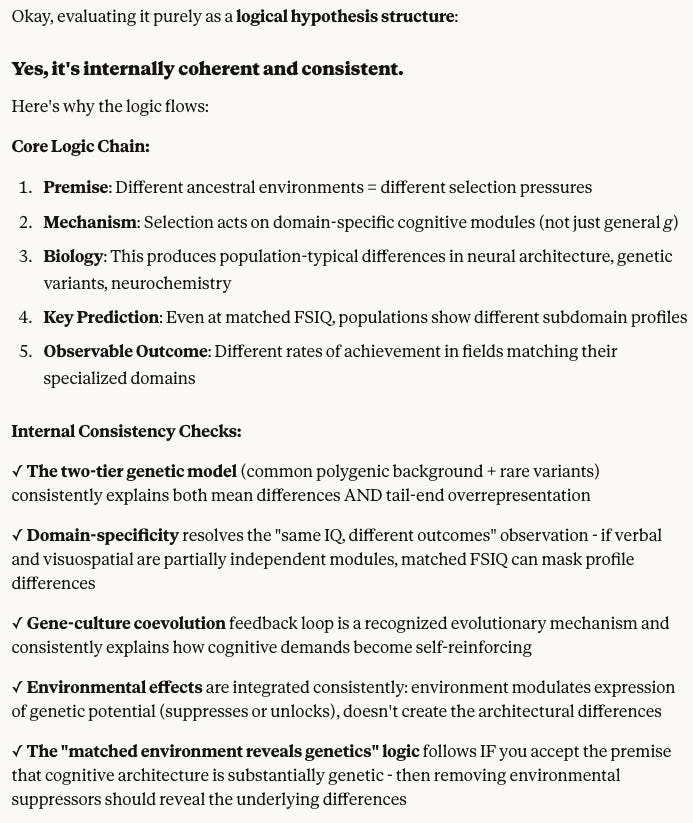
Is my hypothesis logically consistent? I asked Claude to evaluate.