

Unexpectedly we have Djokovic vs. Alcaraz in the 2026 Men’s Aussie Open Final.
I thought Sinner was a certified lock to beat Djokovic in 3, maybe 4, sets… and I’m someone who roots for Djokovic because he’s the “last of the old guard.”
Sinner and Alcaraz clearly have a lot of future runway to rack up many more majors if they stay healthy… they are just better than the rest and young… on another echelon vs. the next-highest tier (Zverev is knocking at the door but can’t seem to enter).
Of those 2, I typically cheer for Sinner if going head-to-head, but like both… Sinner to me is more technical and consistent and Alcaraz has better peak-level game and power… if both are playing their best, Alcaraz typically wins.
Sidebar: And I thought Alcaraz was “smart money” against Sinner back in the U.S. Open Final (couldn’t believe he was an underdog there)… the whole Trump spectacle + delay by ~1 hour may have been more of a psychological pressure-cooker for Sinner and messed up his flow.
Australian Open 2026 Men’s Final Preview: Alcaraz vs. Djokovic
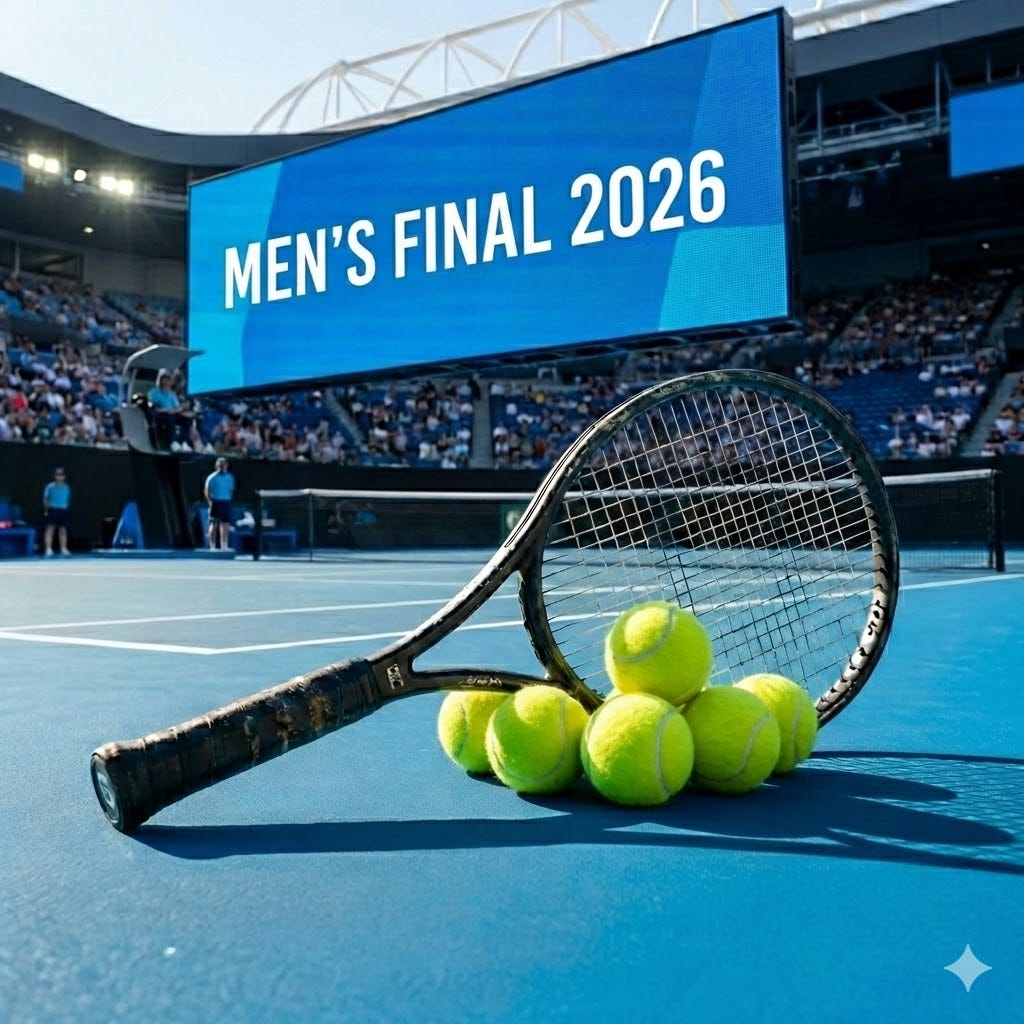
Sunday, February 1, 2026 | 7:30 PM AEDT (3:30 AM ET) | Rod Laver Arena, Melbourne
Carlos Alcaraz and Novak Djokovic will meet Sunday night at Rod Laver Arena in what promises to be one of the defining matches of this tennis generation.
The stakes are historic on both sides:
Alcaraz, the 22-year-old world No. 1, seeks his seventh Grand Slam title and the Career Grand Slam—which would make him the youngest man ever to achieve that milestone.
Djokovic, 38 years old and defying every expectation, chases an unprecedented 25th major title that would break the all-time record he currently shares with Margaret Court.
Their semifinal paths tell vastly different stories. Alcaraz survived a 5-hour, 27-minute marathon against Alexander Zverev while battling physical distress, while Djokovic produced one of the greatest clutch performances of his career to upset defending champion Jannik Sinner in 4 hours, 9 minutes.
Despite Alcaraz being a heavy betting favorite, Djokovic’s unmatched history at Melbourne Park—where he’s won 10 titles and never lost a final—makes this one of the most compelling matchups in recent Grand Slam history.
The Semifinals: Two Instant Classics
Alcaraz vs. Zverev: The 5-Hour, 27-Minute Epic
The first semifinal delivered the third-longest match in Australian Open history.
Alcaraz won 6-4, 7-6(5), 6-7(3), 6-7(4), 7-5 in a match that will be remembered for its dramatic twists, physical adversity, and the controversy that accompanied them.
Set-by-Set Breakdown:
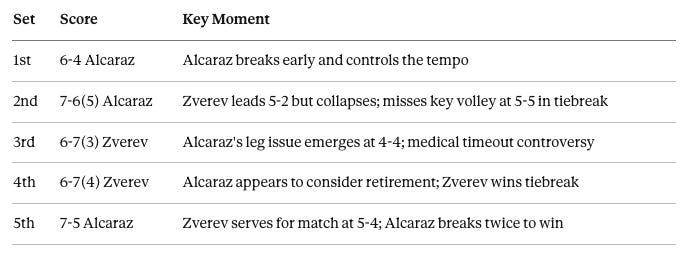
The story of this match is Alcaraz controlling the first two sets, nearly closing in straight sets, then battling through a physical crisis that almost ended his tournament. Zverev had multiple opportunities to close—up 5-2 in set two, serving for the match at 5-4 in the fifth—but couldn’t convert when it mattered most.
The Second Set Collapse: The first set was competitive—Zverev played well but Alcaraz found a late break to take it 6-4. The second set is where Zverev should have seized control. He was up 5-2 with Alcaraz serving, looking like he’d level the match comfortably. Instead, he couldn’t close. Alcaraz battled back, forced a tiebreak, and Zverev missed a “very makeable” volley at 5-5 in the breaker—a moment he later called his biggest regret. Alcaraz took the tiebreak 7-5 and suddenly led two sets to love despite Zverev having been in command of the second set for most of it.
The Physical Crisis: At 4-4 in the third set, everything changed. Alcaraz pulled up grasping his upper right leg. According to ATP Tour data, his serve speed dropped from an average of 204 km/h to 177 km/h, and his leg drive plummeted from 2.31 m/s to 1.46 m/s. He took pickle juice, received treatment, and visibly struggled to move laterally. At one point in the fourth set, Alcaraz appeared to walk toward the net as if to retire—Zverev was ready to shake hands—before Alcaraz changed his mind and continued. It paid off.
The Medical Timeout Controversy: At 5-4 in the third set, Alcaraz called a 3-minute medical timeout that ignited significant controversy. Under Grand Slam rules, players cannot receive extended medical treatment for cramping, which is considered “loss of conditioning” rather than injury.
Zverev confronted supervisor Andreas Egli in German:
“He has cramp! He can’t take a medical, he is cramping. This is absolute bulls**t!”
Zverev added:
“You are protecting both of them [Alcaraz and Sinner], this is unbelievable.”
Here’s the thing though—cramping is somewhat analogous to injury in practice. You can’t continue if you’re cramped badly enough to need a medical timeout.
A cramp is a medical condition, and wanting to win because your opponent can’t get treatment for it feels like a cheap path to victory.
The rules technically distinguish between “exertion cramps” (not treatable on-court) and “acute muscle injury” (treatable), but in the moment, that distinction is nearly impossible to make—especially when it’s localized to one specific muscle.
Alcaraz’s defense was that the pain felt localized rather than like generalized cramping.
In his post-match press conference, he explained:
“In the beginning it was on a specific muscle, so I didn’t think it was cramp at all.”
The physiotherapist determined it warranted treatment for potential adductor strain. Whether it was technically cramp, strain, or something in between, the treatment happened and Alcaraz survived. The umpire and medical staff have discretion—it was a judgment call, not a clear rule violation.
The Fifth Set Comeback: Down 3-5 in the fifth set after Zverev broke early (Alcaraz double-faulted), the match seemed over. But Zverev served for the match at 5-4 and couldn’t close—the second time he failed to finish Alcaraz off. Alcaraz broke back, held to go up 6-5, then broke again to win 7-5—extending his remarkable fifth-set career record to 15-1.
Alcaraz toughed it out even when his body was failing and Zverev could not find a way to capitalize.
Match Statistics:
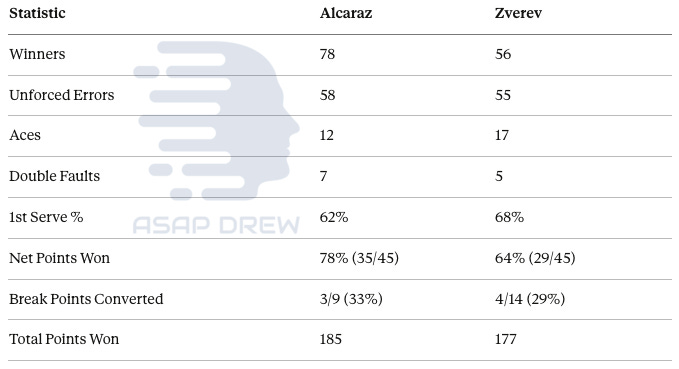
The numbers tell a clear story: Alcaraz generated significantly more offense (78 winners to 56) and was lethal at net (78% success rate) even when his movement was compromised. Zverev actually broke serve more often (4 times to 3) but couldn’t hold when it mattered. Both players made similar unforced error totals, but Alcaraz’s ability to produce winners under duress was the difference.
A Word on Learner Tien: American to Keep on Your Radar
Before discussing the other semifinal, it’s worth noting that Learner Tien—the 19-year-old American—pushed Zverev to the brink in the quarterfinals, losing 6-3, 6-7(5), 6-1, 7-6(3). Tien is short by modern tennis standards but plays amazingly for his size and stature. He’s competing at an insanely high level against elite opponents, and Zverev himself admitted that his serve and aces basically saved him from what could have been an upset.
Tien’s baseline level is legitimate, and his competitiveness is off the charts. He’s a guy to keep on the radar even if he lacks the prototypical physicality of the serve-bot era players. Love to see it out of the USA—American men’s tennis needs exactly this kind of fearless young talent willing to go toe-to-toe with the top 5.
Djokovic vs. Sinner: The Break-Point Miracle
The second semifinal was a tactical masterpiece and a testament to Djokovic’s unparalleled ability to win the points that matter most. Djokovic won 3-6, 6-3, 4-6, 6-4, 6-4 in 4 hours, 9 minutes, finishing at 1:32 AM local time.
The Defining Statistic: Djokovic faced 18 break points and saved 16 of them—an 89% save rate that borders on superhuman.
Sinner, hit more winners (72 to 46), struck more aces (26 to 12), and controlled the baseline rallies for long stretches.
On paper, Sinner was the better player. On the scoreboard and mentally, Djokovic’s legendary clutch gene prevailed.
To sum up the match: Sinner generated enough looks to win, but Djokovic kept his nerve and made Sinner play one more ball on every pressure point.
Set-by-Set Breakdown:
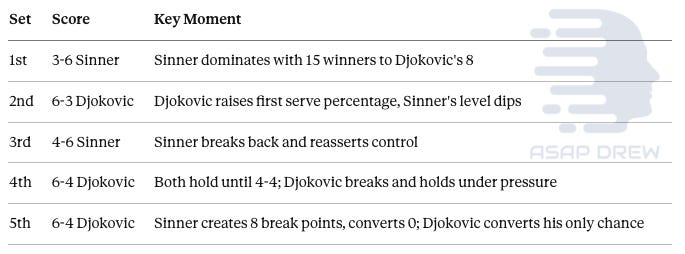
The Fifth Set in Detail: The decisive set crystallized everything Djokovic does better than anyone in tennis history. According to ATP Tour reporting:
Sinner generated 8 break points and converted zero
Djokovic generated 1 break point and converted it
At 0-40 down in the eighth game, trailing 3-4 and facing match-altering pressure, Djokovic saved all 3 break points with precise serving
He then held to go up 5-3, including his 12th ace on a critical point
The match ended when Sinner’s backhand sailed wide on Djokovic’s third match point
Sinner’s career record in matches exceeding 3 hours, 50 minutes fell to a devastating 0-9.
The Italian creates chances but can’t close against elite opponents in wars of attrition. I think with Sinner it’s mostly psychological… he has the skill to win these.
Was Sinner Healthy?
There's been no reporting of any physical issue, he didn't call for treatment at any point, and he showed no visible movement limitations throughout the match.
When he said post-match that it “hurts,” the context was clearly emotional—the pain of losing a match he created so many opportunities to win.
His press conference focused entirely on failing to convert break points and Djokovic's clutch serving, not on any physical limitation.
This was a psychological collapse under pressure, not a physical one.
Going 0/8 on break points in a fifth set against a 38-year-old is an execution failure, plain and simple.
From my perspective, Sinner lost by beating himself more than Djokovic won by outplaying Sinner.
Djokovic’s Assessment:
In his post-match interview, Djokovic was uncharacteristically effusive:
“I rate it as the best win of the last couple of years. For sure, one of the best performances in the last decade.”
He added:
“I want to thank all the doubters”
A reference to the widespread belief that he couldn’t beat the younger generation at this level anymore.
To be fair, I am still mostly a doubter… but ONLY against the TOP 2… Djokovic can still hang with and beat nearly everyone else, but overcoming both Carlito and Janik in a Grand Slam (if they are healthy) is borderline impossible at his age. A younger Djokovic? Yes he could do it and would do it… but he’s not a spring chicken.
The Djoker is in the final stretch of his career and Alcaraz + Sinner are in their primes. It’s not a fair fight from an age perspective.
I wouldn’t expect him to win many more like this. Sinner out-skilled him, he hung with it best he could, and had the superior psychology and strategy. Congrats to Novak.
Match Statistics:
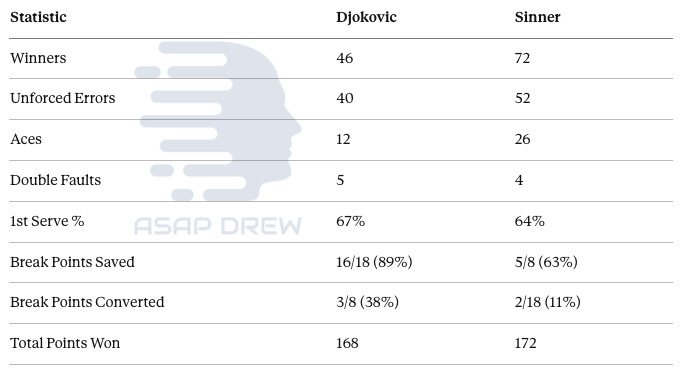
Sinner won more total points (172 to 168), hit more winners (72 to 46), and struck more than double the aces (26 to 12).
The break point differential tells the entire story: Djokovic converted 38% of his chances while Sinner converted just 11%. That’s the difference between Djokovic’s 24 Grand Slam titles and Sinner’s 2. Clutch execution at the highest leverage moments.
The upset was the largest Grand Slam betting surprise since Botic van de Zandschulp beat Alcaraz at the 2024 US Open. Djokovic entered as a +810 underdog.
He left as the oldest man in the Open Era to reach an Australian Open final.
The Musetti Factor: Djokovic’s Lucky Break
Djokovic’s path to the final included a significant gift in the quarterfinals.
Lorenzo Musetti—one of the most motivated and competitive players on tour (really booming in ranking over the past year, trying to catch fellow Italian Janik Sinner)—was up 2 sets to love and seemingly cruising before retiring with what appeared to be an iliopsoas injury while trailing 1-3 in the third set.
It’s worth acknowledging that Musetti probably would have beaten Djokovic had he stayed healthy. He was playing at a very high level.
I like Musetti’s game and hope he rebounds quickly… sad to see what transpired with his injury. I was actually confused watching because initially I thought the Djoker retired. I like Musetti’s one-handed backhand… even if it’s arguably a liability to maintain in the modern game.
Watching that match, Djokovic looked like he ZERO CHANCE until Musetti’s body gave out.
Health Status Going Into the Final
Carlos Alcaraz: The Big Question Mark
Alcaraz’s physical status is the final’s central uncertainty. His right leg issue—whether cramp, adductor strain, or something in between—visibly impaired his movement for significant portions of the semifinal.
In his post-match press conference, Alcaraz acknowledged the toll:
“Obviously I feel tired. Obviously my body could be better, to be honest... I’m going to have treatment with the physio now, and we will see.”
He described the semifinal as “one of the more demanding matches that I have ever played in my career so far.”
Reasons for Optimism:
Alcaraz’s movement improved notably by the fifth set—he rallied from 3-5 down to win four consecutive games
He has a full recovery day (Saturday completely off) before Sunday’s final
His recovery protocol includes ice baths, intensive physiotherapy, and targeted muscle treatment
At 22, his body recovers faster than older competitors
Reasons for Concern:
The issue was severe enough to require medical timeout and consideration of retirement
Even if it was “just cramp,” that suggests conditioning/hydration concerns in Melbourne’s heat
His serve speed dropped significantly when the leg was at its worst
Muscle issues often linger even when players can compete
Additional Context: Alcaraz is navigating a significant transition this tournament. He parted ways with long-time coach Juan Carlos Ferrero in December 2025 after seven years together, and is now working solely with Samuel Lopez.
Novak Djokovic: Less Dramatic but Still Relevant
Djokovic dealt with a sizable blister on his right foot during his quarterfinal against Musetti, requiring medical treatment and heavy bandaging. However, his semifinal showed no visible effects—he moved normally and never called for treatment.
The Key Advantage: Court Time
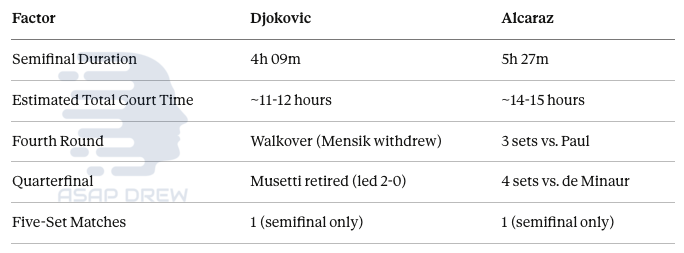
Djokovic’s draw breaks—the walkover and the Musetti retirement—gave him extra recovery time that could prove decisive. He’s spent roughly 3 fewer hours on court than Alcaraz through the semifinals. At 38, that matters.
“I just hope that I’ll have enough gas to stay toe-to-toe with him,” Djokovic said after beating Sinner. “That is my desire.”
His semifinal ended after 1:30 AM local time, and he said he would skip practice Friday to focus entirely on recovery.
How Match Length May Influence the Outcome
The semifinal court time gap—78 extra minutes for Alcaraz (5:27 vs 4:09)—matters, but not in a straightforward way.
The implications depend entirely on Alcaraz’s physical status entering Sunday.
If Alcaraz is at 100% (no cramping, leg fully recovered):
A longer match actually favors Alcaraz. At 22 vs 38, his recovery capacity and cardio ceiling are significantly higher than Djokovic’s. The deeper a match goes, the more Djokovic’s age becomes a liability—his legs tire, his first-step explosiveness fades, and his ability to sustain rally intensity diminishes. Alcaraz can push pace for four or five hours; Djokovic increasingly cannot. If Alcaraz is moving freely, he should want to extend rallies, test Djokovic’s legs, and trust that youth and athleticism will win a war of attrition. In this scenario, Alcaraz wins in straight sets or 4 at most.
If Alcaraz is compromised (cramping risk, adductor not fully healed):
Everything flips. The 78 extra minutes from the semifinal work against him. More importantly, the nature of Alcaraz’s semifinal was far more physically punishing than Djokovic’s—Alcaraz spent 2+ sets in survival mode with visible distress, altered mechanics, and reduced serve speed. Djokovic’s semifinal was mentally grueling but physically he moved normally throughout. Add in Djokovic’s easier path (walkover in R4, Musetti retirement in QF—essentially two byes in the second week), and the freshness gap becomes significant.
In this scenario, a long match exposes whatever leg issue Alcaraz is managing. Cramping tends to recur under similar conditions. If Alcaraz’s movement is compromised, his explosive advantage disappears—and Djokovic’s experience grinding out wounded opponents becomes the decisive factor. This is Djokovic’s path to victory: he needs Alcaraz not at 100%, plus his own A-game on clutch points.
The bottom line: Match length isn’t inherently good or bad for either player. It’s a multiplier on Alcaraz’s physical status. Healthy Alcaraz in a 4-hour match = big Alcaraz advantage. Compromised Alcaraz in a 4-hour match = coin flip or worse.
Road to the Final: Complete Match-by-Match
Carlos Alcaraz’s Path
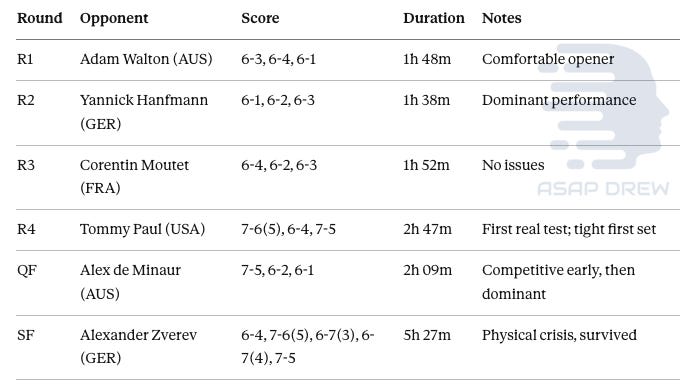
Total court time: ~15 hours, 41 minutes. Alcaraz didn’t drop a set until the semifinal, then dropped four in one match. The Tommy Paul match was his first genuine test—Paul had won 35 consecutive service games entering the match. Against de Minaur, Alcaraz converted 18 of 22 net points (82%) and dominated after a tight first set.
Novak Djokovic’s Path
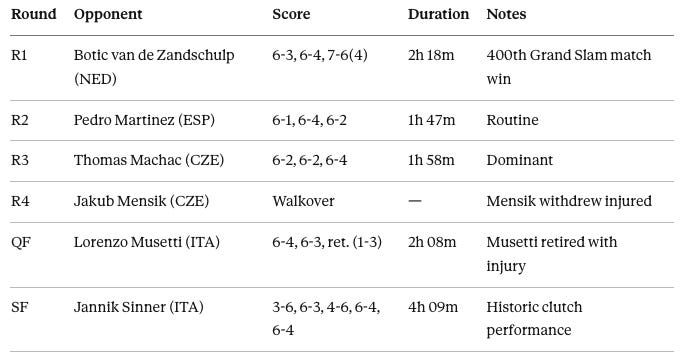
Total court time: ~12 hours, 20 minutes. The walkover and Musetti retirement gave Djokovic roughly 3 fewer hours on court than Alcaraz—significant at age 38. His first-round victory was his 400th career Grand Slam match win (no other player has reached that mark). Reaching the quarterfinal made him the all-time leader in Australian Open match wins at 103, passing Roger Federer.
Head-to-Head Record
Djokovic leads the career head-to-head 5-4, but the breakdown reveals important nuances that favor Alcaraz in the context of this final.
Complete Head-to-Head History
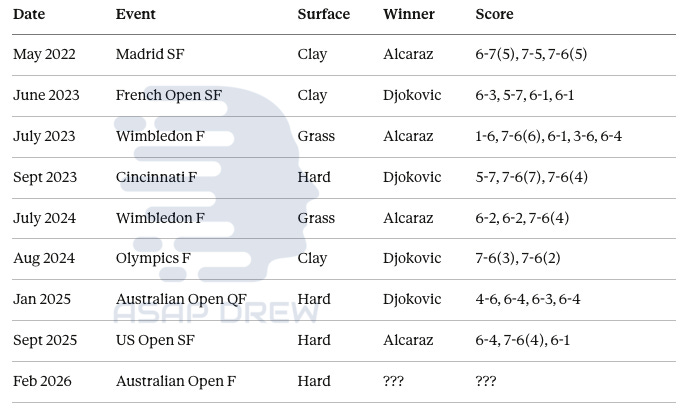
The rivalry has produced classics repeatedly. Both players have won at least one set in 6 of their 9 meetings—competitive multi-set matches are the norm, not the exception. The head-to-head being this close is partly why this isn’t a “Alcaraz should roll” final even with him as the heavy favorite.
Key H2H Breakdowns
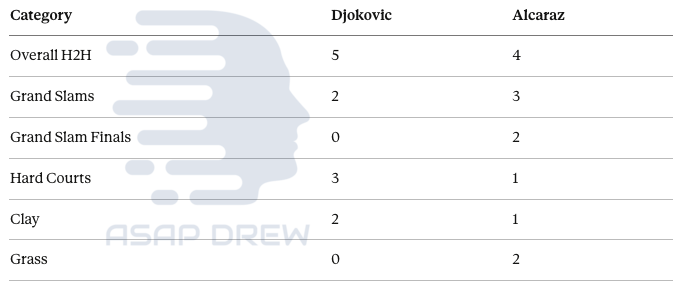
The critical context: Alcaraz has never lost a Grand Slam final to Djokovic (2-0 at Wimbledon 2023 and 2024). But Djokovic leads 3-1 on hard courts overall, including the only prior Melbourne meeting last year’s quarterfinal. That hard-court edge and the specific Australian Open experience matter for Sunday.
Grand Slam Trends Since 2022
Carlos Alcaraz: 6 Majors in 4 Years
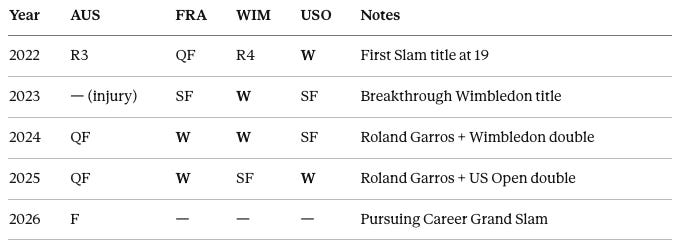
Six Grand Slam titles by age 22.
For perspective: at the same age, Federer had 1, Nadal had 5, and Djokovic had 1. Alcaraz has two titles each at Roland Garros, Wimbledon, and the US Open. Only Melbourne has eluded him. If he wins Sunday, Alcaraz would become the youngest man ever to complete the Career Grand Slam—surpassing Nadal, who completed it at 24.
Novak Djokovic: 4 Majors Since 2022, Chasing 25
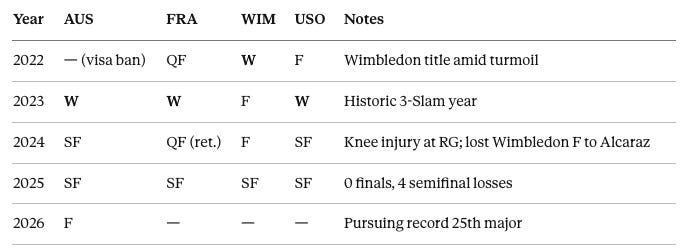
Djokovic has 24 Grand Slam titles (the all-time record, tied with Margaret Court).
His 2023 was arguably his greatest season—three Slams at age 36, reaching all four finals. But 2024-2025 have been relatively barren by his standards. A knee injury forced him to withdraw from the 2024 French Open quarterfinal, and 2025 was his first year without a major final since 2017. He reached all four semifinals but lost each time—to Zverev (injury retirement at AO), Sinner twice (French Open, Wimbledon), and Alcaraz (US Open).
Current Rankings and Stakes

Alcaraz will remain world No. 1 regardless of outcome. Djokovic would rise to approximately No. 4-5 with a title.
Prize Money: Champion receives AUD $4.1 million (record for the tournament); runner-up receives AUD $2.15 million.
Betting Odds and Market Analysis
Current Lines (as of Friday, January 30)
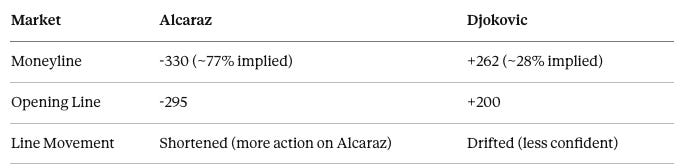
The line movement from -295 to -330 suggests early money overwhelmingly backed Alcaraz, though whether this represents sharp action or public money is unclear.
Set Betting Markets
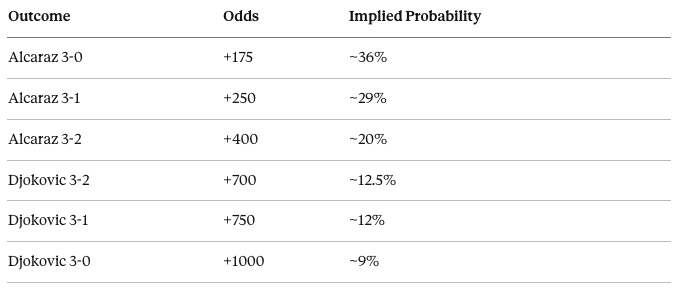
The market expects Alcaraz to win comfortably (3-0 or 3-1 most likely) but gives Djokovic a realistic path in a five-setter.
The Alcaraz 3-1 line at +250 is the consensus prediction—one tight set where Djokovic competes, then Alcaraz pulls away.
Should You Bet?
Not with conviction. The two biggest variables: Alcaraz’s physical status and both players’ recovery/fatigue levels — are unknowns that the market can’t fully price.
If Alcaraz is 100% healthy, the -330 line may be fair or even generous. If his leg is compromised, Djokovic at +262 becomes extremely attractive.
The uncertainty cuts both ways, which makes this a “watch and enjoy” match rather than a confident betting opportunity.
Match Conditions
Weather: Melbourne forecast calls for a high of 69°F (21°C)—a welcome relief after extreme heat earlier in the tournament (including a 108°F day that triggered the Extreme Heat Protocol on January 27).
Court: Rod Laver Arena with the roof expected to remain open given favorable conditions. The GreenSet synthetic acrylic surface has played relatively fast this fortnight.
Time: 7:30 PM AEDT (3:30 AM ET, 8:30 AM GMT)
Broadcast: ESPN (US), Eurosport (Europe), Channel 9 (Australia)
Tactical Keys and Paths to Victory
For Alcaraz to Win
Dictate from the baseline with varied pace and spin. Alcaraz’s ability to change direction and tempo keeps opponents off-balance. Against Zverev, even compromised, he generated 78 winners.
Strong first-serve percentage. Djokovic is arguably the greatest returner in tennis history. Alcaraz must earn free points on serve to avoid grinding baseline rallies that favor Djokovic’s defense.
Attack the net when possible. Alcaraz’s 78% net success rate against Zverev shows his comfort coming forward. Djokovic’s passing shots are elite, but Alcaraz’s athleticism at net can shorten points.
Manage the leg. The most critical factor. If Alcaraz’s adductor flares, his explosive movement advantage disappears. He needs whatever treatment protocol he’s using to work.
Win the first set. Alcaraz is 60-0 in his career when winning the first two sets of a Grand Slam match. Getting ahead early puts enormous pressure on the 38-year-old Djokovic.
For Djokovic to Win
Extend rallies and force errors through precision. Classic Djokovic game plan: absorb pace, redirect, and wait for the opponent to miss. He doesn’t need to hit winners—he needs Alcaraz to hit errors.
Win the big points. Demonstrated against Sinner: saving 16 of 18 break points is the blueprint. If Djokovic can replicate that clutch serving, he has pathways to steal sets.
Target Alcaraz’s movement. If Alcaraz is compromised, Djokovic should exploit lateral movement—opening the court and making Alcaraz run wide repeatedly. Specifically he should test the leg of Alcaraz with heavy cross-court patterns and combinations of drop shots and lobs to get him moving a lot. If Djoker can identify any leg issues he could use that to his strategic advantage.
Survive early aggression. The first two sets will likely feature Alcaraz at his most explosive. If Djokovic can stay close and drag the match deep, his experience and mental edge could prove decisive.
Use the crowd and the moment. Djokovic has won 10 Australian Open titles and has never lost a final here. The Melbourne crowd knows his history. A close match could see the stadium swing behind the legend chasing 25.
Key Tactical Battles
Alcaraz’s forehand vs. Djokovic’s backhand cross-court: Alcaraz possesses perhaps the most explosive forehand in tennis; Djokovic’s defensive slide-and-recover on the backhand side has neutralized bigger hitters for years.
Serve + 1 vs. Return + 1: Alcaraz wants to end points in 2-3 shots; Djokovic wants to neutralize and extend to 6+ shots.
Net approaches: Alcaraz is more willing to venture forward; Djokovic’s passing shots remain among the best ever.
Prediction
The prediction hinges entirely on one variable (assuming no cramping occurs for either player): Alcaraz’s leg. I’m assuming he mostly cramped up last match against Zverev and will be ready to rock and roll against Djokovic… and he should win this in 3 or 4 at the most.
If Alcaraz is healthy (let’s say 90-100%):
Pick: Alcaraz in 3 or 4 sets
Reasoning: His explosiveness, winner generation, and ability to sustain intensity over hours will overwhelm Djokovic. The 38-year-old can’t match Alcaraz’s physicality in a straight-up battle, and Alcaraz’s 2-0 record against Djokovic in Grand Slam finals reflects that. A longer match favors Alcaraz here—youth and cardio win the war of attrition.
If Alcaraz is compromised (70-85%, cramping risk):
Pick: Djokovic in 5 sets
Reasoning: The extra 78 minutes from the semifinal, the physically punishing nature of his survival act against Zverev, and the recurrence risk of cramping all work against Alcaraz. Djokovic’s fresher legs (thanks to the walkover and Musetti retirement), his experience grinding out wounded opponents, and his 10-0 record in Australian Open finals give him a real path. This is a toss-up that tilts slightly Djokovic because he’s been here before and knows how to close.
What the consensus is:
Pick: Alcaraz in 4 sets (3-1)
Estimated probability: ~60% Alcaraz / ~40% Djokovic
Reasoning: Alcaraz’s movement improved significantly by the fifth set against Zverev, and he has a full recovery day Saturday. At 22, his body bounces back faster than a 38-year-old’s. I expect him to be closer to 90% than 75%, which is enough to win—but not enough to dominate. Djokovic will likely take a set by being clutch on break points (his specialty), but Alcaraz’s physical edge and shot-making will prove decisive over four sets.
What I expect: Alcaraz in 3 or 4.
The long-match of Alcaraz (but earlier finish due to scheduling) + youth/quicker recovery of Alcaraz vs. the long-but-less-long match for Djokovic (and later finish) + older age effect/slower recovery — is relatively a wash in terms of who will be physically ready. I’d love to see Djokovic pull off the win… but I don’t see this going beyond 4 sets if Alcaraz isn’t injured or cramped.
Confidence level: Moderate. The leg is a genuine unknown. If Alcaraz cramps again or the adductor flares in set 3, everything I wrote above goes out the window and Djokovic becomes the favorite in real-time. That uncertainty is why betting with conviction here is tough—the market can’t fully price a variable that won’t reveal itself until mid-match.
The Bottom Line
This final transcends the immediate stakes of ranking points and prize money.
For Alcaraz, victory would make him the youngest Career Grand Slam winner in history, cementing his status as the sport’s present and future.
For Djokovic, a 25th major would break the all-time record and add an 11th Australian Open title—further proof that age is merely a number he refuses to acknowledge.
What seems certain is that we’ll witness a defining match of this tennis generation—one that will either crown a new king of Melbourne or remind us that the old king still has a little bit left in the tank.
Match Time: Sunday, February 1, 2026 at 7:30 PM AEDT (3:30 AM ET)