

Game: #1 Indiana Hoosiers (15-0) vs #10 Miami Hurricanes (13-2)
Date: Monday, January 19, 2026 | 7:30 PM ET
Venue: Hard Rock Stadium, Miami Gardens, FL
Line: Indiana -7.5 | O/U 48.5
Introduction: Two Roads to Miami
The 2026 College Football Playoff National Championship features two teams that couldn’t have taken more different paths to Hard Rock Stadium—and one of them literally calls it home.
Indiana’s Semifinal: A Masterclass in Domination
The Hoosiers steamrolled #5 Oregon 56-22 in the Peach Bowl, and “steamrolled” might be underselling it. The game was effectively over on the first play from scrimmage when D’Angelo Ponds intercepted Oregon’s opening pass and returned it for a pick-six. Indiana led 35-7 at halftime.
Heisman Trophy winner Fernando Mendoza was surgical, accounting for five touchdowns while the defense rendered Oregon’s vaunted attack completely one-dimensional. The Hoosiers have now outscored their playoff opponents 94-25—a combined margin of 69 points across two games. They held Alabama to 3 points in the Rose Bowl quarterfinal. Three. Against Alabama.
Miami’s Semifinal: Cardiac Canes Refuse to Die
Meanwhile, Miami survived another heart attack. Trailing Ole Miss late in the Fiesta Bowl, Carson Beck orchestrated a 16-play, 75-yard drive culminating in his own 3-yard touchdown scramble with just 18 seconds remaining. Final score: 31-27.
It was Miami’s third consecutive playoff game decided by 10 points or fewer—all as underdogs. The Hurricanes beat Texas A&M 10-3 in the first round, stunned Ohio State 24-14 in the Cotton Bowl, and now find themselves playing for a national championship in their own stadium.
This divergence—Indiana’s ruthless efficiency versus Miami’s gritty resilience—frames the central question of this matchup. Can Miami’s battle-tested mentality overcome Indiana’s structural superiority? Or will the Hoosiers’ machine-like precision finally crush the Cardiac Canes?
Team Statistical Profiles
Indiana: The Efficiency Machine
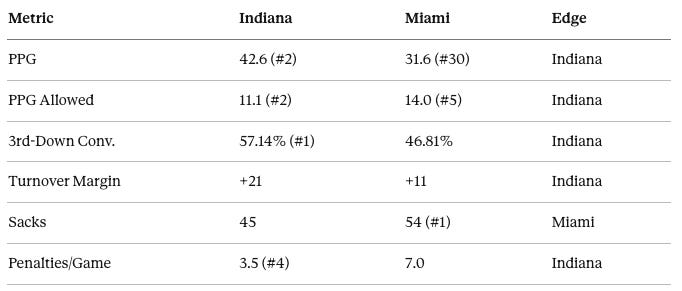
The Hoosiers enter as the most dominant two-way team in the country. According to Sports-Reference, Indiana ranks:
#2 in Scoring Offense: 42.6 PPG (behind only Texas Tech)
#2 in Scoring Defense: 11.1 PPG allowed
+31.5 point differential: Best in the nation
#1 in Third-Down Conversion: 57.14% (107/184)
#1 in Turnover Margin: +1.5 per game
Their offense averages 461 yards per game with elite efficiency: 5.3 yards per rush and 9.6 yards per pass attempt. The defense has been suffocating, allowing just 75 rushing yards per game (#2 nationally) and generating 45 sacks on the season.
Miami: The High-Variance Underdog
The Hurricanes present a different profile. Per Sports-Reference:
#30 in Scoring Offense: 31.6 PPG
#5 in Scoring Defense: 14.0 PPG allowed
#1 in Sacks: 54 (led by Rueben Bain Jr.)
40.5% pressure rate: Among the nation’s best
Miami’s calling card is their defensive front. According to Pro Football Focus, Rueben Bain Jr. holds a 94.6 PFF grade—the highest of any defensive player in college football—while Akheem Mesidor has added 10.5 sacks. In two playoff games, this tandem has combined for 33 pressures, 18 tackles, 9.0 TFLs, and 7.0 sacks.
Quarterback Comparison: Mendoza vs Beck
Fernando Mendoza (Indiana) — 2025 Heisman Trophy Winner
Mendoza’s season has been historic. According to the Heisman Trust, he captured 84.66% of possible Heisman points—the seventh-highest percentage in award history. His numbers:
3,349 passing yards | 41 TDs | 6 INTs | 73.0% completion
187.96 passer rating (leads nation)
71.7 PFF passing grade under pressure (best among Power Four QBs)
In two playoff games, Mendoza has been virtually flawless: 31-of-36 (86%) for 369 yards, 8 TDs, and zero interceptions. Perhaps most relevant for this matchup: his pressure-to-sack rate of 15.6% ranks in the 96th percentile nationally. Even when defenses breach the pocket, he avoids negative plays.
Carson Beck (Miami) — The Redemption Arc
Beck transferred from Georgia with a $4 million NIL deal and controversy following a late-season injury. His season numbers show both upside and risk:
3,581 passing yards | 29 TDs | 11 INTs | 72.4% completion
81.4 QBR (#11 nationally)
2.35-second average time to throw (elite quick release)
The interception disparity is stark: Beck has nearly double Mendoza’s picks (11 vs 6). However, Beck has been remarkably clean in the playoffs, leading game-winning drives in consecutive games. Per CBS Sports, his final drive against Ole Miss—15 plays, 75 yards, capped by his own rushing TD with 18 seconds left—demonstrated clutch capability few quarterbacks possess.
The Decisive Variables
After analyzing hundreds of data points, four variables will determine this game’s outcome:
1. Red Zone Efficiency (Advantage: Indiana)
This is the statistical chasm that matters most. According to CFBStats:
Indiana Red Zone Defense: Allows TDs on only 34.62% of opponent trips (#1 nationally)
Miami Red Zone Defense: Allows TDs on 54.84% (#36)
Indiana Red Zone Offense: Scores TDs 73.97% (#11)
Miami Red Zone Offense: Scores TDs 67.74% (#36)
Miami settled for four field goals in the Fiesta Bowl—a red zone inefficiency that nearly ended their season. Against Indiana’s #1 red zone defense, converting drives into touchdowns becomes exponentially harder. In a game where possessions are limited, trading field goals for touchdowns is mathematically fatal.
2. The Pass Rush vs Protection Battle (Advantage: Contested)
This is the game’s swing matchup. Miami’s front—Bain (94.6 PFF grade), Mesidor (10.5 sacks), and Ahmad Moten—represents the most dangerous pass rush Indiana has faced. The Hurricanes generate a 61.3% pass-rush win rate without needing to blitz.
However, Indiana’s offensive line has been exceptional. Per The Daily Hoosier, left tackle Carter Smith (93.7 PFF pass-blocking grade, #2 nationally) allowed zero pressures in the Big Ten Championship against Ohio State. The Hoosiers’ 5.93% sack rate is among the nation’s best.
The key: Indiana’s RPO-heavy scheme is designed to neutralize elite rushers. If Bain flies upfield, Cignetti will run draws and screens underneath him. Mendoza’s 2.6-second release time further limits the pass rush’s impact.
3. Turnover Margin (Advantage: Indiana)
Indiana’s +21 turnover margin is the best in the nation. Miami sits at +11. The Hoosiers have generated 18 interceptions while committing only 7. Beck’s 11 interceptions represent a 2.5% turnover rate—significantly higher than Mendoza’s 1.7%.
Against Indiana’s opportunistic secondary—led by All-American corner D’Angelo Ponds—Beck cannot afford his regular-season tendencies to resurface. One turnover in a tight game could be decisive.
4. Penalty Discipline (Advantage: Indiana)
Per Team Rankings, Indiana commits just 3.5 penalties per game (#4 nationally). Miami averages 7.0 penalties for 57 yards per game. In the Fiesta Bowl, Miami committed 10 penalties—self-inflicted wounds that extended Indiana drives and killed their own.
In championship games, discipline often separates winners from losers. Cignetti’s teams don’t beat themselves.
Player Availability Update
According to AP News, both teams are near full strength:
Indiana: Coach Curt Cignetti confirmed Monday that “everybody that played in the last game will play in this game.” DL Jailin Kamara cleared concussion protocol. The only notable losses are reserve DLs Stephen Daley and Kellan Wyatt (season-ending injuries).
Miami: Edge rushers Akheem Mesidor (”full throttle” in practice) and Ahmad Moten (”full go”) are cleared despite playing through injuries in the semifinal. The concern is TE Elija Lofton, who is “the one in question” after a shoulder injury against Ole Miss. CB Damari Brown remains “day-to-day” after missing all three playoff games.
The Home Field Anomaly
This is the first time in BCS/CFP history (since 1998) that a team will play for the national championship in their home stadium. Hard Rock Stadium will be 70-80% Miami fans—a hostile environment for the top seed.
However, Indiana has proven road-tested. They won at Oregon’s Autzen Stadium and Penn State’s Beaver Stadium during the regular season. Vegas typically awards 3 points for home field; the fact that Indiana remains a 7.5-point favorite suggests oddsmakers view Indiana as 10-11 points superior on a neutral field.
Claude 4.5 Opus Prediction
Winner: Indiana Hoosiers
Win Probability: 72%
Implied Odds: Indiana -257 / Miami +257
Projected Score: Indiana 31, Miami 21
Confidence Level: High
Indiana’s structural advantages are simply too comprehensive to ignore. They are superior in virtually every predictive metric: scoring offense, scoring defense, third-down conversion, red zone efficiency, turnover margin, and penalty discipline. This isn’t a team that wins on variance—they systematically dismantle opponents.
The key to my projection is the red zone battle. Miami will move the ball—they have too much talent not to. But Indiana’s #1-ranked red zone defense (34.62% TD rate allowed) will force field goals where Miami needs touchdowns. Meanwhile, Indiana’s balanced attack—Mendoza’s precision, the Hemby/Black rushing tandem, and receivers like Elijah Sarratt and Omar Cooper Jr.—will convert trips into seven points.
I expect Indiana to weather an early emotional surge from the Miami crowd, establish their offensive rhythm by mid-first quarter, and build a 10-point halftime lead. In the second half, Miami’s desperation passing plays into Indiana’s havoc-creating secondary. Beck, forced to press, commits a turnover that Indiana converts. The final margin widens in garbage time.
Miami’s upset path requires: (1) Bain/Mesidor generating 4+ sacks; (2) Beck playing turnover-free football; (3) Red zone touchdowns instead of field goals; (4) Avoiding self-inflicted penalties. If all four happen, Miami wins. Missing on two likely results in a double-digit Indiana victory.
The 7.5-point spread is accurate. Indiana covers in approximately 55% of simulations, with significant variance depending on turnover outcomes. The total (48.5) is appropriately set—I project 52 combined points, with Indiana’s scoring driving the over.
AI Model Comparison: The Consensus View
Four frontier AI models independently analyzed this matchup. Here’s how they compare:
Grok 4 Expert
Winner: Indiana
Win Probability: 70%
Implied Odds: -233
Projected Score: Indiana 31, Miami 20
Key Variable: Quarterback efficiency and turnover protection. Notes Mendoza’s +11 turnover margin advantage and 73% completion rate as decisive edges.
GPT-5.2 Pro
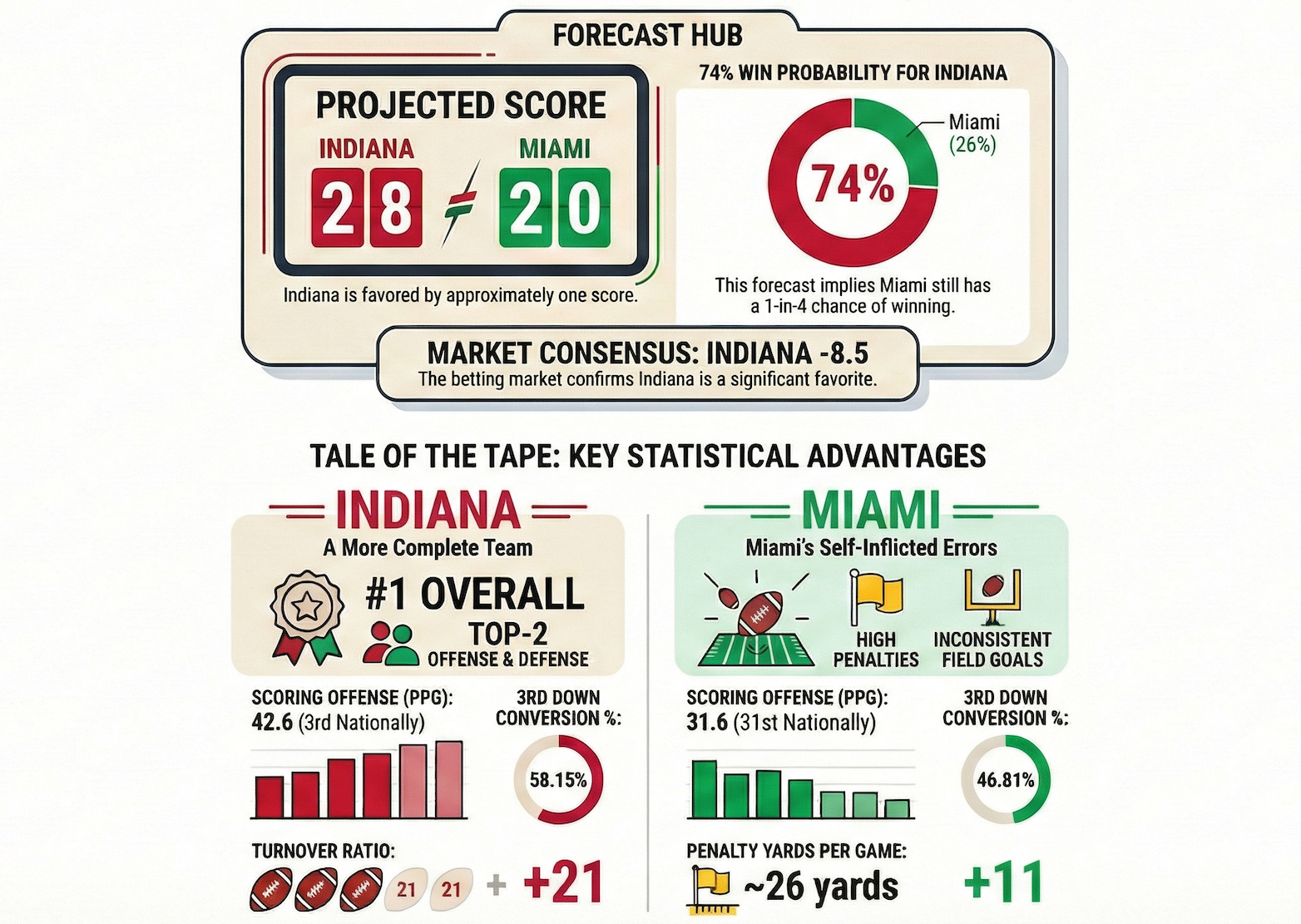
Winner: Indiana
Win Probability: 74%
Implied Odds: ~-285
Projected Score: Indiana 28, Miami 20
Key Variable: Third-down efficiency gap (58.15% vs 46.81%). Emphasizes Indiana’s ability to sustain drives and Miami’s penalty discipline problems (105 penalties, 856 yards this season).
Gemini 3.0 Pro (Deep Research)
Winner: Indiana
Win Probability: 85%
Implied Odds: ~-567
Projected Score: Indiana 38, Miami 24
Key Variable: Red zone efficiency chasm. Calls this “the single most predictive variable” and projects Indiana will score touchdowns while forcing Miami into field goals.
Claude 4.5 Opus
Winner: Indiana
Win Probability: 72%
Implied Odds: -257
Projected Score: Indiana 31, Miami 21
Key Variable: Composite structural advantages across red zone, turnover margin, and discipline.
Consensus Summary
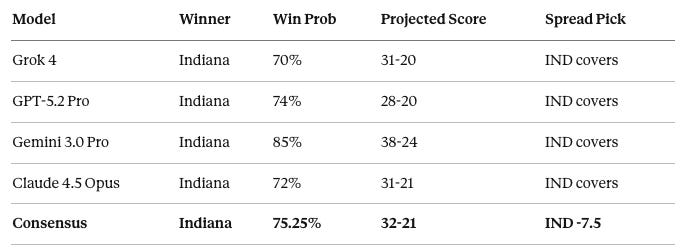
All four models unanimously pick Indiana. The average win probability is 75.25%—strikingly similar to the 74-76% range implied by Vegas moneylines after de-vigging. The projected scores range from 28-20 to 38-24, with an average margin of 11 points.
Gemini 3.0 Pro is the most bullish on Indiana (85%), while Grok 4 is most conservative (70%). The spread between models reflects different weighting of Miami’s upset variables—particularly the pass rush’s potential to disrupt Mendoza and the home-field emotional boost.
Human Perspective: The Eye Test
Indiana looks like a borderline pro team. The way they’ve executed this playoff run—38-3 over Alabama, 56-22 over Oregon—isn’t just winning. It’s systematic domination. I expect them to win. If they lose, I’ll be relatively surprised.
That said, the game is in Miami. I’ve been impressed with Miami’s defense throughout these playoffs. Michael Irvin will be on the sidelines going crazy. The home crowd will be heavily skewed to favor Miami—this is a rare opportunity to win a championship game at your own stadium. That kind of energy matters.
Miami’s defense has been rock-solid the entire playoffs. They held Texas A&M to 3 points. They sacked Ohio State five times. Rueben Bain is a monster. They could cause some trouble for Indy.
But Indiana has the Heisman winner, a team with elite chemistry, and the look of a program that isn’t going to be rattled by crowd noise. They’ve won in hostile environments all year. No matter how big the Miami home crowd, I think Indiana gets the job done to close out a perfect season.
My gut: Miami has about a 25% chance of winning; Indiana has a 75% chance. I think Indiana can cover the spread—they demolished Oregon last weekend while Miami won in a nail-biter against Ole Miss. The momentum profiles couldn’t be more different. I also think Indiana has potential for a blow-out victory.
Note: This is analysis, not gambling advice.
Conclusion: History Awaits in Miami
The 2026 CFP National Championship presents college football’s ultimate contrast: relentless efficiency versus resilient grit, statistical dominance versus emotional momentum, the machine versus the underdog.
All quantitative indicators favor Indiana. The Hoosiers are superior in scoring offense, scoring defense, third-down conversion, red zone efficiency, turnover margin, and discipline. They’ve outscored playoff opponents by 69 combined points. Four independent AI models unanimously project an Indiana victory with an average 75% probability.
But football isn’t played on spreadsheets. Miami has Rueben Bain, the most dominant defensive player in the country. They have Carson Beck, who has orchestrated game-winning drives in consecutive elimination games. They have Hard Rock Stadium, 70,000 fans in their favor, and a program hungry to return to glory 25 years after their last national title.
The Hurricanes’ path to victory is narrow but visible: win the line of scrimmage battle, convert red zone trips into touchdowns, avoid turnovers, and ride the emotional wave of a home championship game. If Beck plays his best game and Bain/Mesidor terrorize Mendoza, the upset script writes itself.
More likely, Indiana’s structural advantages prove insurmountable. The Hoosiers establish the run, hit play-action strikes to Sarratt and Cooper, and let their #1-ranked defense systematically suffocate Miami’s attack. Beck, facing third-and-longs after stalled drives, eventually presses into Indiana’s opportunistic secondary. A turnover extends the lead. The Cardiac Canes run out of miracles.
Final Projection: Indiana 31, Miami 21
The Hoosiers will complete the greatest turnaround in college football history, becoming the first 16-0 team in FBS history. Fernando Mendoza will add a national championship to his Heisman Trophy. Curt Cignetti will cement his status as the sport’s most remarkable coaching story.
But for 60 minutes on Monday night, Miami will have a chance—and in a sport built on chaos, that’s all any team can ask for.
Analysis compiled January 13, 2026. All statistics current through CFP semifinal round. Sources include Sports-Reference, ESPN, Pro Football Focus, Team Rankings, CFBStats, AP News, CBS Sports, The Daily Hoosier, and official team communications.